
Reading your drawings
Three views, a scale bar and a handful of symbols — enough to walk your house before it exists.
Lesson byAmogh N P· Architect & interior designer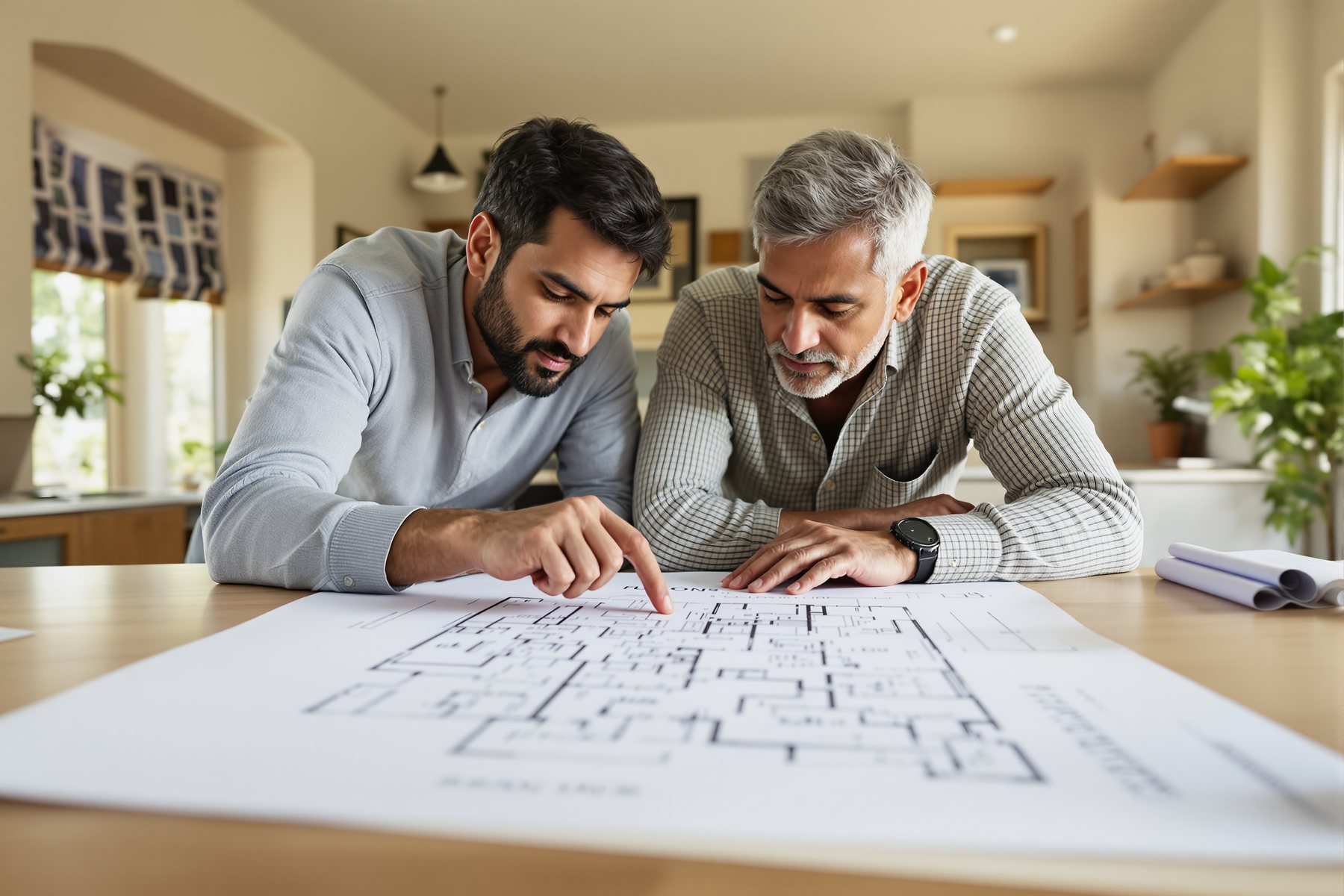
You can walk through your house a year before it's built — if you can read the plan.
A floor plan looks like a maze of lines and numbers, so most owners nod, sign, and hope. But the bedroom that feels cramped on paper will feel cramped in real life — and a half-hour learning to read the drawing lets you catch it now, when the fix is an eraser, not a hammer. You don't need a degree. You need three views, a scale and a few symbols.
Three views: plan from above, elevation from the front, section sliced through
Plan, elevation, section — the same house seen three ways
Every house is drawn three ways, and together they describe it completely:
- Floor plan — the view looking straight down, as if the roof were lifted off and the building sliced at about 4 feet. This is the workhorse: it shows room sizes, wall positions, doors, windows, the staircase and the furniture layout. You'll spend 80% of your time here. - Elevation — the view looking at a face of the house from outside, flat-on. The front elevation is what you'll see from the street: the facade, window proportions, the parapet, materials. No depth, just the face. - Section — an imaginary vertical cut straight through the house, like slicing a cake, so you see ceiling heights, floor levels, the staircase climbing, the slab thicknesses. The section is where you check whether a room feels lofty or low.
Read them together. A room can look generous in plan but feel like a tunnel in section if the ceiling is low. The three views cross-check each other — that's the whole point.
Plan = roof off, look down. Elevation = stand outside, look at. Section = slice the cake, look in.
Numbers, the scale bar and a few symbols turn lines into a real room
Three things turn a drawing from art into information:
Dimensions — the numbers on the lines, in feet-and-inches or millimetres. A bedroom marked 12'0" x 10'0" is exactly that. Indian residential rules of thumb: a comfortable master bedroom is around 12 x 12 ft, a second bedroom 10 x 11, a single bath about 5 x 7, a corridor at least 3'6" wide. Check the rooms against these — paper makes small rooms look fine.
Scale — drawings are shrunk by a ratio. 1:100 means 1 cm on paper is 100 cm (1 m) in real life; 1:50 is twice as big. The scale bar lets you measure anything not dimensioned. Never scale off a screenshot — only off a sheet at its stated scale.
Symbols — a standard shorthand: a door is an arc showing its swing, a window is a thin double line in the wall, a staircase is parallel lines with an arrow and 'UP', a 'FFL +0.450' note is the finished floor level. The legend on the drawing decodes the rest. Once you know the door-swing arc, you'll spot a door that bangs into a cupboard instantly.
You don't need to draw — only to check. Sit with the floor plan and a measuring tape, and pace out the key rooms on your current floor against the dimensions: stand in a 10 x 11 space so 'the second bedroom' becomes a real size in your body, not a number. Walk the plan as a route — front door, shoes, kitchen, stairs — and you'll feel the awkward bits before they're built.
Read drawings the way a client can't: cross-check plan against section against elevation for level clashes, sill heights, head heights at stairs, and door swings into circulation. Keep a consistent symbol legend and title block across the set, and dimension to a grid. The errors that survive to site are usually the ones that look fine on a single sheet but contradict another sheet nobody laid side by side.
Orthographic projection — plan, elevation, section — is the language of the discipline, and fluency means reading and drawing in it without translation. Learn the conventions (cut lines poché'd solid, hidden lines dashed, the section line with its direction arrows) and standard scales. The section is the most under-taught and most revealing view: it's where structure, services and spatial quality all show up at once.
“I can't read technical drawings — I'll just trust the architect and approve them.”
You don't need technical training to catch the things that matter to you. A scale bar, the dimension numbers and a handful of symbols are enough to check that your bedroom is big enough, the kitchen has a window, and the stairs aren't a ladder. The drawing is the last cheap place to find a problem — read it before you sign, not after the walls are up.
Practise on your own plan before you approve it:
- 01Find the scale (e.g. 1:100) and the dimension numbers, then pace out your two most important rooms at home so their sizes feel real, not abstract.
- 02Walk the floor plan as a journey — front door to kitchen to bedrooms to bathroom — and flag any awkward route, a door that bangs, or a room with no window.
- 03Cross-check the section against the plan: confirm ceiling heights feel right (about 10–11 ft is typical) and that the staircase has comfortable steps, not a steep climb.
A drawing is your house, full-size, shrunk onto paper — and the half-hour you spend learning to read it is the cheapest insurance you'll buy. Three views, a scale bar, a few symbols. Walk the plan, slice the section, stand the elevation up in your mind, and you'll catch the cramped bedroom and the windowless kitchen while they're still just lines you can ask to redraw.
A house is drawn three ways — floor plan (roof off, looking down), elevation (the face from outside) and section (a vertical slice). Read them together, using the dimensions, the scale (1:100 = 1 cm to 1 m) and standard symbols for doors, windows and levels. Check rooms against real sizes before you sign.
How do I read a house floor plan in India?
A floor plan is the view looking straight down with the roof removed. Find the scale (often 1:100 or 1:50), then use the dimension numbers — in feet-and-inches or millimetres — to check room sizes. Learn a few symbols: a door is an arc showing its swing, a window is a thin double line in the wall, and stairs are parallel lines marked 'UP'. Walk the plan as a route to test how the house flows.
What's the difference between an elevation and a section drawing?
An elevation is the flat, head-on view of a face of the house from outside — the front elevation is the street facade. A section is an imaginary vertical cut straight through the house, showing ceiling heights, floor levels and the staircase. The elevation shows what it looks like; the section shows how tall and how it stacks inside.
What does scale 1:100 mean on a house drawing?
It means the drawing is shrunk so that 1 unit on paper equals 100 units in reality — 1 cm on the sheet is 100 cm (1 metre) on site. A 1:50 drawing is twice as large for the same building. Use the printed scale bar to measure anything that isn't dimensioned, and never scale off a screenshot, only a sheet at its stated scale.
The author
Amogh N P
Architect, interior designer, and creative polymath. Studio Matrx began in his notebooks — his vision of design made honest, useful, and open to everyone. Its Academy is written and taught in his memory, and free, forever.
More about Amogh →You can read the drawing — now make sure it's a smart one. The final lesson shows how a good design works _with_ your climate and site: the sun, the breeze and the shade that decide whether your house is cool and bright or hot and dark.