
B.Arch CurriculumFree, forever
A tribute to Amogh N P
Basic Design Studio
This is where the hand learns what the theory course only names. Basic Design is the foundation studio that every design school on the Bauhaus–Ulm–NID line has taught for a century: you do not read about a point or a line, you push it to its limit on a sheet; you do not define balance, you cut paper until an asymmetric composition holds; you generate form by adding to, subtracting from and transforming a solid; and you abstract a leaf, stage by stage, until only its structure remains. Colour is mixed by hand and discovered to be relative. It is disciplined training in seeing and composing — the eye and the hand that every later interior rests on.
Course byAmogh N P· Architect & interior designer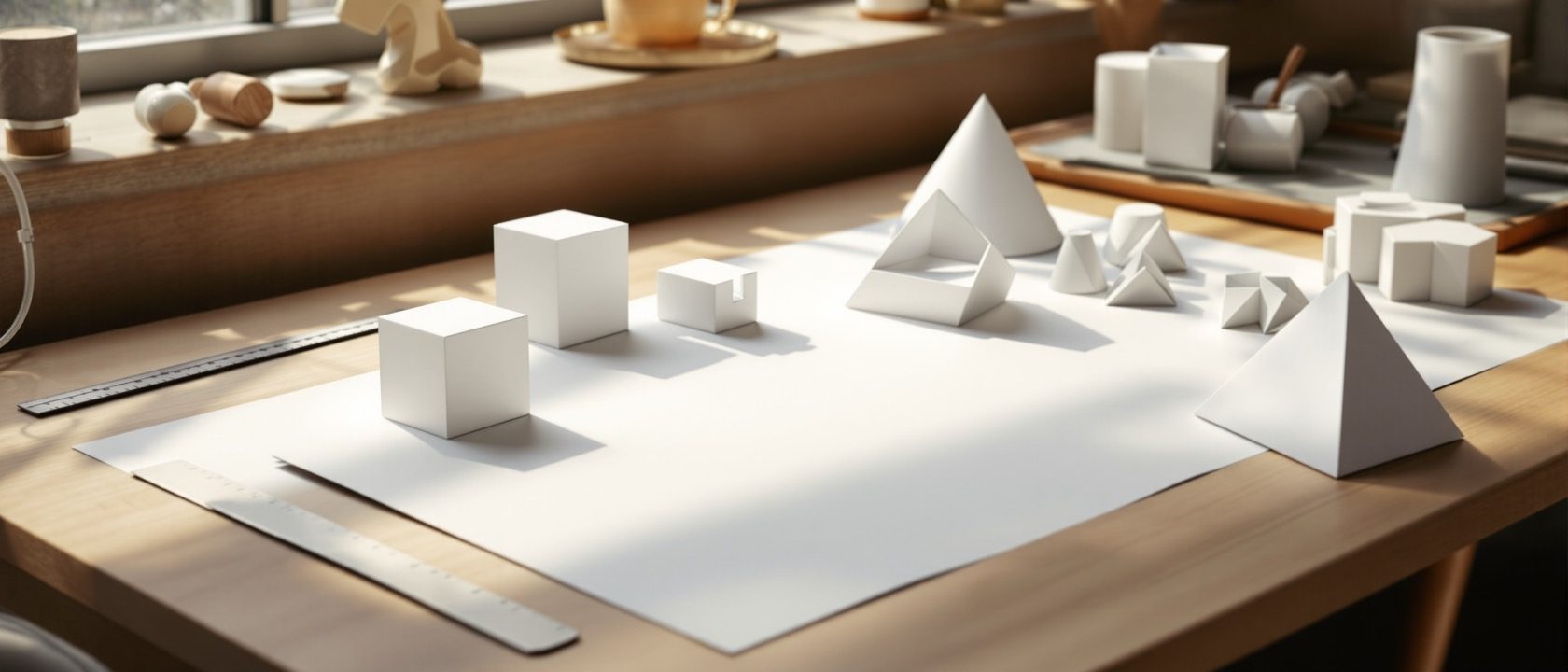
The syllabus
5 units · 5 liveThe foundation studio of the Interior Design curriculum — the hands-on companion to Design Fundamentals. All 5 units are live as full interactive lessons, each with original zoomable diagrams, a self-assessment quiz and studio exercises.
Unit 1 — Elements in the Studio
LiveThe elements as things you MAKE, not define — point (density builds tone), line (character and direction), shape and plane, volume, texture (actual and visual), colour-in-light and pattern — each isolated and pushed to its limit on a sheet or in a paper study. The foundation-course tradition (the Bauhaus Vorkurs — Itten, Moholy-Nagy, Albers; HfG Ulm; NID and the Eames India Report) that turns 'art class' into disciplined design training.
Unit 2 — Principles in the Studio
LiveThe principles as operations you perform on a sheet and then translate into a relief or model — balance (symmetrical, asymmetrical, radial), emphasis and hierarchy, contrast and variety versus unity and harmony, repetition, rhythm and movement, proportion, and negative (positive) space. The 2D-to-3D translation, and the discipline of doing much with little.
Unit 3 — Form Studies
LiveThe heart of the foundation studio — generating and transforming form. The primary solids (and how they differ from the five Platonic solids); the three generative operations from Ching — dimensional transformation, subtractive form and additive form (with the additive groupings: linear, centralised, radial, clustered, grid); and the signature abstraction exercise — take a natural object and reduce it realistic → stylized → simplified → geometric → abstract, keeping the essential structure.
Unit 4 — Composition & Gestalt
LiveOrganising the whole field — grids and modular order, positive and negative space, figure-ground and its reversal, symmetrical and asymmetrical composition, the rule of thirds and centre of interest, and the intellectual anchor: the Gestalt theory of perception (proximity, similarity, closure, continuity, figure-ground, and Prägnanz — the whole is OTHER than the sum of its parts).
Unit 5 — Colour in the Studio
LiveColour made by hand and discovered to be relational — build a 12-hue wheel from three primaries; make value and saturation scales; compose the schemes (monochromatic, analogous, complementary, split-complementary, triadic) as sheets and a model; and the perceptual truths that matter for interiors — colour changes with its neighbours (Albers's simultaneous contrast), with the light source, with surface texture, and with area and viewing distance.
Course outcomes
What you will be able to doMake abstract compositions that push each element (point, line, texture, value) to its limit.
Arrange elements by the principles — balance, rhythm, emphasis, unity — on sheets and in relief.
Generate and transform form by addition, subtraction and dimensional transformation.
Abstract a natural object from realistic to abstract while preserving its essential structure.
Compose whole fields using grids, figure-ground and the Gestalt grouping principles.
Mix colour by hand, build schemes, and use colour's relativity to light, surface and scale.
The author
Amogh N P
Architect, interior designer, and creative polymath. Studio Matrx began in his notebooks — his vision of design made honest, useful, and open to everyone. Its Academy is written and taught in his memory, and free, forever.
More about Amogh →Where the hand learns what the theory only names
Push a line to its limit, cut paper until an asymmetric composition holds, abstract a leaf to its structure, and mix colour by hand. Read the five units, try the tools, then test yourself.
The curriculum is free, forever