
Form Studies
Generating and transforming form — and abstracting from nature.
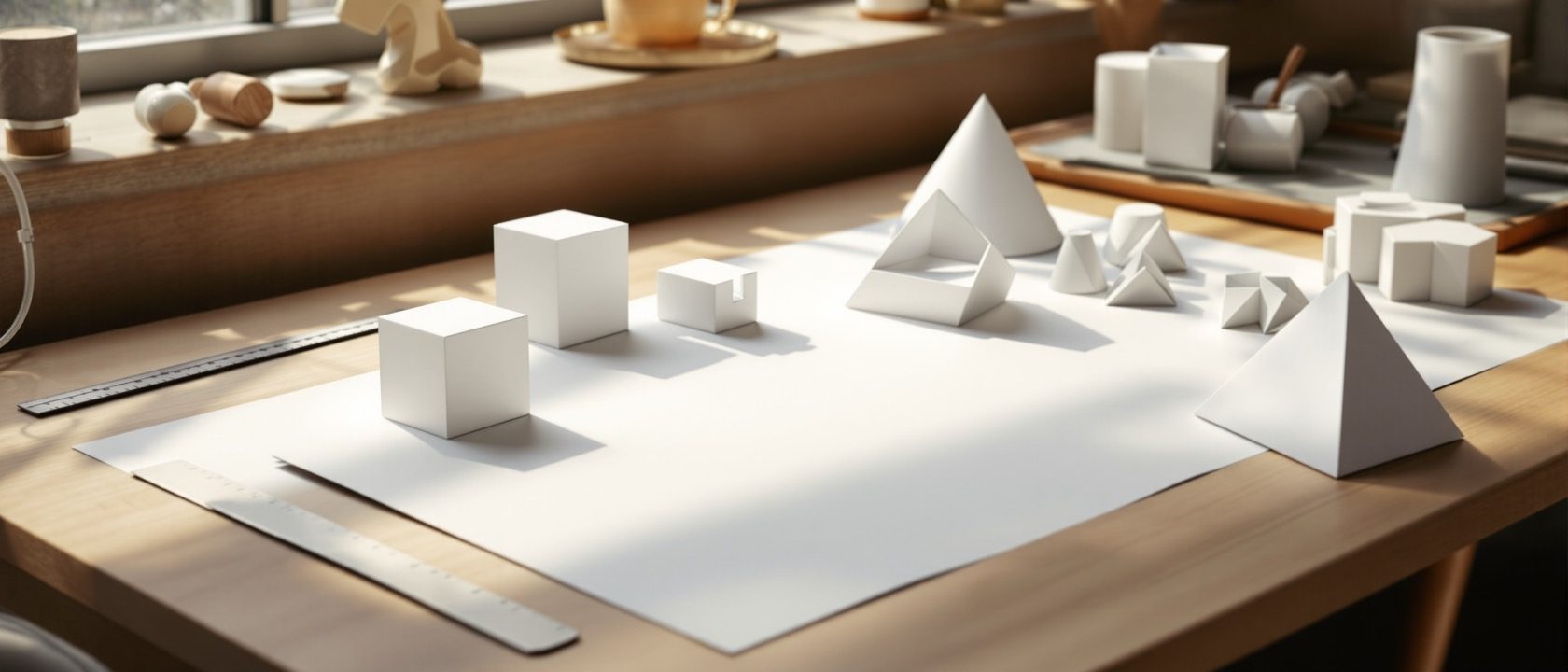
This is the heart of the foundation studio. First, form generation: all forms can be read as transformations of the primary solids by three operations — transform, subtract, add. Second, the signature abstraction exercise: reduce a natural object realistic → abstract, keeping its essential structure. A foundation model is an abstract study of form — never a miniature.
Learning objectives
By the end of this lesson, you will be able to — mapped to the course outcomes for Basic Design Studio:
Name the primary solids and distinguish them from the five Platonic solids.
Generate form by dimensional transformation, subtraction and addition.
Abstract a natural object through the five stages, keeping its essential structure.
Treat a foundation model as an abstract study of form, not a miniature.
Generating and transforming form
The primary solids (and how they differ from the Platonic five), and the three generative operations — moves, not a formula.[1]
The vocabulary of form
The PRIMARY solids — sphere, cylinder, cone, cube and pyramid — derive from the primary shapes (circle, triangle, square) and are the stable, recognisable building blocks of form (Ching). They are NOT the same as the five PLATONIC solids (tetrahedron, cube, octahedron, dodecahedron, icosahedron — the regular convex polyhedra); the overlap is only the cube. Build clean study models of the primary solids before operating on them.[1]
Abstraction from nature
The course centrepiece — reduce a leaf stage by stage, dropping detail but keeping the structure, then model the final abstract stage.[2, 3]
The signature exercise
Take one natural object (a leaf, shell, seed pod, fish, flower, bone) and represent it in a controlled progression: REALISTIC → STYLIZED → SIMPLIFIED → GEOMETRIC → ABSTRACT. Each step removes descriptive detail while preserving the essential structure — proportion, gesture, rhythm, symmetry. The final abstract stage still 'carries' the source even when the source is unrecognisable.[2, 3]
Climb the abstraction ladder
Step through the five stages and watch the leaf reduce — while its structure survives.
Abstraction ladder · reduce a leaf
1. Realistic
Draw the leaf as it is — every vein, edge and tonal shift. You are learning to SEE it fully before you reduce it.
Detail falls away at each step, but the essential structure survives — the leaf is gone yet still “carries”.
At a glance
| Aspect | One side | The other |
|---|---|---|
| Solids | Primary: sphere, cylinder, cone, cube, pyramid | Platonic: the 5 regular polyhedra (math) |
| Form generation | Myth: a single formula | Reality: generative operations (add/subtract/transform) |
| Abstraction | Myth: the object disappears / random | Reality: controlled reduction, keeps the structure |
| A model | Myth: a scale miniature | Reality: an abstract study of form |
| Subtraction | Identity survives: profile intact | Identity lost: too much removed |
Key terms
Sphere, cylinder, cone, cube, pyramid — the designer's practical form vocabulary (Ching).
The five regular convex polyhedra — a mathematical set, distinct from primary solids.
Changing a solid's dimensions while it keeps its family identity.
Removing a portion of a volume — identity survives if the profile survives.
Attaching elements — grouped centralised, linear, radial, clustered or grid.
Realistic → stylized → simplified → geometric → abstract, keeping the structure.
Studio exercise
Choose one natural object (a leaf, shell, seed pod or bone). Produce a five-stage sheet — realistic → stylized → simplified → geometric → abstract — deciding at each step what to keep and what to drop. Then translate the final abstract stage into a small 3D relief or sculptural model. Judge the model as an object in its own right, not as a copy of anything.
Self-assessment
1. Ching's three form-generating operations are —
2. The abstraction ladder ends when —
3. A foundation form-model is —
Recap
References & further reading
- [1]Francis D.K. Ching, Architecture: Form, Space and Order, Wiley (primary solids; dimensional/subtractive/additive form).
- [2]Johannes Itten, Design and Form: The Basic Course at the Bauhaus (form and contrast studies).
- [3]Gail Greet Hannah, Elements of Design: Rowena Reed Kostellow… , Princeton Architectural Press, 2002 (abstract 3D structure, abstraction from nature).
Further reading
- Francis D.K. Ching — Architecture: Form, Space and Order.
- Gail Greet Hannah — Elements of Design (Rowena Reed Kostellow).
- Johannes Itten — Design and Form.
Sources gathered and fact-checked June 2026. Published values vary by source, sample and method — treat as indicative and confirm against the cited standard before structural use.
The author
Amogh N P
Architect, interior designer, and creative polymath. Studio Matrx began in his notebooks — his vision of design made honest, useful, and open to everyone. Its Academy is written and taught in his memory, and free, forever.
More about Amogh →