
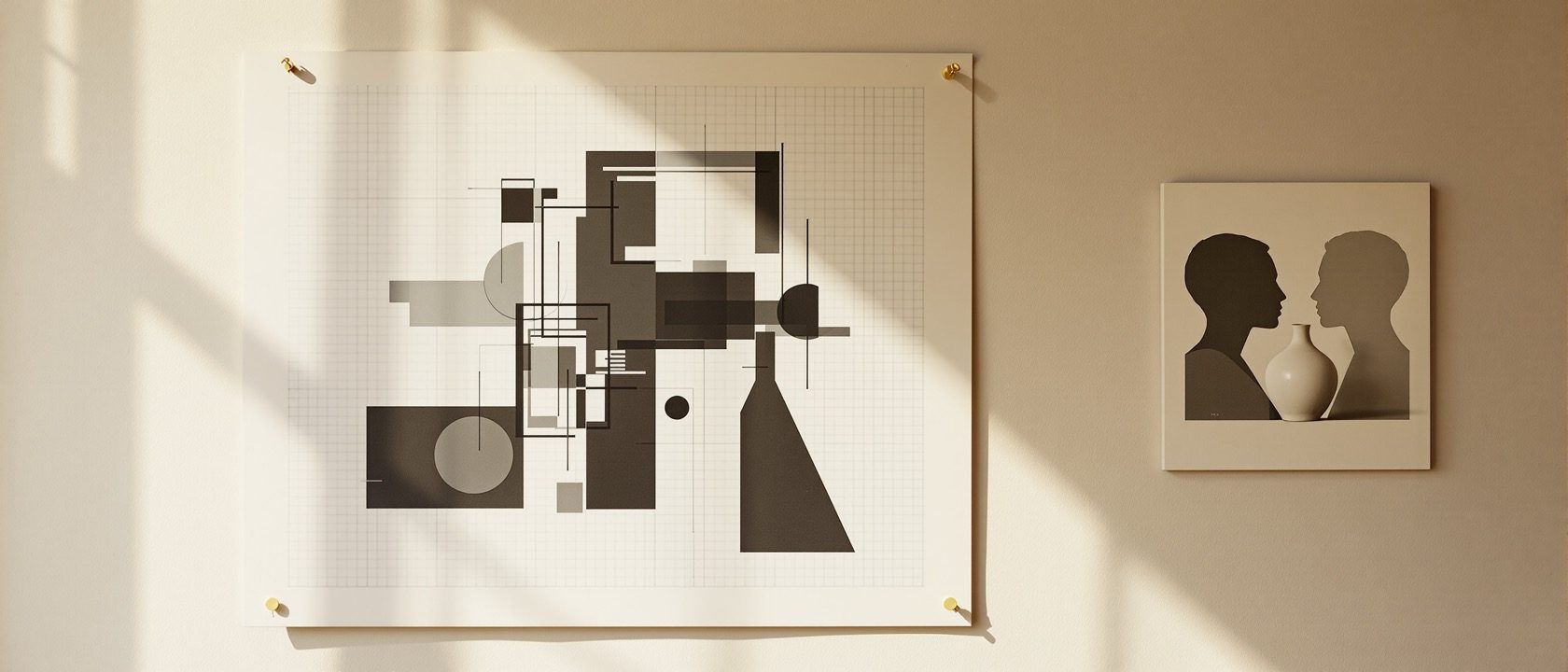
Composition & Gestalt
Organising the whole field — grids, figure-ground and perception.
This unit treats the whole surface as a system — grids, positive and negative space, figure-ground and its reversal, the rule of thirds. Its intellectual anchor is the Gestalt theory of perception: how the eye groups marks into wholes, all pulled toward the simplest stable whole. The correct phrasing matters — the whole is other than the sum of its parts.
Learning objectives
By the end of this lesson, you will be able to — mapped to the course outcomes for Basic Design Studio:
Compose on a grid and break it deliberately to create emphasis.
Design a figure-ground reversal in which the void reads as a second image.
Use the Gestalt grouping principles to guide the eye to a centre of interest.
State the Gestalt principles precisely — the whole is OTHER than the sum of its parts.
Organising the whole field
Compose on a grid and break it for emphasis; reverse figure and ground; and use the rule of thirds as a heuristic, not a law.[2, 3, 4]
The hidden structure
A grid is an underlying structure that organises the field and gives measured proportion (the Ulm-flavoured, systematic side of composition). The studio exercise composes strictly ON a grid, then BREAKS the grid at one point to create a focal accent — structure plus a controlled exception.[3]
Gestalt — how perception groups
The grouping principles and figure-ground/Prägnanz — perception designers use, not a style they invented.[5]
How the eye assembles wholes
Gestalt psychology (founded by Wertheimer, Köhler and Koffka; the 1912 phi-phenomenon study) describes how vision groups marks: PROXIMITY (near things group), SIMILARITY (alike things group), CLOSURE (the eye completes an implied contour), and CONTINUITY (the eye follows the smoothest path). A grouping study demonstrates each, then uses them to lead the eye to a centre of interest.[5]
See the Gestalt principles
Tap a principle to watch how the eye groups the same marks.
Gestalt explorer · how the eye groups
Proximity
Elements placed near each other are read as one group — spacing, not lines, does the grouping.
Perception, not a style — the whole is other than the sum of its parts (Prägnanz).
At a glance
| Aspect | One side | The other |
|---|---|---|
| Gestalt whole | Myth: greater than the sum of parts | Reality: OTHER than the sum of parts |
| Rule of thirds | Myth: a law you must obey | Reality: a heuristic; centred is valid too |
| Gestalt | Myth: a design style | Reality: perceptual psychology designers use |
| Negative space | Passive: leftover | Active: co-equal partner of figure |
| Grid | Compose on it | Break it once for emphasis |
Key terms
An underlying modular structure that organises a field and sets proportion.
A composition readable as two images depending on which is taken as figure.
Near / alike elements are perceived as groups.
The eye completes implied shapes / follows the smoothest path.
The pull toward the simplest, most stable perceptual whole.
A compositional heuristic for placing the focal point off-centre — not a law.
Studio exercise
Design an original black-and-white composition that reads convincingly as TWO things depending on which you take as figure (your own figure-ground reversal, not a copied vase). Then compose a second sheet strictly on a grid and break the grid at exactly one point to create the focal accent. Note which Gestalt principles are doing the work.
Self-assessment
1. The correct Gestalt phrasing is —
2. The rule of thirds is —
3. The Gestalt principle by which the eye completes an implied contour is —
Recap
References & further reading
- [1]Wassily Kandinsky, Point and Line to Plane (Bauhaus Book 9), 1926 (the plane/surface as a compositional field).
- [2]Timothy Samara, Design Elements, Rockport, 2020 (grids and compositional systems).
- [3]Christian Leborg, Visual Grammar, Princeton Architectural Press, 2006 (structure, grid, relations).
- [4]Edgar Rubin (figure-ground, c.1915) — the vase/face ambiguity as a figure-ground demonstration.
- [5]Gestalt psychology — Wertheimer (1912, phi phenomenon), Köhler, Koffka (Principles of Gestalt Psychology, 1935).
Further reading
- Timothy Samara — Design Elements (grids & composition).
- Kurt Koffka — Principles of Gestalt Psychology.
- Christian Leborg — Visual Grammar.
Sources gathered and fact-checked June 2026. Published values vary by source, sample and method — treat as indicative and confirm against the cited standard before structural use.
The author
Amogh N P
Architect, interior designer, and creative polymath. Studio Matrx began in his notebooks — his vision of design made honest, useful, and open to everyone. Its Academy is written and taught in his memory, and free, forever.
More about Amogh →