
Twenty-two hours in Alappuzha
A day and a night in Alleppey, the Venice of the East, reading a Kerala backwater town through its long argument with the water.
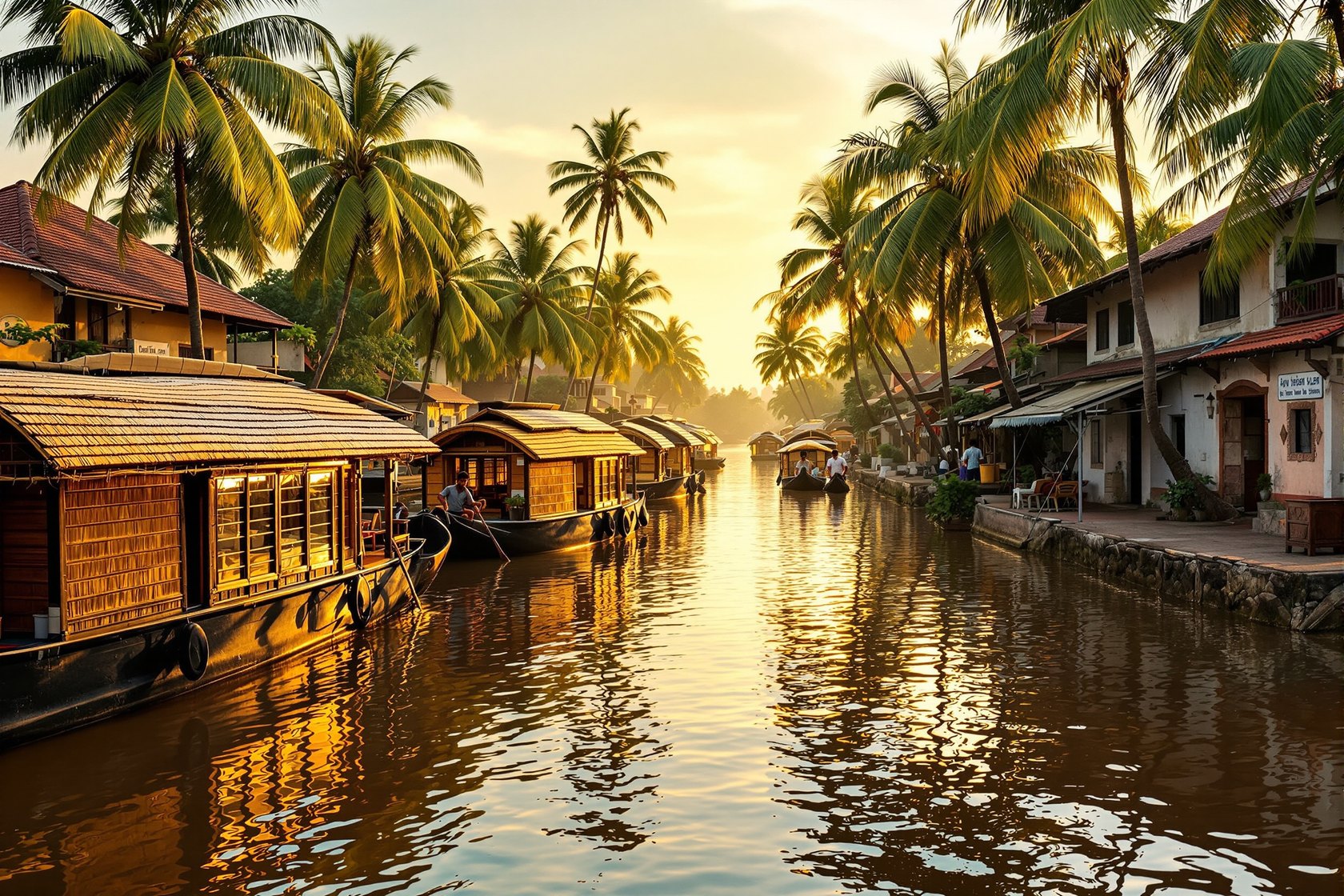
You arrive in Alappuzha already a little wet, and you stay that way, pleasantly, for as long as you are here. The town sits on a low strip of the Kerala coast between the Laccadive Sea and the backwaters, and water is not the scenery — it is the plan. Streets run alongside canals the way streets elsewhere run alongside footpaths. Lord Curzon, the Viceroy, is the one usually credited with calling the place the Venice of the East, and for once the postcard phrase is doing honest work. We have twenty-two hours. We decide to spend them reading the town through the one thing it cannot stop talking about.
Arrive: a town on canals
The first thing to do is get lost on foot, which in Alappuzha means walking the canal banks until the streets and the water blur into the same system. Bridges everywhere, small and functional. Houses that turn their backs to the road and their faces to the water. You start to notice that the town was laid out for boats before it was laid out for wheels, and that the canals are not decorative leftovers but the original working arteries, dug to move goods to the sea. The place makes more sense the moment you stop treating the water as an obstacle between one dry bit and the next.
Wander: the coir warehouses
Walk the old commercial spine and you meet the warehouses. Long, deep, thick-walled sheds and godowns, many of them turned to face the canals so a barge could load straight from the door. This is coir country. Making rope and matting from coconut husk has held up the local economy for more than 150 years, since British traders worked out what the fibre was worth. The architecture follows the trade: buildings sized for stacking and drying, jetties worn smooth, the whole waterfront organised around getting a light, bulky product onto a boat and away. Some of the old sheds now hold coir workshops and a small museum, but even shuttered they read clearly as what they are.
Water: the boat that is tied, not nailed
Then you get on the water, because you have to. The kettuvallam is the town's signature vessel, and its story is better than its tourist reputation. The name means, roughly, a boat of knots. The traditional hull is assembled without a single nail — the planks held together by coir rope tied in knots and sealed against the water. These were cargo barges once, carrying rice and spices down the backwaters, and only later were they roofed over and fitted out as the slow houseboats that now number in the hundreds on these waters. The lesson sits there in the joinery. In a place this wet, you do not fight the material. You lash it, you let it flex, and you accept that everything will one day need re-tying.
A boat held together by knots, in a town held together by water.
The fields below the sea
Push east and the water does its strangest trick. This is Kuttanad, the rice bowl of Kerala and one of the very few places on earth where farming happens below sea level. Some of the lowest ground in India is out here. Fields sit inside a web of bunds and dykes, the water held back by earth banks and pumped out so the paddy can grow beneath the level of the sea that is trying to get in. It is a landscape that only exists because generations decided to farm in an argument with the water and keep winning it, season after season, by a margin of centimetres. Nothing about the coast's relationship with water is theoretical here. It is drawn on the land in bunds.
Dusk: Vembanad and the light off the lake
Late afternoon belongs to Vembanad, the great lake that is the heart of the whole backwater system and, at around 96 kilometres, the longest in India. The light goes long and gold, the houseboats turn for home, and the fishermen's shore-set dip nets stand black against the water. This is also boat-race country: the snake-boat races, run on Punnamada Lake in the post-monsoon season, are the town's great communal spectacle. Even empty of a race, the lake at dusk explains the town in a single glance. Everything faces this water. Everything always has.
Leave: a town that never asked to be dry
By the time you go, the reading is done, and it is simpler than you expected. Alappuzha is not a dry town that happens to have canals. It is a wet place that decided, calmly and long ago, to build with the water rather than against it. The nail-less boat, the warehouse on the jetty, the field below the sea — all of it comes from the same unspoken agreement. The water is staying. You might as well design for it. For a country now learning that lesson the hard way, twenty-two hours here is a short, cheap education, and the town has been teaching it for centuries without raising its voice.