
The Pritzker goes to Chile — and to fragility
Smiljan Radić has won architecture's highest honour for buildings that look about to vanish. In a flood-anxious year, the jury's words read like a design brief.
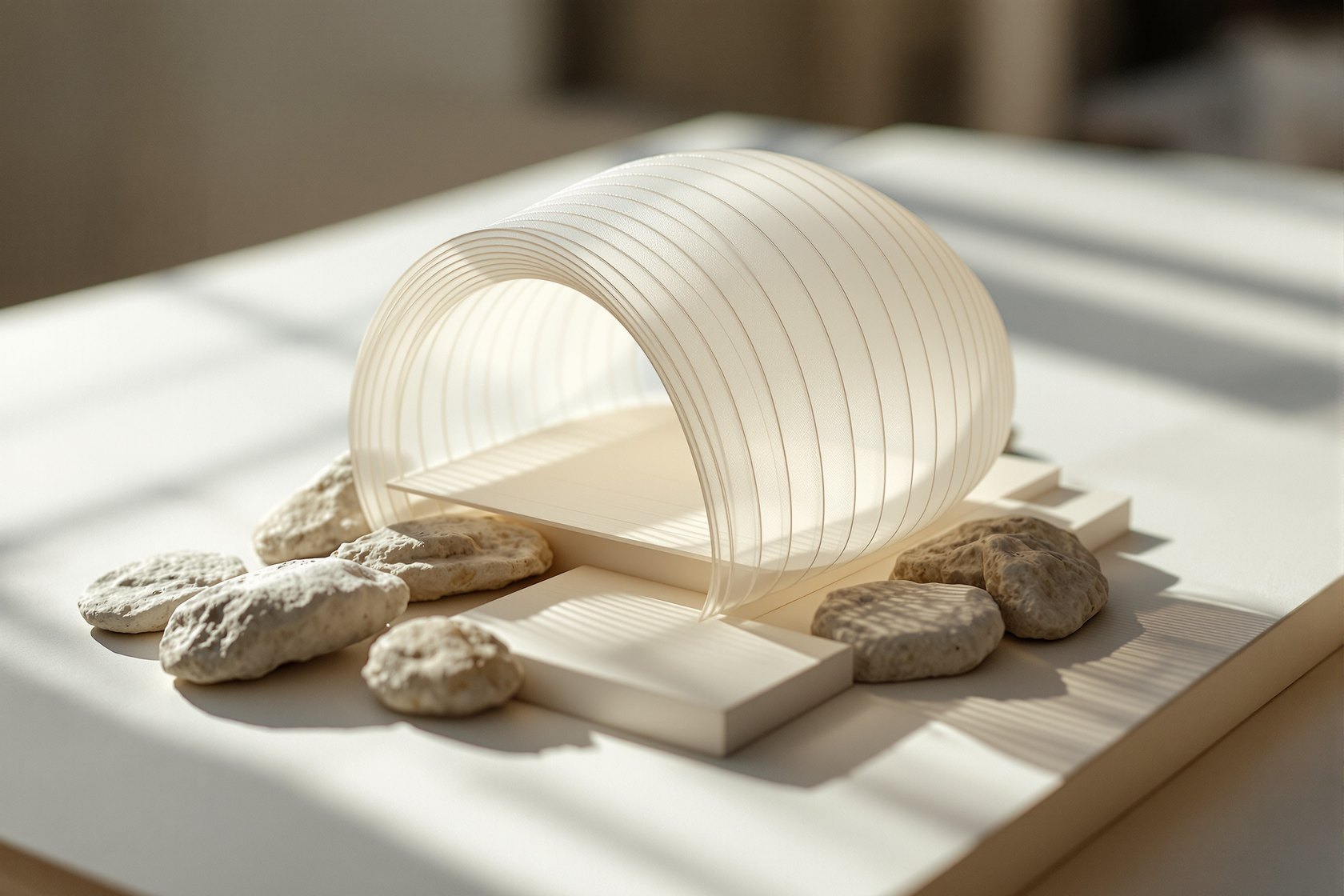
On 12 March 2026, the Pritzker Prize — the honour the field treats as its Nobel — went to Smiljan Radić Clarke of Santiago, Chile. He is the 55th laureate, the fifth from Latin America, and only the second Chilean after Alejandro Aravena in 2016. If the name means less to a lay reader than the usual roll-call of tower-builders, that is rather the point of this year's choice.
Radić, born in Santiago in 1965 and running his own small practice there since 1995, is not an architect of glass skylines. Trained at the Universidad Católica de Chile and then in Venice, he makes strange, quiet, intensely material buildings — often in dialogue with the sculptor Marcela Correa. The world met him in 2014, when his temporary Serpentine Pavilion in London sat like a pale, translucent shell balanced on rough quarry stones, half creature and half ruin. At home the work runs deeper: the Teatro Regional del Bío-Bío in Concepción, the arts centre NAVE and the expansion of the Chilean Museum of Pre-Columbian Art in Santiago, houses that look grown rather than built.
A citation that reads like a brief
It is the jury's language that makes this a dispatch for a resilience issue rather than an arts-page footnote. Radić, they wrote, "favours fragility over any unwarranted claim to certainty." His buildings, the citation goes on, "appear temporary, unstable, or deliberately unfinished — almost on the point of disappearance — yet they provide a structured, optimistic and quietly joyful shelter, embracing vulnerability as an intrinsic condition of lived experience."
Read that again with a flooded street in mind. Architecture's establishment has just handed its highest prize not to the fortress, the mega-tower or the parametric spectacle, but to a man who builds as if permanence were a vanity — who treats shelter as something provisional, humble before forces larger than itself.
Why it lands here
That is the whole argument of this issue, arriving from an unexpected quarter. Everything July has been about — the stilt house that lets the flood pass, the plinth raised in humility before the water, the vernacular that builds light and expects to be mended — is a version of Radić's fragility: not weakness, but the wisdom to stop pretending a building can out-muscle its climate. A house designed for the flood is a house that has, in the jury's phrase, embraced vulnerability as an intrinsic condition of lived experience.
The prize did not crown the most permanent building of the year. It crowned the humility to build as though nothing lasts — which, in a warming, wetter world, may be the most durable idea of all.
For an Indian reader the resonance is close to home. The kinship between Radić's raw, provisional shelter and our own vernacular — Baker's economy, the bamboo settlement on stilts, the mud wall meant to be renewed — is not a coincidence. The centre of architecture's attention is drifting, at last, from the monument to the mended, from mastery over nature to a wiser accommodation with it. It is a good year for that drift to become official.