
Inside a practice that builds for the water
In flood country, one small studio treats resilience as ordinary — reading the site in the rain, modelling water before form, building light on stilts.
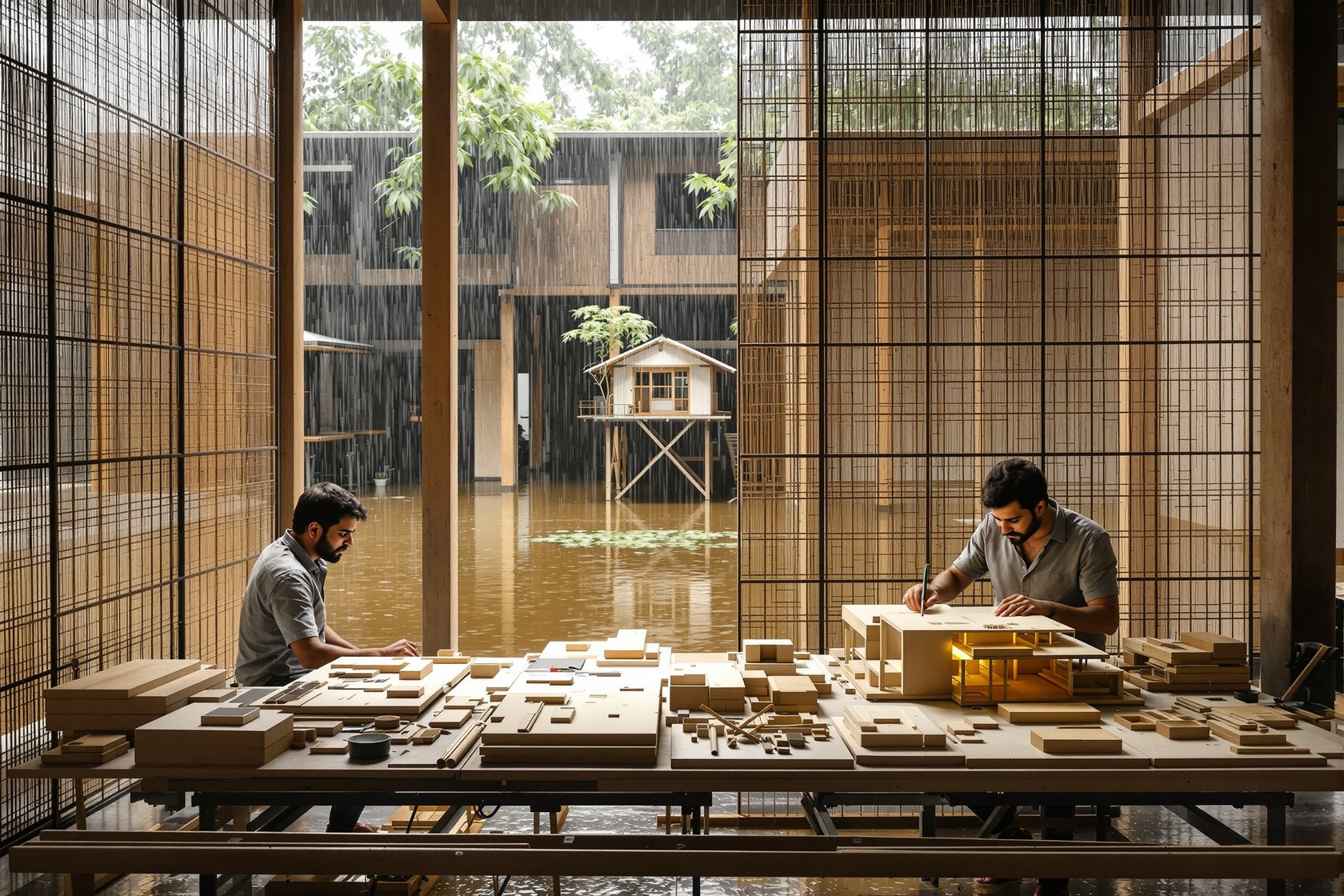
The rain reaches the studio before we do. By the time our shoes are off at the door the courtyard has become a shallow brown sheet, moving a little, and nobody in the room looks up. This is a practice in water country. It could be coastal Kerala, where the backwaters push in at high tide, or one of the river islands of the North-East, where the Brahmaputra rearranges the map every year. It hardly matters which, because the studio we are describing is not one firm. It is a composite, drawn from the small practices that build where the land floods on schedule and treat that as the weather, not a disaster. The people here are unnamed on purpose. They stand for a type.
They visit the site in the wet
Most offices go to a plot in the dry season, when the ground is honest and easy to walk. This one does the opposite. They come in the rain, on purpose, and they come more than once. A site in July tells you things a site in January hides: where the water sits and how long it stays; which corner drains and which one turns to soup; the exact line the flood reached last year, still legible as a faint tide-mark on a neighbour's compound wall. The senior in the room calls this the only survey that matters, and says it with a shrug, as if everyone knew.
The mark on the wall
On one visit an elderly farmer walked them to the back of his house and put his palm flat against the plaster, chest-high. That was the water, three monsoons ago. Not a gauge reading, not a hydrology report — a hand on a wall. The studio designs to a line half a metre above that hand. When the drawings come back to the village, the old man's mark is on them, redrawn to scale. He is, in the truest sense, a consultant.
Water first, then the house
The order of work is inverted here. In a normal brief you draw the house, then figure out the drainage. In this room they draw the water first. Before there is a plan there is a story of where the water comes from, where it wants to go, and where it will sit when it is in no hurry. Only once that is settled does a building get placed into the gaps the water has left. Form follows the flood line, not the other way round. It is slower at the start and far calmer at the end.
They do not fight the water onto the site. They find out where it is going and build in the space it leaves.
Light, local, and up on legs
Because the water is coming, the buildings are made to let it pass. They stand on stilts, timber or reinforced concrete, so the living floor sits above the worst of it and the flood runs through underneath without doing much harm. The materials are deliberately light and local: bamboo, which the region grows faster than it can use; timber; woven screens; earth where the earth behaves. Heavy is a liability in water country. A wall that soaks and slumps is worse than one that can be lifted off and rebuilt in a week. Nothing precious is put where the flood can reach it, which turns out to be a design principle you can plan a whole house around.
The craftsmen are already there
The studio does not import a construction crew. It builds with the men and women of the village, the ones who have been tying bamboo and setting stilts since before there was an architect on the job. This is not charity and it is not folklore. It is the fastest way to a house that can be repaired by the people who live in it. The detailing gets negotiated on site, in the local language, with someone who has fixed the last flood's damage with their own hands. The drawings loosen a little to make room for that knowledge. The buildings are better for it.
Resilience without the drama
What strikes you, sitting in that damp room, is how unheroic all of it is. There is no talk of fighting nature or defeating the flood. Resilience here is not a slogan on a competition board. It is a set of quiet, practical habits: build high, build light, build so it can be mended, and never put your faith in keeping the water out. The water is going to come. The whole method assumes it. That assumption, more than any material or clever section, is the thing the rest of us tend to get wrong.
We leave when the rain eases, wading the last few metres to the road. Behind us the courtyard is still a sheet of brown water, and the studio is still working, unbothered, the way you are unbothered by something you long ago stopped arguing with.