Which kitchen actually lasts?
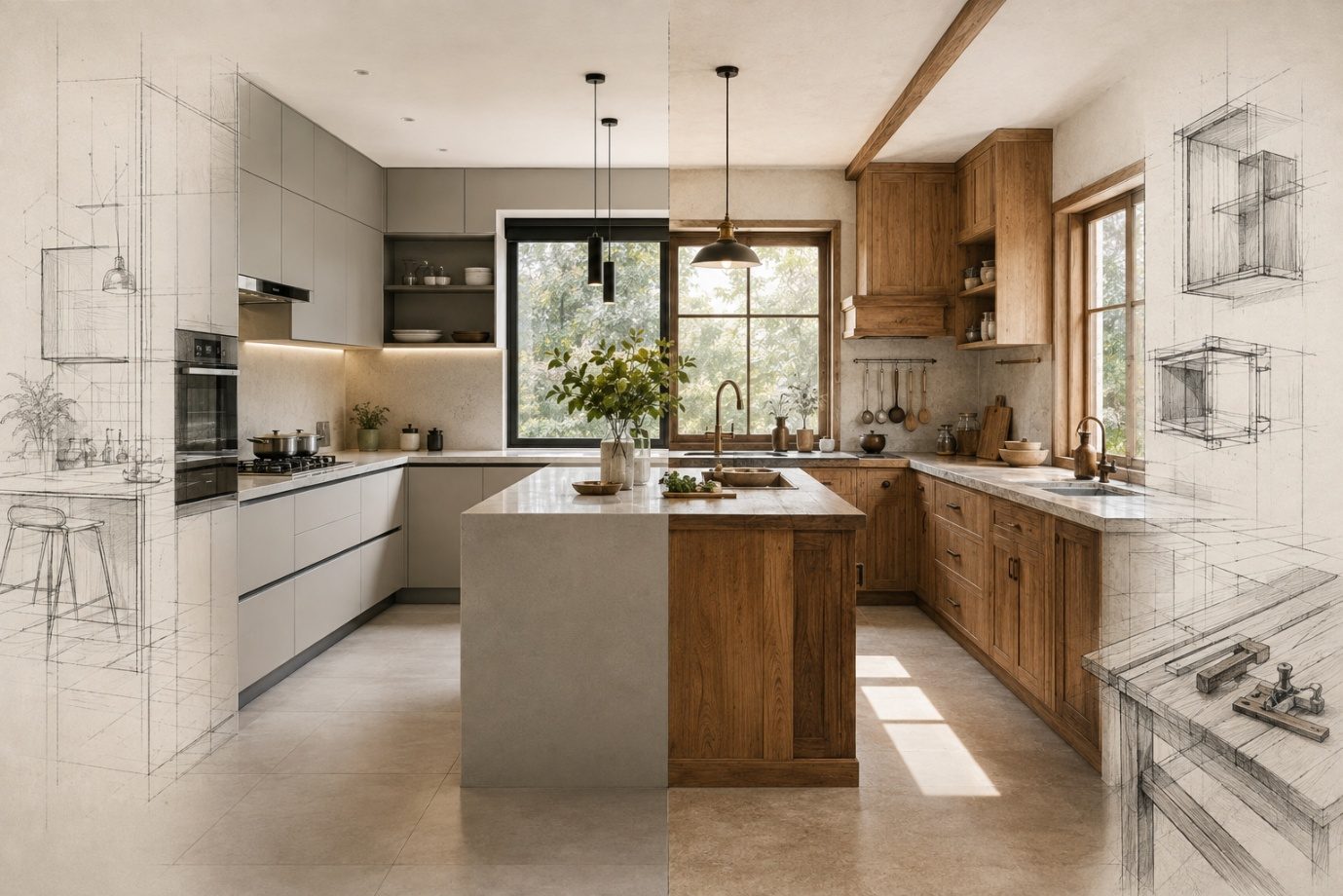
The modular-versus-carpenter debate is framed as a contest of quality. It isn't. Both are only ways of making a kitchen. We sort every claim into what is genuinely better, what depends on your kitchen, and what is merely marketing — then ask the question that actually decides longevity: when something fails, can the kitchen recover?
Ask three people how to build a kitchen in India and you may get three answers. A modular-kitchen company will point to factory precision, consistency and cleaner installation. A carpenter will tell you a well-built plywood kitchen can last decades and, unlike a factory system, be repaired almost anywhere. A homeowner who has lived with either for ten years may say it mattered less how the kitchen was made than which sink leaked, which hinge failed, which shutter swelled — and who was available to fix it.
Yet we keep arguing as if modular and carpenter-made were grades of quality. They are not. They describe two ways of producing and assembling a kitchen, nothing more. A factory-made cabinet can be poorly specified; a carpenter-made one can be exceptionally detailed — and the reverse is just as possible. Material, moisture protection, hardware, fabrication, installation and maintenance all sit between the label on the quotation and the kitchen that eventually exists in the home.
Both systems have genuine strengths, and that is where the confusion grows. Factory production offers repeatability, machine processing and standardised components that are hard to reproduce consistently by hand on site; site carpentry can answer crooked walls, unusual dimensions and specific requirements without forcing every condition into a predetermined module. But genuine advantages harden quickly into marketing absolutes — factory-made is waterproof, plywood lasts forever, modular is maintenance-free, carpenter kitchens are stronger, imported hardware guarantees longevity.
So the useful question is not which side wins. It is which claims survive scrutiny. We separate what is genuinely decided by the method of manufacture from what depends on material, climate, cook, budget and quality of execution — and from what is largely a sales claim. Then we ask the question that matters long after the kitchen is new: when something fails, can the kitchen recover? Longevity is not simply the years before the first problem appears; a kitchen that can be maintained, repaired and adapted may serve a family longer than one that was technically superior on the day it was installed.
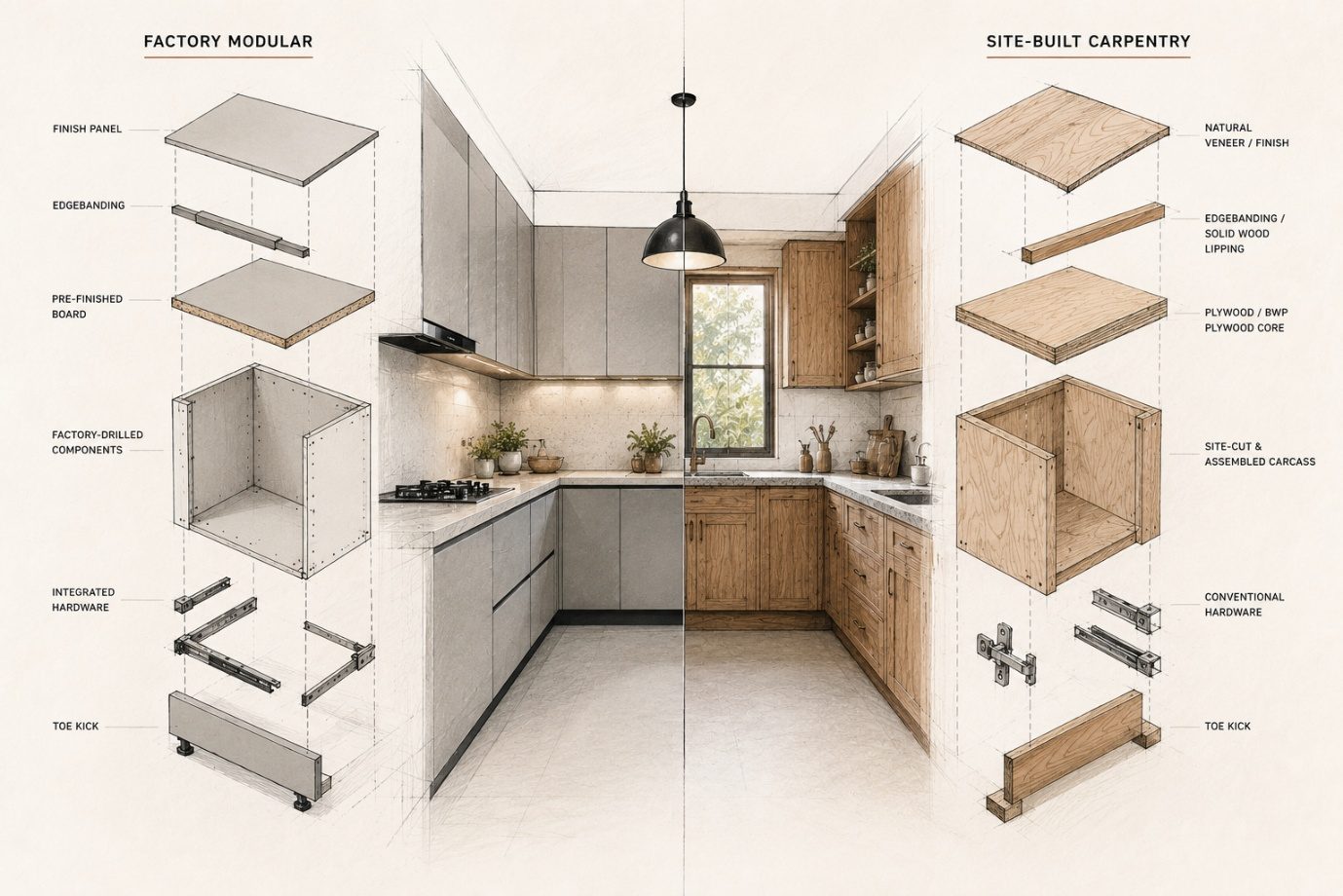
It helps to be precise about the two words. A factory-modular kitchen is built as a system of cabinet modules: components are measured and designed for the project, then much of the cutting, drilling, edge finishing and fabrication is done by machine in a workshop and assembled on site — controlled conditions that make dimensions, finishes and components easier to standardise. A carpenter-built kitchen moves that fabrication to the site, cutting and fitting boards around the actual room, so the result leans heavily on the material specified, the carpenter's skill and how carefully the work is executed. The boundary is no longer clean: many kitchens sold as modular still need considerable site adjustment, many carpenters now use workshop machinery, and hybrids combine factory-made shutters and hardware with site-built carcasses. The Indian market runs on a spectrum, not two separate camps — which is exactly why comparing the words alone misleads. So throughout, we separate the method of making a kitchen from the quality of what is being made.
Genuinely better
Read without the labels, each method does carry real strengths — but they are two different kinds of strength. Factory modular is strongest when repetition and controlled processing matter; site carpentry is strongest when adaptation and bespoke intervention matter. Neither, on its own, settles long-term durability, because that depends far more on the materials and processes that come after the first panel is cut.
Factory production gives repeatability and consistency.
Computer-controlled cutting and boring and machine edge-banding turn out cabinet components with consistent dimensions and hole patterns — a uniformity that is hard to reach when every panel is measured, cut and drilled individually on site. It is what keeps shutters aligned across long runs, drawer channels parallel, and hinges and connectors precisely placed, with a clean, even finish on exposed edges. But the advantage is real only where the factory runs good machinery, calibrated processes, suitable adhesives and genuine quality control. The word factory alone guarantees none of it.
The modular kitchen guide — layouts, materials, hardwareFactory manufacture moves the mess and the risk out of your home.
Much of the cutting, drilling and finishing happens in the workshop, so components arrive prepared for assembly and final adjustment rather than as raw boards needing extensive fabrication in an occupied house — less dust and disruption, and a more predictable installation. The true advantage here is effective process control, not the word modular.
Site carpentry adapts to the actual room.
The carpenter works with the real walls rather than the drawings alone, so out-of-square corners, awkward columns, small dimensional discrepancies and unusual storage needs can be answered during fabrication. A skilled carpenter is not boxed in by predetermined modules; the cabinetry is tailored to the architecture instead of the architecture being forced to fit a standard system. That is especially valuable in older homes, renovations and kitchens with irregular geometry.
A site-built kitchen can be repaired by any good local carpenter.
Built so other skilled tradespeople can understand it, a site-made kitchen can often be modified or repaired later without the original supplier — a quiet advantage over the life of a kitchen. But this is not carpentry's alone: a modern modular kitchen with standardised, replaceable components can allow just as straightforward a swap of a damaged shutter, hinge or drawer part, provided compatible parts and manufacturer support are still available.
It depends
This is the uncomfortable middle of the argument, and the most useful one. Once a kitchen is in everyday use, the production method is only one part of its durability. Material specification, water exposure, hardware, workmanship, installation and the cook can matter as much or more than whether the cabinet came from a factory or was made on site. Each of these claims is true — but only under conditions you have to check against your own kitchen.
Saying plywood or modular tells you the material.
Neither word names a material or a grade. Kitchens are built from different engineered boards and plywood grades, each with different properties, and even the word plywood is insufficient — Indian standards distinguish grades and test requirements, including BWP and BWR classifications and marine plywood under IS 710. A homeowner comparing two quotations needs the actual material and grade, location by location, not reassurance that one kitchen is ply and the other is modular.
Plywood grades in India, decoded — BWP, BWR and IS 710A moisture-resistant board makes the kitchen waterproof.
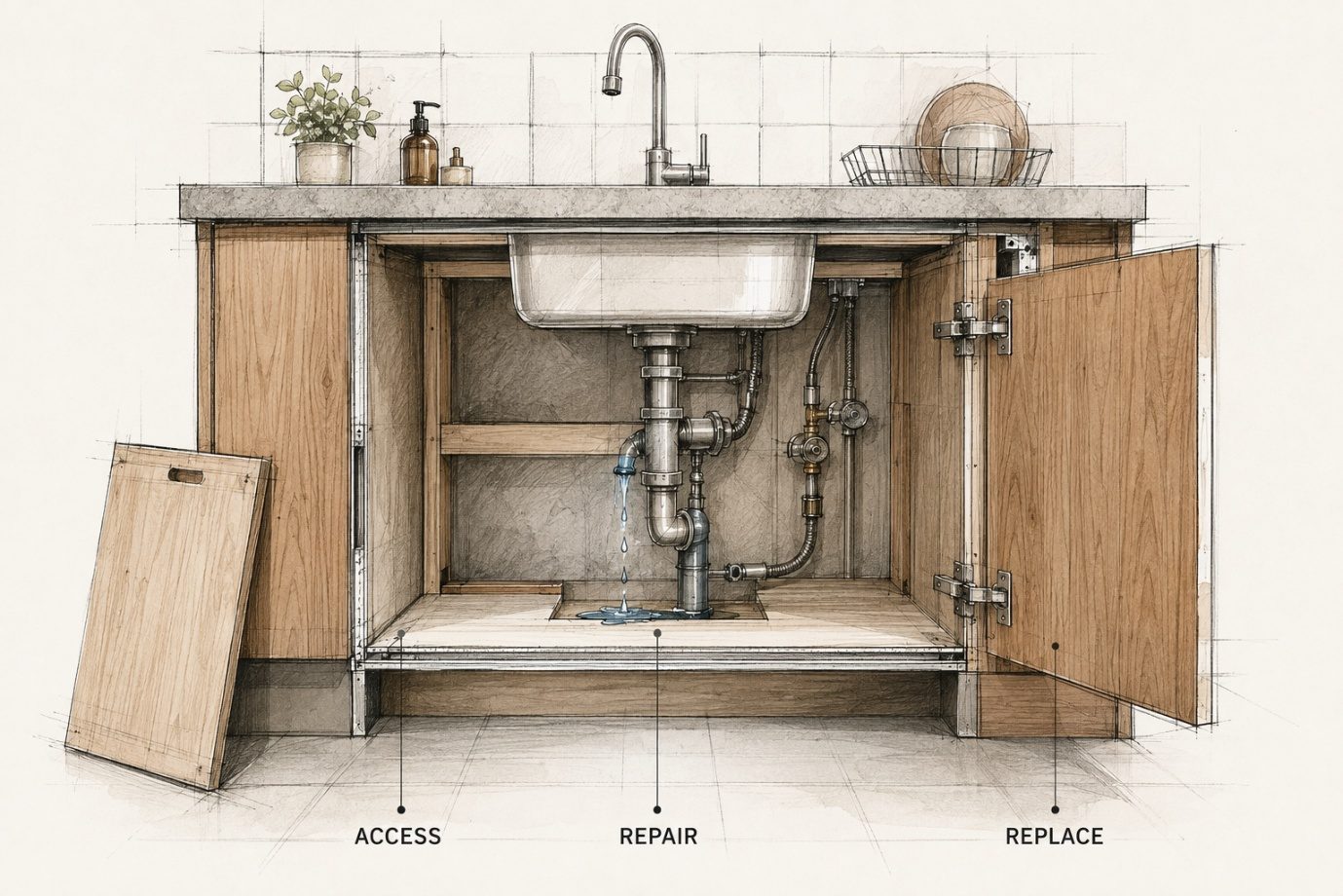
The sink cabinet lives in a very different environment from an overhead unit across the room — leaking joints, wet vessels stored nearby, cut-outs interrupting finished surfaces, water reaching exposed edges and penetrations. A moisture-resistant board is not the same as a kitchen detailed intelligently against water. Edge treatment, sink detailing, accessible plumbing and how quickly a leak can be found and repaired matter as much as the board itself.
Good hardware lasts the life of the kitchen.
The cabinet box can stay sound while the part you touch daily begins to fail. Hinges, runners and lift systems undergo thousands of repeated movements; serious manufacturers such as Blum state their hinge systems are put through extensive cycle testing and that correct, precise installation is necessary for intended performance. The question is not whether the kitchen is modular or carpenter-made, but which fitting was specified, whether it suits the shutter or drawer it carries, and whether it was installed correctly.
If it lasted in that home, it will last in mine.
A kitchen used occasionally by one person and one producing three meals a day do not impose the same load — more cooking means more heat, steam, cleaning, wet utensils and repeated use of drawers and mechanisms, and environmental moisture and ventilation vary from home to home. A material or detail that performs well in one kitchen cannot be promised the same life in every other.
The specification decides everything.
Workmanship sits over all of it. Factory accuracy can be undone by poor site installation; excellent plywood can be compromised by careless cut-outs or detailing; a skilled carpenter can produce precise work, while poor site fabrication can waste an expensive specification. Neither production method is immune to bad execution. The better question is not which lasts longer, but what exactly has been specified, how it has been protected, and how well it has been put together.
Marketing
Kitchen sales language often turns qualifications into absolutes. A material that resists moisture becomes waterproof; hardware tested for repeated use becomes lifetime hardware; factory production becomes maintenance-free; plywood becomes shorthand for durability. None of these claims is invented from nothing — the problem is that the condition attached to the claim tends to disappear between the technical specification and the sales pitch. When a claim sounds absolute, ask for the specification hiding behind it.
Factory-made kitchens are waterproof.
A kitchen is not a single material. Even when moisture-resistant boards are specified, the finished cabinet still has edges, drilled holes, joints, sink cut-outs, plumbing penetrations and hardware fixing points, and performance depends on how those vulnerable locations are detailed. Water-resistant and waterproof are not interchangeable, and a prolonged plumbing leak can challenge cabinetry whether its components were made in a factory or on site.
A plywood kitchen will last forever.
Plywood describes a broad family of products, not a single level of performance — grade, manufacturing quality, bonding, thickness, exposure conditions and workmanship all matter. A well-specified plywood carcass can be highly durable, but choosing plywood does not protect a kitchen from poor edge detailing, persistent leakage, inappropriate hardware or bad installation. The material can contribute to longevity; it cannot guarantee it.
Modular kitchens are maintenance-free.
No hard-working kitchen should be considered maintenance-free. Hinges may need adjustment, drawer channels take repeated loading, silicone and sealants deteriorate, plumbing needs inspection, extraction filters need cleaning or replacement, and shutters and worktops still need care. A better question than is it maintenance-free is: what will require maintenance, and can I access, repair or replace it?
Imported hardware is better.
Country of origin is not a performance specification. What matters is the manufacturer, product series, intended load, testing, warranty, installation and availability of replacement components. A premium hinge installed incorrectly, or used beyond its intended application, does not become better because it came from overseas. Ask for the exact brand and series, not just the word imported.
A modular kitchen can move with you.
Modularity can make individual cabinet units more separable than permanently site-built construction, but a kitchen is still designed for a particular room. Countertop dimensions, wall lengths, plumbing, electrical points, fillers, end panels and appliance positions may not match the next home. Dismantlable does not automatically mean relocatable without modification.
Carpenter-made means fully custom.
Site fabrication offers substantial freedom, but custom is valuable only when the customisation solves a problem. A cabinet made to an unusual dimension does not automatically improve its internal organisation, ergonomics or detailing. Bespoke construction still needs good design.
A new kitchen is easy to judge. The shutters align, the drawers glide, the countertop is unmarked, and nothing has yet met years of water, heat, cleaning and repeated use. The more revealing test begins later, when something goes wrong.
Picture a slow leak beneath the sink, unnoticed behind the stored cleaning supplies until the damage is done. Now the question is not whether the kitchen was factory-made or carpenter-built, but what material surrounds the leak, whether the vulnerable edges and cut-outs were protected, whether the plumbing is accessible, and whether the damaged component can be removed and replaced without dismantling half the kitchen. A kitchen designed for longevity should not just resist failure; it should make failure visible and recovery possible.
A damaged shutter tells the same story. In a modular system, replacing one can be straightforward while its dimensions, finish and hardware are still supplied — standardisation is a genuine advantage — but years later the original finish may be discontinued or the system unsupported. A carpenter-built shutter may be easier for a local tradesperson to reproduce or modify, though matching an aged laminate, veneer, paint finish or profile can be just as hard. In both cases replaceability depends on what remains available when the failure occurs, not on how the kitchen was first built. Good kitchens treat frequently used hardware — hinges, runners, lift mechanisms — as replaceable components rather than permanent parts of the carcass, which is why premium soft-close hinges on a quotation tells a future repairer far less than a named manufacturer and series.
Some changes are not failures at all. Five years on, the family buys a larger refrigerator; an elderly parent needs easier access to everyday storage; a new appliance wants counter space; one cook becomes two. A kitchen can remain physically intact and still stop serving the household well, so longevity includes some capacity to adapt. The question to ask before installation is disarmingly simple: if this part fails five years from now, what happens next? If the answer means destroying perfectly serviceable work, waiting for a proprietary component that may no longer exist, or reaching the plumbing only by dismantling cabinetry, the kitchen has a resilience problem — whether it began in a factory or a carpenter's workshop.
So which kitchen lasts longer, modular or carpenter-made? There is no universal winner, because the label describes only one part of the system that determines longevity. Factory modular makes sense when consistency and process control are priorities, and when the manufacturer also provides clear specifications, dependable installation, replaceable components and long-term service, it offers something equally valuable after installation: predictability. Site-built carpentry is compelling when the architecture does not behave like a module — renovations, irregular walls, unusual corners, specific storage, bespoke details — and when the kitchen can be understood and repaired by skilled local tradespeople rather than tied to one proprietary system. But custom fabrication is only as good as the carpenter, the detailing and the supervision behind it.
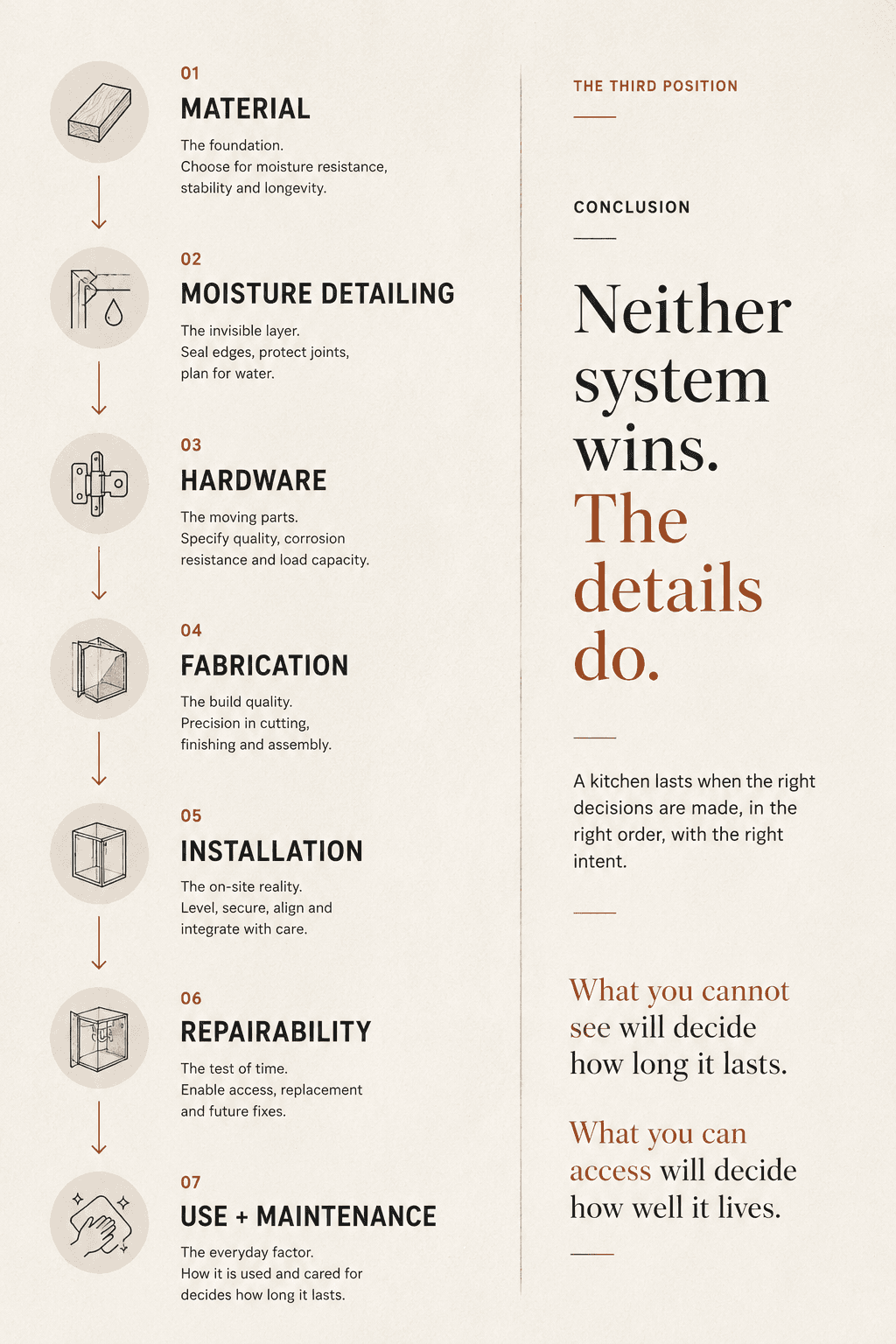
A well-built kitchen from either system can outperform a poorly built kitchen from the other. A good BWP-grade plywood carcass does not become weak because it was processed in a factory, and machine-cut components do not become durable just because they are modular. The useful comparison moves away from labels toward the decisions underneath them — which produces a very different hierarchy: material specification, then moisture detailing, then hardware, then fabrication, then installation, then repairability, then use and maintenance. The manufacturing method runs through several of these factors, but it does not replace them. It also explains why comparing only the final rupee figure of two quotations tells you little when one includes better board, branded hardware, machine edge finishing, installation, warranty and after-sales support while the other does not.
So StudioMatrx's third position is deliberately less satisfying than declaring a winner, and considerably more useful. Don't choose between modular and carpentry first. Choose the level of material, detailing, execution and repairability you expect from the kitchen, then decide which method can deliver those requirements most reliably for your home, your budget and the people available to build it. A regular apartment kitchen with a strong modular supplier may have an obvious answer; a complicated renovation with an excellent carpenter may have another; a hybrid — factory-made shutters and hardware combined with carefully site-built carcasses — may sometimes be the most sensible answer of all. The answer to which kitchen actually lasts is not a category. It is the kitchen whose specification and construction remain defensible after the sales language has been removed.
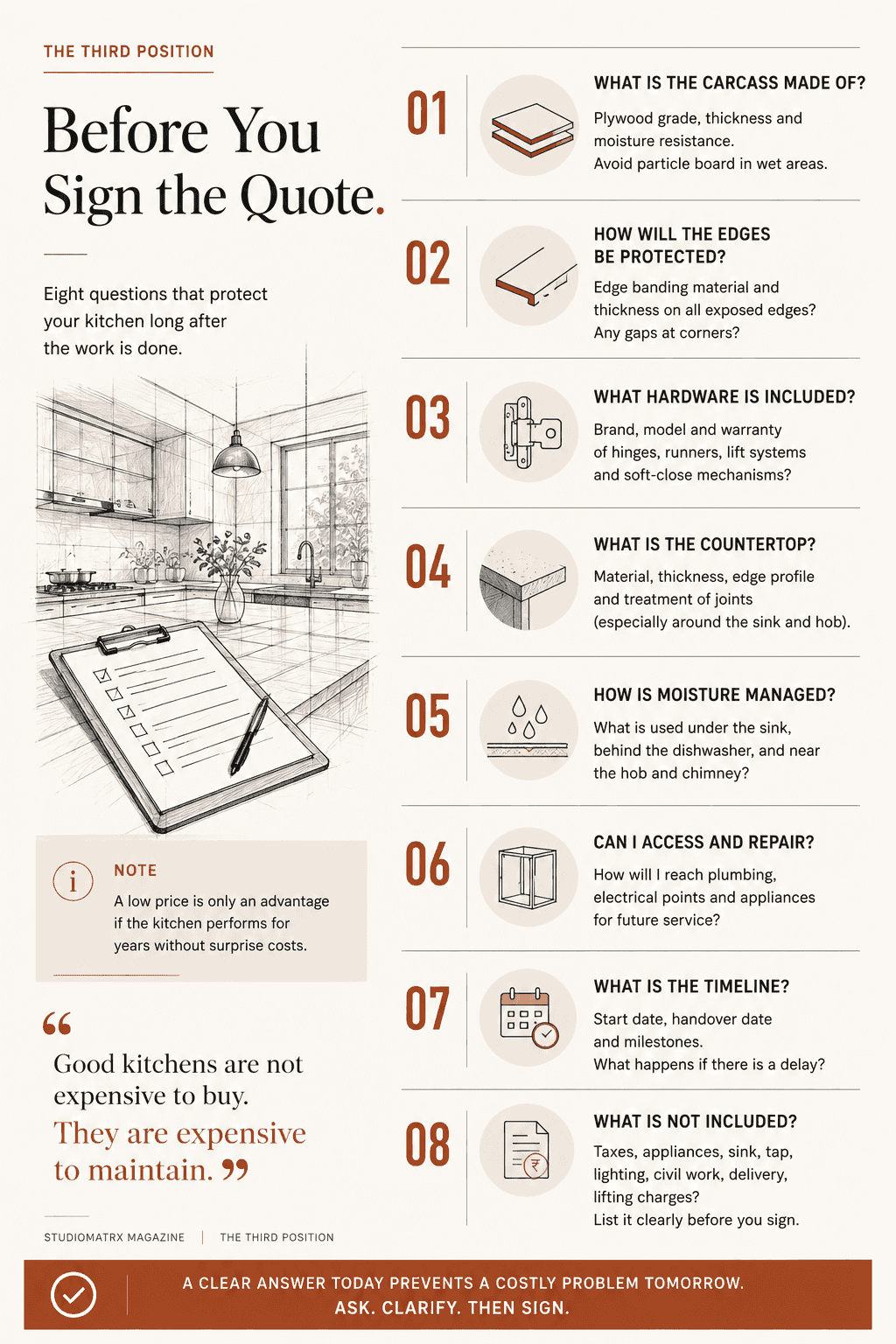
Which is why the real work happens before you sign the quote. A quotation is where the labels become least useful: two kitchens described the same way can contain completely different materials, hardware, construction details and provisions for future repair. Before comparing prices, compare what is actually promised — eight questions that turn labels into evidence.
01 — What exactly is the carcass material? Don't settle for plywood, water-resistant board or premium board. Ask for the material, grade, thickness and manufacturer in writing, and whether the same material is used throughout or changes around the sink, overhead units and tall units.
02 — What happens around the sink? This may tell you more about durability than the shutter finish. Ask what the sink cabinet is made of, how cut and exposed edges are protected, how the sink junction is sealed and whether plumbing stays accessible. The key question is not is this waterproof but what happens if water gets where it shouldn't.
03 — What hardware am I actually getting? Premium hardware is not a specification. Ask for the manufacturer, product series and model of hinges, drawer runners, lift-up systems and specialised mechanisms, so that if a component fails years later, knowing exactly what was installed makes replacement easier.
04 — How are the exposed edges finished? Ask how board edges are treated, especially in frequently used or moisture-prone areas — the factory's edge-finishing process, or how a carpenter will finish and protect vulnerable cut surfaces. A beautiful face finish should not distract from where the underlying board is most exposed.
05 — Can one damaged component be replaced? If a shutter is damaged five years from now, can it be replaced independently — and what about a drawer runner, hinge or sink-base panel? Ask whether components can be removed without harming neighbouring cabinetry and whether replacement finishes and hardware are likely to remain available.
06 — Who comes back when something goes wrong? A warranty is useful only when its scope is clear. Ask who is responsible for the carcass, shutters, hardware, countertop, installation and service calls — they may not all be the same party — what is excluded, how long components are covered and what happens after the warranty ends.
07 — What is excluded from this price? This is where two apparently similar quotations diverge. Clarify whether the price includes installation, transportation, countertops, sink, plumbing modifications, electrical work, chimney ducting, appliances, accessories, fillers, end panels, handles, taxes and removal of the existing kitchen. Compare scope against scope, not just total against total.
08 — Show me the specification, not just the sample. A showroom shutter shows what the kitchen might look like, not what is behind it. Before signing, ask for a written specification recording materials, thicknesses, finishes, hardware, countertop, accessories and warranty terms, so what gets installed does not depend on a salesperson's memory.
The objective is not to turn every homeowner into a cabinet manufacturer. It is to move the conversation from labels to evidence, so modular versus carpenter-made becomes far easier to judge once the two proposals can finally be compared on the things that matter. A good quotation should survive questions. A good kitchen should survive what comes after it. A kitchen doesn't last because it is called modular or carpenter-made — it lasts because materials, detailing, fabrication, installation and maintenance keep working together long after the people who built it have left.
In detail
Photographs & diagrams