
Designing for the flood line: the student showcase
Five studio schemes that stop fighting the water and start designing with it — a look at where the next generation is taking resilience.
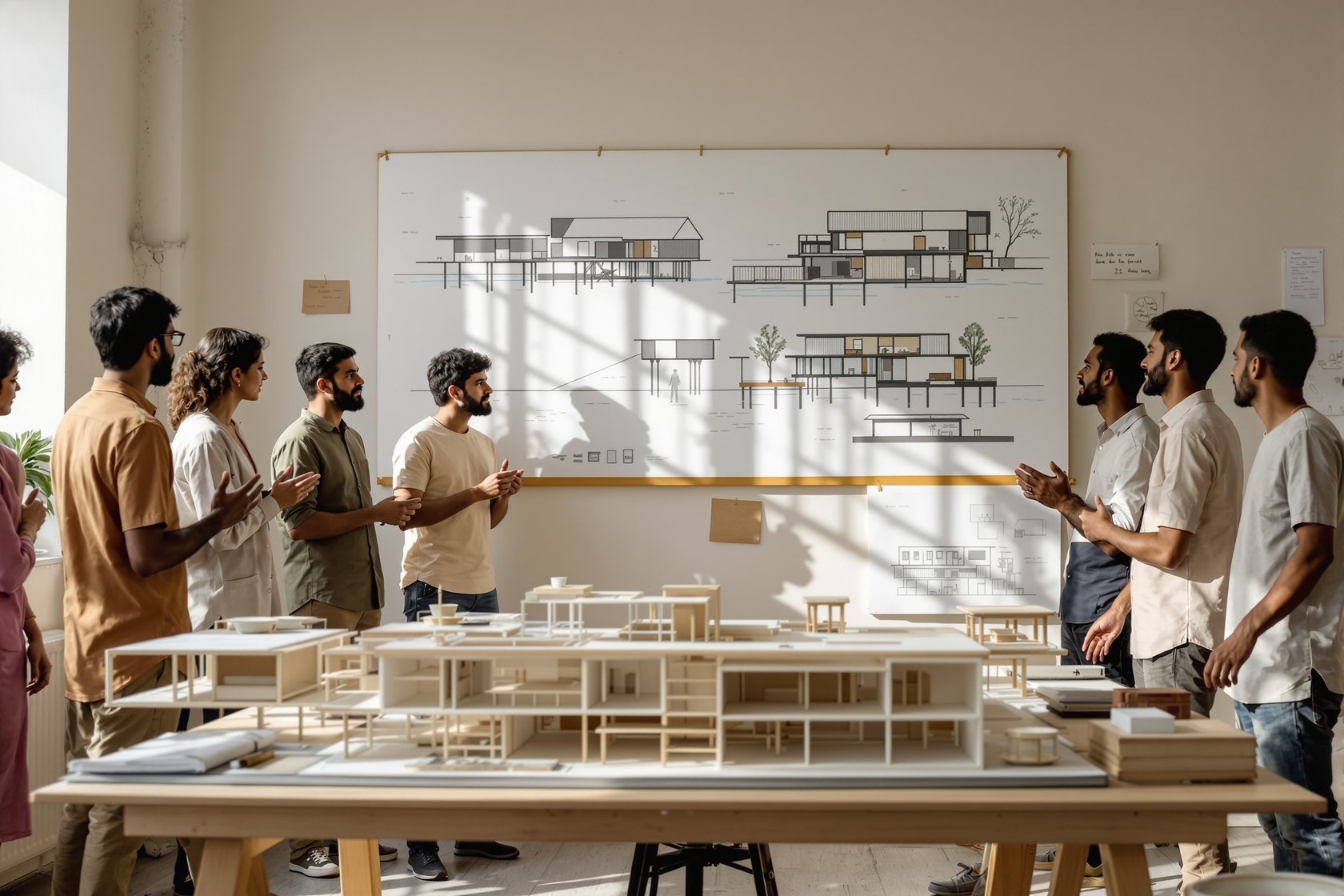
Ask a studio full of young architects to design against the flood and you get walls, dykes, pumps, a fortress at war with the sky. Ask them to design with it and something better happens. This year a run of thesis and studio projects crossed our desks that all began from the same quiet, grown-up premise: the water is coming, it has every right to, and the interesting question is not how to keep it out but how to let it in without loss. What follows is a curated showcase of five schemes — representative of the work we are seeing rather than any single named project — chosen because each answers the flood line with imagination instead of concrete alone.
The house that floats
The most quietly radical of the lot was an amphibious house: a home that sits on the ground like any other for most of the year and rises with the flood when it comes. The trick is old and elegant — a buoyant base held by vertical guide posts, so the whole house lifts straight up on the rising water and settles back exactly where it started when the flood withdraws. Services arrive through flexible connections that stretch as the house climbs. On paper it reads like a stunt. In section it reads like wisdom: nothing to defend, nothing to lose, a house that treats a metre of floodwater the way a boat treats a wave. The student's drawings of the same living room at ground level in April and floating serenely in August were the single most persuasive thing in the show.
They stopped drawing a wall against the water and started drawing a friendship with it.
The stilt cluster, brought up to date
Another team went the vernacular route and did it justice. Stilts are the oldest flood answer on the subcontinent, from the bamboo homes of the north-eastern river valleys to the coastal fishing settlements, and this scheme lifted a whole cluster of dwellings clear of the flood plain on a shared raised deck, leaving the ground beneath open for the water to pass and for daily life to spill out in the dry months. What lifted it above a history lesson was the community thinking: the raised deck became a street in the sky, a shared verandah linking the homes, so the flood defence and the social life of the settlement were the same move. Resilience, the scheme argued, is not a private purchase. It is something a neighbourhood does together, up on one deck, above one line.
The campus that drinks the rain
Not every answer was a building. One landscape-led scheme reimagined an institutional campus as a sponge: no rushing every drop to an already-drowning drain, but a soft ground of swales, rain gardens, permeable courts and a chain of retention ponds designed to hold the monsoon's first violent flush and let it soak slowly into the aquifer. The plan looked, deliberately, less like engineering and more like a wetland that had been invited to live inside a campus. Its argument was pointed and correct: a great deal of our urban flooding is not the river's fault but our own, the sum of a thousand plots that paved themselves and pushed their water onto everyone else. A campus that drinks its own rain makes every street around it a little drier.
A shelter for the worst night
The most sober project in the room was also, in some ways, the most moving: a community flood shelter for the villages where raising every house is simply not affordable this decade. A raised, robust, generous public building — high plinth, strong frame, a safe upper hall for people and a few animals, clean water and a charging point held above the flood — designed to be the one place in the settlement that never goes under. The student had clearly spent time with people who had lived through the real thing, because the plan understood dignity as well as safety: space to keep families together, somewhere for the elderly to sit, a roof that becomes a gathering place when the water finally goes. It is not glamorous architecture. It is the kind that saves the night.
The street that becomes a canal
The showcase closed on the boldest note — a floating market street for a delta town that floods so predictably the design simply plans for both states. In the dry season it is an ordinary lane of shops and stalls. In flood it becomes a working canal, the shopfronts opening onto water, boats where the auto-rickshaws were, trade carrying on at a new level entirely. It is speculative, and it knows it, but it does the thing the best student work always does: it refuses to treat the flood as a disaster to be survived and reframes it as a season to be inhabited. Whether or not a town ever builds it, every young designer who drew it will now look at a flood plain differently. That, in the end, is what a showcase like this is for. The water is coming. This generation has stopped bracing for it and started designing for it, and the buildings they will make because of these drawings are going to keep a great many people dry.