
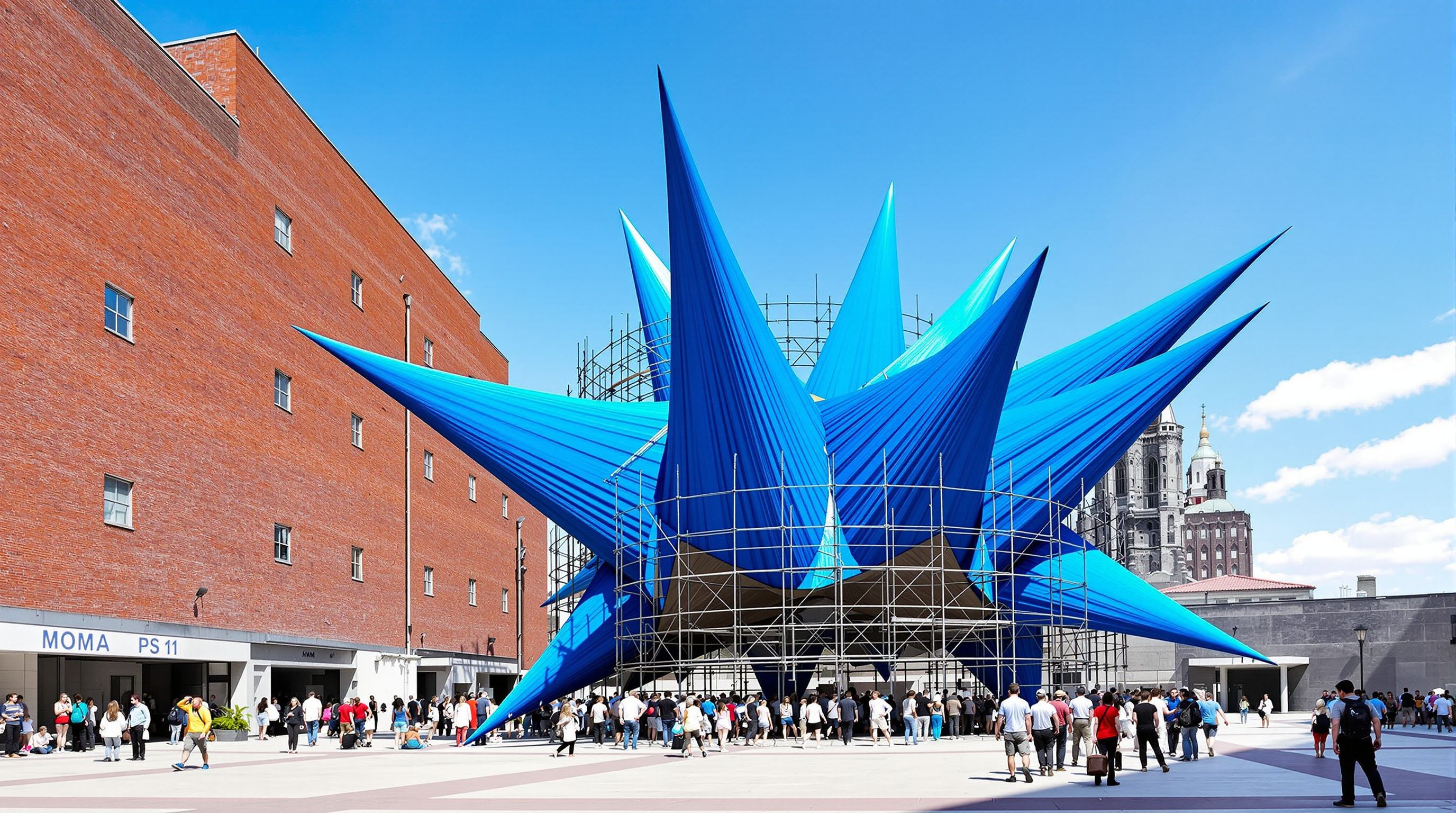
Wendy: The Spiky Blue Pavilion That Tried to Clean New York's Air
HWKN's 2012 MoMA PS1 pavilion was a starburst of titanium-dioxide-coated nylon stretched over builders' scaffolding — a summer party-scape engineered as a working air-purifier. It is the clearest test case for a provocative idea: that a building can be a net-positive environmental machine, not merely a less-harmful object.
Most buildings in this canon try to do less harm. Wendy tried to do active good. For one summer in 2012, a jagged, electric-blue creature the size of a small building squatted in the concrete courtyard of MoMA PS1 in Long Island City, Queens, spitting mist at overheated partygoers and — its designers claimed — quietly scrubbing pollutants out of the New York air. It was loud, cheap, temporary, and slightly ridiculous. It was also one of the most pointed arguments of its decade about what a building is for.
Wendy was the winning entry in the 2012 Young Architects Program (YAP), the annual competition run by MoMA and MoMA PS1 that hands a young firm the museum's courtyard, a famously tight budget, and a brief to build a shade-and-water installation for the summer Warm Up party series. The firm was HWKN (HollwichKushner), led by Matthias Hollwich, with Marc Kushner as co-founder. That authorship matters to this project more than most: Kushner would go on to write The Future of Architecture in 100 Buildings (2015), the book this very canon extends. Wendy is, in a sense, its author's own manifesto built at full scale.
We wanted to prove that sustainability doesn't have to be a sacrifice — that a building can be fun, social, spectacular, and still do real environmental work at the same time.
The question it poses
Kushner's framing question — what does this building tell us about where architecture is going? — has an unusually direct answer here. Wendy asks: what if a building were not just less bad for the environment, but actively good for it?
The dominant sustainability paradigm of the 2000s was subtractive. Green buildings were the ones that consumed less — less energy, less water, less carbon. The whole vocabulary was one of reduction, efficiency, harm-minimisation. Wendy proposed something different and more aggressive: a building as a positive environmental actor, a machine that reaches out and improves the air around it. In the language that would later crystallise as regenerative or net-positive design, Wendy was an early, gleeful, populist prototype. It did not whisper about efficiency. It shouted, in the shape of a giant blue sea-urchin, that architecture could clean up after the city.
Placing it in this canon's sixth chapter — Shelter from the Storm, the chapter about resilience and response to a destabilising environment — is a deliberate stretch. Wendy shelters no refugees and survives no flood. But airborne pollution is a slow-motion storm, a chronic urban emergency that kills more people than the acute disasters do. Wendy is what resilience looks like when the threat is invisible and ambient: not a bunker, but an active remediation device dressed up as a party.
The central move: a skin that eats pollution
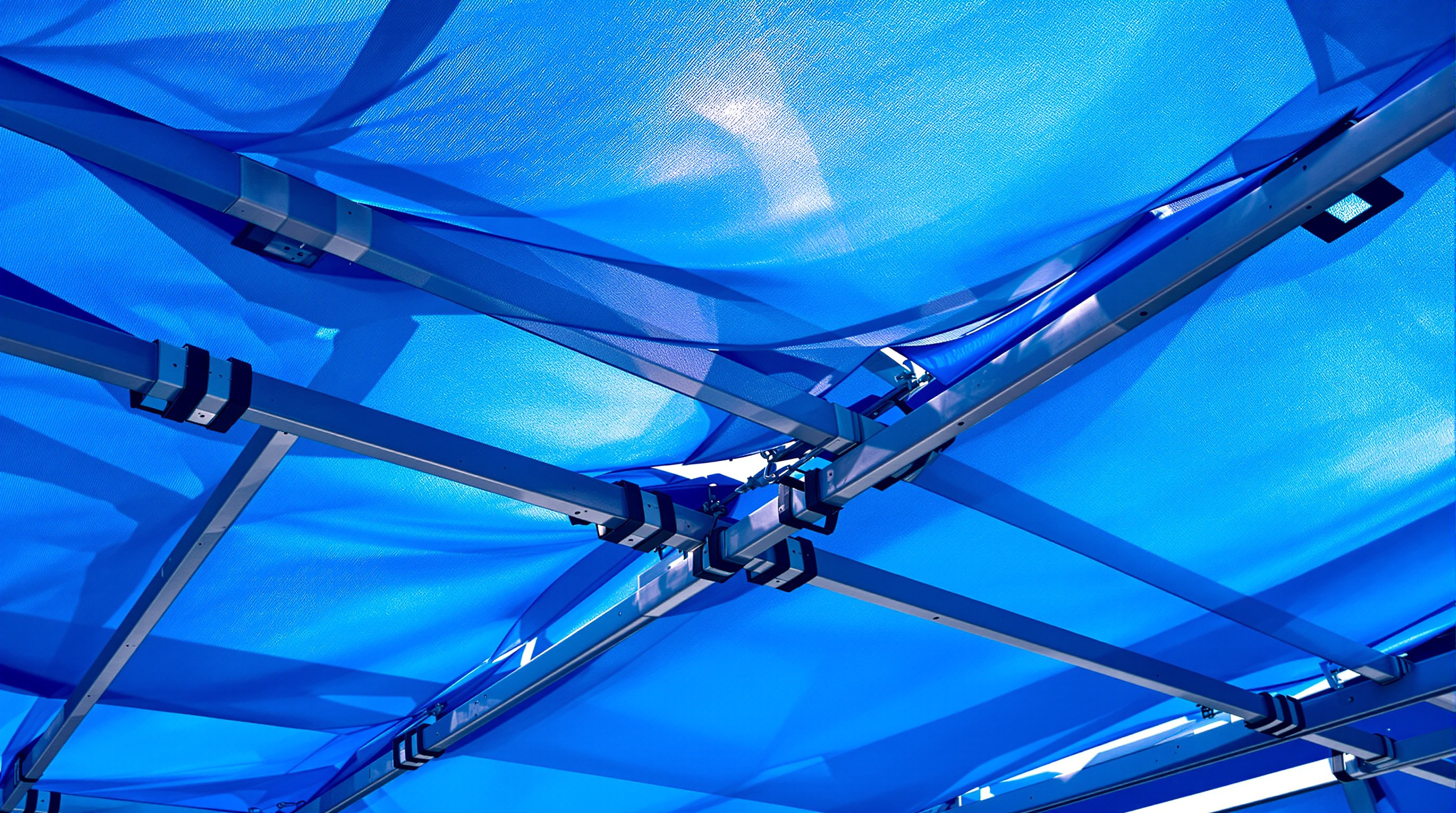
Wendy's structural body is almost aggressively ordinary. It is built from a cage of standard builders' scaffolding — the same galvanised steel tube-and-clamp system used on any construction site — assembled into a cubic frame roughly 21 metres (about 70 feet) square and 14 metres (45 feet) tall. There is nothing precious or bespoke about it. That was the point: YAP budgets are small, timelines short, and Wendy's honesty about its own cheapness is part of its charm and its argument.
Stretched over and through this frame is the thing that makes Wendy Wendy: a taut, spiky skin of blue nylon fabric pulled into six or so dramatic points that lunge outward and upward, giving the whole a starburst or exploded-crystal silhouette. That spikiness is not styling. It is the technical crux of the project.
The fabric was treated with a titanium dioxide (TiO2) nano-coating — a sprayed-on layer of titania nanoparticles that turns the surface into a photocatalyst. When ultraviolet light in ordinary sunlight strikes titanium dioxide, it kicks electrons into an excited state and drives a reaction called photocatalytic oxidation. The energised surface generates highly reactive radicals that break down organic and nitrogenous pollutants — nitrogen oxides (NOx), volatile organic compounds, and airborne soot — that land on it, converting them into far more benign residues: water vapour, trace carbon dioxide, and salts that simply rinse off in the rain. The chemistry is real and well documented; it is the same effect used in self-cleaning glass and depolluting concrete pavers.
And the starburst geometry? It is a surface-maximising strategy. Because the reaction only happens where sun-lit coated fabric meets moving air, more surface means more cleaning. The spikes exist to unfold as much active skin as possible into the wind and the light — form following, quite literally, chemistry.
Cheap, fast, and photogenic: the anti-monument
If the Heydar Aliyev Center is what happens when a client hands architecture an almost unlimited budget, Wendy is the opposite pole — and just as instructive. Everything about it is provisional. Scaffolding is rented, not fabricated. The fabric is stretched, not moulded. The whole thing went up fast, performed for one season, and came down. HWKN even gave it a name and a personality — Wendy, not "the 2012 YAP pavilion" — and ran it like a character, complete with a social-media presence and the tagline of a "party-scape that cleans the air."
That branding is not a footnote. It signals a genuine shift in how a generation of architects understood their work: as content as much as construction, as an event that lives in photographs and memory. Hollwich has said the highest compliment the pavilion received was a security guard asking, a year later, where Wendy had gone — the building as a friend people missed. This is architecture optimised for cultural half-life, and Wendy is a hinge point in that story.
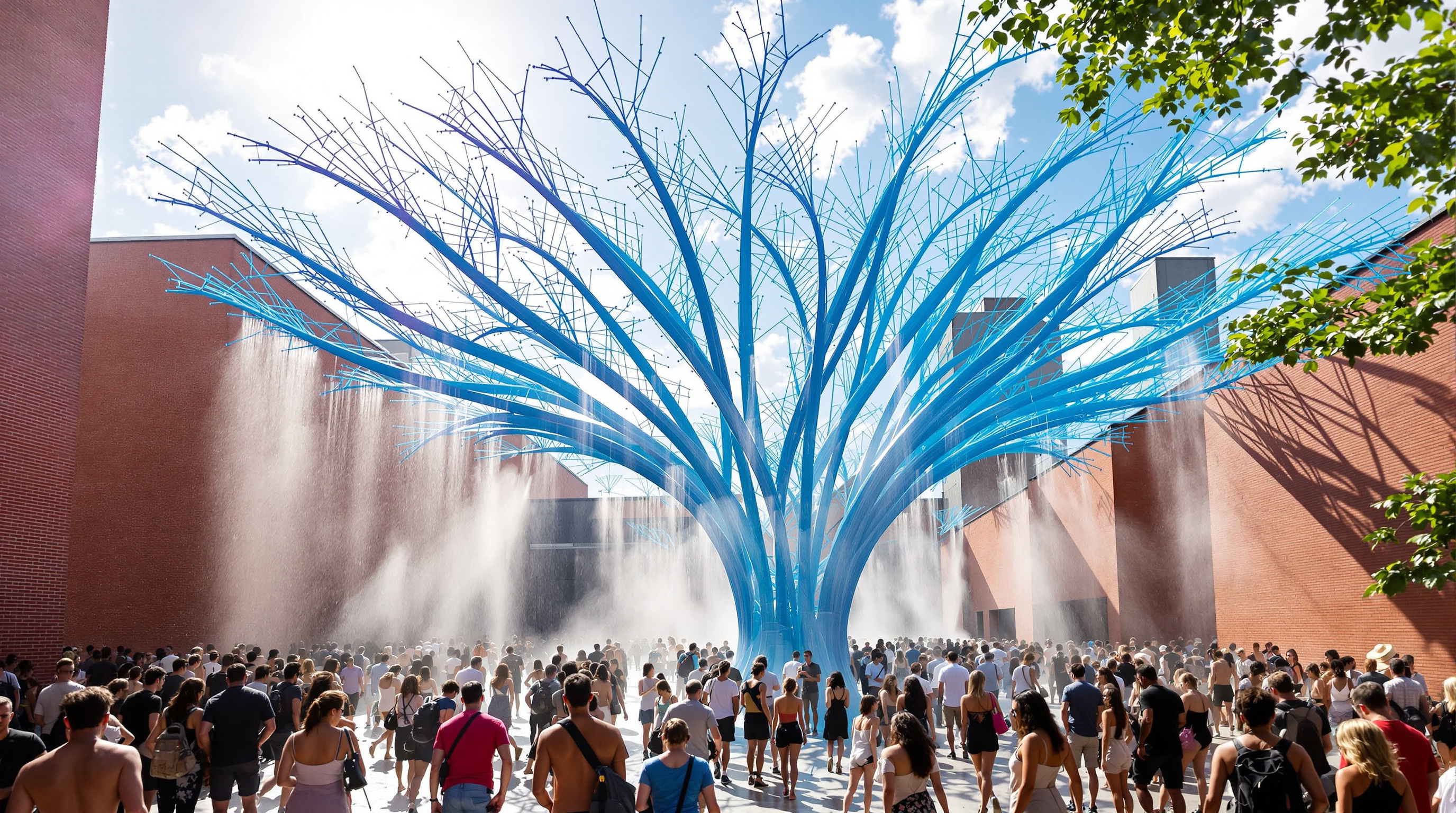
The program packed into the scaffold cage was pure summer courtyard: a shallow pool, banks of misting jets and water cannons for cooling the crowd, an elevated DJ booth, and shaded lounging space beneath the blue overhangs. Later in 2012 a version of Wendy was reprised abroad, reportedly in Abu Dhabi in partnership with a local foundation and Masdar — evidence that the idea was meant to travel, not just to entertain Queens for one July.
| Attribute | Wendy | A conventional pavilion |
|---|---|---|
| Primary structure | Rented steel scaffolding | Bespoke fabrication |
| Skin | TiO2-coated nylon, tensioned | Timber, ETFE, or cladding |
| Environmental stance | Active (cleans air) | Passive (shade / low-impact) |
| Lifespan | One summer, then dismantled | Permanent or semi-permanent |
| Form driver | Maximise coated surface area | Composition / enclosure |
The critique the mist cannot hide
An honest account has to slow down at the green claims, because this is where Wendy is both most exciting and most vulnerable. HWKN reported that over its summer run the pavilion cleaned the air by an amount equivalent to taking around 260 cars off the road. It is a vivid, quotable figure — and it should be read as a design-communication claim rather than a peer-reviewed measurement. No independent, published air-quality monitoring of the installation appears to exist, and the "cars off the road" unit conflates several assumptions about coating area, sunlight, wind exposure and reaction rates.
The underlying science is sound but modest. Titanium-dioxide photocatalysis genuinely degrades NOx and organic pollutants; that is established across a substantial peer-reviewed literature on depolluting concrete, self-cleaning glass and photocatalytic coatings. But real-world efficiency at building scale is limited by UV availability, humidity, air-flow contact time and gradual fouling of the surface, and studies repeatedly caution that headline lab figures overstate what a facade delivers in the street. A tensioned fabric exposed to a single season of Queens weather is a demonstration, not a treatment plant.
So the fair verdict — Studio Matrx's third position — is to hold two things at once. Wendy oversells: the precise environmental benefit was almost certainly small and was never independently verified, and the spectacle did more cultural than atmospheric work. And Wendy matters: it dragged an emerging materials science out of the lab and into a museum courtyard, made it social and legible and desirable, and asked the right question a decade before "regenerative design" became a mainstream phrase. Greenwashing and genuine provocation are not mutually exclusive; Wendy is a little of both, and pretending otherwise flattens the lesson.
Why it belongs in the canon
Wendy is minor in every conventional metric — small, cheap, temporary, gone. It belongs here anyway, for the same reason a good manifesto outlives the pamphlet it was printed on. It proposed that the future of a green building is not a quieter, more abstemious object but a livelier, more generous one: a building that gives something back to the commons it sits in, and does so without asking anyone to feel guilty or bored. It fused three things the profession usually keeps apart — hard materials science, cheap fast fabrication, and unashamed popular fun — into a single blue creature.
A decade on, active air-cleaning surfaces, depolluting coatings and net-positive ambitions are no longer exotic. Wendy did not invent any of that, and it did not prove it at scale. What it did was make it loveable — and give a whole cohort of architects permission to imagine buildings that are environmental actors rather than environmental apologies. That is a small pavilion's large idea, and it is exactly the kind of question this canon exists to track.
References
- HWKN (HollwichKushner), "WENDY" — official project page (design lead Matthias Hollwich; client MoMA PS1; reprised for the Sheikha Salama Bint Hamdan Al Nahyan Foundation and Masdar; photography Michael Moran and Iwan Baan). hwkn.com/projects/wendy (primary source)
- MoMA / MoMA PS1 (2012). "HWKN (HollwichKushner) Selected as Winner of the 2012 Young Architects Program." Press release. moma.org (primary source)
- The Architect's Newspaper (2012). "Meet Wendy, HWKN's pollutant-fighting pavilion at MoMA PS1." archpaper.com (architectural press)
- Dezeen (2012). "Wendy by HWKN." dezeen.com (architectural press)
- Chen, J. & Poon, C. S. (2009). "Photocatalytic construction and building materials: From fundamentals to applications." Building and Environment, 44(9), 1899–1906. DOI: 10.1016/j.buildenv.2009.01.002. (peer-reviewed; establishes the TiO2 photocatalysis Wendy relies on and its real-world limits)
- Marolt Čebašek, T. et al. (2023). "Recent advances in photocatalytic self-cleaning performances of TiO2-based building materials." RSC Advances, 13. DOI: 10.1039/D2RA07839B. (peer-reviewed review of TiO2 depolluting/self-cleaning building surfaces)
- Kushner, M. (2015). The Future of Architecture in 100 Buildings. Simon & Schuster / TED Books. (the book this canon extends; written by Wendy's co-author)
Part of The Future of Architecture in 300 Buildings — Studio Matrx's canon of the buildings asking where architecture goes next. Chapter 6: Shelter from the Storm.
Export this guide
Related Guides — Deep-dive reading
MoMA PS1 Young Architects Program: The Courtyard That Rebuilds the Future Every Summer
For two decades a concrete courtyard in Queens became a laboratory where emerging architects tested recyclable structures, robotic fabrication and urban agriculture under a single brutal brief — shade, seating, water. This deep study reads the Young Architects Program not as one building but as an institution that made the temporary pavilion a serious site of architectural research.
The Future of ArchitectureSuperC, Aachen: A Building That Reaches Up 17 Metres and Down 2.5 Kilometres
Fritzer + Pape's students' service centre for RWTH Aachen is two experiments in one body — a dramatic 17-metre steel cantilever above ground, and a single deep coaxial borehole heat exchanger 2,500 metres below it that was meant to heat and cool the whole building. One of those experiments worked. The story of the one that did not is the more important lesson.
The Future of ArchitectureSelf-Cleaning Facades in India: Photocatalytic, Lotus-Effect and Easy-Clean Glass, Honestly Assessed
Photocatalytic concrete, lotus-effect coatings and self-cleaning glass promise facades that wash themselves — but in India's dust, monsoon and hard water, the science is more modest than the marketing, and good detailing still wins.
Building FacadesRelated Tools — Try Free
Client Brief Generator
8-section questionnaire that produces a professional design brief PDF with signature lines.
Brief GeneratorDesign Brief Generator
Answer 10 questions and generate a professional interior design brief PDF for your designer or architect.
Brief GeneratorAI Measurement Tool
Measure your room using voice, photos, or video sweep — no tape measure needed.
DesignAI