
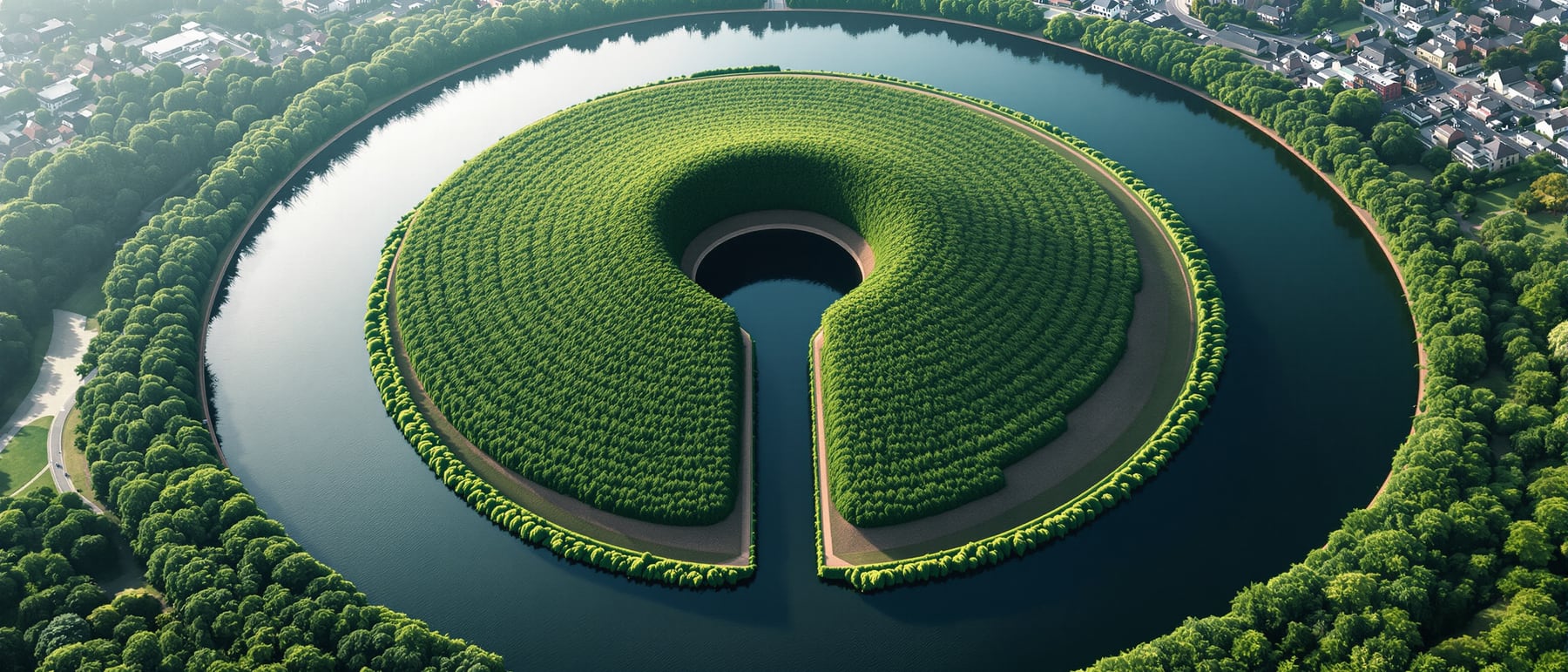
Daisen Kofun: The Keyhole Tomb You Can Only See From the Sky
How ancient Japan raised a mound the size of a small city in the shape of a keyhole — a half-kilometre of earth ringed by three moats, guarded by thousands of clay haniwa, and sealed so completely as an imperial grave that no archaeologist has ever entered it, leaving one of the largest tombs on Earth, and the identity of the emperor within, a mystery kept by reverence.
Our tombs have taken many shapes — pyramids, beehives, cliffs, mounds. Our next takes a shape found nowhere else on Earth: a colossal keyhole, cut into the ground of Japan, so vast that no one standing beside it can perceive its form at all. Only from the sky does the whole extraordinary outline appear — a great round mound joined to a broad trapezoid, wrapped in rings of water, blanketed in forest, sitting like a green island in the middle of a modern city.
This is Daisen Kofun, near Osaka — the largest of Japan's ancient kofun, or mounded tombs. By the sheer area it covers, it is among the largest tombs on Earth, ranked in Japan alongside the Great Pyramid and the tomb of China's First Emperor as one of the "three great tombs of the world." Officially it is the mausoleum of an emperor named Nintoku — though, as we will see, no one is entirely sure that is true, because in a remarkable act of restraint, the tomb has been sealed for fifteen centuries and never opened.
This is the forty-fifth article in our Architectural Wonders series.
1. The keyhole in the earth
Start with the shape, because there is nothing else like it in the world.
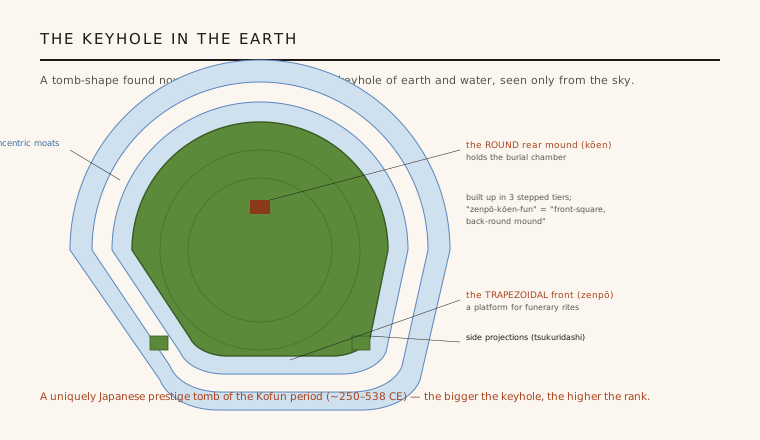
Daisen is the greatest example of a uniquely Japanese tomb-form called the zenpō-kōen-fun — literally "front-square, back-round mound," and known in English as the keyhole tomb. It joins a round rear mound, which holds the burial chamber, to a trapezoidal front platform, thought to have been a stage for funerary rites — and from above, the combined outline looks unmistakably like a keyhole. The whole thing was built up in three great stepped tiers and encircled by three concentric moats of water, and it is dense with forest today. This shape was the ultimate status symbol of Japan's Kofun period (roughly 250–538 CE), the age when the early Yamato state was coalescing, and elite power was expressed through tomb-building: the bigger and grander your keyhole, the higher your rank. There are on the order of a hundred and sixty thousand kofun scattered across Japan — but none is bigger than this one.
2. One of the largest tombs on Earth
The scale of Daisen is genuinely staggering — but in a way quite different from the pyramids we have seen.
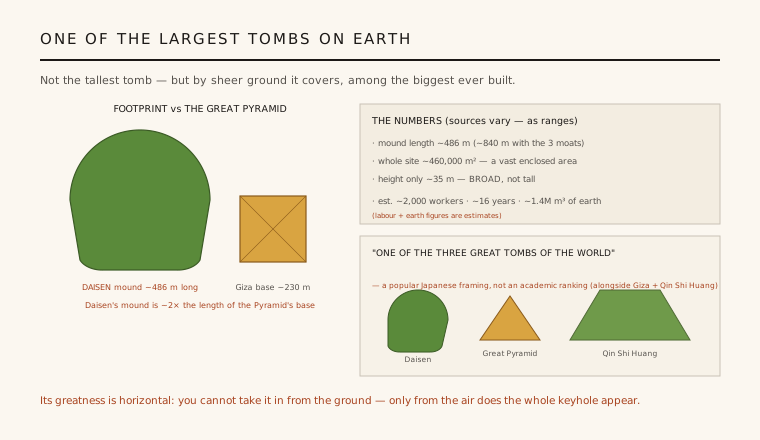
The mound itself is about 486 metres long — roughly 840 metres if you include the three moats — and the whole site covers some 460,000 square metres. And yet it stands only about thirty-five metres tall. That is the key to understanding Daisen: its greatness is horizontal. Where the Great Pyramid reaches for the sky, Daisen spreads across the land — its mound is nearly twice the length of the Great Pyramid's base. By footprint, by the sheer area it encloses, it is frequently called the largest tomb in the world, and Japan proudly promotes it as one of the "three great tombs of the world," alongside Giza and the mausoleum of Qin Shi Huang (a popular framing, it should be said, not an academic ranking). Building it is estimated to have taken around two thousand workers some sixteen years, moving roughly 1.4 million cubic metres of earth — all by hand, all to raise a shape that its own builders could never have seen whole, because there was no way, in the fifth century, to get above it. They built for the view of the gods.
3. Whose tomb is it?
Here is where Daisen becomes not just a wonder but a genuine mystery — because its famous name may well be wrong.
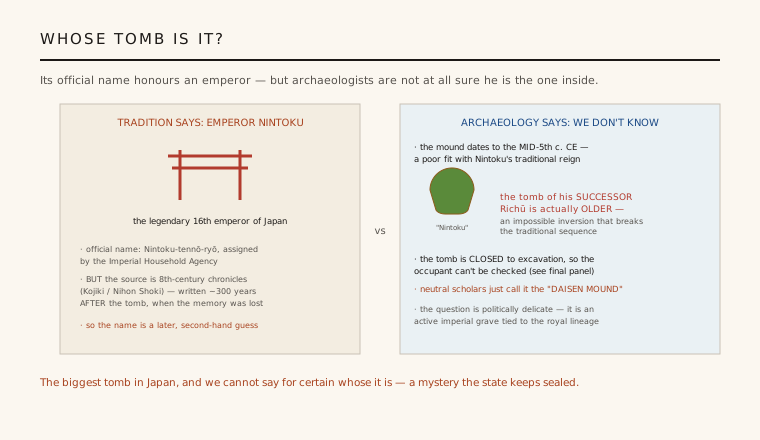
Officially, this is the Mausoleum of Emperor Nintoku, the legendary sixteenth emperor of Japan — a name assigned by the Imperial Household Agency and honoured on every map. But the attribution rests entirely on eighth-century chronicles (the Kojiki and Nihon Shoki), written some three hundred years after the tomb was built, at a time when the memory of who lay in which mound had already been lost — so the identification is really a later, second-hand guess. And modern archaeology quietly undermines it. The mound dates to the mid-fifth century, which fits Nintoku's traditional reign poorly; worse, the nearby tomb assigned to his successor Richū appears to be older than this one — an impossible inversion that breaks the tidy traditional sequence. The honest truth is that we do not know for certain whose tomb this is, and neutral scholars simply call it the "Daisen mound." It is a delicate matter, too, for this is an active imperial grave, bound up with the story of Japan's unbroken royal line. The largest tomb in the country, and we cannot say for sure who is inside it — because, as we will see, the state has chosen not to look.
4. The clay circle: haniwa
Daisen was not a bare hill of earth. It was ringed and studded with thousands of terracotta figures — an army of clay that, unlike China's, stood in the open air.
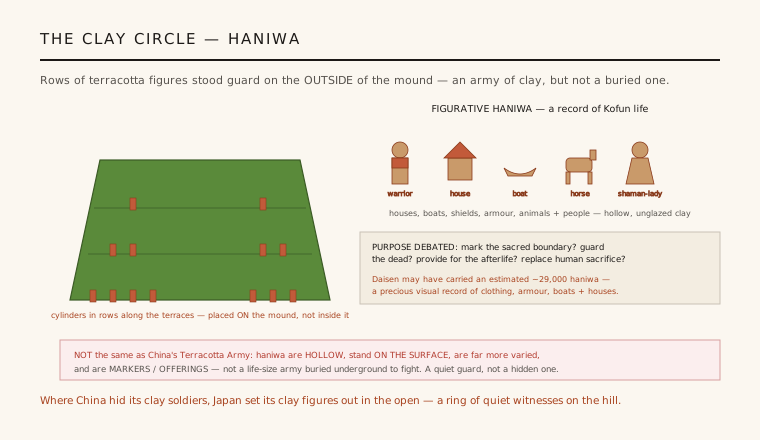
The tomb's tiers were lined with haniwa — hollow, unglazed terracotta objects, set in rows along the terraces and around the edges. Most were plain cylinders (the word haniwa means roughly "clay ring," for how they were set in circles), but among them stood figurative haniwa: little clay houses, boats, shields, horses, armoured warriors, and shaman-ladies. Daisen may once have carried an estimated twenty-nine thousand of them. Their exact purpose is debated — to mark the sacred boundary, to guard the dead, to provide company and possessions for the afterlife, perhaps (a later legend says) to replace the live human sacrifice of retainers. Whatever their meaning, they are a priceless record of Kofun-era life, showing us the clothes, armour, boats and houses of a world that left no other pictures. And they invite an irresistible comparison with the Terracotta Army of China — but the contrast is as telling as the likeness. China's soldiers were buried, hidden, life-size, an interred army. Japan's haniwa were hollow, set out on the surface in the open, and endlessly varied — not a secret guard but a ring of quiet witnesses on the hill. Two great cultures, the same instinct to people a tomb with clay, and two utterly different answers.
5. The forbidden tomb
And so to the most extraordinary fact of all — the thing that makes Daisen unique among every tomb in this series.
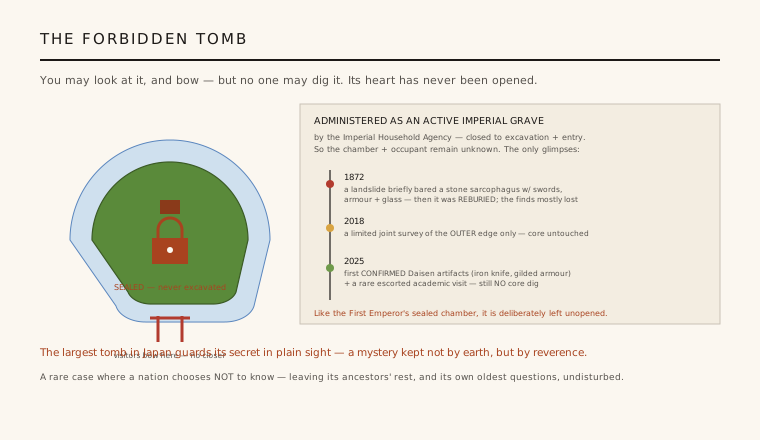
Daisen Kofun is administered by the Imperial Household Agency as an active imperial grave, and it is closed — closed to the public, and closed to archaeological excavation, out of reverence for the imperial ancestors. Visitors may walk to a gate at the front, and bow, and go no closer. As a result, the burial chamber has never been scientifically excavated, and its contents — and its true occupant — remain unknown. Almost everything we have has come through the narrowest of windows: in 1872, a landslide briefly exposed a stone sarcophagus with swords, armour and glass vessels, which were recorded and then reburied; in 2018, the Agency permitted a limited survey of the outer edge only; and in 2025, the first artifacts confidently linked to Daisen were confirmed and a rare escorted academic visit was allowed — but still no core excavation. It is, like the sealed chamber of the First Emperor of China, a tomb deliberately left unopened — but where China's is sealed by scale and danger, Japan's is sealed by reverence, a nation choosing not to disturb its ancestors even to answer its own oldest questions. In an age that digs up everything, there is something profound in that restraint: the largest tomb in Japan, guarding its secret in plain sight, kept not by earth or lock but by respect. Some mysteries, Daisen says, are better honoured than solved.
6. What a modern architect can learn from Daisen Kofun
- Form can be for a viewer who isn't there yet. The keyhole shape could not be seen whole by anyone alive when it was built; it was made for the gods, and, as it turns out, for us in the age of flight. Design can address a perspective beyond the immediate — the aerial, the future, the divine.
- Greatness can be horizontal. Daisen is not tall; it is vast. We tend to equate monumentality with height, but the command of a huge horizontal expanse — area, ground, enclosure — is its own kind of grandeur. Not everything great must reach upward.
- Shape can encode status and meaning. The size and form of a kofun literally mapped a person's rank. Geometry itself carried information. A building's form is never neutral; it always says something about who and what it is for.
- Markers on the surface, not just treasure within. The haniwa did their work in the open, ringing the mound in full view. What a building shows on the outside — its edges, its thresholds, its public face — communicates as powerfully as anything hidden inside.
- Restraint is a form of respect. Japan chooses not to excavate. There is deep wisdom in deciding that some places are for reverence rather than research, that not every question must be answered by disturbance. Knowing what not to do to a site is part of caring for it.
- A mystery can be a monument's greatest asset. Because Daisen is sealed, it keeps its power to fascinate — every generation wonders anew who lies within. Sometimes the unknown, respectfully preserved, is more moving than any excavated fact.
References & further reading
1. UNESCO World Heritage Centre — Mozu-Furuichi Kofun Group: Mounded Tombs of Ancient Japan (inscribed 2019). https://whc.unesco.org/en/list/1593/
2. Sakai City (official) — Nintoku-tennō-ryō Kofun (Daisen Kofun). https://www.city.sakai.lg.jp/foreign-language/english/visitors/topics/world_heritage_site/notable_tombs/nintoku-ryo.html
3. World History Encyclopedia — Kofun Period. https://www.worldhistory.org/Kofun_Period/
4. World History Encyclopedia — Haniwa. https://www.worldhistory.org/Haniwa/
5. Encyclopaedia Britannica — Haniwa. https://www.britannica.com/art/haniwa
6. Japan National Tourism Organization — Mozu-Furuichi Kofun. https://www.japan.travel/en/world-heritage/mozu-furuichi-kofun/
Last verified 2026-07-04. Figures follow UNESCO, Sakai City and standard archaeological sources and are given as widely cited approximations that vary by source (partly depending on whether the moats are included). Daisen Kofun (Sakai, Osaka), the largest kofun in Japan, dates to the mid-5th century CE; its mound is ~486 m long (~840 m with the three moats), the whole site ~460,000 m², and only ~35 m high — vast in footprint, modest in height. The attribution to Emperor Nintoku is TRADITIONAL (from 8th-century chronicles) and IHA-designated, but DISPUTED by archaeologists (the dating fits poorly, and the neighbouring "Richū" tomb appears older); the true occupant is unconfirmed, and neutral scholars call it the "Daisen mound." "Largest tomb by area/footprint" is defensible but best treated as a claim; "one of the three great tombs of the world" (with Giza and Qin Shi Huang) is a popular Japanese framing, not an academic ranking. Labour/earth estimates (~2,000 workers, ~16 years, ~1.4M m³) and the ~29,000 haniwa figure are estimates. Haniwa are hollow, unglazed terracotta set on/around the mound (not buried inside), differing fundamentally from China's buried Terracotta Army; their purpose is debated. The tomb is administered by the Imperial Household Agency as an active imperial grave and is closed to excavation and the public; knowledge comes from an 1872 landslide glimpse (reburied), a limited 2018 outer-edge survey, and 2025 confirmed artifacts/escorted visit — the core remains unexcavated. It is part of the Mozu-Furuichi Kofun Group, a UNESCO World Heritage Site (2019).
Export this guide
Related Guides — Deep-dive reading
Cahokia and Monks Mound: The Great City America Forgot
A thousand years ago, across the river from where St Louis now stands, Native Americans built a city of perhaps twenty thousand people — larger than London at the time — with a hundred and twenty earthen mounds, a plaza the size of dozens of football fields, and a solar calendar of cedar posts. At its heart rose Monks Mound, the largest earthwork in the Americas, with a footprint to rival the Great Pyramid. Then, before Europeans ever arrived, it vanished — and almost no one remembers it.
Architectural WondersThe Pyramid of the Sun: A Mountain Raised Over a Cave by a People With No Name
In the Valley of Mexico, a civilisation we cannot name built one of the largest pyramids on Earth — a man-made mountain of a million cubic metres — and set it precisely over a sacred cave they believed was the womb of the world. They left no writing we can read; even the words 'Pyramid of the Sun' were given, a thousand years later, by the Aztecs, who found the city in ruins and called it the birthplace of the gods.
Architectural WondersThe Tomb of the First Emperor: An Empire Buried to Rule Forever
How Qin Shi Huang, the first emperor of a united China, buried a whole functioning empire beneath Mount Li — an army of eight thousand life-size clay soldiers guarding a sealed palace where, an ancient historian says, the rivers of China flow in mercury under a ceiling of stars — a chamber so complete, and so dangerous, that we have never dared open it.
Architectural WondersRelated Tools — Try Free
AI BOQ Generator
AI generates detailed Bill of Quantities with city-specific rates and labour breakdown.
ArchitectAIBefore & After Studio
Generate AI before-and-after renders to preview how your redesign could look.
DesignAIDesign Brief Generator
Answer 10 questions and generate a professional interior design brief PDF for your designer or architect.
Brief Generator