
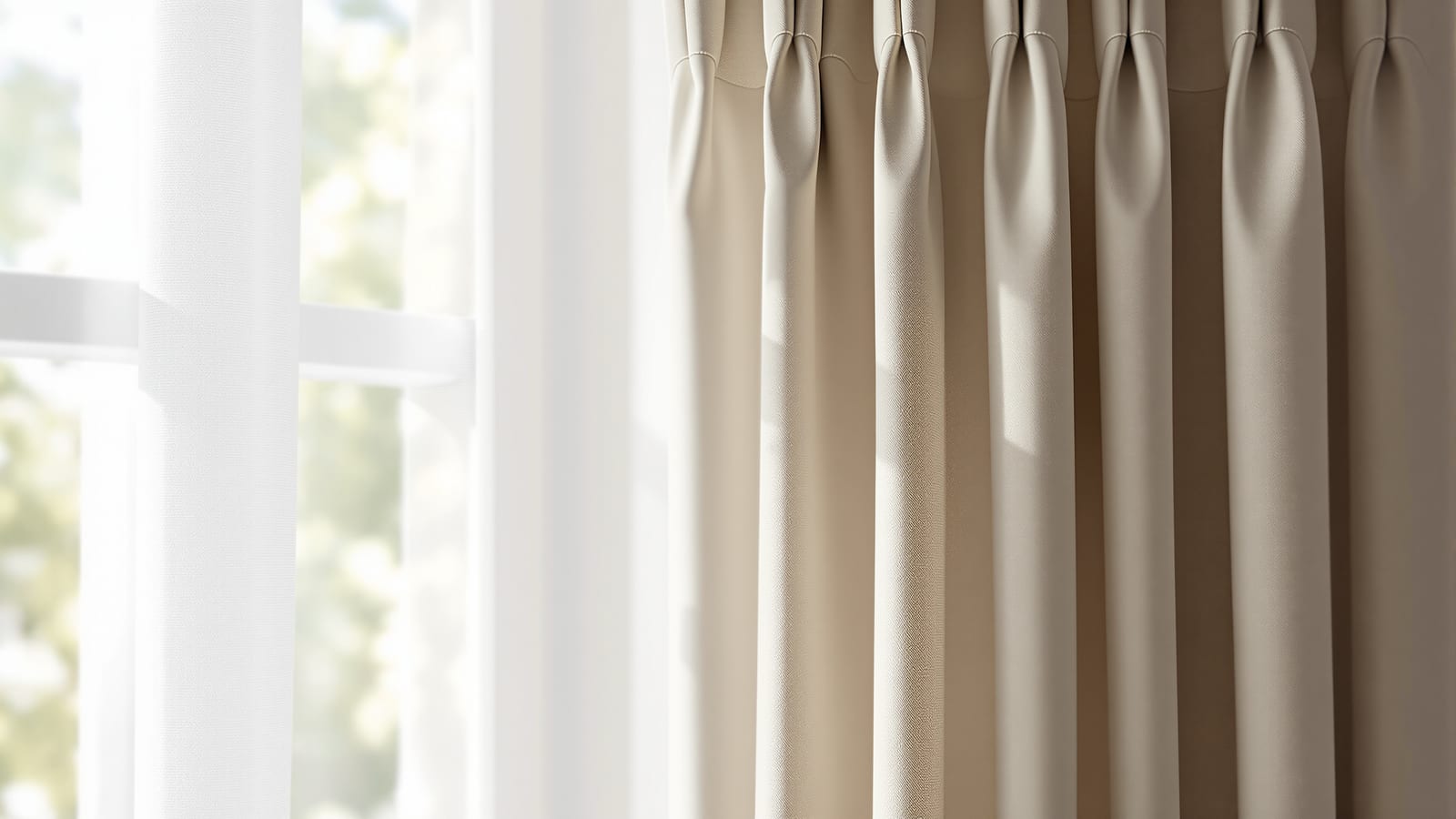
Tab-Top & Rod-Pocket Curtains: The Casual Headings (India 2026)
The two simplest no-pleat headings — fabric loops and a sewn channel. Cheap, relaxed and easy to make, but they drag on the rod and do not draw smoothly. Where they shine, and where they quietly let you down.
Most curtain headings are pleated — gathered, stitched and tailored at the top. Tab-top and rod-pocket are the two that are not. They are the simplest, cheapest and most casual ways to hang a curtain: one uses fabric loops that sit over the rod, the other threads the rod through a sewn channel in the cloth. No tape, no pleating, often no professional stitching at all. That simplicity is exactly their charm and exactly their limitation. They look relaxed and informal, they cost very little, and they will gently frustrate you the first time you try to actually pull them shut.
Tab-top and rod-pocket are dress curtains, not working curtains. They are made to frame a window beautifully and stay roughly where they are — not to be swept open and closed twice a day.
This guide is the honest verdict on both. If you want the full menu of pleats and headings first, read the curtain pleats and headings reference. For the whole picture — opacity, fabrics, tracks and motors — start with the complete curtain guide for Indian homes.
What "tab-top" actually means
A tab-top curtain hangs from a row of fabric loops — the "tabs" — sewn along the top edge. The rod slides through the loops, so the curtain hangs a little below the rod with the rod fully visible. Tabs can be plain cloth, contrast fabric, or finished with a button or tie. The look is soft, breezy and unstructured, with gentle open folds between the tabs rather than crisp pleats.
Tab-tops read as casual and cottage-like — they suit kids' rooms, study nooks, balconies, farmhouse and boho interiors, and light cotton or linen fabrics. Because the rod shows, a nice wooden or wrought-iron rod becomes part of the design. They are also one of the easiest curtains to make or order locally, which keeps them cheap.
What "rod-pocket" actually means
A rod-pocket curtain (also called pole-pocket or pocket-top) has a sewn channel stitched across the top. You thread the rod straight through this channel, so the cloth gathers tightly around the rod and the rod itself disappears behind the fabric. Above the channel you can stitch a small frill — a header flounce — that stands up above the rod for a soft, dressmaker finish.
Rod-pocket is the most traditional, homely heading of all. It gives a soft, gathered, slightly old-fashioned look that suits cottages, guest rooms, sheers and lightweight cafe curtains. Because the rod is hidden, you do not need a decorative rod — a plain one will do. Like tab-top, it is simple to sew and very economical.
Tab-top vs rod-pocket, side by side
Both are casual and cheap, but they differ in look, the rod they want, and how badly they resist being drawn:
| Feature | Tab-top | Rod-pocket |
|---|---|---|
| How it hangs | Fabric loops over the rod | Rod threaded through a sewn channel |
| Rod visible? | Yes — rod is a design feature | No — rod hidden behind cloth |
| Look | Relaxed, breezy, slightly modern-casual | Soft, gathered, traditional, homely |
| Drawing it open/shut | Drags and bunches; tabs catch on the rod | Very stiff; cloth grips the rod, barely slides |
| Best as | Dress curtain or rarely-moved window | Static dress curtain, sheers, cafe curtains |
| Fullness needed | 1.5x-2x | 1.5x-2x (channel eats a little drop) |
| Best fabrics | Light cotton, linen, casual prints | Light cotton, voile, sheers, lightweight prints |
| Skill to make | Easy | Easiest |
| Relative cost | Low | Low |
The single most important row in that table is "drawing it open/shut" — and it is the reason both headings come with a warning.
The honest drawbacks — read this before you buy
These are friendly, good-looking headings, but they are genuinely poor at the one thing many people expect a curtain to do: open and close smoothly, several times a day. Be clear-eyed about the trade-offs:
- They drag and they do not glide. Tab loops catch and bunch on the rod; rod-pocket cloth grips the rod so tightly it barely moves. Pulling either across the window is a tug-and-shove job, not a smooth sweep. Do it daily and the top edge wears.
- They are not for tracks or motors. Both need a visible rod by definition. You cannot run them on a recessed track, a ripple-fold system or a motor. If you ever want tracks or motorisation, these headings rule it out.
- They do not stack tightly. When pushed open they bunch into a fat, uneven cluster that still covers part of the glass, so you lose daylight and a clean look.
- Light gaps. Between tabs (tab-top) and through the gathered channel (rod-pocket), light leaks at the very top. Neither makes a good blackout curtain for a bedroom.
- Heavy fabrics misbehave. Both suit light cloth only. A heavy lined drape on tabs sags between loops; on a rod-pocket it is too stiff to gather nicely.
- A subtler one — drop is harder to predict for rod-pocket, because the channel and any flounce eat into the finished length. Measure with that allowance, or use the curtain fullness calculator to get the panel width right before you commit fabric.
Where they genuinely shine
None of that makes them bad — it makes them specialist. They are excellent when the curtain is meant to stay put and simply look good:
- Dress curtains / static panels — a fixed panel either side of a window for softness and colour, never actually drawn. This is their natural home.
- Sheers and voiles (rod-pocket especially) — light, airy day curtains that hang as a soft veil and rarely move.
- Kids' rooms and casual bedrooms — cheerful prints, low cost, easy to replace as a child grows.
- Cafe curtains — short rod-pocket panels on the lower half of a kitchen or bathroom window for privacy with light above.
- Cottage, farmhouse, boho and rental homes — where the relaxed look is the point and you do not want to drill for a track.
- Balconies and study nooks — small windows you dress once and leave.
A common designer move: hang a tab-top or rod-pocket decorative panel as the fixed outer layer, and put a smoother, working layer (eyelet on a rod, or a track) behind it for the curtain you actually draw. You get the casual look and a functional close.
What they cost in India
These are the cheapest headings to buy and to make, which is a big part of their appeal:
- Ready-made tab-top or rod-pocket panels start very low — often the entry price in any curtain shop or online store, especially in light cotton and printed poly-cotton.
- Custom-stitched panels are inexpensive too, because there is no pleating tape and the labour is minimal — frequently the lowest stitching charge a tailor will quote.
- Fabric stays modest because fullness is low (1.5x-2x), so you buy less cloth than for a pinch-pleat at 2x-2.5x.
- Hardware is cheap for rod-pocket (any plain rod works) and a small premium for tab-top only if you choose a handsome decorative rod, since it will be on show.
Price your own window properly with the curtain cost calculator — feed in your width, drop and a 1.5x-2x fullness, and you will see just how budget-friendly these headings are versus a tailored pleat.
How to choose, in three questions
1. Will you draw this curtain often? If yes, do not choose tab-top or rod-pocket — pick eyelet on a rod or a pleat on a track instead. If it is a dress curtain that stays put, read on.
2. Do you want the rod seen or hidden? Seen, as a feature — tab-top. Hidden, soft and traditional — rod-pocket.
3. Is the fabric light? Both demand lightweight cloth. Heavy lined drapes belong on a pleated heading and a track.
Get those three right and these become the easiest, cheapest, most cheerful curtains in the house — doing exactly the one job they are good at, and none of the jobs they are not.
Choosing your heading? See every option side by side in the complete curtain guide for Indian homes and the curtain pleats and headings reference, then size your fabric and price the window in seconds with the curtain cost calculator and the curtain fullness calculator. Browse the full menu in types of curtains for India.
Export this guide
Related Guides — Deep-dive reading
Curtain Pleats & Headings: Eyelet, Pencil, Pinch, Goblet, Wave Explained (India, 2026)
The heading is the pleated top of a curtain — and it quietly decides the look, the hardware and the bill. A plain-language reference to every style and how to pick the right one.
Window TreatmentsPencil Pleat Curtains: The Versatile All-Rounder (India 2026)
Gathered three-cord tape, adjustable fullness, works on rod or track — the forgiving, economical heading that quietly dresses most Indian windows. Here is exactly when it is the right call.
Window TreatmentsThe Complete Home Curtain & Window Treatment Guide for Indian Homes (2026)
Types, fabrics, pleats, tracks, motorisation and real Indian costs — the one guide that turns a confusing purchase into a confident decision.
Window TreatmentsRelated Tools — Try Free
Curtain Cost Calculator
Get the fabric metres you need plus the total curtain cost by window size, fabric, pleat, lining and hardware.
Curtain CalculatorCurtain Fullness Calculator
Work out the fabric width and number of widths you need for a chosen heading and fullness.
Curtain CalculatorWindow Treatment Selector
Curtains, blinds or a layered system? Answer five questions about your room and get a specific recommendation.
Selector