
Curtain Rods vs Tracks: Which to Choose (India 2026)
The hardware decision that quietly sets the look, the fold quality and whether you can ever motorise — decorative rods versus slim tracks, compared honestly for Indian homes.
Everyone agonises over the fabric and the colour, and almost nobody thinks about the thing that actually holds the curtain up. Yet the rod or track you choose quietly decides more than the cloth ever will: how crisply the curtain folds, how heavy a curtain you can hang, whether you can bend it around a bay, which pleat styles are even possible, and — the one that catches people out years later — whether you can ever motorise that window. The hardware is invisible in photos and decisive in real life. This guide settles the rods-versus-tracks question for an Indian home.
Choose the cloth for how the room feels; choose the hardware for how the room works. A beautiful curtain on the wrong rail hangs badly, snags daily and can never be automated — and that is a fix you usually can't make without re-drilling the wall.
If you want the whole picture first — opacity, layers, fabrics, motors, room-by-room — start with the complete curtain guide for Indian homes. This page zooms into the one decision that sets the mechanics.
The two families, in one breath
There are really just two kinds of hardware, and they behave very differently:
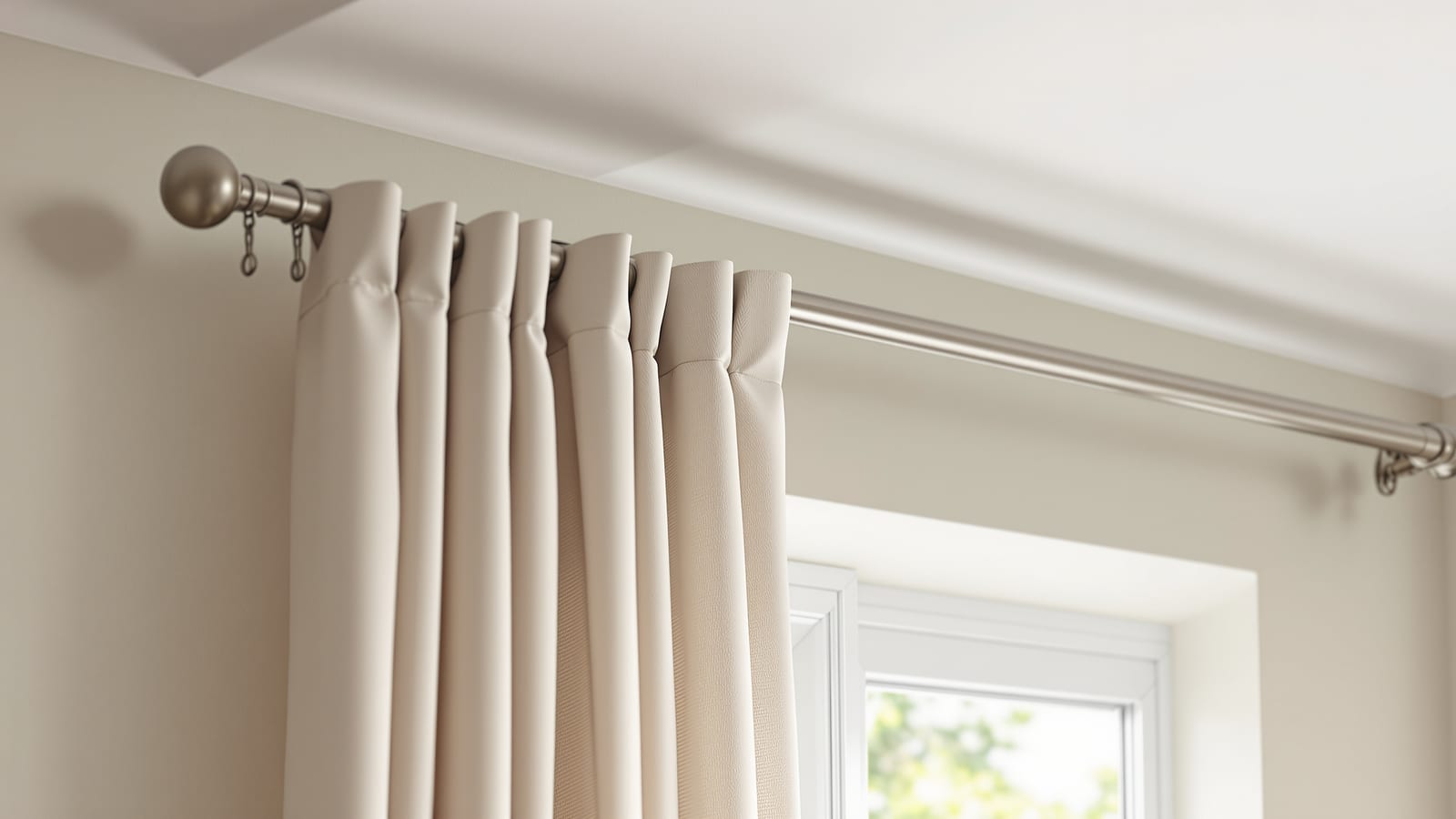
- Decorative rods — a round (or square) pole on visible brackets, with finials (the decorative end caps) on each side. The pole is part of the look. Curtains hang from rings, eyelets or hooks that ride on the pole.
- Tracks — a slim, low-profile channel, usually meant to be barely seen or hidden entirely. Gliders run inside the channel and carry the curtain. Tracks can be straight, curved, wall- or ceiling-mounted, and they are the only family that motorises.
A rod says "I am a feature." A track says "look at the curtain, not the rail." That instinct — feature versus invisible — already points most people to their answer.
Rods vs tracks, compared honestly
| Factor | Decorative rod | Slim track |
|---|---|---|
| Look | A visible feature (finials, finish) | Hidden or barely seen |
| Fold quality | Soft, slightly irregular | Crisp, uniform, repeating |
| Weight capacity | Light to medium | Medium to heavy |
| Bay / curved windows | Hard (mitred joints look clumsy) | Easy (bends smoothly) |
| Corner / L-shape returns | Awkward | Continuous round the corner |
| Motorisation | No (essentially) | Yes — the only option |
| Which headings | Eyelet, tab, rod pocket, pinch, pencil | Pinch, pencil, wave, plus all motors |
| Wave / ripple fold | Not possible | Required hardware |
| Ceiling mount | Possible but bulky | Native, looks built-in |
| Ease of DIY fit | Easier | Fiddlier (alignment matters) |
| Relative cost | Often cheaper at entry | Cheap PVC to premium aluminium |
The honest summary: rods win on character and quick fitting; tracks win on fold quality, heavy curtains, awkward windows and any future automation. Most Indian homes end up using both — rods on the rooms they want to feel decorative, tracks on the windows that need to work hard.
Fold quality: the difference you actually see
This is the gap people notice without knowing why one window looks more "designed" than another. On a track, gliders sit at fixed, even intervals, so the fabric folds into a uniform, repeating rhythm every single time you draw it. On a rod, rings ride loose along the pole, so the folds are softer, deeper in places and a little irregular — relaxed and lovely for a casual room, less precise for a formal one.
Crucially, the cleanest contemporary look of all — the continuous, even wave (ripple) fold — is only possible on a track, because the special wave tape is tied to glider cords spaced inside the channel. You cannot make a true wave on a rod. If that minimal S-curve is the look you want, the hardware decision is already made for you. See curtain pleats and headings explained for how each heading hangs.
Weight, headings and what each hardware demands
Headings and hardware are tied together, so let the heading you love narrow the hardware:
- Eyelet, tab top, rod pocket — rod only. The rings or loops or channel slide directly on the pole; there is no track equivalent.
- Pencil pleat and pinch pleat — either. They hang via rings/hooks on a rod, or via gliders on a track. On a track they fold more crisply and carry more weight.
- Wave / ripple fold — track only.
- Heavy curtains — multi-layer blackout, lined drapes and tall floor-length panels are heavy. A slim aluminium track with good brackets carries that weight without sagging far better than a thin decorative rod, which can bow in the middle over a wide span. For wide windows, a track (or a rod with a centre support bracket) is the safer call.
In short: if you have settled on eyelet, you are on a rod. If you have settled on wave or you want to motorise, you are on a track. Everything in between is a free choice — pick on look, weight and the window's shape.
Bays, corners and the windows rods can't handle
This is where tracks pull decisively ahead. A bay window (the angled three-pane projection common in Indian apartments and bungalows) and an L-shaped or corner window need the curtain to turn a corner continuously. A track simply bends — flexible PVC tracks curve by hand, aluminium tracks come pre-bent to your angle — so the curtain glides smoothly round the whole bay as one run. Rods can only manage a bay with clumsy mitred joints and corner connectors, and the rings catch at every join. For any bay, curve or return, plan a bent track and forget the rod.
Motorisation: the decision you make years before you make it
Here is the trap that catches the most people. You buy lovely decorative rods today, and three years later you want the living-room curtains to open at dawn and close against the afternoon west sun on a voice command. You can't — motors run on tracks, not rods. Retrofitting means new hardware and usually re-drilling.
If there is any chance you will motorise a window — the living room and main bedroom are the usual candidates — put a track there now, even if you start with a manual glider cord. The track is motor-ready; you add the motor whenever you like. See the motorised curtain tracks guide, and the full hardware reference in the curtain hardware guide.
Wall mount or ceiling mount?
This is a second axis, separate from rod-versus-track, and it changes the whole proportion of the room:
- Wall-mounted (above the window frame) — the default, easy to fit, works for both rods and tracks. Mount it high — 10 to 15 cm above the frame, or near the ceiling for tall drama.
- Ceiling-mounted track — the channel is fixed to the ceiling (or recessed into a slot or false-ceiling pocket), so the curtain appears to fall from the sky. It makes ceilings read taller and is the high-end, built-in look. Tracks do this natively; a ceiling-mounted rod needs bulky drop brackets and rarely looks as clean.
If a false ceiling or pelmet is in your plans, design the curtain pocket into it now — a hidden recessed track conceals the hardware completely. Retrofitting a hidden track after the false ceiling is built is the single most common avoidable regret in this whole category. The dedicated ceiling-mounted curtains guide covers the recessed-pocket detail in full.
Materials and finishes
Rods come in:
- Wrought iron / mild steel — sturdy, classic, takes powder-coat finishes; the Indian workhorse.
- Brass / antique brass — warm, premium, traditional; ages beautifully.
- Stainless steel / chrome / nickel — modern, clean, rust-resistant (good near coastal humidity).
- Wood — warm and characterful, but heavier and pricier; best for period rooms.
Finials (the end caps) are where rods get their personality — finial, ball, crook, crystal, minimalist disc. Match the metal to your other hardware (door handles, light fittings) for a pulled-together room.
Tracks are typically:
- PVC / plastic — cheapest, flexible (good for curves), fine for light curtains; can sag or yellow over years.
- Aluminium — the quality default: strong, light, smooth-gliding, carries heavy curtains, available in white or anodised finishes and pre-bent for bays. Worth the upgrade on any window you use daily.
For coastal and high-humidity Indian homes, prefer stainless or quality aluminium and powder-coated finishes; raw mild steel can rust at the brackets.
Sizing and a few fitting rules
The rules are the same for both families, and getting them right matters more than the brand:
- Mount it wider than the window — extend the rod or track 15 to 20 cm past the glass on each side so the open curtain stacks off the pane and lets full daylight in. This one rule makes any window look bigger.
- Mount it higher than the frame — 10 to 15 cm above the frame at least; near the ceiling for height and drama.
- Support wide spans — a single rod over ~2.5 m will bow; add a centre bracket (or use a track) for wide windows.
- Allow stack-back — leave room beyond the glass for the gathered curtain to sit when fully open.
- Anchor into something solid — into the lintel/RCC or with proper wall plugs; heavy lined curtains pull hard on the brackets.
The fabric arithmetic that follows from your width and drop — metres, fullness, price — is done for you by the Curtain Cost Calculator; feed it your finished rod/track width and it returns fabric metres and a per-window cost.
What it costs in India
Treat these as honest ranges, not quotes — finish, span and brand swing them a lot:
- Decorative rods — basic iron rod sets start low (a few hundred rupees a window); brass, designer finials and wide spans climb into the low thousands.
- PVC tracks — the cheapest hardware of all per metre; fine for light curtains and curves.
- Aluminium tracks — a clear step up in price and quality; worth it on daily-use and heavy windows.
- Ceiling-recessed / bent tracks — add fabrication and fitting labour on top.
- Motor-ready tracks — cost more upfront, but save a full re-fit later.
The bigger cost lever is rarely the hardware — it is fullness and lining of the fabric, which the cost calculator and the complete curtain guide break down. Spend on a good track where it earns its keep (daily use, heavy curtains, future motors) and a simple rod elsewhere.
The honest caveats
- Cheap PVC tracks sag and yellow. On any window you'll use for years, the aluminium upgrade pays for itself.
- A rod cannot become a track later without re-drilling. Decide motorisation intent before you buy.
- Wide rods bow. Above ~2.5 m, add a centre support or switch to a track.
- Numbers here are indicative. Measure your own windows and price your own hardware locally before ordering.
How to choose, in four moves
1. Is it a bay, curve, corner or might you motorise it? If yes — track.
2. Do you love eyelet, or want the rod to be a visible feature? If yes — rod.
3. Is the curtain heavy or the span wide? Lean track (or a rod with centre support).
4. Everything else — a free choice; pick on look, then mount it wide and high.
Do those four in order and the hardware question — the one nobody thinks about — sorts itself out before you ever pick the cloth.
Plan your windows with Studio Matrx. Size the fabric and price each window in the Curtain Cost Calculator, get a tailored recommendation from the Window Treatment Selector, and read the complete curtain guide for Indian homes for the full system — opacity, layers, headings, motors and room-by-room. The curtain hardware, motorised tracks and ceiling-mounted curtains guides go deeper across this Window Treatments cluster.
Export this guide
Related Guides — Deep-dive reading
Ceiling-Mounted & Hidden Curtain Tracks: The Floor-to-Ceiling Look (India 2026)
How ceiling-fixed and recessed curtain tracks make a room read taller, why you must design the pocket before the false ceiling, the wall-vs-ceiling trade-offs, depths, costs and the one retrofit regret to avoid.
Window TreatmentsThe Complete Home Curtain & Window Treatment Guide for Indian Homes (2026)
Types, fabrics, pleats, tracks, motorisation and real Indian costs — the one guide that turns a confusing purchase into a confident decision.
Window TreatmentsPencil Pleat Curtains: The Versatile All-Rounder (India 2026)
Gathered three-cord tape, adjustable fullness, works on rod or track — the forgiving, economical heading that quietly dresses most Indian windows. Here is exactly when it is the right call.
Window TreatmentsRelated Tools — Try Free
Curtain Cost Calculator
Get the fabric metres you need plus the total curtain cost by window size, fabric, pleat, lining and hardware.
Curtain CalculatorWindow Treatment Selector
Curtains, blinds or a layered system? Answer five questions about your room and get a specific recommendation.
SelectorFalse Ceiling Cost Estimator
Live ₹/sqft across 8 ceiling types — POP, gypsum, designer, metal, PVC, wooden — with cove and spot lighting for 20 Indian cities.
Cost Calculator