
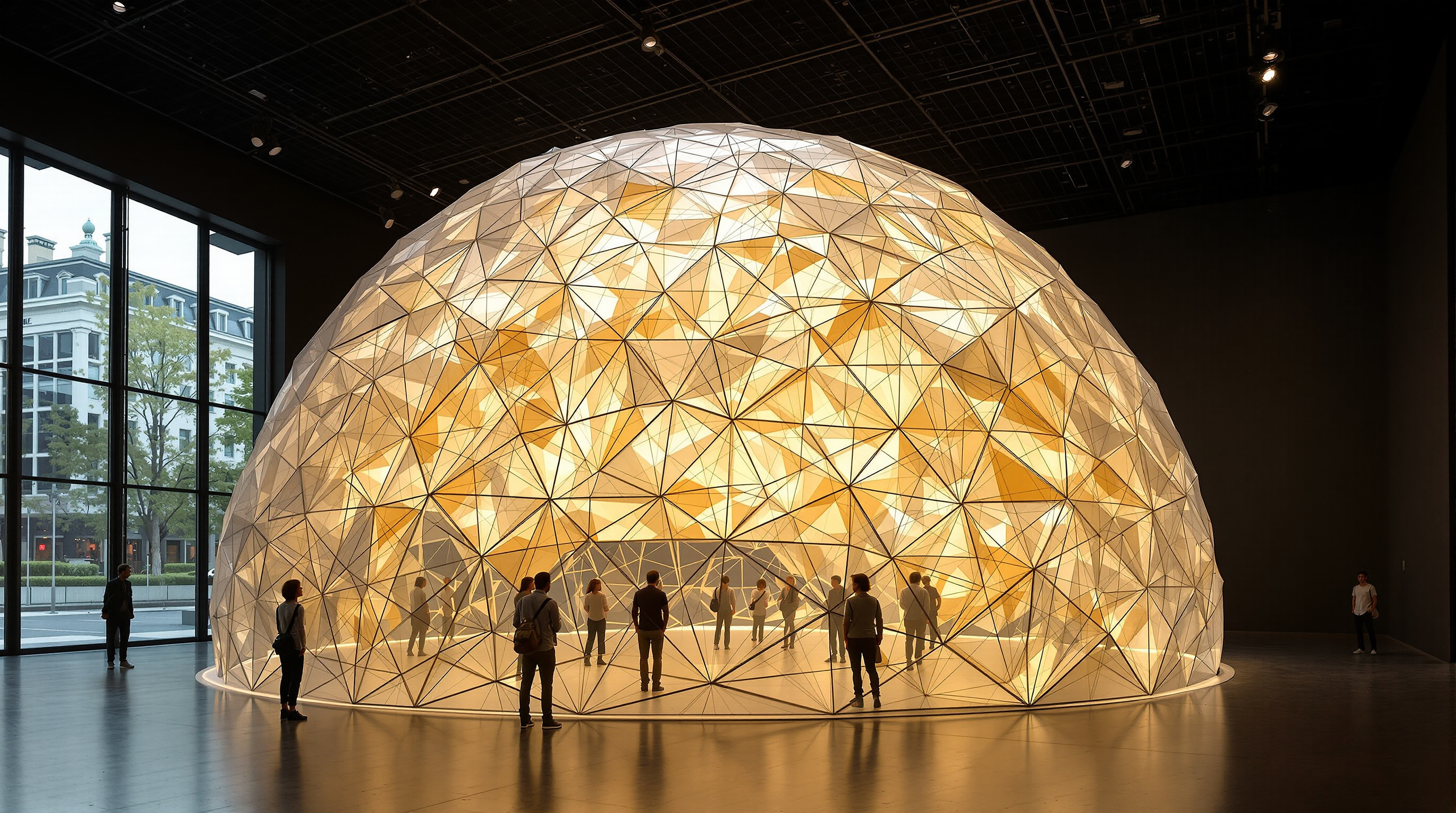
Silk Pavilion: How Neri Oxman Made 6,500 Silkworms Finish the Building
MIT's Mediated Matter group let a CNC machine lay a silk-thread scaffold and then handed the job to a swarm of live silkworms — a small dome in Cambridge that proposes a genuinely new idea: architecture co-fabricated by machines and organisms, printed with material and behaviour instead of ink.
Most of the buildings in this canon were finished by people. The Silk Pavilion was finished by insects. In the spring of 2013, in a gallery at the MIT Media Lab, a robotic arm laid down a scaffold of silk thread across twenty-six flat panels; then researchers released roughly 6,500 live silkworms onto the frame and let them spin. Over a few days the worms crawled, sensed the light and the geometry around them, and deposited their own silk exactly where the machine-laid structure was thinnest — closing the gaps, skinning the dome, and completing a piece of architecture that no drawing had fully specified in advance. It is one of the smallest structures we cover, a hemisphere only a few metres across, and one of the most quietly radical.
The Silk Pavilion was designed and built by the Mediated Matter research group at the MIT Media Lab, directed by the architect and designer Neri Oxman, in collaboration with Professor Fiorenzo Omenetto at Tufts University and Dr James Weaver at Harvard's Wyss Institute. It belongs in any honest account of where architecture is going because it asks a question the discipline has barely begun to answer: what if we did not manufacture buildings at all, but grew them — or, more precisely, co-fabricated them, with machines and living organisms working the same material at the same site?
The Silk Pavilion explores the relationship between digital and biological fabrication on product and architectural scales — a scaffold laid by a machine, a skin completed by a swarm.
The question it poses
Kushner's book keeps returning to a single provocation: the tools change, and when the tools change, the buildings change. For a century the dominant tool has been the machine that repeats — the press, the mould, the printer that lays identical layers. Additive manufacturing (3D printing) inherited that logic: it builds by depositing material in flat horizontal slices, one on top of the next, which is why printing anything at architectural scale is slow, wasteful in support material, and stubbornly earthbound.
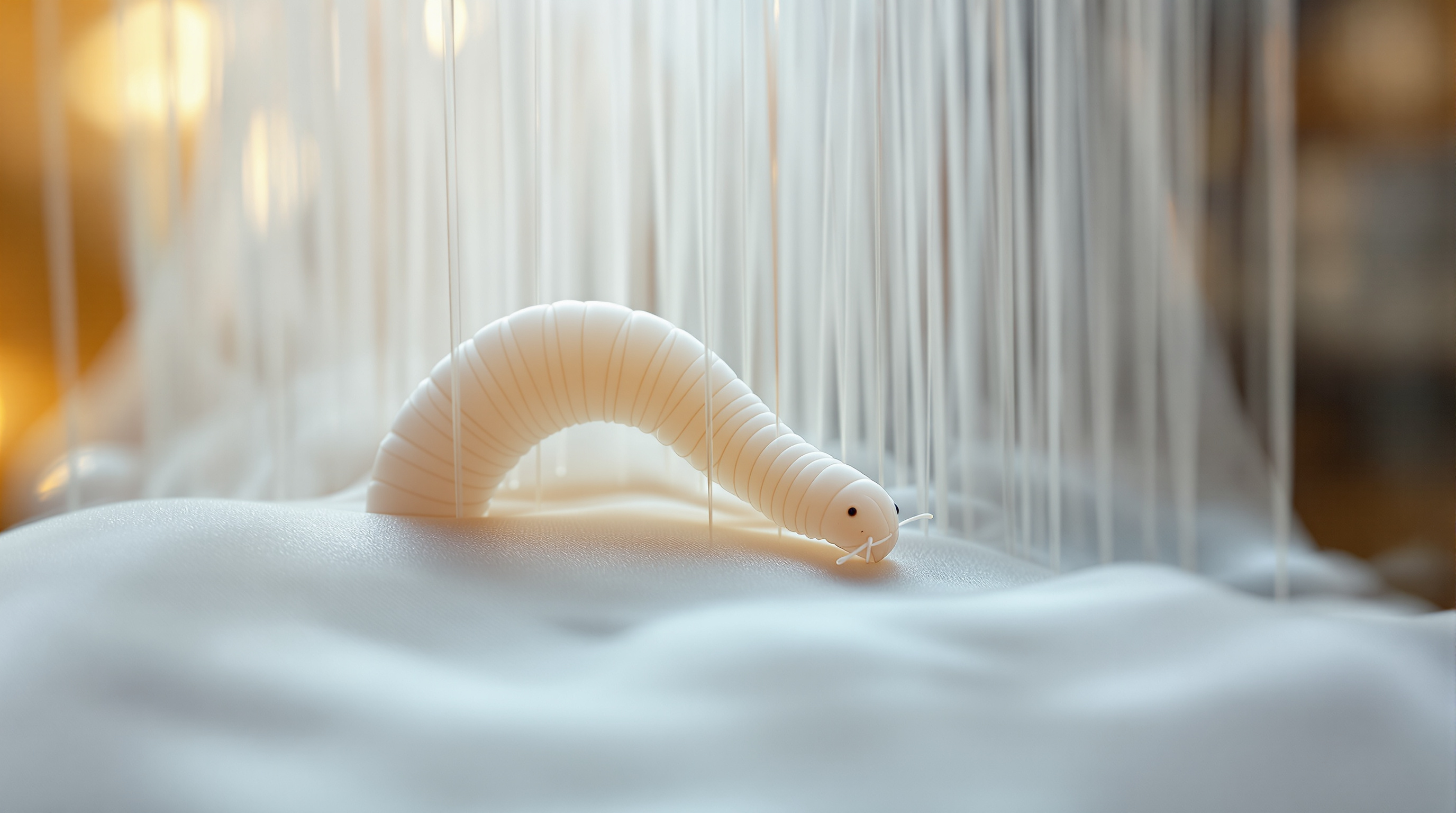
Oxman's central move is to reject the flat layer entirely and look instead at how nature already solves the problem. A silkworm does not print in slices. It builds its cocoon by extruding a single continuous filament — a thread reported to run close to a kilometre in length from one animal — moving its head in a figure-of-eight to lay that fibre in three dimensions, varying density and structure as it goes, using no scaffold and no supports at all. The cocoon is a non-woven, variable-property shell produced by pure behaviour. Mediated Matter's insight was that this is not a metaphor for fabrication; it is a fabrication method waiting to be borrowed.
How it was actually made
The team studied the worm first. In the basic research behind the project, they attached tiny magnets to the heads of individual silkworms to track how the animal moves as it spins, and they altered the surfaces they were placed on to learn how geometry shapes where silk gets deposited. Two findings drove the design: silkworms will spin a flat patch rather than a full cocoon if placed on a surface that is flat and open enough, and they migrate toward darker, denser regions, avoiding brightly lit gaps.
Those two behaviours became design instructions. The pavilion's primary structure was a CNC-laid scaffold of 26 polygonal panels, each strung with silk thread by a computer-controlled machine following an algorithm inspired by the worm itself — a single continuous thread distributed across each patch at varying densities. The scaffold was deliberately left incomplete: dense where structure was needed, sparse and open elsewhere. Then the swarm was positioned at the lower rim, and the worms did the rest, reading the light and geometry and reinforcing the sparse regions with flat non-woven silk exactly where the machine had left the surface thin. The environment was tuned — light and heat gradients steered the migration — so that the biology finished what the digital started.
The result is a variable-property surface produced without a single mould, without support material, and without the flat-layer logic of conventional 3D printing. The machine supplied global structure; the organism supplied local skin and finish, tuned in real time to its own environment. Combined, the swarm laid down a continuous silk surface whose total filament, the team noted, would stretch a distance often likened to the Silk Road itself.
Where it sits: material ecology and the fabrication future
The Silk Pavilion is the built emblem of what Oxman calls material ecology — a way of designing that treats material behaviour, structural form, and environmental context as one continuous system rather than separate stages handed between specialists. It sits squarely in this canon's Fast-Forward theme, the chapter about new materials, digital fabrication and the race to decarbonise construction, and it makes an argument few of its neighbours make: that the most advanced fabrication tool available may be biological.
To see why that matters, it helps to line up the three logics side by side.
| Approach | How it builds | Support / waste | Property control |
|---|---|---|---|
| Conventional casting / moulding | Pour into a fixed mould | High; single fixed shape per mould | Uniform, set at the mould |
| Layered 3D printing | Deposit identical flat slices | Support scaffolds, print waste | Graded slice-by-slice, machine-limited |
| Silk Pavilion (co-fabrication) | Machine scaffold + organism skin | Minimal; no mould, no supports | Continuously variable, behaviour-tuned |
Read that way, the pavilion is not a gimmick about cute worms. It is a proof of concept for water-based, biologically-driven fabrication at architectural scale — a deliberate counter-argument to the fossil-fuel-intensive, high-heat, high-waste processes that dominate construction. The silkworm builds at room temperature, out of a renewable protein, with no waste stream, and it embeds structural intelligence in the material as it goes. That is the future the pavilion is pointing at.
The honest third position
Studio Matrx's editorial habit is to house a third position, and the Silk Pavilion needs one. First, this is a research pavilion, not a building — a small dome, made once, indoors, under controlled light and humidity, in 2013. It does not weatherproof anything, span anything load-bearing, or scale straightforwardly to human shelter. Treating it as literally the future of construction overstates it; treating it as a demonstration of a new method gets it right.
Second, there is a genuine ethical wrinkle that press coverage often smooths over. Commercial silk usually kills the pupae in their cocoons. Mediated Matter's stated intent was that the silkworms here would complete their life cycle and emerge as moths — a deliberately non-lethal, "kinder" silk. That framing has been contested and complicated in later discussions of the work and of Oxman's practice generally, so the responsible thing is to report the intent, note that outcomes and claims around it have been questioned, and avoid pretending the pavilion resolves the ethics of using living animals as fabricators. It raises the question more than it answers it.
Third, attribution deserves care. This is authored work by a team — Markus Kayser, Jared Laucks, Carlos David Gonzalez Uribe, Jorge Duro-Royo and Neri Oxman as director, with the Tufts and Wyss collaborators — even though it circulates in the press under Oxman's name alone. The idea is collective; the credit should be too.
Why it belongs in the canon
Strip away the theory and the controversy and one fact remains: before the Silk Pavilion, almost no one had built a piece of architecture in which a digital machine and a living swarm shared authorship of the same surface, each doing what it does best — the machine supplying reach and geometry, the organism supplying finish, adaptation and material intelligence the machine could not encode. It reframed 3D printing away from the flat, additive slice and toward continuous, fibre-based, behaviour-driven deposition. And it put a question on the table that the rest of the century will have to answer: not how do we manufacture buildings faster, but what if we do not manufacture them at all — and grow them instead.
The Silk Pavilion's answer is deliberately incomplete, in exactly the way its scaffold was. It leaves the gaps open on purpose, and trusts something alive to close them.
References
- Mediated Matter Group, MIT Media Lab, "Silk Pavilion" — official project overview (research and design by the Mediated Matter Group, dir. Neri Oxman; collaborators Prof. Fiorenzo Omenetto, Tufts, and Dr James Weaver, Wyss Institute, Harvard; 26 CNC-laid polygonal panels, ~6,500 silkworms, 2013). media.mit.edu (primary source)
- Oxman, N., Laucks, J., Kayser, M., Duro-Royo, J. & Gonzales-Uribe, C. (2014). "Silk Pavilion: A Case Study in Fibre-based Digital Fabrication." In F. Gramazio, M. Kohler & S. Langenberg (eds.), FABRICATE 2014: Negotiating Design & Making, pp. 248–255. gta Verlag / UCL Press. Available via JSTOR. (peer-reviewed / edited scholarly conference proceedings; the authors' own technical account)
- Wyss Institute at Harvard University, "Spinning up a Silk Pavilion" — institutional account of the collaboration and the silkworm-behaviour research. wyss.harvard.edu (primary / institutional source)
- OXMAN, "Silk Pavilion I" — the studio's own later project description and reflection. oxman.com (primary source)
- "Silkworms and robot work together to weave Silk Pavilion." Dezeen (3 June 2013). dezeen.com (architectural press)
- "MIT Media Lab Enlists 6,500 Silkworms to 3D Print a Dome Pavilion." The Architect's Newspaper (2013). archpaper.com (architectural press)
Part of The Future of Architecture in 300 Buildings — Studio Matrx's canon of the buildings asking where architecture goes next. Chapter 8: Fast-Forward.
Export this guide
Related Guides — Deep-dive reading
3D Print Canal House: How DUS Architects Printed a Building One Room at a Time
On a plot in Amsterdam-Noord, DUS Architects turned a six-metre FDM printer called the KamerMaker into a research laboratory disguised as a house — extruding honeycomb rooms from plant-based bioplastic to ask whether a building can be downloaded, printed on site, and shredded back into feedstock when it is done.
The Future of ArchitectureIn-Vitro and Grown-Material Habitats: The Building That Is Cultivated, Not Constructed
From mushroom-brick towers to bacteria-cemented blocks and speculative dwellings grown from living cells, a cluster of experiments asks a genuinely new question: what if we stopped mining and manufacturing our buildings and started farming them instead? A deep study of grown architecture — its biology, its structural limits, and the honest gap between the manifesto and the load path.
The Future of ArchitectureWikiHouse: The House You Can Download, Print and Snap Together
Begun in 2011 and now stewarded by Open Systems Lab, WikiHouse turns a building into open-source information — a Creative Commons file that a local CNC micro-factory cuts from plywood into interlocking blocks a small team can assemble by hand, no nails, no glue, no wet trades. A deep study of its Skylark chassis, its peg-jointed structure, the peer-reviewed tests that now back it, and the gap between the utopia and the building site.
The Future of ArchitectureRelated Tools — Try Free
Concept Generator
Get 3 AI-generated design concepts for any room with style, materials, and cost estimate.
DesignAIApartment Furniture Size Chart
Standard furniture dimensions for Indian apartments — sofas, beds, tables, dining, storage.
Reference ChartCircadian Light Meter
Patient-centric circadian lighting visualizer for Indian healthcare design — time-of-day × intensity → CCT, melanopic lux (EML / mEDI), melatonin suppression, and an alertness curve. Calibrated against WELL v2 L03 Circadian Lighting Design, CIE S 026:2018, Brainard 2001, and Lucas et al. 2014.
Circadian Tool