
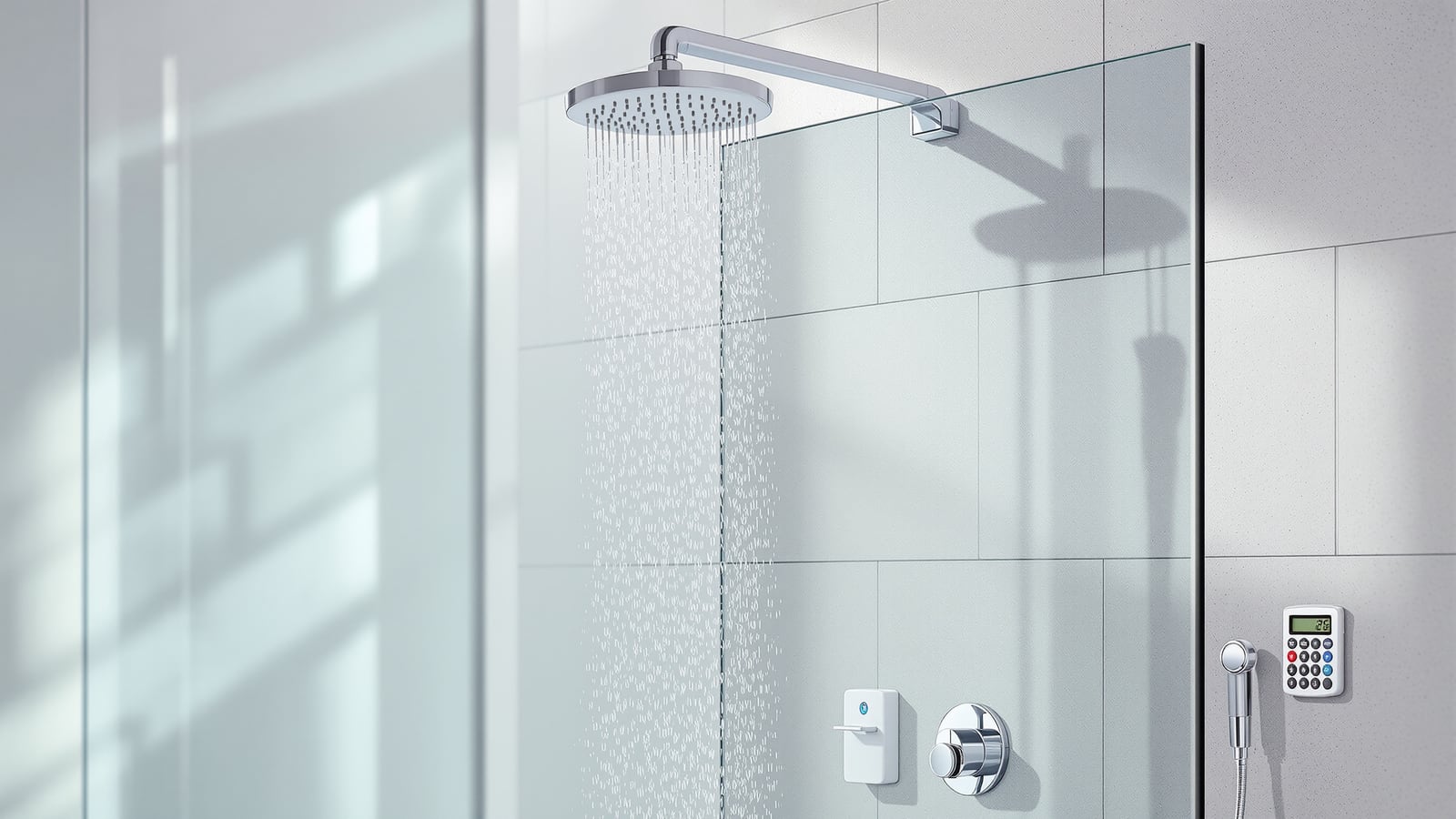
Shower System Cost in India (2026): Hand, Overhead, Rain & Multi-Function Price Guide
What a shower actually costs in India — from a ₹1,500 hand shower to a ₹2 lakh thermostatic body-jet panel — plus the concealed-body, pump, plumbing-point and glass-enclosure add-ons people forget, and honest budget, standard and luxury totals.
Ask three people what a shower costs and you will hear ₹2,000, ₹40,000 and "why is my plumber asking for a lakh?" — and all three can be right. The confusion is that the shiny metal head on the wall is only a fraction of the bill. The real cost of a shower in India is the head plus the mixer and diverter behind it, the concealed brass body buried in the wall, the extra plumbing points, sometimes a pump to make it work at all, and — if you want to keep the rest of the bathroom dry — a glass enclosure that often costs more than the shower itself.
This guide puts honest 2026 rupee numbers against each of those, so you can price a real shower rather than just the head. Read it alongside the shower systems guide to understand how the parts fit together, how to choose a shower to pick the right type, and the bathroom construction cost guide to see where the shower sits in the whole-room budget.
A shower head is a purchase; a shower is a project. Budget for the body, the points, the pressure and the glass — not just the chrome you can see.
The four shower types and what the fittings cost
Start with the outlet you actually stand under. Prices below are for the fittings only — the visible trim plus the working valve — from mainstream Indian brands (Jaquar, Cera, Hindware, Kohler entry ranges). They exclude plumbing, the concealed body where relevant, and installation.
| Shower type | What you get | Fitting cost (2026) |
|---|---|---|
| Simple hand shower | Handheld head, 1–1.5 m hose, wall hook or rail, single-lever wall mixer | ₹1,500–6,000 |
| Overhead + hand combo | Fixed 100–200 mm overhead head + hand shower, two-way diverter/mixer | ₹6,000–18,000 |
| Rain shower + concealed diverter | 200–300 mm rain head, hand shower, concealed two/three-way diverter plate | ₹18,000–55,000 |
| Multi-function / body-jet / thermostatic panel | Rain head, hand shower, 4–6 body jets, thermostatic control (or all-in-one panel) | ₹55,000–2,00,000+ |
A few notes that save money and disappointment:
- A simple hand shower is the most-used outlet in any Indian bathroom — rinse, wash hair, bathe a child. Even in a luxury shower, include one.
- The jump from overhead+hand to rain+concealed is not really about the head. It is the concealed diverter body and the wall work behind it (below). The head itself is cheap.
- A rain shower on a bare gravity supply will drizzle. The number above buys the head, not the pressure to run it — see the pump add-on.
- A body-jet or thermostatic panel is as much a plumbing and pressure commitment as a purchase. Do not price the panel without pricing a pump.
The add-on costs people forget
This is where budgets blow up. The head is on the price tag; these are not.
| Add-on | Why you need it | Typical cost (2026) |
|---|---|---|
| Concealed diverter/mixer body | The brass valve buried behind the tile for that clean concealed look | ₹4,000–20,000 |
| Extra plumbing points (hot+cold to a new outlet) | Each overhead, hand shower or jet needs feed and fixing points | ₹1,500–3,500 per point |
| Wall chasing + re-tiling for concealed work | Cutting the wall to bury the body, then patching tile | ₹3,000–10,000 |
| Booster / shower pump (for a rain head or jets) | Gravity from an overhead tank rarely runs a rain shower | ₹8,000–35,000 |
| Body-jet plumbing (4–6 jets) | Extra points, a manifold and higher flow | ₹10,000–30,000 |
| Larger geyser (25 L for a rain head) | A small 15 L tank drains in minutes under a rain head | ₹8,000–18,000 |
| Installation / plumber labour | Fitting, testing, pressure-checking | ₹1,500–6,000 |
The single most-forgotten line is the concealed body. A ₹20,000 rain-shower set advertised online is the trim; the working diverter body behind it is a separate ₹4,000–20,000, and it must be fitted and tested before tiling. Buy them together or you will be chasing an open wall later.
The second is the pump. If you live on a top floor with a terrace tank a metre or two above your head, a rain shower or body jets will disappoint on gravity alone. A dedicated inline shower pump (₹8,000–20,000) or a whole-flat pressure pump (₹15,000–35,000) is the difference between a spa and a sad drizzle. The shower systems guide explains the pressure maths.
The glass shower enclosure — a cost of its own
If you want a dry-and-wet split rather than a wet room, you will add a glass partition or enclosure — and it is a significant line, often ₹15,000–60,000+ on its own.
| Enclosure type | Description | Cost (2026) |
|---|---|---|
| Fixed glass partition (single panel) | One toughened 8–10 mm pane, no door | ₹12,000–25,000 |
| Sliding glass shower cubicle | Two/three-panel sliding enclosure, framed or semi-frameless | ₹18,000–45,000 |
| Frameless hinged-door enclosure | Premium 10–12 mm frameless glass, minimal hardware | ₹35,000–80,000 |
| Full walk-in with fixed screen + return | Large frameless walk-in, custom size | ₹50,000–1,20,000+ |
Glass is priced by area (roughly ₹350–900 per sq ft for the toughened pane) plus hardware and fitting, so a taller or wider shower costs proportionally more. Frameless and low-iron ("extra-clear") glass carry a premium. A glass shower partition is optional — a low kerb and good floor grading can keep splash contained for far less — but for a hotel-like feel it is usually the biggest single line after the fittings.
Budget, standard and luxury — realistic totals
Now put it together. These totals cover a single shower zone — fittings, concealed work, plumbing, pump where needed, geyser allowance and a glass enclosure where included. They exclude tiling, waterproofing and the rest of the bathroom (see the construction cost guide for the full room).
| Tier | Shower set-up | All-in shower zone total (2026) |
|---|---|---|
| Budget | Single-lever mixer, small overhead + hand shower, no concealed body, low kerb (no glass) | ₹8,000–20,000 |
| Standard | Concealed two-way diverter, 200 mm rain/overhead + hand shower, booster pump, 25 L geyser, fixed glass partition | ₹45,000–90,000 |
| Luxury | Thermostatic concealed mixer or panel, rain head + hand shower + body jets, pressure pump, frameless enclosure | ₹1,20,000–3,00,000+ |
A worked example — a standard family shower
Take a typical 40 sq ft (about 5x8 ft) bathroom on the second floor of a Bengaluru apartment, gravity-fed, upgrading to a proper rain-plus-hand shower behind glass.
- Rain head + hand shower + rail: ₹22,000
- Concealed two-way diverter body + plate: ₹13,000
- 3 plumbing points at ₹2,500: ₹7,500
- Wall chasing + re-tile patch: ₹6,000
- Inline booster pump: ₹9,000
- Step up 15 L to 25 L geyser (net add): ₹8,000
- Fixed glass partition (single panel): ₹18,000
- Plumber labour + testing: ₹4,000
- Total: about ₹87,500
Drop the glass and the pump (if pressure allows) and the same shower lands near ₹60,000. Add body jets and a thermostatic mixer and it climbs past ₹1.5 lakh. The head barely moved — everything around it did.
Cost drivers — what pushes it up or down
- Concealed vs exposed — concealed looks clean but adds the body, wall chasing and re-tiling. Exposed is cheaper and easier to service.
- Brand tier — Cera and Hindware entry ranges undercut Jaquar mid ranges; imported Grohe, Hansgrohe and Kohler premium lines can multiply the fitting cost 3–5x.
- Pressure — every rain head or jet bank may force a pump; gravity-friendly small heads avoid it entirely.
- Number of outlets — each extra jet or head is more points, more flow, more pump.
- Glass — frameless and low-iron glass, and taller/wider panels, add fast.
- City / tier — metro plumber labour (Mumbai, Delhi, Bengaluru) runs ₹800–1,200 a day versus ₹400–700 in tier-2/3 towns; a full shower fit is often 20–40% cheaper on labour outside the metros, though fittings cost much the same everywhere.
How to save without cutting corners
- Spend on the valve, save on the head. A good concealed diverter and a modest overhead beats a cheap valve under a giant rain head that drizzles.
- Fix pressure before you buy a rain head — a raised tank or right-sized 25 mm pipe can save a ₹15,000 pump.
- Keep it exposed where looks allow — you skip the concealed body, chasing and re-tiling entirely.
- A low kerb instead of glass contains splash for a tenth of the cost if you can live without the partition.
- Buy trim and body as a matched set to avoid mismatch, rework and an open wall.
- One good hand shower does more daily work than a second overhead head — spend there first.
- Get 2–3 local quotes and price fittings separately from labour so you can see each line.
Prices here are indicative for 2026 and move with brand, city and the rupee — treat them as a planning frame, not a quotation, and always get local quotes before you commit. Match the shower to your water pressure and your walls, not to the showroom, and you will spend where it counts. For the fuller picture, revisit the shower systems guide, how to choose a shower, and the whole-room bathroom construction cost guide.
References
- National Building Code of India (NBC) 2016, Part 9 — Plumbing Services (water supply, drainage and sanitation) — basis for points and pipe sizing.
- CPWD Delhi Schedule of Rates (DSR) and CPWD plinth-area rates — public-works reference for plumbing labour and sanitary-fitting rates.
- IS 1172 — Code of Basic Requirements for Water Supply, Drainage and Sanitation.
- IS 2065 — Code of Practice for Water Supply in Buildings (pressure and pipe context).
- Manufacturer price lists (2026) — Jaquar, Cera, Hindware, Kohler and Grohe published shower and diverter ranges.
- Market survey — indicative retail and installation quotes from metro and tier-2 plumbing contractors, mid-2026.
Export this guide
Related Guides — Deep-dive reading
Shower Systems Guide India: Overhead, Rain, Hand Shower, Body Jets, Mixers & Water Pressure
The complete guide to shower systems for Indian bathrooms — overhead and rain showers, hand showers and body jets, the mixer and diverter that drive them, the hard truth about water pressure from overhead tanks, geyser sizing for hot water, and how to waterproof the shower zone. Choose the right system for your pressure and budget.
BathroomsBody Jets Shower India: Body Spray Massage Systems, the Flow & Pressure They Really Need, and What It Costs (2026)
Wall-mounted horizontal body jets turn a shower into a spa massage — but every jet is a thirsty extra outlet. How many jets, at what heights, the big pump and geyser they force, the pipe sizing and concealed valves you must plan before tiling, the water and running cost, and exactly who it is worth it for.
BathroomsConcealed Diverter Faucet India: In-Wall Body, Diverters, Cost & Servicing Guide
In-wall concealed faucets and diverters for Indian bathrooms — how the concealed body buried behind the tiles works with the exposed trim plate and lever, single, two-way and three-way diverters that route water to the overhead rain shower, hand shower and spout, why the hidden brass body is the part that really matters, and how to plan the rough-in before you tile.
BathroomsRelated Tools — Try Free
Shower Pump Calculator
Check whether your shower needs a pressure-boost pump and what size — available vs required pressure from your tank height or supply.
Bathroom CalculatorShower Water Flow Calculator
Shower water use per shower, day and month by head type, plus a pressure-adequacy check for your tank height or pump and low-flow savings.
Bathroom CalculatorBefore vs After — Cost Reality Check
Compare what you expected to pay vs what you actually paid, category by category.
Reality Check