
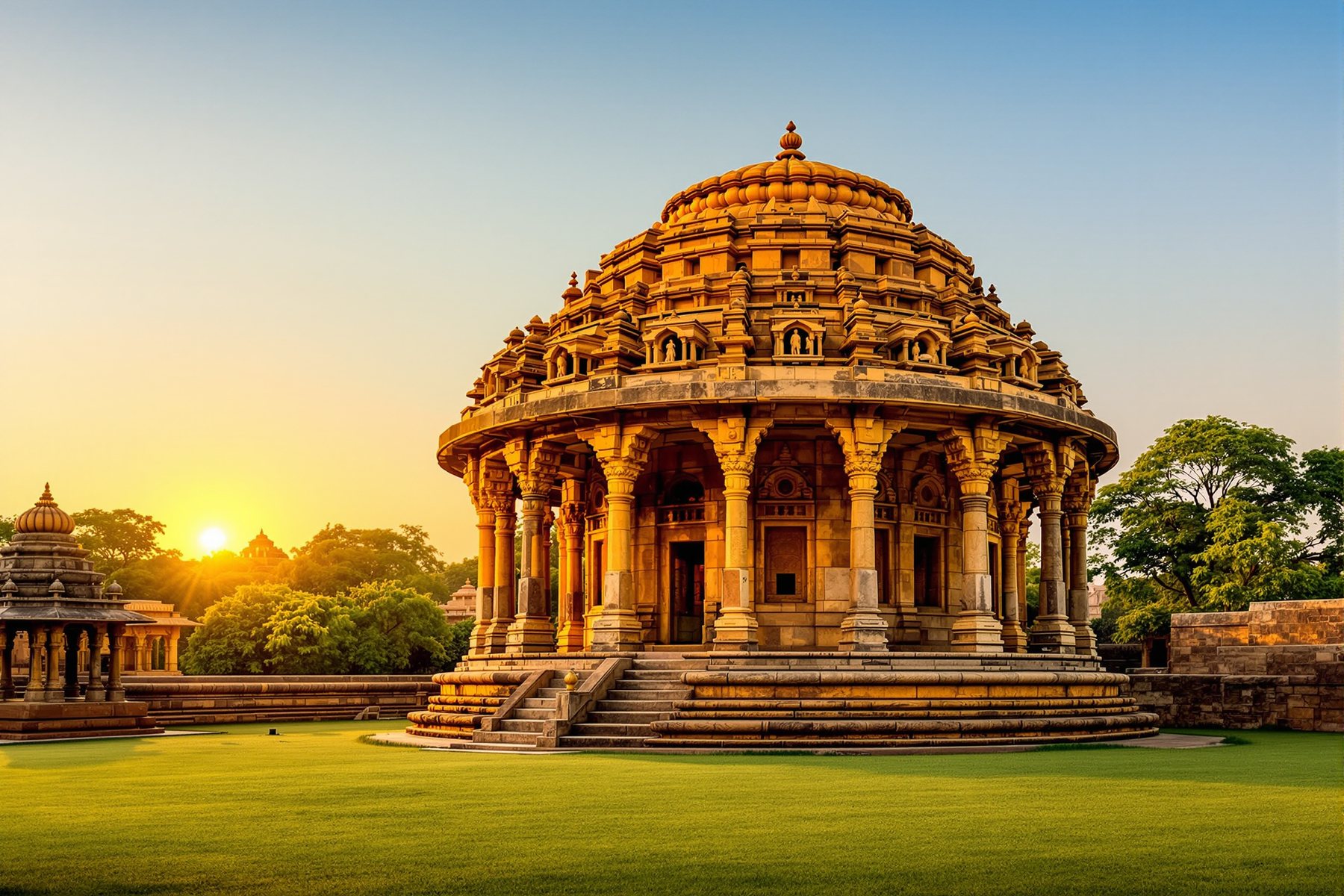
Aihole: The Laboratory of the Indian Temple
How a small Chalukya town on the Malaprabha became the cradle of Indian temple architecture — a workshop of some 125 temples where the builders tried every roof and every plan, made the first drafts and the odd experiments, and slowly figured out what a temple should be. The questions that Badami and Pattadakal would answer.
We have now visited the two famous corners of the great Chalukya triangle: the rock-cut laboratory of Badami and the open-air mastery of Pattadakal. This article goes back to the third corner — the one that comes first in the story, even though we have saved it for last. A few kilometres up the Malaprabha river from Pattadakal lies the small town of Aihole, and it has one of the most wonderful nicknames in all of architecture: the cradle of the Indian temple.
Aihole is not a single great monument. It is a town of roughly 125 temples, built by the Chalukyas and their successors across centuries, and what makes it priceless is that it is messy. It is full of false starts, odd shapes, borrowed forms and brave failures. Aihole is the place where the Indian temple was not perfected but _figured out_ — a working architect's sketchbook, left open in stone.
This is the eighth article in our Architectural Wonders series, and after seven finished masterpieces it is, in a way, the most human of them all: the wonder of watching people learn.
1. A town of temples
Spread across Aihole and its fields stand temple after temple — perhaps 125 in all, gathered in named clusters (the Durga group, the Kontigudi group, the Galaganatha group), with a rock-cut cave or two and, alone on a low hill above the town, the Jain temple of Meguti. They were built mostly between the 6th and 8th centuries, with some earlier and some much later, by the Early Chalukyas who made this stretch of the Malaprabha their cultural heartland.
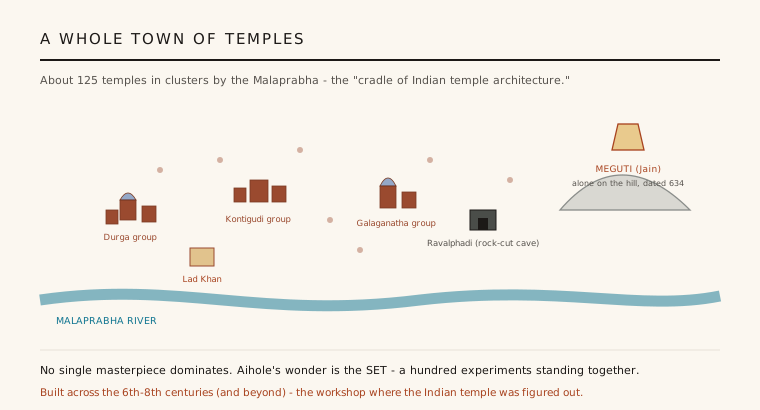
There is no single building here on the scale of Brihadeeswara, and no view like Hampi's. Aihole's wonder is the set — a whole landscape of experiments standing together, so that you can walk from one idea to the next and read, almost in order, how a civilisation taught itself to build the sacred.
2. The laboratory: every form, tried
Here is what makes Aihole unique in the world. Before there was a fixed idea of "the temple," the Chalukya builders at Aihole tried all of them — and left the evidence standing.
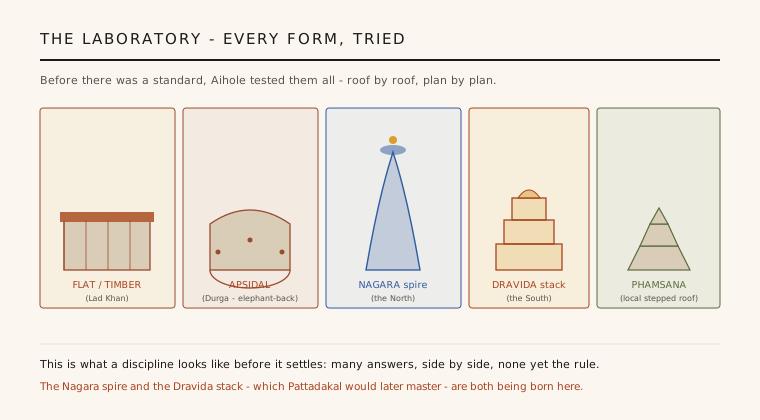
Within a short walk you can find flat roofs and stepped pyramidal roofs; the curved Nagara spire of the North and the stacked Dravida tower of the South, both in their infancy; the local Phamsana / Kadamba stepped roof; square plans, rectangular plans and even a rare apsidal (rounded-end) plan. It is, quite literally, a specimen board of early Indian architecture — a discipline caught in the act of inventing itself, before any one answer had hardened into the rule.
This is why Aihole, Badami and Pattadakal are best understood together, and why they are on UNESCO's list as a single story of the evolution of temple architecture. Aihole asked the questions — what shape, what roof, where does the god go? Badami rehearsed answers in the controlled medium of rock. Pattadakal built the mature answers, both grammars at once. The order matters: you cannot have Pattadakal's confidence without Aihole's experiments first.
3. Lad Khan: a hall learning to be a temple
No building shows the experiment more touchingly than the Lad Khan temple — one of the earliest at Aihole, and an honest record of builders working out the temple from scratch. (Its odd name is late and accidental: it was called after a Muslim commander, Lad Khan, who used the long-disused temple as a residence centuries afterward.)
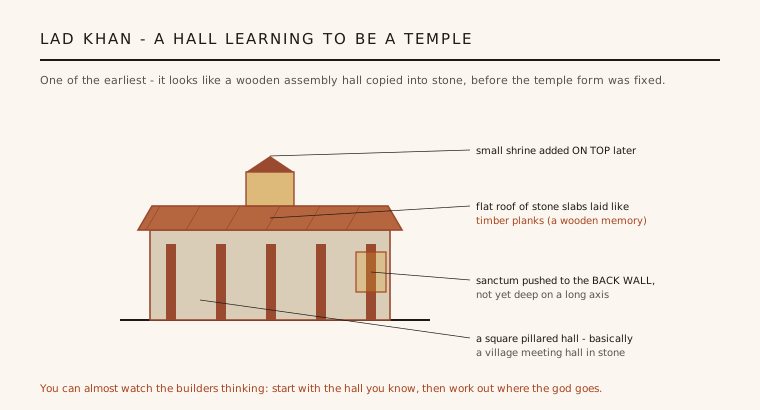
Look at it and you can almost watch the thinking happen. It is essentially a square village assembly hall — a _panchayat_ hall — translated into stone: a low, broad, pillared room with a nearly flat roof of stone slabs laid to imitate timber planks (a wooden memory in stone, exactly like Ajanta's carved beams). The sanctum is not yet a deep cell on a long processional axis; it is a small shrine pushed up against the back wall. And a little square shrine-box sits awkwardly, almost as an afterthought, on top of the roof. The builders, as one historian nicely put it, did not yet quite know how to build a temple — so they started with the hall they knew, and worked out where the god should go. The whole later genius of the South Indian temple begins with that honest, fumbling first draft.
4. The Durga temple: a borrowed shape
The most famous and most beautiful building at Aihole is the Durga temple — and it is famous precisely because it is an experiment that exists almost nowhere else.
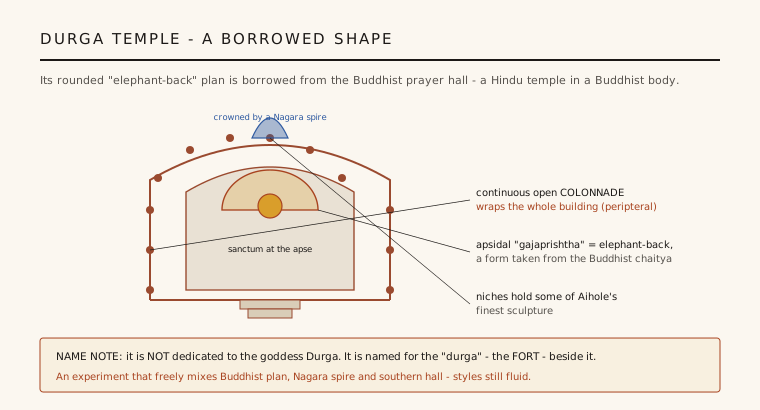
Its plan is apsidal — rounded at the rear end like the back of an elephant, which is exactly what its Sanskrit name for the form, _gajaprishtha_, means. That shape is not Hindu in origin at all: it is lifted straight from the ancient Buddhist chaitya prayer hall (the very form we saw at Ajanta). The Chalukya builders wrapped the whole temple in a continuous open colonnade, like a Greek peripteral temple or a Buddhist hall, so you can walk all the way around it under a roof — and then, with complete freedom, crowned it with a Nagara spire from the North and gave it a southern-style hall. It mixes Buddhist plan, northern tower and southern hall without the slightest anxiety, because in this period the styles were still fluid — nothing had yet been declared correct. Its wall niches hold some of the finest early Chalukya sculpture anywhere.
(One useful note, since it confuses everyone: the Durga temple is not dedicated to the goddess Durga. It takes its name from the _durga_ — the fort — beside which it stands.)
5. Meguti: a date, and a great poem
Almost everything at Aihole has to be dated by its style, because early temples rarely carry a year. But one building gives us a fixed point — and it is one of the most important inscriptions in all of Indian history.
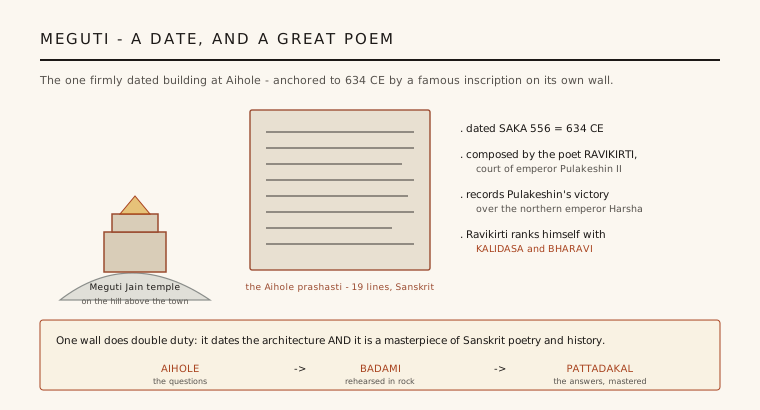
On the wall of the Meguti Jain temple, standing alone on its hill, is carved the famous Aihole inscription (the _Aihole prashasti_): nineteen lines of polished Sanskrit, dated to Saka 556, that is 634 CE, composed by the court poet Ravikirti in praise of his patron, the Chalukya emperor Pulakeshin II. It records, among much else, Pulakeshin's great victory over the North Indian emperor Harshavardhana — making it a primary source for the political history of all of early-medieval India — and the poet, with magnificent confidence, ranks his own verse alongside the two greatest names in Sanskrit literature, Kalidasa and Bharavi.
So this one wall does extraordinary double duty: it dates the architecture (giving scholars an anchor from which to date everything else at the site by comparison), and it is itself a masterpiece of literature and history. It is a perfect emblem of Aihole — a place where building, writing, dating and remembering are all the same act, carved into the same stone.
6. What a modern architect can learn from Aihole
- Honour the rough draft. Aihole's whole greatness is that it is unfinished thinking made visible — first attempts, odd hybrids, ideas that went nowhere. No masterpiece arrives without a hundred experiments behind it, and a culture confident enough to keep its sketches is a culture that learns fast. (It is the exact spirit our design education writing keeps pressing.)
- Build many before you build the one. The Chalukyas tried a hundred and twenty-five temples before the South Indian temple "settled." Variety is not indecision; it is research. Give yourself permission to make the strange version.
- Borrow shapes freely. The Durga temple takes a Buddhist plan, a northern spire and a southern hall and feels no need to apologise. Before a style hardens into orthodoxy, it is gloriously open — and the most alive work often lives in that openness.
- Start from what you know. Lad Khan begins as the village hall its builders understood, and reaches toward the temple they did not yet know how to make. Working from the familiar toward the unknown is not a weakness; it is how almost everything new is actually built.
- Let one record do many jobs. The Meguti wall dates a building, wins a war in memory and makes great poetry, all at once. The richest architecture carries its history, its meaning and its authorship together.
References & further reading
1. UNESCO World Heritage Centre — Evolution of Temple Architecture – Aihole-Badami-Pattadakal (tentative list). https://whc.unesco.org/en/tentativelists/5972/
2. Archaeological Survey of India — Group of Monuments, Aihole. https://asi.nic.in/
3. Encyclopaedia Britannica — Aihole and Chalukya architecture. https://www.britannica.com/place/Aihole
4. Karnataka Tourism — Aihole. https://karnatakatourism.org/en/destinations/aihole
Last verified 2026-06-30. The temple count, dates and style attributions follow standard archaeological and ASI reference sources and are widely accepted approximations; the 634 CE date and content of the Aihole inscription follow the inscription itself and established scholarship, and the apsidal plan and "named for the fort" point follow the standard art-historical record.
Export this guide
Related Guides — Deep-dive reading
Pattadakal: Where India's Two Temple Grammars Meet
How the 8th-century Chalukyas built the temple at last in the open air — and set the curved spires of the North beside the stepped towers of the South, on one riverbank, as if in a single open-air showroom of styles. The site that crowned kings, named its architects, and gave Ellora its model.
Architectural WondersBadami: The Cradle of the South Indian Temple
How 6th-century Chalukya carvers, still working into a red sandstone cliff like the cave-makers before them, designed the porch, hall and sanctum that every later South Indian temple would copy — and shared one cliff between Shiva, Vishnu and the Jain Tirthankaras. The rock-cut laboratory where Dravidian architecture was born.
Architectural WondersHampi: The Stone City of Vijayanagara
How a medieval South Indian empire built an entire capital out of the boulder field it stood on — granite that sings, a chariot carved in rock, two architectural worlds fused into one — and how the whole of it fell in a single year.
Architectural WondersRelated Tools — Try Free
Before & After Studio
Generate AI before-and-after renders to preview how your redesign could look.
DesignAIMoodboard Builder
Build curated moodboards from your own images and a library of Indian-style references.
DesignAIApartment vs Villa Interior Planning Guide
Compare ceiling height, structural flexibility, lighting, storage, and services between apartments and villas.
Planning Guide