
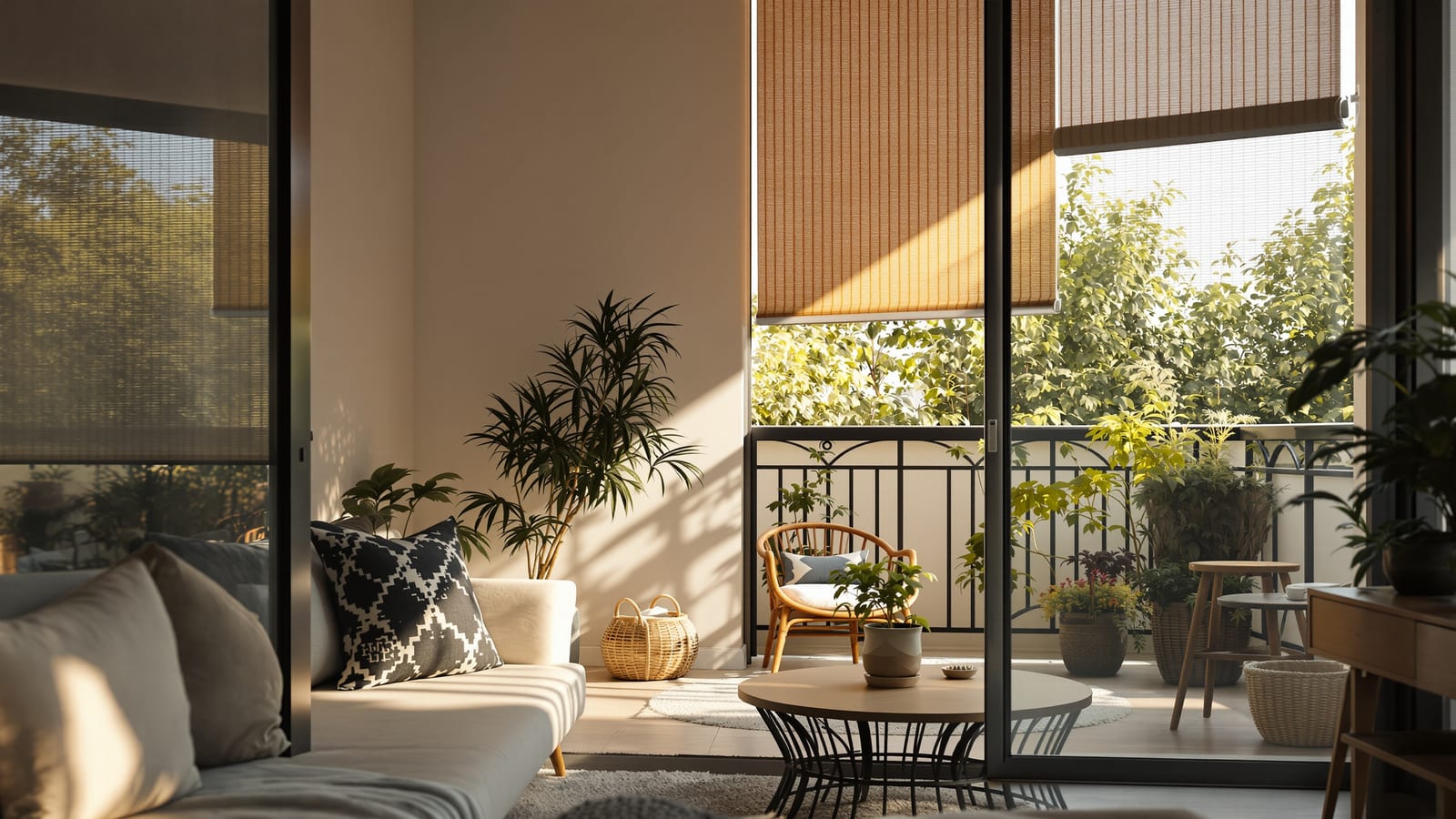
Outdoor Blinds & Patio Shades for Indian Homes (2026)
Weatherproof shading for balconies, verandahs, patios and terraces — outdoor roller and zip-track blinds, transparent monsoon PVC, woven chik and mesh fabrics that survive Indian sun, wind, rain and dust.
In most Indian homes the balcony or verandah is the room that never gets used. For half the year the afternoon sun makes it an oven; for the other half the monsoon turns it into a wind tunnel that soaks the floor and the furniture. An outdoor blind is the single cheapest fix for both: a weatherproof screen that drops down over the open side of a balcony, patio, verandah or terrace and gives you back the space — shaded in summer, dry in the rains, private from the neighbours, and rolled away the moment you want the open view again.
This is a genuinely different product from an indoor blind. Indoor blinds manage light and looks; an outdoor blind has to survive direct UV, gusting wind, driving rain and gritty dust for years, mounted on the most exposed face of the house. Pick the wrong fabric or the wrong fixing and the monsoon will tear it off the wall by August. This guide walks the types, the honest weather caveats, the costs and the care.
An outdoor blind is not an indoor blind moved outside. It is exterior weather equipment — judge it the way you would judge a window or an awning, on how it handles sun, wind and rain, not on how it looks in a showroom.
The five things an outdoor blind has to fight
Before any type, name what your open side is actually exposed to. Outdoor blinds trade off against five forces, and no single blind beats all of them:
- Sun and UV — west- and south-facing balconies take brutal heat; the blind is real thermal shade, and its own fabric must be fade- and UV-stable.
- Wind — the force everyone underestimates. A loose blind on an exposed high floor billows, flaps and eventually rips. Wind resistance is the single biggest quality difference between blind types.
- Rain — a transparent PVC monsoon blind keeps a verandah usable in a downpour; a breezy chik does not. Decide whether you want to keep rain out or just shade the sun.
- Dust — Indian cities coat everything in grit; smooth PVC and acrylic wipe clean, woven and mesh fabrics hold dust.
- Privacy — high-rise balconies overlook each other; the right opacity hides you from the flat opposite without blacking out your own light.
Write down your top two. A monsoon-lashed Mumbai balcony and a dust-blown Delhi terrace want very different blinds.
Outdoor blind types, compared honestly
"Outdoor blind" covers a spread of very different products. The table compares the realistic options for an Indian home:
| Type | Best at | Wind handling | Indicative cost per sq ft |
|---|---|---|---|
| Outdoor roller blind (acrylic/mesh fabric) | Sun + glare shade, breeze through | Medium | ₹90–₹250 |
| Zip-track / channel blind | Sun, rain and wind sealed at the edges | High (best) | ₹250–₹600 |
| Transparent PVC monsoon blind | Keeping rain and wind out, keeping the view | Medium–High | ₹70–₹180 |
| Waterproof mesh / shade-net blind | Cutting heat while keeping airflow | Medium | ₹60–₹150 |
| Bamboo / woven chik (outdoor) | Natural shade, breeze, low cost | Low–Medium | ₹50–₹150 |
| Motorised outdoor roller | Convenience on large or high openings | Depends on type | Add ₹6,000–₹20,000 per blind |
The honest pattern most homes land on: a transparent PVC blind where you must beat the rain (a monsoon-facing balcony you want to sit in year-round), an acrylic-fabric or mesh outdoor roller where shade and breeze matter more than total weather sealing, and a zip-track blind for large, exposed or high-floor openings where wind would destroy anything looser.
The standout choices, explained
Zip-track (channel) blinds are the premium answer. The fabric edges run inside side channels, so the blind is sealed top, bottom and both sides — it cannot billow or flap, which makes it by far the best for wind and driving rain on high floors and large terraces. It is the closest an outdoor blind gets to a wall on demand. You pay for it, and it usually wants motorising on big spans.
Transparent PVC monsoon blinds are the classic Indian balcony saver: clear flexible PVC sheets, often with a coloured border, that let you keep using the balcony through a downpour while preserving the view and the light. They are cheap and effective but scratch, yellow and crackle over a few hard summers — treat them as a 2–4 year consumable, not a lifetime fitting, and buy a reputable thicker grade (0.5 mm and up).
Waterproof mesh / shade-net blinds (often outdoor-grade acrylic or HDPE mesh) cut a large share of solar heat while letting air and a softened light pass — ideal for a hot, dry terrace where airflow matters more than keeping rain out. They will not keep heavy rain out.
Outdoor bamboo chik is the traditional, breathable, lowest-cost screen — wonderful for shaded verandahs and a connection to the outdoors, but the weakest against wind and rain. See the dedicated bamboo blinds guide for how the outdoor chik and its indoor woven-wood cousin differ.
Manual vs motorised outdoors
Most outdoor blinds are manual — a cord, a crank, a spring roller or simple roll-up ties. Manual is cheap, reliable and has nothing to corrode, and on a single balcony it is usually the right call.
Motorise when the opening is large, high, or awkward to reach — a wide terrace, a double-height verandah, or a blind you will raise and lower daily. Outdoor motors must be weather-rated (look for an IP-rated tubular motor), and you can wire them or use a rechargeable/battery tubular motor. A weather sensor that retracts the blind automatically in high wind is the upgrade that actually protects the investment — a motorised blind left down in a squall is the one that gets destroyed. The motor logic is the same family as indoor automation covered in the types of window blinds guide.
Mounting: where the blind lives or dies
A loose fixing is why outdoor blinds fail, not the fabric. Three rules:
- Fix into structure, not plaster — use proper anchors into the RCC slab, beam or solid masonry above the opening; an outdoor blind catches wind like a sail and will tear out weak fixings.
- Mount above and outside the opening so the rolled-up blind clears the gap and water sheds away from the wall, not into it.
- Use the channels — on any wind-exposed or high-floor balcony, side guides or a zip-track are not a luxury; they are what stops the blind flapping itself to death.
If you are mounting outside a railing on a high floor, this is a job for a professional installer with the right anchors — do not improvise.
What outdoor blinds cost in India
Treat these as honest ranges, not quotes — they swing with fabric, size, city and brand:
- Per square foot: transparent PVC and basic mesh from around ₹60–₹180/sq ft; outdoor fabric rollers ₹90–₹250/sq ft; premium zip-track from ₹250–₹600/sq ft.
- A typical balcony (say 8 ft × 7 ft) therefore runs roughly ₹3,500–₹14,000 manual, depending entirely on the type, before motorisation.
- Motorisation adds ₹6,000–₹20,000 per blind for a weather-rated motor, plus a hub or wind sensor.
The cost driver people underestimate is fabric grade and the fixing system, not the size — a cheap blind on cheap anchors is a false economy outdoors. Size your spend with the Curtain Cost Calculator, which works out area and fabric from your opening dimensions.
Care and the honest weather caveats
Outdoor blinds live hard lives, so plan for upkeep:
- Wipe PVC and acrylic with mild soapy water; never use harsh solvents that haze the clear sheet.
- Roll the blind up in storms unless it is a wind-rated zip-track — a blind left down in a gale is the one that fails.
- Let it dry before rolling to stop mildew on fabric and chik.
- Check the fixings before and after each monsoon; re-tighten anchors and replace frayed cords.
Two caveats worth stating plainly. First, no outdoor blind is forever — transparent PVC yellows and stiffens in a few summers, cheap fabrics fade, and even good blinds need re-tensioning; budget for replacement. Second, wind is the real enemy, not rain: on an exposed high floor, only a channel or zip-track system is genuinely safe, and every cost and dimension here is indicative — measure your own opening and price locally before committing.
How to choose, in four moves
1. Name your opening's top two problems — sun, wind, rain, dust or privacy.
2. Pick the type to match: PVC for rain, zip-track for wind, mesh for hot airflow, chik for cheap natural shade.
3. Decide manual or motorised — motorise only large, high or daily-use openings, with a wind sensor.
4. Spend on fabric grade and proper structural fixing, not on size.
Get the type and the fixing right and an outdoor blind turns a wasted balcony back into the best seat in the house — for a fraction of what enclosing it would cost.
Plan your balcony shade with Studio Matrx. Match the right outdoor solution to your opening with the Window Treatment Selector, and price the area and fabric with the Curtain Cost Calculator. For the wider picture, start with the complete curtain and window treatment guide and the Window Treatments cluster hub; for indoor balcony softening see the balcony curtains guide.
Export this guide
Related Guides — Deep-dive reading
Balcony Curtains & Outdoor Window Solutions (India 2026)
Weather-, sun- and rain-tolerant ways to dress an exposed balcony — outdoor waterproof curtains, bamboo chik, zip blinds and transparent PVC monsoon screens, with honest costs and caveats.
Window TreatmentsCurtains vs Blinds: The Complete Comparison for Indian Homes (2026)
Light, privacy, heat, noise, cleaning, cost and looks — a head-to-head verdict on curtains and blinds, plus the under-rated answer most good designers actually use: both.
Window TreatmentsBamboo & Woven-Wood Blinds: Natural Shade for Indian Homes (2026)
The chik reborn — how woven-wood and reed blinds filter light, catch a breeze and weather Indian sun, rain and humidity, with honest costs and best uses.
Window TreatmentsRelated Tools — Try Free
Window Treatment Selector
Curtains, blinds or a layered system? Answer five questions about your room and get a specific recommendation.
SelectorCross-Ventilation Analyzer
Estimate airflow and air changes per hour (ACH) from room size, window areas, layout, and local wind — with NBC 2016 Part 8 compliance check.
Ventilation CalculatorCurtain Cost Calculator
Get the fabric metres you need plus the total curtain cost by window size, fabric, pleat, lining and hardware.
Curtain Calculator