
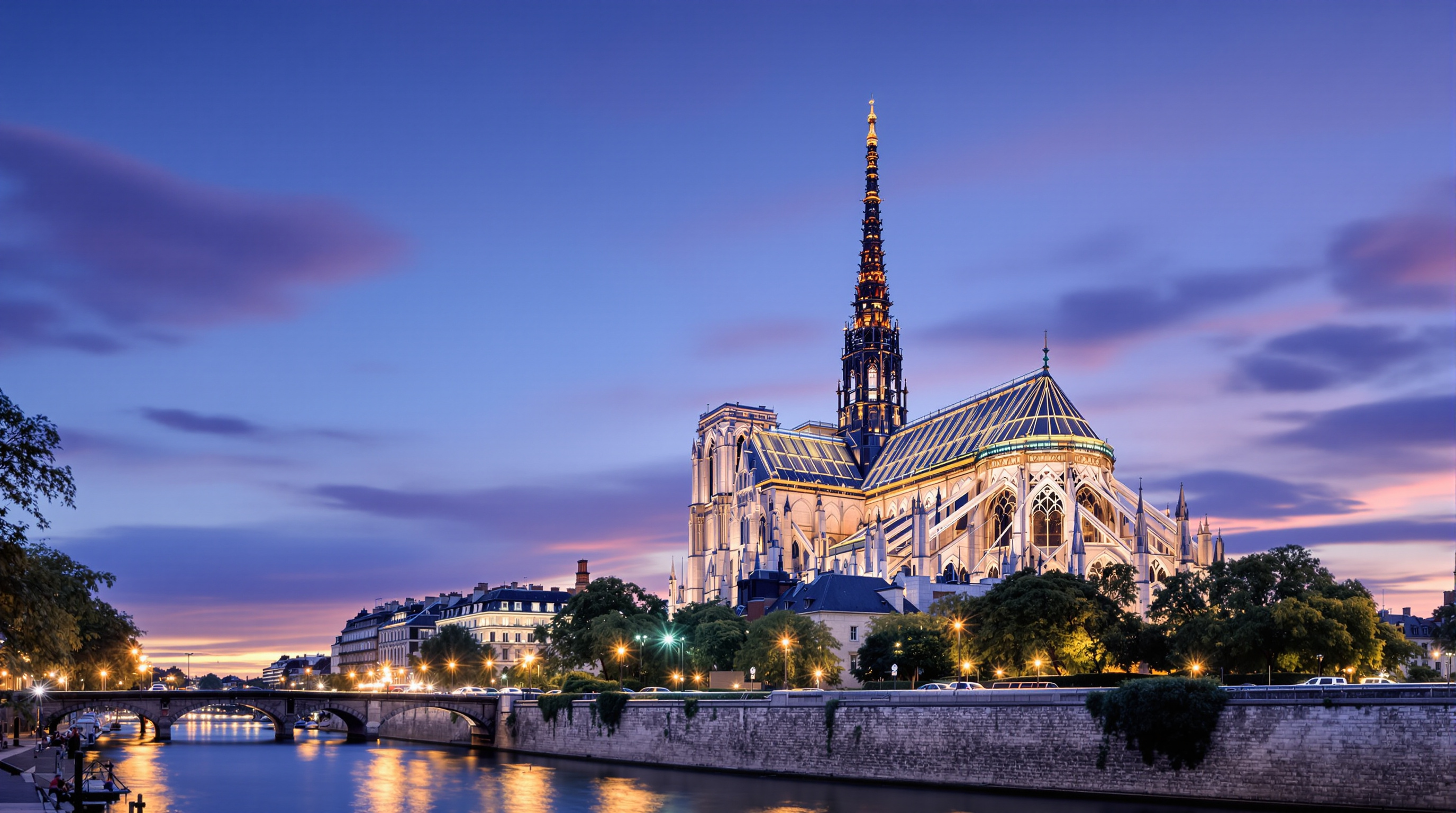
Notre-Dame de Paris: What Rebuilding a Cathedral 'Exactly As It Was' Says About the Future
Five years after the 2019 fire, France rebuilt Notre-Dame's oak 'forest' and Viollet-le-Duc's spire à l'identique — hand-hewn green oak, medieval scribing, a billion-point laser scan and a nationwide science project. A case study in why the frontier of architecture now runs through restoration, craft revival and digital memory as much as through the new.
On the morning of 15 April 2019 the world watched Notre-Dame de Paris burn. The fire took the great oak roof frame that carpenters had called la forêt — the forest — and it took the slender lead-and-oak spire that Eugène Viollet-le-Duc had added in the 1850s. Two-thirds of the roof was gone by nightfall; molten lead ran from the gutters; part of the stone vault below collapsed. And then, almost immediately, the argument began. Not about whether to rebuild — that was never in doubt — but about what kind of future a wounded medieval cathedral should be rebuilt toward.
That argument is why this building belongs in a book about where architecture is going. Marc Kushner's canon asks each building what it tells us about the future. Most answers point at something new: a new material, a new geometry, a new way to make a wall. Notre-Dame's answer is stranger and, in 2026, more urgent. It says that one of the sharpest frontiers in architecture is no longer invention at all. It is restoration — the disciplined, technically demanding, philosophically fraught work of bringing an old building back — and that this work is now powered by exactly the same forces reshaping new construction: digital capture, revived craft, and materials science.
The decision was to restore the cathedral to its last known complete state — the spire and framework as they stood before the fire — rather than to add a contemporary gesture. Restoration here is not nostalgia; it is a claim about what a monument is for.
The question: a contemporary gesture, or à l'identique?
Within days of the fire, President Emmanuel Macron promised a rebuilt cathedral in five years and floated an international competition for a "contemporary architectural gesture" to crown it — a new spire for a new century. The proposals that followed were the stuff of magazine covers: glass spires, gardens in the sky, a beam of light. For a moment it looked as though Notre-Dame might become another icon of the new.
It did not. The cathedral's chief architect, Philippe Villeneuve — an architecte en chef des monuments historiques, France's elite corps of heritage architects — reportedly threatened to resign if the spire were not rebuilt as it was. General Jean-Louis Georgelin, appointed by Macron to run the public body overseeing the works, clashed with him publicly. Conservation bodies, historians and much of the French public lined up behind an identical rebuild. In July 2020, after the national heritage commission's recommendation, Macron reversed course: Notre-Dame would be restored à l'identique — "exactly as it was," including Viollet-le-Duc's nineteenth-century spire.
This is the building's central move, and it is a genuinely contested one. To restore à l'identique is to argue that a monument's value lies in its continuity — that the public deserves the cathedral it lost, not a designer's improvement on it. The counter-position, held by many serious architects, is that every great restoration in history (including Viollet-le-Duc's own) added something of its age, and that a frozen replica is a kind of taxidermy. Studio Matrx's house view is a third position: the interesting thing about Notre-Dame is not which side won, but that "faithful" turned out to be the most radical and technically advanced option on the table. Copying the forest exactly forced France to rebuild capacities — in forestry, carpentry, science and digital survey — that a "contemporary gesture" would have let quietly die.
Rebuilding the forest: green oak, axes, and thirteenth-century joints
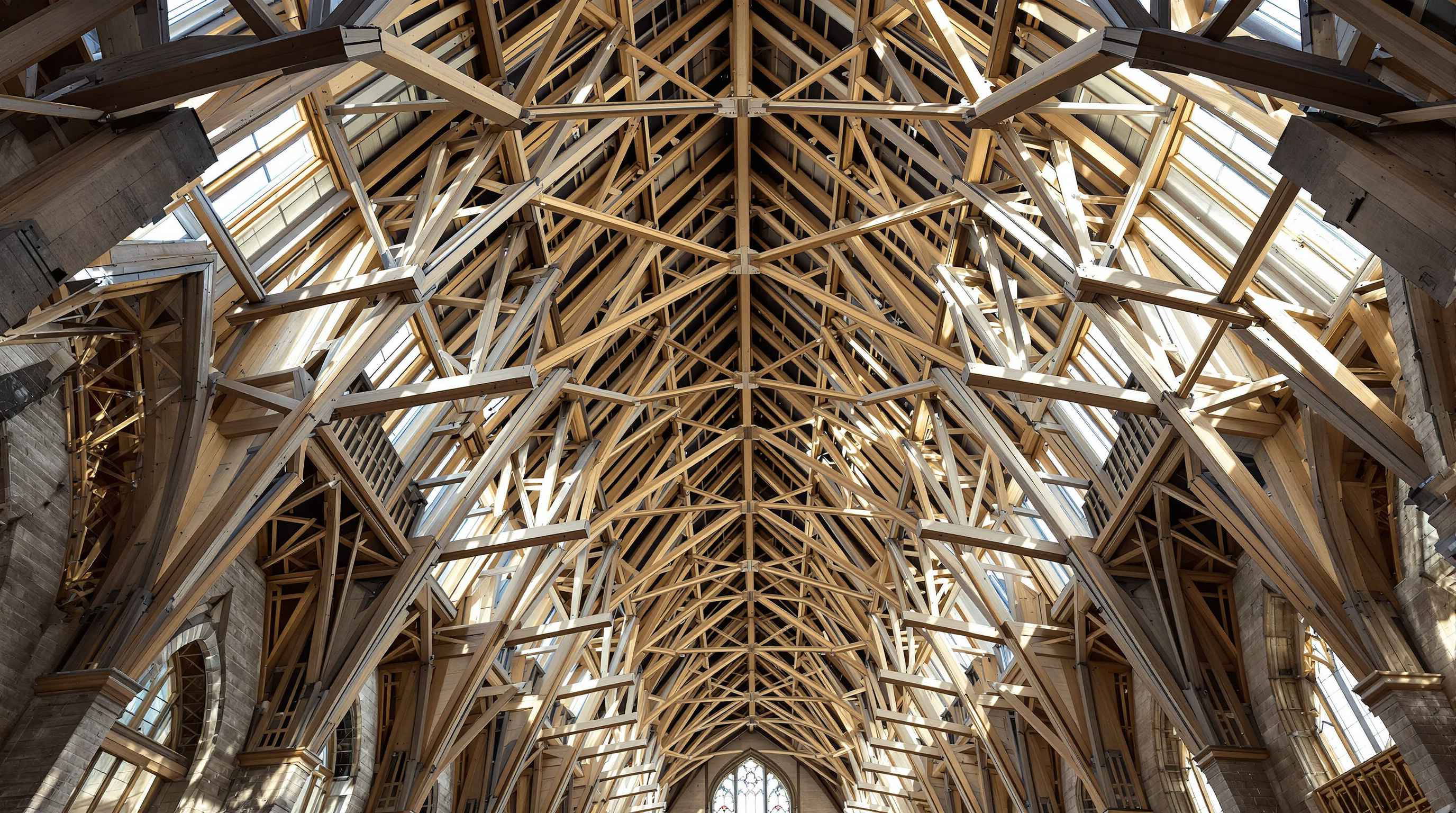
The medieval roof frame was called the forest because building it in the twelfth and thirteenth centuries had consumed something like a thousand oaks, each beam hewn from a single tree. Rebuilding it faithfully meant doing the same again. Craftspeople felled on the order of 2,000 oaks from French forests — Bercé, Bellême, Tronçais, the Chandelais and dozens of others — many of them tall, slow-grown trees around 150 to 200 years old, selected for the long straight sections the trusses demanded.
Crucially, the carpenters chose to work the wood the way the original builders had: as green oak, freshly felled and still wet, shaped by hand with the axe rather than sawn and kiln-dried. Teams — including recruits through Charpentiers Sans Frontières and know-how developed at the experimental medieval building site of Guédelon — used the old technique of scribing (l'établi, laying out and marking each joint on a full-scale floor drawing) to test-assemble each truss flat on the ground before it was ever lifted into place. The nave and choir frames were reconstructed using thirteenth-century trussed-rafter geometry; the spire framework followed Viollet-le-Duc's nineteenth-century design, its openwork oak later clad in lead and topped once more with a cross and a golden cockerel.
The point is easy to miss. This was not re-enactment for its own sake. Working green oak by hand produced a frame that matches the original's structural behaviour — how it dries, shrinks and settles — in a way that industrial glue-laminated timber never could. The "old" method was, for this specific building, the technically correct one.
The other rebuild: a billion laser points
There is a quiet reason the five-year deadline was even thinkable, and it is not craft — it is data. In 2010, the architectural historian Andrew Tallon of Vassar College had walked Notre-Dame with a terrestrial laser scanner, capturing on the order of a billion measured points and stitching them to panoramic photographs into a survey accurate to a few millimetres. Tallon died in 2018, a year before the fire. When the roof came down, his scan — together with other surveys and archival drawings — became a digital blueprint for a building that no longer fully existed above the vaults.
This is the second future the restoration reveals. The digital twin, the scan-to-BIM workflow, the point cloud as legal and structural record — the tools we associate with the design of new buildings turn out to be the essential insurance policy for old ones. A cathedral that had been measured could be restored. One that had not, could only have been guessed at.
A cathedral becomes a laboratory
One month after the fire, the CNRS (France's national research agency) and the Ministry of Culture stood up a scientific project around the site, eventually organising hundreds of researchers into working groups on wood, stone, metal, glass, structure, acoustics, anthropology and digital data. The burned ruin became, briefly, the best-studied Gothic building in history.
The findings rewrote parts of the textbook. Dendrochronology re-dated the timbers and phased the medieval building campaigns to the year. Most strikingly, archaeometallurgical study of the masonry revealed that Notre-Dame's builders had used iron staples extensively to bind stone from the earliest twelfth-century campaigns — evidence that iron reinforcement was designed into the fabric of Gothic construction far earlier and more deliberately than had been assumed. The building we thought we knew turned out to have secrets, and losing part of it was, grimly, the price of reading them.
| Element | Lost in 2019 | How it was rebuilt |
|---|---|---|
| Roof frame ("la forêt") | Twelfth–thirteenth-century oak | ~2,000 green oaks, hand-hewn, medieval joints |
| Spire | Viollet-le-Duc, 1850s | Rebuilt à l'identique in oak, clad in lead |
| Stone vault | Sections collapsed | Rebuilt in matching Lutetian limestone |
| Survey record | — | Tallon laser scan + archival drawings |
| Knowledge | — | CNRS science project; dendrochronology; iron-staple discovery |
The honest complications
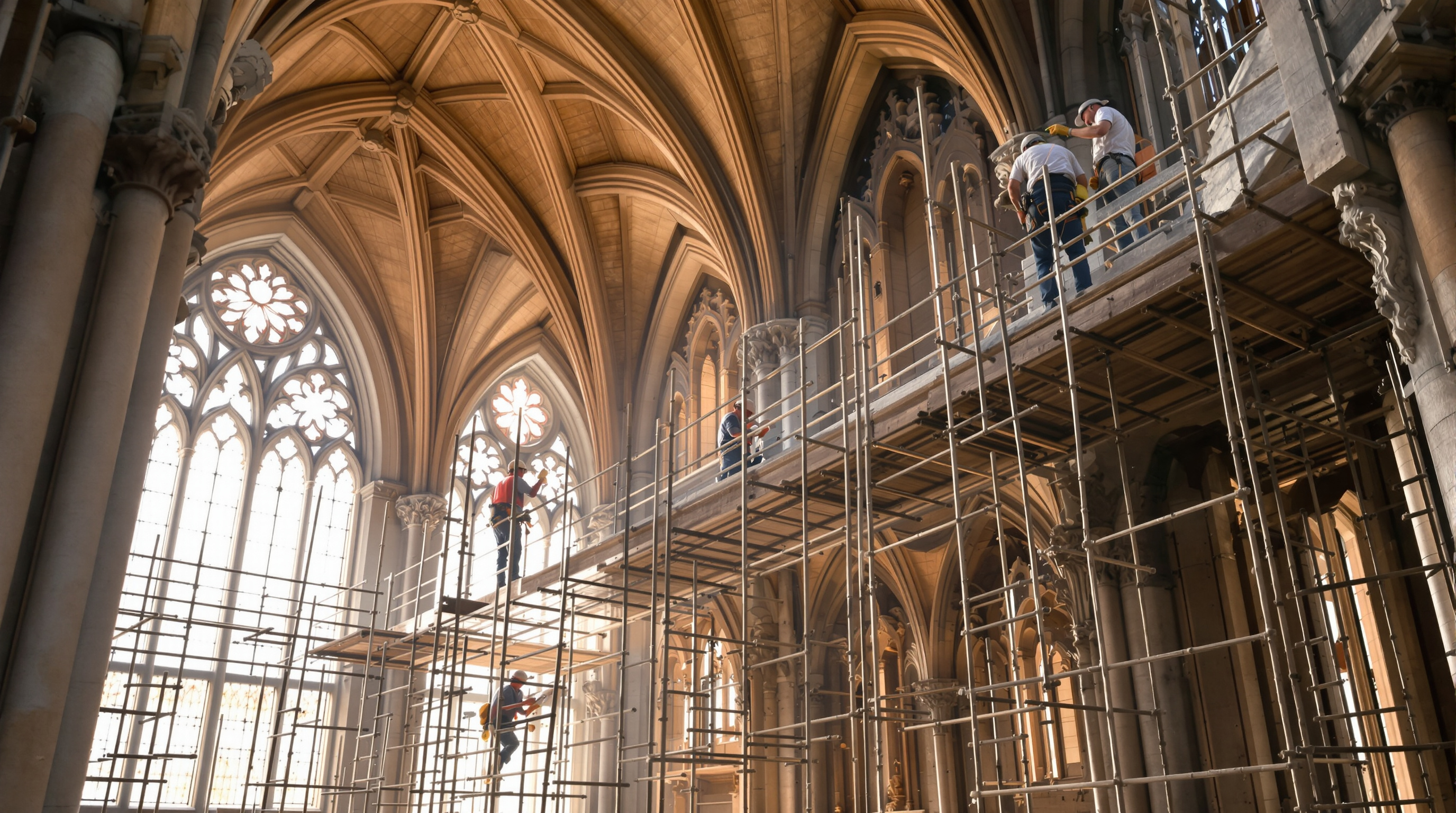
No restoration of this scale is uncomplicated, and Studio Matrx's editorial position is to name the tensions rather than smooth them. The frequently cited numbers — around 2,000 craftspeople, some 250 companies, roughly €700 million drawn from close to €840 million in donations pledged by families, corporations and the public — should be read as reported orders of magnitude, not audited certainties; sources vary, and the full accounts are still settling. General Georgelin, who drove the deadline, died in a hiking accident in August 2023 and did not see the reopening; Philippe Jost succeeded him. The cathedral reopened on the weekend of 7–8 December 2024, close to five years after the fire, but conservation work on the exterior, buttresses and surroundings continued well beyond that date.
There are deeper unease points too. The heavy use of lead — hundreds of tonnes across roof and spire — raised real public-health concerns about contamination during and after the fire, and the decision to rebuild in lead again was not universally welcomed. The interior stone was cleaned to a brightness some critics found startling against a monument long read as sombre. And the à l'identique choice itself, by declining a contemporary layer, arguably broke with the very tradition of accretion that gave Notre-Dame its Viollet-le-Duc spire in the first place. These are not reasons to withhold admiration; they are the terms on which honest admiration has to be given.
Why it belongs in the canon
The Future of Architecture is usually told as a story of the new. Notre-Dame insists on a second story running alongside it. As the built stock of the world ages, as the carbon cost of demolition-and-rebuild becomes indefensible, and as war and fire and climate keep destroying what we thought was permanent, the capacity to bring buildings back — accurately, structurally, culturally — becomes a frontier discipline in its own right. Notre-Dame proved that this frontier is not backward-looking. It runs through forestry and dendrochronology, through the axe and the laser scanner, through a nation choosing to rebuild not just a roof but the knowledge of how the roof was made.
That is the building's answer to Kushner's question. The future of architecture is not only what we will invent. It is what we refuse to let disappear — and how much science, craft and will we are prepared to spend to keep it.
References
- Établissement public Rebâtir Notre-Dame de Paris — official project record on the restoration, timber framework and spire (client/state body overseeing the works). rebatirnotredamedeparis.fr (primary source)
- L'Héritier, M., Dillmann, P., et al. (2023). "Notre-Dame de Paris: The first iron lady? Archaeometallurgical study and dating of the Parisian cathedral iron reinforcements." PLOS ONE, 18(3), e0280945. DOI: 10.1371/journal.pone.0280945. (peer-reviewed; the iron-staple discovery)
- Épaud, F., et al. (2022). "Naming, relocating and dating the woods of Notre-Dame 'forest': first results based on collated data and archaeological surveys of the remains." Journal of Cultural Heritage (Elsevier). ScienceDirect S1296207422001431. (peer-reviewed; the medieval timber framework)
- CNRS & Ministère de la Culture — "Chantier scientifique Notre-Dame de Paris," working groups on wood, stone, metal, glass, structure, acoustics and digital data. news.cnrs.fr (primary / institutional source)
- Tallon, A. — 2010 terrestrial laser survey of Notre-Dame (Vassar College); ~1 billion points, used as a reconstruction reference. Reported in CNN, "A billion laser points helped bring Notre Dame back to life" (2024). cnn.com (press, reporting on primary survey work)
- "Out of the ashes: how Notre-Dame has been resurrected in a miraculously short time." The Art Newspaper (2 Dec 2024). theartnewspaper.com (architectural/heritage press)
- "Reopening of Notre-Dame de Paris." Wikipedia — timeline, figures and dignitaries at the 7–8 December 2024 reopening. en.wikipedia.org (tertiary reference; figures corroborated against press)
Part of The Future of Architecture in 300 Buildings — Studio Matrx's canon of the buildings asking where architecture goes next. Chapter 17: Extending Kushner.
Export this guide
Related Guides — Deep-dive reading
Finlandia Hall Restoration: What to Do When the Masterpiece Was Built of the Wrong Stone
Arkkitehdit NRT's three-year, 136-million-euro renovation of Alvar Aalto's 1971 Helsinki landmark is a test case for the century's quietest revolution — keeping great buildings alive. It confronts the marble that bowed like a mattress, the ethics of replacing an architect's own material, and the argument that the most radical thing architecture can now do is not build anew.
The Future of ArchitectureSharma Springs: How IBUKU Made Bamboo Grow Six Storeys Tall
Elora Hardy and IBUKU's bamboo villa above the Ayung River valley in Bali is the tallest bamboo house in Indonesia — a lotus-shaped structure grown from a single grass, designed through physical models rather than drawings, and a serious argument that the fastest-growing plant on earth belongs in the future of building.
The Future of ArchitectureLimberlost Place: How a Beamless Timber Floor Made a Net-Zero Tower Possible
Moriyama Teshima and Acton Ostry's ten-storey mass-timber building for George Brown College in Toronto pairs a Canadian-first exposed-wood structure with two solar chimneys that ventilate the building on no energy at all — a working prototype for how a decarbonised, low-tech-passive architecture might actually be built at scale.
The Future of ArchitectureRelated Tools — Try Free
Home Building & Interior Cost Calculator — 20 Cities
Construction + interior costs for 20 Indian cities across kitchen, wardrobes, flooring, painting, ceiling.
Cost CalculatorMaterial Decision Framework (M-Score)
Score 30+ Indian construction materials across cost, durability, climate fit, maintenance, and sustainability.
MaterialsClient Brief Generator
8-section questionnaire that produces a professional design brief PDF with signature lines.
Brief Generator