
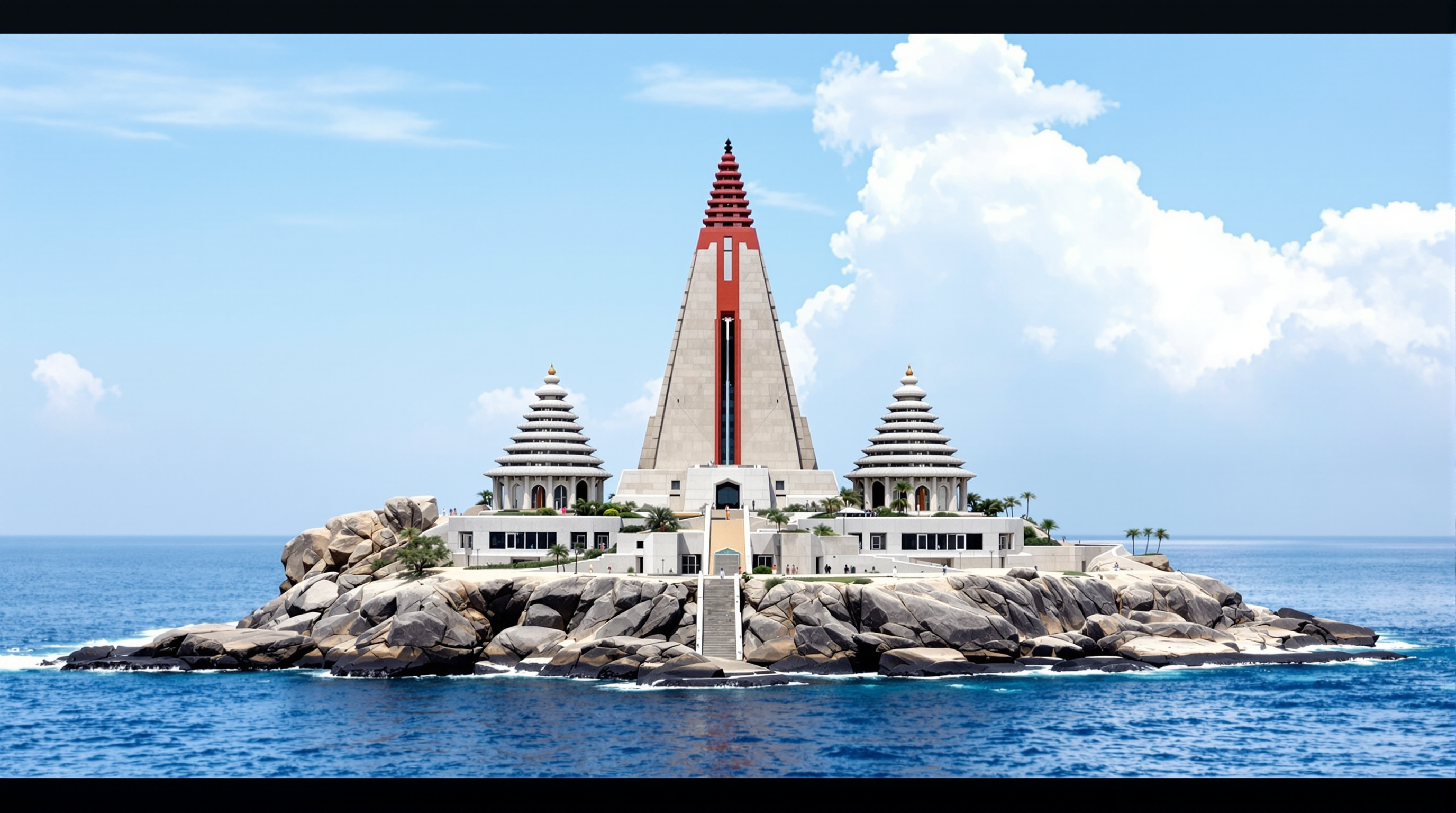
The Vivekananda Rock Memorial: How India Learned to Build the Modern Monument on a Rock in the Sea
At the tip of the subcontinent, where three seas meet, a nation with no single architect built a granite memorial by public subscription in 1970 — and, three decades later, a 133-foot poet beside it. Read together, the two rocks of Kanyakumari explain the revivalist, identity-driven monument that now defines a whole strand of Indian building.
Stand on the last beach of the Indian mainland at Kanyakumari and look south, and there is nothing beyond you but water — the Bay of Bengal, the Arabian Sea and the Indian Ocean folding into one another. Except that, about half a kilometre out, two bare granite rocks break the surface, and on them sit two of the most-visited monuments in the country: a grey stone memorial hall completed in 1970, and, beside it, a 133-foot statue of a Tamil poet unveiled on the first day of the year 2000. Neither was designed by a famous architect. Both draw millions of pilgrims and tourists a year. Together they pose a question that the rest of "The Future of Architecture" tends to ask of glass towers and parametric shells, but which India answers on a rock in the sea: what is a monument for in a modern nation, and who gets to build one?
This is not a building by a signature designer, and that is precisely the point. The Vivekananda Rock Memorial belongs in this canon not as an object of formal novelty but as a type — the revivalist, identity-driven, publicly financed monument that has become one of the most consequential strands of Indian building, running from this rock through the Thiruvalluvar Statue beside it to the 182-metre Statue of Unity in Gujarat. To understand where a great deal of Indian architecture is going, you have to understand where this particular idea of the monument came from.
The memorial presents Vivekananda's experience at Kanniyakumari as the defining moment in his mission — a rock turned into the origin point of a national story.
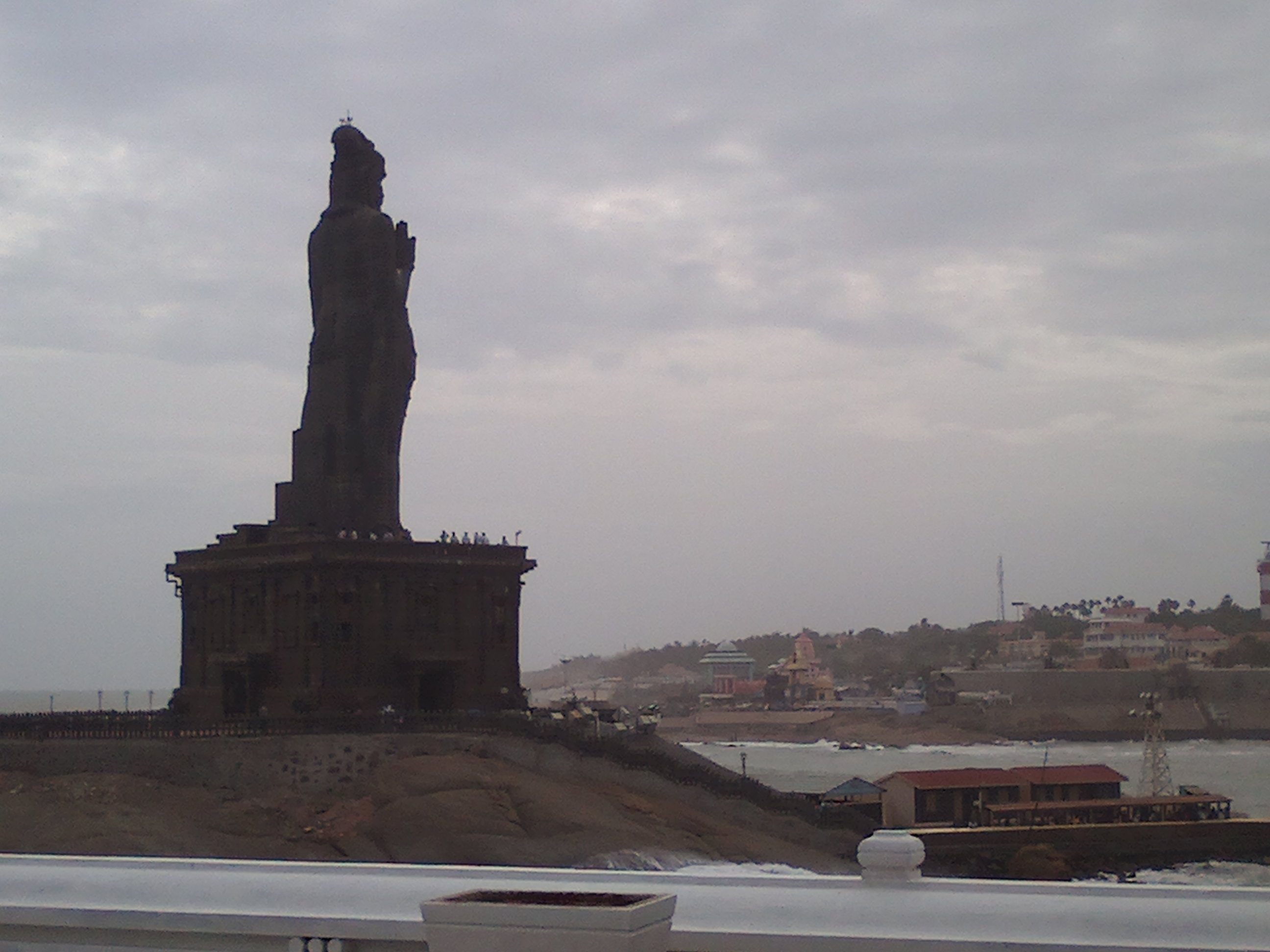
The 133-foot Thiruvalluvar Statue on the adjacent rock at Kanyakumari. Photograph: Mkanimozhi — CC BY-SA 3.0, via Wikimedia Commons.
The rock before the memorial
The claim on which everything rests is that in December 1892, the young Swami Vivekananda swam out to this rock and meditated there for three days before leaving for the Parliament of the World's Religions in Chicago. Whether the visit lasted three days is one of the facts a careful account must hedge — the historian Gwilym Beckerlegge, whose 2022 study in the International Journal of Hindu Studies is the most rigorous scholarly treatment of the site, notes that the story underpinning the memorial's location is more constructed than settled. The rock had older names and older claimants: local Catholic fishermen knew it as Kurusu Paarai, the rock of the cross, and Hindus revered it as bearing the Sri Pada — the footprint of the virgin goddess Devi Kanya Kumari, who gives the cape its name. The memorial's site was contested ground long before it was consecrated as national ground.
That contest turned bitter in the early 1960s. When the Kanyakumari committee sought to mark the rock for Vivekananda's birth centenary in 1963, a cross was removed from it, reportedly at night, and the Tamil Nadu government of the day tried to limit the intervention to a modest plaque. What broke the deadlock was not an architect but an organiser.
Eknath Ranade: the memorial as a campaign
The decisive figure is Eknath Ranade, an organiser of the Rashtriya Swayamsevak Sangh who took charge of the project in 1962 and treated it less as a construction job than as a national mobilisation. He is said to have gathered the endorsements of 323 Members of Parliament to overcome political resistance, negotiated past a hostile state government and union minister, and — most tellingly — financed the memorial through a mass "one-rupee folder" campaign that solicited small donations from ordinary citizens across India. The building was, quite deliberately, to be paid for by the nation rather than by a patron.
That financing model is inseparable from the architecture. A memorial built from millions of one-rupee gifts must look like it belongs to everyone, which in practice meant it could not be the regional temple of any single community or the personal statement of any single designer. The brief, in effect, was for a synthesis — and the result reflects it.
A building with no single architect
Ask who designed the Vivekananda Rock Memorial and you get a list rather than a name, which is why the canon entry for it leaves the architect field blank and why its attribution should be treated with care. The initial wax model was made by a student, E. Thanumalayan of S.T. Hindu College, Nagercoil. The working design is generally credited to S.K. Achari, a chief engineer-architect from the Ramnad district and a disciple of the Mahabalipuram sthapati M. Vaidyanatha Achari — placing the project inside the living lineage of Tamil temple building rather than the world of the drafting-board modernist. The overall dimensions, usually given as about 130 feet by 56 feet, and the design itself were reportedly submitted for the approval of the Paramacharya of the Kanchi Kamakoti Peetham around 1964. The Swami Vivekananda statue inside was sculpted by Narayanrao Sonavadekar of the J.J. School of Arts, Mumbai.
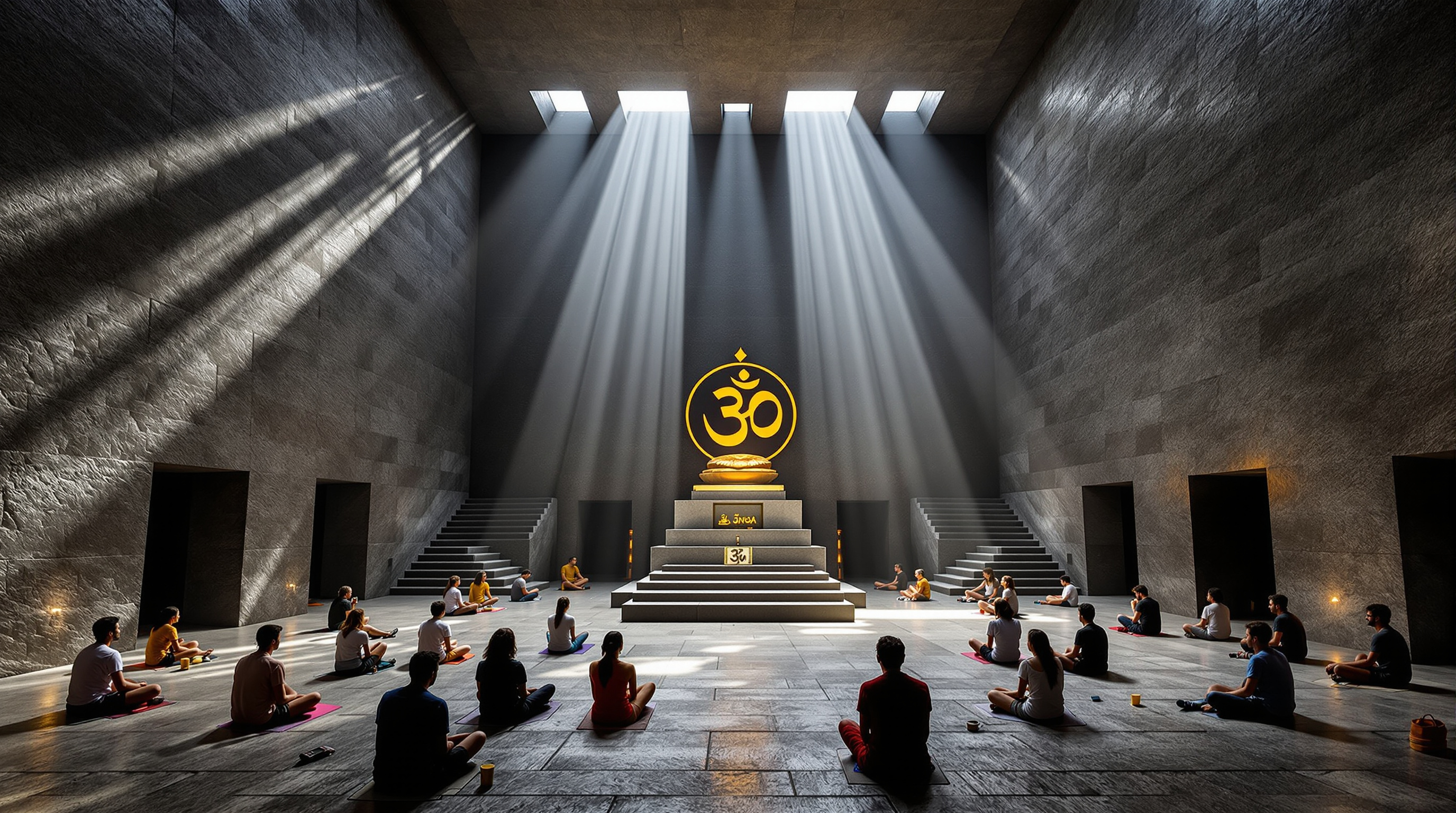
The idiom this collaboration produced is a conscious pan-Indian fusion. The main Vivekananda Mandapam — the memorial hall proper, housing the Dhyana Mandapam meditation chamber and the Sabha Mandapam assembly hall — is modelled on the Ramakrishna temple at Belur Math in Bengal, the mother house of the Ramakrishna Mission, itself a nineteenth-century synthesis of Hindu, Islamic and Christian forms. Onto that Bengali template the designers grafted the tower and detailing of southern Dravidian temple architecture, with entrance motifs said to echo the rock-cut caves of Ajanta and Ellora. Adjacent to it, the smaller Shripada Mandapam enshrines the goddess's footprint — the pre-existing sacred claim, absorbed rather than erased.
The engineering was as much a feat as the styling. There is no bridge; every block had to be barged to an exposed sea rock and set against wind and salt spray. The bulk of the granite came from a quarry near Ambasamudram, reported at roughly 70 miles away, while the huge monolithic pillars were floated from a nearer quarry at Pothayadi. Around 650 workers are said to have completed the structure in about six years, and it was dedicated to the nation on 2 September 1970, inaugurated by President V.V. Giri.
The site diagram: two rocks, three seas
The second rock, and the pattern completed
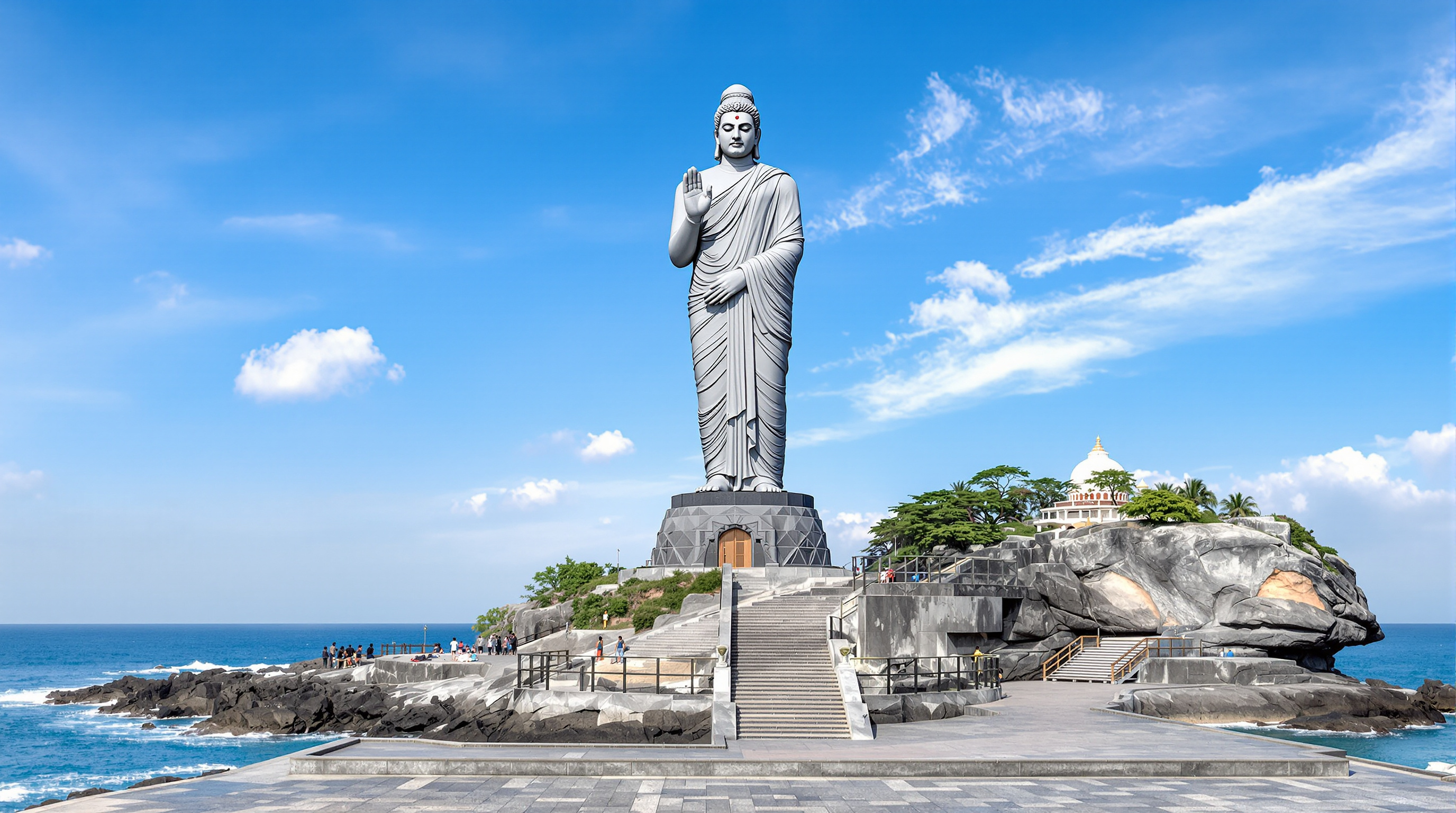
For thirty years the memorial stood alone. Then, on the neighbouring rock, the Tamil Nadu government raised a statue of Thiruvalluvar, author of the Thirukkural, the classical Tamil ethical text. Sculpted under the master sthapati V. Ganapati Sthapati — the same lineage of Mahabalipuram temple-builders — it stands 133 feet tall, the number chosen to echo the 133 chapters of the Kural. Work reportedly began in 1990, and the statue was placed on its pedestal in October 1999 and unveiled on 1 January 2000, at a cost reported at around 61 million rupees with roughly 150 sculptors and workers. Read against the memorial, it is impossible to miss the counter-statement: where the 1970 monument casts Kanyakumari as the origin point of a pan-Indian spiritual nationalism, the 2000 statue plants a specifically Tamil cultural and linguistic assertion on the rock next door. The two monuments are in conversation, and the conversation is about identity.
| Vivekananda Rock Memorial | Thiruvalluvar Statue | |
|---|---|---|
| Dedicated | 1970 (2 September) | 2000 (1 January) |
| Prime mover | Eknath Ranade / public subscription | Tamil Nadu state government |
| Design lineage | S.K. Achari (Mahabalipuram sthapati line); Belur + Dravidian fusion | V. Ganapati Sthapati (same sthapati tradition) |
| Scale | ~130 ft hall on the rock | 133 ft statue (denoting 133 Kural chapters) |
| Argument | Pan-Indian spiritual nationalism | Tamil cultural and linguistic identity |
| Material | Barged granite, monolithic pillars | Stone, carved on site |
The third position: what the rocks tell us
It would be easy to file both monuments under "kitsch revivalism" and move on, and it would be a mistake. The honest reading holds several truths at once. As architecture, the memorial is a genuinely skilful synthesis: to barge a temple onto an exposed sea rock, to weld Bengali and Tamil idioms into one coherent hall, and to do it as a craft tradition rather than a design signature, is an achievement that the modernist canon — obsessed with authorship — has trouble even seeing. The living sthapati lineage that built both rocks is a form of continuity most countries lost centuries ago.
But an account that stops at admiration would be dishonest about the politics. The memorial's own scholars, Beckerlegge foremost among them, show that the site's founding story was actively constructed, that a cross was displaced to make room for it, and that the memorial has since become a node in Hindu-nationalist iconography and in Kanyakumari's booming heritage-tourism economy. The one-rupee folders that make the building feel democratic are also what make it a supremely effective instrument of nation-branding. The Studio Matrx position is to hold both: the Vivekananda Rock Memorial is a remarkable piece of offshore craft-engineering and a carefully authored ideological artefact, and its lesson for the future is that the two are not separable. When a nation rediscovers the monument — as India visibly has, from these rocks to the Statue of Unity — it is never only building a building. It is deciding whose story the ground will tell.
That is why Kanyakumari belongs in a book about where architecture goes next. The glass tower and the parametric shell ask what we can make; the two rocks at the tip of India ask what we choose to mean. In an age of resurgent identity, that second question may turn out to be the more powerful one.
References
- Beckerlegge, Gwilym (2022). "Celebrating Heritage, Promoting Tourism, and Relocating Svāmī Vivekānanda: A Study of the Vivekananda Rock Memorial." International Journal of Hindu Studies, 25(3). Springer. DOI: 10.1007/s11407-021-09302-x. (peer-reviewed; the most rigorous scholarly treatment of the site, its founding story and its politics)
- Vivekananda Kendra / VRMVK, "Vivekananda Rock Memorial" — official account of the memorial, the two mandapams and Eknath Ranade's campaign. vrmvk.org (primary source; project custodian)
- "Vivekananda Rock Memorial." Wikipedia. en.wikipedia.org (reference summary; attribution to S.K. Achari, E. Thanumalayan, N. Sonavadekar, dimensions and the Kurusu Paarai dispute — treat detailed dates with care)
- "Thiruvalluvar Statue." Wikipedia. en.wikipedia.org (reference summary; V. Ganapati Sthapati, 133 ft, unveiled 1 January 2000, cost and workforce)
- Government of Tamil Nadu, Kanniyakumari District, "Thiruvalluvar Statue." kanniyakumari.nic.in (primary source; state administration)
- Business Today (2024), "Timeline of events that led to the formation of Vivekananda Rock Memorial." businesstoday.in (press; useful for the Ranade campaign chronology)
Part of The Future of Architecture in 300 Buildings — Studio Matrx's canon of the buildings asking where architecture goes next. Chapter 17: Extending Kushner — More Post-2015 Landmarks.
Export this guide
Related Guides — Deep-dive reading
Vidhana Soudha: How a New Democracy Built Its House in Stone
Kengal Hanumanthaiah's 1956 legislature in Bengaluru is a modern steel-and-concrete government block wearing the carved grammar of the South Indian temple — India's most confident answer to the question every newly independent nation faces: whose architecture should a free people speak? A deep case study in the Neo-Dravidian synthesis, its granite craft, its contested authorship, and the cost it drew fire for.
The Future of ArchitectureStatue of Unity: The Architecture of the Approach, the Museum, and the World's Tallest Figure
Michael Graves Architecture wrapped a 182-metre bronze colossus of Sardar Patel around two concrete cores, then choreographed a kilometres-long arrival sequence — road, bridge, visitor centre, museum, and a chest-height viewing gallery — into a single national monument on the Narmada. This is a deep study of the building behind the statue: its structure, its staged approach, and the contested ground it stands on.
The Future of ArchitectureJawahar Kala Kendra: How Charles Correa Turned a City's Horoscope into a Building
In Jaipur, Charles Correa organised a national arts centre as nine squares of the navagraha mandala — the same cosmic diagram that laid out the eighteenth-century city around it — then prised one square loose and hollowed out the centre. A study of the plan as argument: how an 'archaic notion of the Cosmos' became a working piece of contemporary civic architecture, and what its inward, fortress-walled world tells us about where architecture goes when it stops copying tradition and starts thinking with it.
The Future of ArchitectureRelated Tools — Try Free
Design Brief Generator
Answer 10 questions and generate a professional interior design brief PDF for your designer or architect.
Brief GeneratorHome Building & Interior Cost Calculator — 20 Cities
Construction + interior costs for 20 Indian cities across kitchen, wardrobes, flooring, painting, ceiling.
Cost CalculatorCircadian Light Meter
Patient-centric circadian lighting visualizer for Indian healthcare design — time-of-day × intensity → CCT, melanopic lux (EML / mEDI), melatonin suppression, and an alertness curve. Calibrated against WELL v2 L03 Circadian Lighting Design, CIE S 026:2018, Brainard 2001, and Lucas et al. 2014.
Circadian Tool