
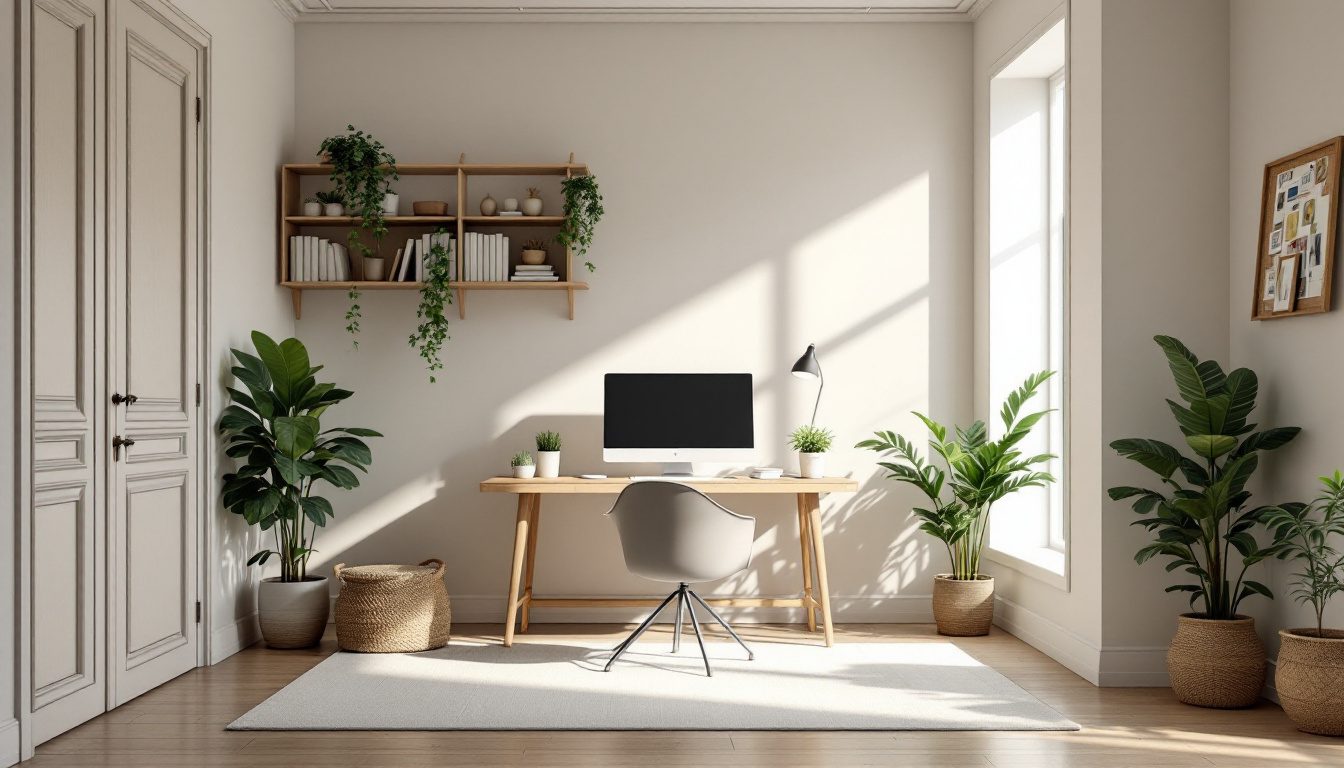
Home Office, Hobby & WFH Room Design in India
Why quiet is the whole point, matching the room to the work, desk ergonomics and video-call setup, hobby zones, the home theatre, and the balcony sit-out
The Indian home has quietly taken on jobs it was never designed for. The same flat that once held only sleeping, cooking and the evening television now has to host a 10 a.m. video call, a half-finished painting, a child's exam preparation and a Sunday film night. We adapted to this overnight during the pandemic, and most of us are still living with the makeshift arrangements we improvised then: a laptop on the dining table, a desk wedged into the bedroom corner, a hobby that migrates from balcony to bed to floor and back.
This is the easiest category of room to get wrong, precisely because it is the one most often left unplanned. Nobody draws a "work-from-home room" on a builder's standard floor plan. Yet these spaces reward deliberate thought more than almost any other, because you live their flaws every single working day — the call that gets interrupted, the glare on the monitor, the project you never finish because it has nowhere to stay out.
The thread running through this entire guide is a single idea borrowed from good architectural practice: each of these spaces has its own list of requirements that goes well beyond length and width, and each should be designed in response to those needs — not squeezed in as an afterthought.
A spare room is not a study. A corner is not an office. A room becomes a workspace only when it is shaped around the work that happens in it.
Quiet is the whole point of a home office
Ask people what they want from a home office and they will talk about the desk, the chair, the view. Ask them what actually ruins their working day and the answer is always the same: noise and interruption. The single most important quality of a home office is the one most people forget to design for — quiet.
The best home office in an Indian flat is a room you genuinely will not be interrupted in. That means placing it away from the two loudest zones of the house: the kitchen, with its mixer-grinder, pressure-cooker whistles and the constant traffic of family life, and the street-facing wall, with its horns, hawkers and construction. A bedroom on the quiet, inner side of the plan often makes a better office than a dedicated room that happens to sit over the road.
And it needs a door that actually closes. The moment your work involves video calls, that door stops being a nicety and becomes the entire point. A door you can shut for an hour of focus, or for a client call, is what separates a real workspace from a desk that everyone walks past.
Sizing, ceiling and the door itself
A home office does not need to be large. A comfortable single-occupant study works well at around 2.4 by 3.0 metres (8 by 10 feet), giving room for a desk, a chair that can roll back, a bookshelf and a little breathing space. A nine- to ten-foot ceiling feels cosy rather than cavernous, and the same room happily doubles as a quiet reading room or library when you are not working.
For the door, pocket or sliding doors are elegant where you only need to close the room occasionally — they save the swing space that a hinged door eats up in a tight flat. One caution: pocket doors are awkward to lock and not very soundproof, so if the room ever doubles as a guest bedroom, fit a solid-core hinged door instead. A hollow flush door does almost nothing for sound; a solid-core door with a draught seal at the bottom is worth the extra few thousand rupees.
If a whole room is not possible — and in most Indian flats it isn't — a study nook with a partition that can close is the honest answer. Not a curtain. Something that gives you a wall and a door.
Match the room to the work
Before any dimensions, settle the principle that ties this whole guide together: different work wants different rooms. Trying to make one space do everything is exactly how you end up with a room that does nothing well. Each activity has its own nature, and each deserves its own short list of requirements.
Focus work wants quiet and a door. A hobby wants storage, a generous surface and good task light. A media room wants the precise opposite of an office — darkness and contained sound. A child's study wants daylight and a parent within earshot. Name the activity, list what it genuinely needs, and only then shape the room. Our room programming worksheet walks you through writing that list for each space before you commit a single wall, and the home lifestyle quiz helps you work out which of these rooms your household actually needs versus which are wishful.
| Space | Primary need | Light | Sound | Storage | Power & data | Typical size |
|---|---|---|---|---|---|---|
| WFH office | Quiet, a door | Front daylight + task lamp | Buffered from kitchen/street | Shelf + filing | UPS line, LAN point | 2.4 × 3.0 m |
| Study nook | Defined focus zone | Task light, no glare | Quiet corner | Open shelf above | 1 power point | 0.6 × 1.2 m niche |
| Hobby / craft | Worktop + storage | Bright, even daylight | Contain if noisy | Heavy, dedicated | Multiple sockets | 2.5 × 3.0 m |
| Music room | Sound isolation | Comfortable, warm | Treated, isolated | Instrument storage | Audio circuit | 3.0 × 3.5 m |
| Home theatre | Darkness + acoustics | Blackout, dimmable | Isolated, treated | Equipment niche | Dedicated circuit | 3.5 × 5.0 m |
| Child's study | Daylight + supervision | North daylight + lamp | Calm, not isolated | Grows with the child | 1–2 points | 1.5 × 1.8 m |
| Balcony sit-out | Air, shade, a view | Soft, shaded | Open to the world | Minimal, weatherproof | Weatherproof point | 1.5 m+ deep |
The desk, the chair and the video-call setup
Once the room is in the right place, the workstation itself comes down to a handful of dimensions that ergonomists have settled long ago. Get these right and your back, neck and eyes will thank you across a thousand working hours; get them wrong and no amount of styling will save the room.
Desk and clearance dimensions
A practical desk for a monitor, keyboard and a notebook is about 1,200 by 600 mm — the size that anthropometric studies such as Panero and Zelnik's classic work converge on. Go to 1,500 mm wide if you run dual monitors. Allow at least 600 mm of clear depth so the screen sits a forearm's length from your eyes, and keep 750–900 mm behind the chair so you can push back and stand without colliding with a wall or bed.
| Element | Recommended dimension | Why it matters |
|---|---|---|
| Desk worktop | 1,200 × 600 mm (1,500 wide for dual screens) | Room for screen, keyboard, notebook |
| Desk height | 720–750 mm | Standard seated working height |
| Seat height | 400–450 mm, adjustable | Feet flat, thighs roughly level |
| Seat depth | 400–450 mm | Two fingers' gap behind the knee |
| Backrest | Lumbar support at 150–250 mm above seat | Protects the lower back |
| Elbow angle | 90–110 degrees at keyboard | Shoulders relaxed, wrists neutral |
| Monitor top edge | At or just below eye level | Neck stays neutral, not craned down |
| Monitor distance | 500–700 mm from eyes | Reduces eye strain |
| Knee clearance under desk | 600 mm high, 450 mm deep min. | Legs not cramped |
| Circulation behind chair | 750–900 mm | Push back and stand freely |
A monitor riser or a few hardcover books under the screen costs nothing and fixes the most common Indian home-office mistake — a laptop flat on the table that pulls your neck into a permanent downward bend. If you only buy one good thing for your home office, make it the chair: a genuinely ergonomic task chair with real lumbar support costs ₹8,000–25,000 but will outlast and out-help a ₹3,000 plastic one many times over. Use our scale and proportion calculator to check that your chosen desk and clearances actually fit the room you have before you order furniture.
The video-call essentials
The camera changed the home office permanently. A call now broadcasts your room to colleagues and clients, and four things decide whether you look composed or chaotic.
| Setup element | Do this | Avoid this |
|---|---|---|
| Backdrop | Plain wall, bookshelf or a feature panel behind you | The bed, a cluttered room, the kitchen |
| Lighting | Soft daylight or a lamp in front of you | A bright window directly behind you (silhouette) |
| Camera height | At or slightly above eye level | Looking up your nostrils from a low laptop |
| Network | Wired LAN point or strong, near router Wi-Fi | A dead-zone corner two walls from the router |
| Power | Dedicated socket + a UPS/inverter line | One overloaded extension board |
| Acoustics | Soft furnishings, curtains, a rug to cut echo | A bare, hard-surfaced, echoing room |
The location of the room decides most of this before you furnish a thing. A quiet wall behind you, away from the kitchen and street, gives a calm acoustic and a clean backdrop in one move. Good front-facing daylight — you facing the window, not your back to it — lights your face evenly and stops you appearing as a dark silhouette. Plan a network point or strong Wi-Fi and a dedicated power point, and given our load-shedding reality, route at least one socket through an inverter or UPS so a power cut does not drop you out of an important meeting mid-sentence.
Get the light levels right for the task
Light is not a single setting. A room used for relaxed conversation and a room used for fine craft need wildly different illumination, measured in lux — lumens per square metre. Indian lighting practice follows the recommendations of IS 3646, the national code for interior illumination, and the figures below are a working guide for the spaces in this guide.
| Task / space | Recommended illuminance (lux) | Notes |
|---|---|---|
| General room ambient | 100–150 | Background level, never the only layer |
| Desk / office work | 300–500 | Task lamp tops up ambient at the desk |
| Detailed VDU / screen work | 300–500 (avoid glare) | Light the desk, not the screen |
| Reading and study | 300–500 | A focused pool over the book |
| Fine craft, sewing, model-making | 750–1,000 | High, even, shadow-free |
| Drawing / painting | 500–750, daylight-balanced | North light is the classic ideal |
| Home theatre (viewing) | 10–50, dimmable | Low, bias lighting behind the screen |
| Balcony / sit-out evening | 50–100, warm | Soft, glare-free, mosquito-aware |
Two principles matter more than the exact numbers. First, layer your light: an ambient layer for the room, a task layer for the work, and never expect one ceiling tube to do both. Second, respect colour temperature — a cool, daylight-balanced light (around 4000–5000K) keeps you alert at the desk and shows craft colours truthfully, while a warm light (2700–3000K) is right for the sit-out and the media room where you want to wind down.
Hobby and craft spaces, designed around the activity
A hobby room is defined entirely by what you do in it, so that is where the design must start. There is no generic hobby room — there is a painter's room, a tailor's room, a potter's corner, a musician's room, and each demands different things.
Painting and crafts want strong, even daylight and washable, durable surfaces that survive spills and glue. Tailoring and dressmaking want a large, flat cutting surface — often 1,800 mm or more long — generous storage for fabric and a chair you can sit at for hours. Pottery and model-making want a robust worktop, a wet zone or small sink nearby, and easy-clean flooring like vitrified tile rather than wood. Music wants the opposite of all this: sound control, so practice does not disturb the rest of the house, and a way to isolate the room with carpet, curtains and a heavy door.
The four constants across every hobby are storage, a work surface, durable easy-clean finishes, and good light. The deepest design move of all is allowing the project to stay out between sessions. A hobby that must be packed away after every hour quietly dies; a hobby with its own home, where the half-finished canvas or the pinned dress pattern can simply wait for you, is a hobby you actually keep up. Plan dedicated, often deep and heavy storage — open shelves for things in use, closed cabinets for materials — so the room can hold a project mid-flight.
In a flat where a whole room is a luxury, a hobby can still get its corner: a fold-down wall-mounted worktop that drops to working height and folds flat when done, a tall storage tower beside it, and a good clip-on task lamp turn one square metre into a genuine craft station.
The home theatre: design the anti-office
If the office is a room of light, openness and alertness, the home theatre is its mirror image — and a clear "nice to have" rather than a necessity unless films and sport are genuinely central to how your household lives. It is also high-cost, so be honest about whether you will use it before you commit a room and a budget to it.
A simple projector-and-screen setup can start near ₹50,000, while a properly acoustically treated and isolated room runs into several lakhs once you add panels, soundproofing, tiered seating and AV — so size the ambition to how much you will actually use it. If you do build one, design for the opposite of a workspace. Where the office wants daylight, the theatre wants controllable darkness — minimal windows, or blackout blinds and dark, non-reflective wall surfaces so the screen is the only bright thing in the room. Where the office wants quiet for you, the theatre needs contained sound so a loud film at 10 p.m. does not travel into the bedrooms or, in an apartment, to the flat below. And it wants acoustic treatment — soft surfaces, panels and thick curtains that tame echo so dialogue stays crisp.
| Element | Home theatre requirement |
|---|---|
| Wall and ceiling colour | Dark, matte, non-reflective |
| Windows | Few, or fully blackout-able |
| Acoustics | Absorptive panels, carpet, heavy drapes |
| Sound isolation | Dense walls, gasketed solid door, no shared bedroom wall |
| Lighting | Dimmable, low-level bias light behind the screen |
| Seating | Tiered if more than one row, clear sightlines to screen |
| Screen distance | Roughly 1.5–2.5× the screen's diagonal |
| Wiring | Dedicated power circuit, concealed cabling, AV niche |
Two design decisions solve most theatre problems at once. Place the room on a lower level or as an interior room with no exterior wall, and you get darkness and sound isolation for free. And if you seat more than one row, tier the back row up by 150–300 mm so the second row sees over the first — the single move that turns a media room into something that feels like a real cinema.
The study corner for children
Children's study spaces need their own thinking, because their needs invert the adult office in one key way: a child often works better near the family, not isolated behind a closed door. A study corner in a quiet part of the living area or the child's bedroom, within a parent's earshot, supports focus and supervision at once for younger children, while older students nearing exams will want the quiet, door-able study described earlier.
The essentials are simple and worth getting right early. Plenty of daylight, ideally from a north or east window, plus a task lamp for evening study at 300–500 lux. A desk and chair sized for the child and adjustable as they grow — a fixed adult-height desk leaves a small child with dangling feet and a hunched back. Open shelving within reach, and crucially, a surface kept clear of the family's clutter so it stays the child's own. A study that doubles as where everyone dumps the post will not be used for studying. Trade-offs are unavoidable in a small flat — our design trade-off helper is built for exactly these "do I give the child a desk or keep the dining corner clear" decisions.
Don't forget the outdoor rooms
Your outdoor spaces deserve the same questions as the indoor ones — and in India, they answer back more generously than almost anywhere. The balcony, verandah or terrace is the natural Indian "extra room," and it has carried our domestic life for generations: the morning chai watching the street wake up, the plants tended at dusk, the swing — the jhula — that turns a ledge into a destination, the evening unwind when the heat finally lifts.
The difference between a balcony that gets used and one that becomes a junk store is intent. Ask the same programming questions you would of any room. How many people should it hold? Is it for sitting, for eating, for plants, or all three? A sit-out wants enough depth to be a room and not a ledge — aim for at least 1.5 metres of clear depth so two chairs and a small table fit without anyone's knees against the railing, and a low parapet at a comfortable leaning height. Plan it for our climate above all: shade from the harsh afternoon sun, a breeze path that pulls air through, and weatherproof, monsoon-surviving finishes — vitrified tile or treated wood underfoot, rust-resistant furniture, and good drainage so it does not flood every July.
The most-loved arrangement of all is a study or hobby corner that opens onto the sit-out — focus indoors with fresh air a single step away, so a break from the screen means a few minutes in real daylight rather than a walk to the kitchen for another cup of tea.
Bring it to life with Studio Matrx
None of these rooms is right or wrong in the abstract — each is right only when it fits the activity and your life. Name what each space is truly for, list what that activity needs, and build the room around it. A home office you can focus in, a hobby room that keeps your hobby alive, a child's corner that holds their attention, a media room that disappears into the film, and a sit-out you actually sit out in — that is what responsive, honest design delivers.
Tell Studio Matrx how you work, what you make, how your children study and how you unwind, and watch it shape rooms to each — quiet offices with a backdrop for calls, brightly lit hobby spaces, dark and contained media rooms, and breezy sit-outs sized for real evenings. Start with the room programming worksheet to capture each space's brief, then design your spaces with Studio Matrx.
References
- Bureau of Indian Standards. National Building Code of India (NBC) 2016, Volume 1 — Part 4 (Fire and Life Safety), Part 8 (Building Services) and habitable-room/clearance provisions. New Delhi: BIS.
- Bureau of Indian Standards. IS 3646 (Parts 1–3): Code of Practice for Interior Illumination — Recommended Illuminance (Lux) Levels for Tasks and Interiors. New Delhi: BIS.
- Panero, Julius, and Martin Zelnik. Human Dimension and Interior Space: A Source Book of Design Reference Standards. New York: Whitney Library of Design.
- Bureau of Indian Standards. IS 7250 / Ergonomics and Anthropometric Data for Indian Workspaces and Seating. New Delhi: BIS.
- Bureau of Energy Efficiency. Energy Conservation Building Code (ECBC) — Daylighting, Lighting Power and Comfort Guidance. Ministry of Power, Government of India.
- Neufert, Ernst. Architects' Data. Oxford: Blackwell Science (workstation, furniture and circulation standards).
- Ching, Francis D. K. Architecture: Form, Space, and Order. Hoboken: John Wiley & Sons (principles of spatial organisation and proportion).
- Hirsch, William J. Jr. Designing Your Perfect House: Lessons from an Architect. Dalsimer Press. (A general inspiration for this series' approach to designing work, hobby and WFH spaces.)
Export this guide
Related Guides — Deep-dive reading
Home Office & Study Lighting: Bright, Glare-Free & Focused (2026)
The design guide to lighting a home office or study for long-hour focus and eye comfort in an Indian home — a good ambient base, a proper task lamp, no screen glare or reflections, the right colour temperature through the day, and flattering light for the video call.
LightingApartment-Friendly Home Office Design
Building a real workspace in a flat that has no spare room
Apartment LivingWhy Scale Matters: Keeping Rooms Comfortable for Humans
How sizing furniture, art and lighting to the human body — not the showroom — keeps small Indian flats from feeling crushed and large halls from feeling empty.
Design PrinciplesRelated Tools — Try Free
Circadian Light Meter
Patient-centric circadian lighting visualizer for Indian healthcare design — time-of-day × intensity → CCT, melanopic lux (EML / mEDI), melatonin suppression, and an alertness curve. Calibrated against WELL v2 L03 Circadian Lighting Design, CIE S 026:2018, Brainard 2001, and Lucas et al. 2014.
Circadian ToolAcoustic Privacy (STC) Visualizer
Indian healthcare acoustic visualizer — compare wall assemblies and noise sources, see received SPL after STC attenuation, and check FGI 2018 / IS 1950 / NABH speech-privacy compliance with live dual-canvas waveform.
Acoustic ToolApartment Interior Planning Checklist
51-item checklist across structural, ceiling, lighting, furniture, storage, electrical, kitchen, bathroom.
Checklist