
Dining Space Design in India: Where the Family Comes Together
Why a dining room can be too big, centring on the light, casual vs formal dining, table sizes and clearances, and the clever buffet-alcove trick
Begin with one honest question, the kind you answer at the kitchen counter and not on a mood board: how does your family actually eat? Is dinner a quick plate balanced on a knee in front of the television, or does everyone sit down together while the dal is still steaming? Is mealtime a daily ritual of gossip and homework spread across the table, or something grander when relatives descend for a function? The answer shapes every dimension, every clearance, and every light fitting that follows. A dining space is designed for the ordinary Tuesday and the once-a-year feast, and the trick is to make one room serve both without feeling wrong on either.
Most Indian homes, once they think it through, want two kinds of dining. There is the everyday spot, light and casual, usually beside or open to the kitchen, where breakfast happens and homework lands between meals and the laptop migrates for an hour of work-from-home. And then there is the occasion, the table you set when the good crockery comes out, when there is a havan or an engagement or simply Diwali. One is for living, the other for hosting. Knowing which you are designing, or whether you genuinely need both, is the very first decision, and the one most people skip.
A dining room can actually be too big
Almost every room in a house rewards a little extra generosity. A wider living room feels luxurious. A bigger bedroom feels calm. Dining is the strange exception to this rule, and once you understand why, half of dining design becomes obvious.
Sitting across a table from another person is a specific, faintly intimate act. There is a comfortable distance at which you can pass the sabzi, hear a quiet remark, and read a face, and a distance beyond which all of that simply stops working. Push the walls too far out and the table sits marooned on a hard floor, the chairs look like driftwood, and conversation loses its warmth. A dining room that is too large does not read as grand. It reads as lonely.
A space built for sitting across a table from the people you love has real, almost physical limits in all three directions. Stretch any of them too far and the meal stops feeling like a meal.
This is why the double-height dining void, so seductive in a render with its chandelier dropping through twenty feet of air, is almost always a mistake in a home you actually live in. Sound floats up and never comes back, and the intimacy that makes a shared meal feel like a shared meal drains straight out through the volume above your head. Dining is the one place where cosy beats grand every single time, and where the most expensive instinct, build it bigger, is precisely the wrong one. Before you commit a square foot, it is worth running the room through a quick room programming worksheet to separate what you need from what merely looks impressive.
Center on the light, and the room organises itself
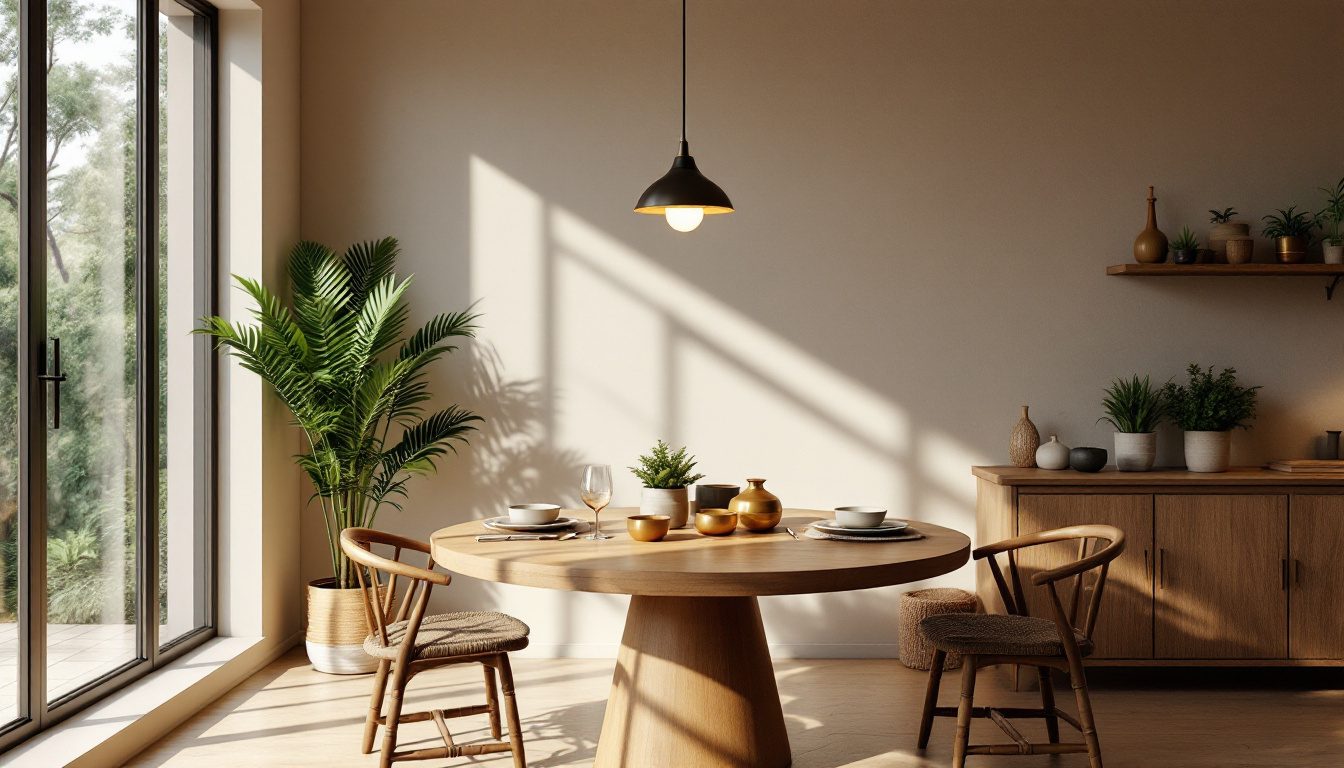
A dining room almost always has one unmistakable focal point, and unlike most rooms it announces itself before you switch anything on: the hanging light, the pendant, the chandelier over the table. It is the gravitational centre of the space, and that fact carries a logic most people miss entirely.
Because the table must sit directly beneath the light, everything else is forced to line up with it. The window at one end, the console or sideboard at the other, the art on the blank wall, the run of the ceiling cove, all of it wants to share a single centred axis with that fixture and that table. Get the light right and the room more or less composes itself. Get it off-centre and nothing will ever quite sit straight, in a way your guests will feel but never be able to name.
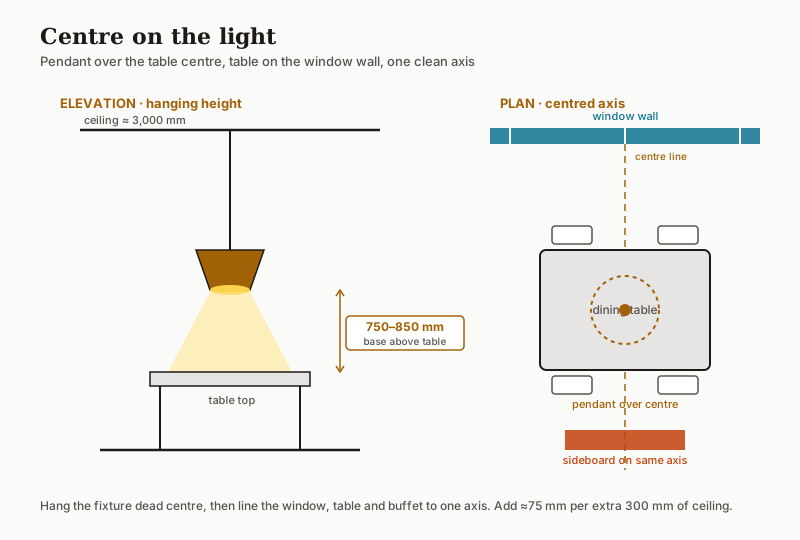
So the first move in any dining layout is to decide where the table goes, then hang the light dead centre above it, then arrange the window, the buffet, and the art to that same line. The ideal is to centre the whole composition on a window wall, so that the table looks out at daylight and your eye travels from fixture to table to view in one clean axis.
How high should the light hang?
The single most common mistake with a dining pendant is hanging it as though it were a living-room light. Over a table it should drop low, close enough to pool warm light on the food and faces and to feel like a roof over the meal, but high enough that nobody across the table is hidden behind a glowing shade. The numbers below assume an Indian ceiling of around 3,000 mm, which is to say a little under ten feet.
| Element | Recommended dimension | Why |
|---|---|---|
| Pendant base above table top | 750 to 850 mm | Lights the food, keeps sightlines clear across the table |
| Add per extra 300 mm of ceiling height | Raise base about 75 mm | Keeps proportion as ceilings get taller |
| Fixture width vs table width | About one-half to two-thirds of table width | A fixture too small looks lost, too wide feels heavy |
| Linear pendant or twin pendants | Centre over a long rectangular table | Even light along the full length, not just the middle |
| Dimmer | Always | Bright for homework, low and golden for guests |
A linear suspension or a pair of matched pendants suits the long six- or eight-seater that most Indian dining rooms end up with far better than a single round chandelier, which tends to leave the table ends in shadow.
Casual and formal: does an Indian home really need both?
The honest answer is that most homes use one table for everything, and that is entirely fine. The everyday table next to the kitchen quietly absorbs breakfast, lunch, the children's homework, the spillover of a work call. It is informal by design, it forgives mess, and it lives close to where the food is cooked.
A separate formal dining room, used a dozen times a year, is a luxury of space that compact apartments cannot spare. If you have the floor area, a second, dressier table is lovely. If you do not, the smarter play is one good table that can rise to the occasion: a surface that wipes clean for the everyday, chairs that can be supplemented at festival time, and lighting on a dimmer that shifts the same room from practical to ceremonial in one twist of a knob. The bubble diagram planner is a quick way to test whether a separate formal zone earns its place against everything else competing for that area.
Most families do not need two dining rooms. They need one honest table that can switch costumes between a weeknight and a wedding.
The Indian reality worth designing for is the festival surge. For most of the year a six-seater is generous. Twice a year, twenty people arrive and the meal flows from dining table to floor seating to a buffet on the kitchen counter. Plan for the everyday number and a graceful way to expand, rather than a cavernous room that sits half-empty for fifty weeks out of fifty-two.
Table sizes and the clearances that actually matter
Here is where good intentions meet hard geometry. A dining set looks fine against a showroom wall and then chokes a real room, because the table is only half the footprint. The other half is the empty floor around it, and that floor is not negotiable.
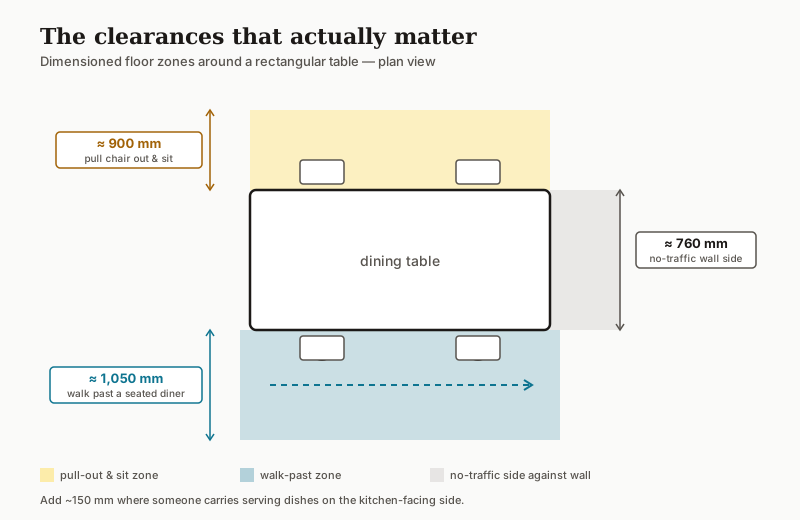
There are two clearance numbers to memorise. To slide a chair back and sit down comfortably, a person needs roughly 900 mm of clear floor from the table edge. To walk behind someone already seated, you need about 1,050 mm, because the seated person and their pulled-out chair are already eating into that space. These are the minimums below which dining becomes a series of small apologies as people squeeze past each other.
| Movement around the table | Clearance from table edge | Notes |
|---|---|---|
| Pull chair out and sit | 900 mm | Absolute comfortable minimum |
| Pull chair out and sit, then stand | 950 to 1,000 mm | Add this on the chief serving side |
| Walk behind a seated diner | 1,050 mm | Below this, expect side-stepping |
| Walk behind, carrying serving dishes | 1,150 to 1,200 mm | Worth it on the kitchen-facing side |
| No-traffic side against a wall | 760 mm | Acceptable only where nobody passes |
Now the tables themselves. Allow about 600 mm of table edge per person for elbow room and a place setting, plus depth across the table so two rows of plates and the serving bowls in the middle do not collide.
| Seats | Rectangular table size | Round table diameter | Comfortable room footprint |
|---|---|---|---|
| 4 | 1,200 by 750 mm | 900 to 1,050 mm | 2,700 by 2,400 mm |
| 6 | 1,650 by 900 mm | 1,200 to 1,350 mm | 3,300 by 2,700 mm |
| 8 | 2,100 by 1,000 mm | 1,500 mm plus | 3,900 by 3,000 mm |
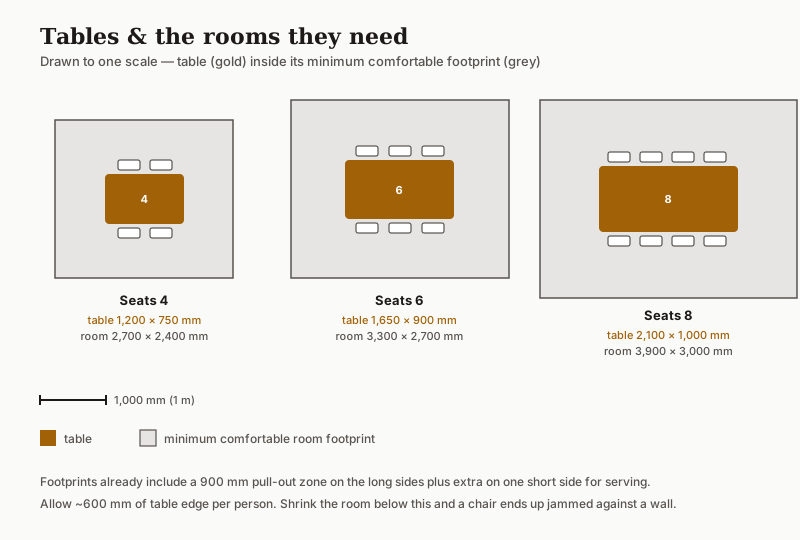
The room footprints above already fold in a 900 mm pull-out zone on the two long sides and a little extra on one short side for serving. Shrink the room below these and someone will spend every meal with their chair jammed against a wall. If your room is awkwardly proportioned, the scale and proportion calculator will help you check a table against the actual measured space before anything is ordered.
Round or rectangular?
This is not a style question so much as a room-shape question, and the two tables behave very differently in a tight Indian apartment.
| Quality | Round table | Rectangular table |
|---|---|---|
| Seating flexibility | Excellent, squeeze in one more easily | Limited by fixed sides and ends |
| Conversation | Everyone sees everyone | Ends feel cut off on a long table |
| Fits a small or square room | Very well, soft edges save circulation | Can feel boxy in a square room |
| Seats large numbers | Diameter grows fast, reach gets long | Scales cleanly to eight and beyond |
| Pushing against a wall | Wastes a chair position | Sits flush, frees the room |
| Festival surge seating | Hard to extend | Add a leaf or butt two together |
A round table up to about 1,200 mm across is the friend of the compact flat: it softens a small room, lets a stray cousin pull up a stool, and keeps everyone in one conversation. Past six seats, the diameter balloons and the reach to the centre dishes becomes a stretch, at which point the rectangular table, ideally one that takes an extension leaf for festivals, wins decisively.
The buffet alcove, and other clever tricks for narrow rooms
Indian dining rooms are very often narrow, a long slot between the living area and the kitchen, and a narrow room runs straight into a classic conflict. You want a sideboard or crockery buffet along the long wall, the place for the dinner set you use twice a year, the glassware, the serving platters. But push that buffet against the wall and it crowds the chairs on that side, stealing the pull-out clearance you just learned to protect. Slide the table over to compensate, and now it is no longer centred under the light, and the whole composition goes subtly crooked.
The expensive fix is to build a wider room, four feet of extra width across the entire length, a small fortune per square foot. The clever, cheap fix is to carve a shallow alcove into the wall and let the buffet sit back into it. That single move recovers the chair clearance, keeps the table centred under the light, and costs you only a foot and a half of width on one wall rather than four feet across the whole floor plate.
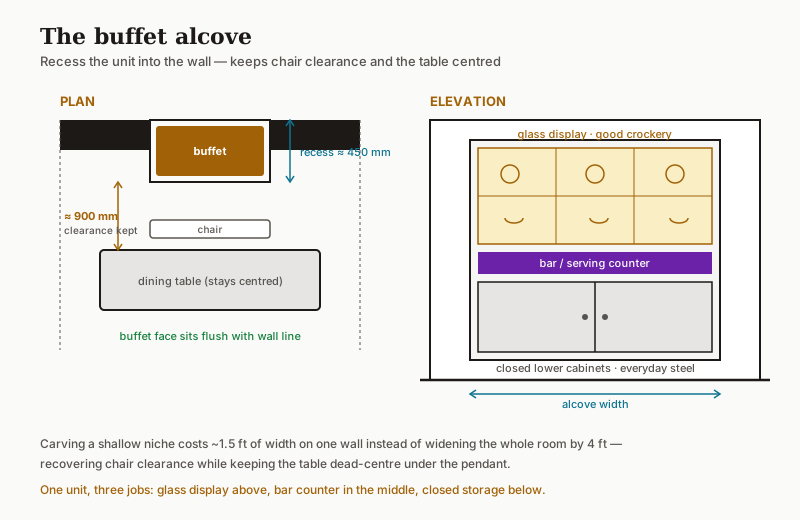
The alcove earns its keep as a crockery unit and bar-cum-display in one. The good dinner set lives behind glass at eye level, the everyday steel and melamine sit in closed lower cabinets, and a slim run becomes a bar for the evenings you entertain. And if your dining adjoins a separate kitchen, a small service counter or butler's pantry between the two is pure gold: it stores the festival dinnerware close to where it is needed, smooths serving when twenty people arrive for a function, and doubles as that same bar without anyone tramping through the cooking zone.
Dining beside the kitchen versus a separate room
Where dining sits relative to the kitchen is one of the quietly decisive choices in an Indian home, because so much of our food is served hot, in many small dishes, in several rounds.
| Arrangement | Best for | Watch out for |
|---|---|---|
| Open to the kitchen | Everyday family eating, small flats, easy serving | Cooking smells and noise reach the table; needs good exhaust |
| Beside the kitchen, half-open | Most homes, a balance of service and separation | Sightline from table into a messy kitchen |
| Fully separate formal room | Frequent hosting, larger homes | Long carry from stove to table; cold food unless there is a pantry |
For the vast majority of Indian families, dining open to or immediately beside the kitchen is the right answer, because it shortens the trip from kadhai to table and keeps the cook in the conversation. A separate formal room only pays off when you host often and can afford a service counter to bridge the gap, otherwise the food arrives lukewarm and the host spends the evening in transit.
Windows, ceilings, and the atmosphere of a good meal
Dining is forgiving about daylight in a way few other rooms are. A dining room can take light from a single wall and still feel completely right, because you are most often at the table after dark anyway, lit by the pendant rather than the sun. One good wall of light is genuinely enough.
In fact a blank wall is an asset, not a deficiency. You need somewhere to hang art, to stand the console, to set the buffet into its alcove. A dining room wrapped in glass on every side leaves you nowhere to anchor the room and floods the evening meal with reflections of a dark window. Resist the urge to over-glaze.
Where a dining room gains real character is overhead and at the edges. A tray ceiling, a recessed rectangle of plaster mirroring the table below, draws the eye down and gathers the room around the meal. A chair rail and a darker dado lend a warmer formality. Cove lighting tucked above the perimeter throws a soft wash that makes faces look kind and food look good. None of these make the room any larger, and that is exactly the point. They are the details that turn a table in a room into a dining room.
The best dining rooms are not the largest. They are the ones where, an hour after the food is finished, nobody has got up to leave.
A practical word on surfaces, because Indian meals are gloriously messy. Haldi stains, oil splatters, the ring from a hot serving bowl, a child's spilled Bournvita. Choose a table top that wipes clean and forgives heat: a sealed solid wood, a quartz or sintered stone, a good laminate. Save the delicate marble and the open-grain teak for the formal table. The everyday table is a working surface as much as a dining one, and should be specified like one.
Layered light and the all-important dimmer
One pendant is the headline, not the whole story. A well-lit dining space layers three things: the pendant or chandelier for the table itself, an ambient layer of cove or downlight to keep the room from going cave-dark beyond it, and a small accent or two on the buffet and the art. Crucially, the pendant must be on a dimmer. The same fixture that throws bright light over the children's homework at seven should sink to a low, golden pool by the time guests are lingering over dessert at ten. That one dimmer does more to switch a room between casual and formal than any amount of separate furniture.
Indian lighting practice puts a working dining table at roughly 150 to 200 lux for comfortable eating, with the option to lift it higher for tasks and drop it far lower for atmosphere. Warm colour temperature, around 2,700 to 3,000 kelvin, flatters both food and faces; cooler white belongs in the kitchen, not over the meal.
Bring it to life with Studio Matrx
A dining space done right is not about square footage or a showpiece fixture. It is a table the right size for how your family actually eats, lit and centred well, close enough to the kitchen to serve hot food easily, with a clever alcove for the good crockery and a dimmer that carries the room from homework to hosting. Tell Studio Matrx how your household eats and entertains, and get dining layouts sized, lit, and centred for your exact room, whether that is one honest everyday table or a casual-and-formal pair. You can also pressure-test the budget for the furniture, the buffet joinery, and the lighting with the cost calculator before anything is commissioned.
Design my dining space with Studio Matrx
References
- Bureau of Indian Standards. National Building Code of India 2016 (SP 7), Part 4 on minimum room sizes and Part 8 on building services, including illumination. BIS, New Delhi.
- Panero, Julius, and Martin Zelnik. Human Dimension and Interior Space: A Source Book of Design Reference Standards. Whitney Library of Design. Anthropometric clearances for dining tables, chair pull-out, and circulation zones.
- Bureau of Indian Standards. IS 3646 (Part 1): Code of Practice for Interior Illumination, recommended illuminance and lighting practice for dining and living spaces. BIS, New Delhi.
- Bureau of Indian Standards. SP 41: Handbook on Functional Requirements of Buildings, guidance on space standards and furniture layouts for Indian dwellings. BIS, New Delhi.
- Neufert, Ernst, and Peter Neufert. Architects' Data. Wiley-Blackwell. Standard dining table dimensions, seat allowances, and room layout grids.
- DeChiara, Joseph, Julius Panero, and Martin Zelnik. Time-Saver Standards for Interior Design and Space Planning. McGraw-Hill. Dining room layout standards and lighting heights over tables.
- Indian Society of Lighting Engineers (ISLE). Lighting design guidance for residential interiors, on layered lighting, colour temperature, and dimming for living and dining areas.
- Hirsch, William J. Jr. Designing Your Perfect House: Lessons from an Architect. Dalsimer Press. (A general inspiration for this series' approach to designing a dining space that brings the family together.)
Export this guide
Related Guides — Deep-dive reading
Why Scale Matters: Keeping Rooms Comfortable for Humans
How sizing furniture, art and lighting to the human body — not the showroom — keeps small Indian flats from feeling crushed and large halls from feeling empty.
Design PrinciplesDining Room Lighting Design: The Pendant & the Glow (2026)
How to light a dining area the design way — the pendant or chandelier as the hero over the table, warm and dimmable for the meal, layered with soft ambient fill and a buffet accent, and centred on the table (not the room) before the ceiling point is ever wired.
LightingLiving Room Design in India: Built Around How You Actually Live
Resolving the three competing focal points, sizing to people not floor area, the double-height trap, and the formal-vs-family living room question
Room PlanningRelated Tools — Try Free
Interior Layout Planner — Printable Graph Grid
Printable graph grid to sketch room layouts to scale before committing to furniture placement.
Layout ToolApartment Furniture Size Chart
Standard furniture dimensions for Indian apartments — sofas, beds, tables, dining, storage.
Reference ChartApartment Video Door System Planner
Enter flats, entrances, floors and guard desk for a first-pass building intercom plan — door stations, indoor monitors, guard station, the right architecture and an indicative cost band.
Building Planner