
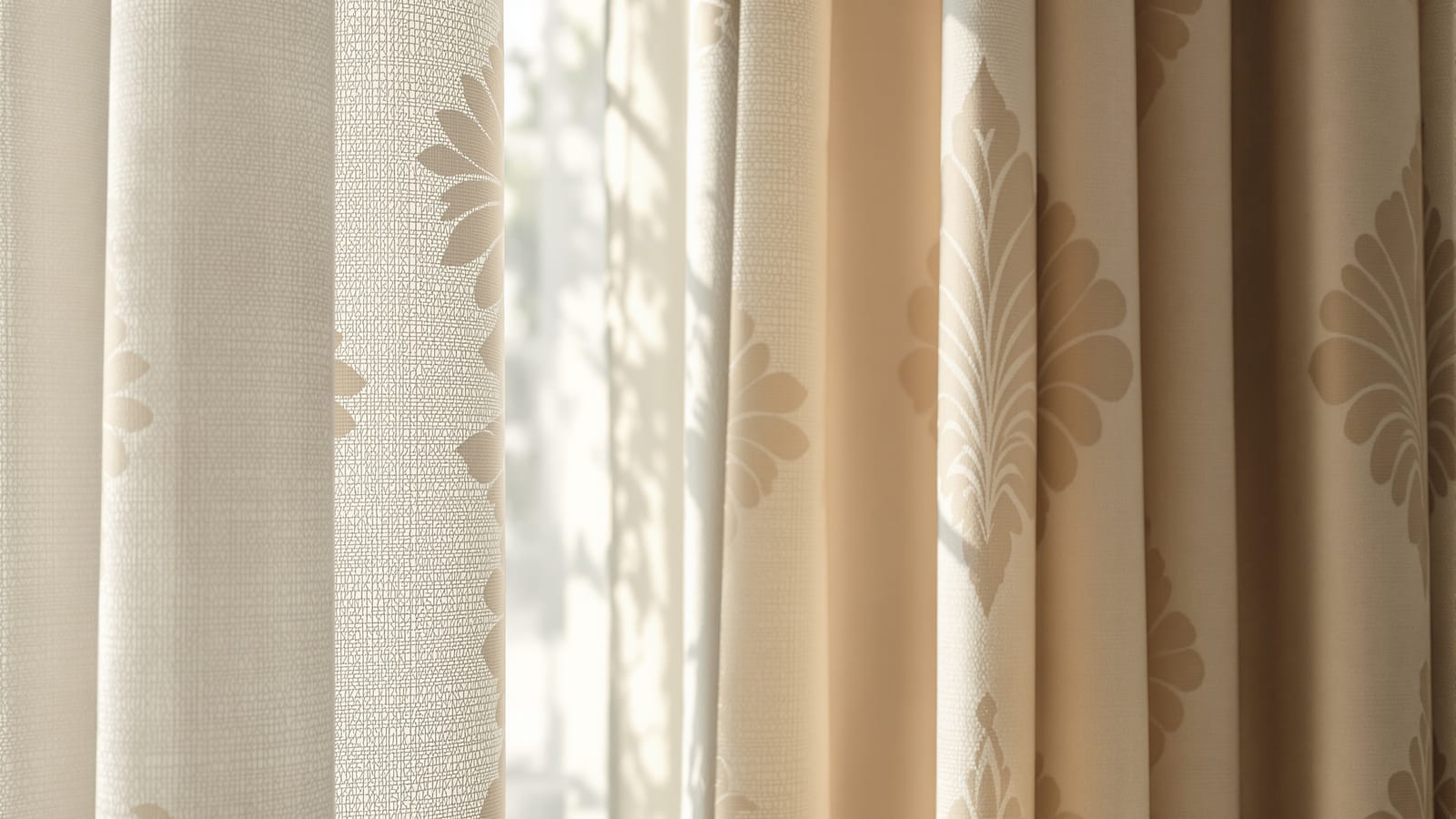
Jacquard Curtains: Woven Pattern, Weight & Drama (India 2026)
Why jacquard's pattern is woven into the cloth, not printed on it — the texture, weight, two-sided look and durability that make it the formal-room favourite, plus the honest cost and care caveats for Indian homes.
Hold a printed curtain to the light and you see a picture lying flat on the surface. Hold a jacquard curtain the same way and the pattern moves — raised threads catch the light while recessed ones fall into shadow, and the back of the cloth shows the same design in reverse. That is the whole story of jacquard in one gesture. The pattern is not a layer sitting on top of the fabric; it is built into the weave on a special loom that lifts each warp thread individually. You are not buying a printed image. You are buying a structure.
That distinction is why jacquard feels heavier, drapes with more body, photographs as more formal and lasts longer than a printed equivalent. This guide is about using that woven structure well in an Indian home — which rooms reward its formality, what the damask and brocade family actually means, the honest cost and care trade-offs, and exactly how it differs from a printed panel.
A print is a picture on cloth. A jacquard is cloth that is the picture. The pattern cannot fade off the surface or wash away, because there is no surface layer — it is woven through.
What "jacquard" actually means
Jacquard is named after the loom, not a fibre or a single look. On an ordinary loom every thread in a row lifts together, so you can only make plain or simple stripes. The jacquard loom — invented in the early 1800s and the ancestor of the punch-card computer — lifts each warp thread independently, so the weave itself can draw flowers, medallions, scrolls and damask scrolls in raised and recessed relief.
That mechanism gives jacquard four properties no print can copy:
- Texture you can feel. The pattern stands in physical relief — you can run a finger over it. Light grazes the raised threads, so the design shifts as you move past the window.
- Real weight and body. The denser, multi-layered weave makes jacquard heavier than a printed panel of the same fibre, so it hangs in fuller, more sculptural folds.
- A two-sided look. Because the pattern is woven through, the reverse shows the same design in inverted colours — the curtain has no ugly back, which matters on tall windows seen from outside.
- Durability. There is no printed coating to crack, peel or fade off the face. The pattern is as permanent as the cloth itself.
The "self-design" curtains you see in Indian shops — tone-on-tone patterns in a single colour family — are usually jacquards. So are most of the formal patterned drapes in hotels and banquet halls.
The damask and brocade family
Jacquard is the umbrella term; damask and brocade are its best-known members, and the names get used loosely. Here is the honest distinction:
| Weave | What it is | Look | Typical use |
|---|---|---|---|
| Damask | Reversible single-warp jacquard, usually one or two colours | Subtle, tone-on-tone, matte-and-sheen contrast | Formal living, dining, classic interiors |
| Brocade | Jacquard with extra raised threads (often metallic gold/silver) | Rich, ornate, often three-dimensional | Festive, traditional, very formal rooms |
| Matelasse | Quilted-look double-cloth jacquard | Padded, dimensional, cushiony | Heavier drapes, upholstery-style panels |
| Tapestry-weave | Dense pictorial jacquard | Heavy, busy, scenic | Traditional, statement walls of fabric |
For most Indian homes the practical choice is between a damask (the refined, reversible, tone-on-tone default that suits modern-classic rooms) and a brocade (the richer, often gold-threaded festive option for traditional or occasion rooms). Brocade reads as more ornate and can date a room if overdone; damask is the safer, more timeless pick. For where these sit among woven and printed patterns generally, the curtain pattern selection guide gives you the wider decision.
Jacquard vs printed: the honest comparison
This is the question that brings most people to jacquard, so weigh it plainly. Neither is "better" — they solve different briefs.
| Factor | Jacquard (woven) | Printed |
|---|---|---|
| Pattern permanence | Woven through, never fades off | Can fade, crack or wash out over years |
| Texture | Raised relief you can feel | Flat surface |
| Weight & drape | Heavier, fuller folds | Lighter, flatter |
| Reverse side | Clean two-sided look | Plain or muddy back |
| Colour range | Limited per design (one to three) | Photographic, unlimited colours |
| Cost | Higher | Lower |
| Best for | Formality, longevity, texture | Bold multicolour motifs, budget, casual rooms |
The takeaway: choose jacquard when you want formality, texture and a curtain that still looks expensive in ten years; choose print when you want a bold, many-coloured or photographic motif, a casual room, or the lowest cost. Print wins on colour freedom and budget; jacquard wins on feel, durability and how grown-up the room reads. For the full fibre-by-fibre picture behind both, the curtain fabric guide goes deeper, and you can put the two side by side in the curtain fabric comparison tool.
Best rooms for jacquard in an Indian home
Jacquard is a formal specialist, not an everyday all-rounder. Put it where its weight and pattern are an asset, not a chore.
- The formal living room. This is jacquard's home ground. Floor-length damask in ivory, champagne, deep teal or wine reads instantly as a "designed" room — pair it with a sheer for daytime softness and the jacquard becomes the evening drama.
- The dining room. The weight and texture add a hushed, hotel-like formality to evening meals, and the body of the cloth tames echo in a hard-surfaced dining space — a room where pattern earns its keep.
- The pooja or festive room. Brocade with a discreet gold thread suits a traditional, occasion-focused space far better than a casual print.
- A formal guest or drawing room. The room you dress for visitors rewards jacquard's grown-up formality.
Where jacquard does not belong: kitchens (the texture traps grease and the weight resists frequent washing), bathrooms and balconies (moisture and the loose woven structure do not mix), children's rooms and most home offices, where you want easy-clean, light, glare-controlling cloth rather than heavy formality. Jacquard rewards the rooms you cool, dress up and use deliberately — not every window in the house.
The honest caveats
The same woven structure that makes jacquard luxurious also sets its limits. State them before you buy.
- It is not blackout. Jacquard is about pattern and weight, not light control. A patterned jacquard alone lets light through the weave; for darkening you either line it or pair it with a separate blackout layer behind. Do not expect a jacquard to do the bedroom sleep job on its own.
- Snags and loose threads. The raised float threads on the surface can catch on jewellery, claws or rough hands and pull. It is a more delicate surface than a smooth flat-weave.
- Dust in the texture. The relief weave holds dust more than a flat cloth — it needs gentle, regular vacuuming, especially in dusty cities.
- Pattern scale matters. A large, busy jacquard can overwhelm a small room and date quickly. In compact Indian flats, a fine tone-on-tone damask reads far better than a big ornate brocade.
- It costs more. The complex weave and heavier cloth sit at the premium end — more on that next.
None of these rule jacquard out. They simply place it: formal, conditioned rooms where its texture and weight are welcome and its care is worth it.
What jacquard curtains cost in India
Jacquard sits above plain and printed fabrics and below silk and pure velvet. The cost lives in the fabric per metre — the dense, patterned weave uses more yarn and slower loom time than a flat print. Treat these as honest ranges, not quotes; fibre, pattern complexity, fullness, drop, lining and city all move them.
- Polyester jacquard — the affordable, durable, fade-resistant Indian workhorse; the value choice that still looks rich.
- Cotton or cotton-blend jacquard — a step up for a more matte, natural depth of colour.
- Brocade with metallic thread — the premium, ornate tier, noticeably dearer per metre.
- Lining and stitching — jacquard is usually lined (to add darkening, protect the back from sun and improve the drape), and the heavier cloth wants a generous 2× to 2.5× fullness to fold well — both push the per-window total above the headline per-metre figure.
The cost driver people underestimate is fullness plus lining, not the pattern itself — a patterned jacquard that hangs flat looks cheap, so the cloth allowance matters. Run your own numbers — fabric metres, fullness, lining and a per-window price — with the Curtain Cost Calculator. For where jacquard fits among the broader high-end options, the luxury curtain design guide sets the scene, and the heavier velvet curtains guide is the natural comparison when you are chasing drama and weight.
Caring for jacquard so it lasts
Jacquard is durable but not indestructible — the woven pattern outlives a print, but the textured surface needs the right routine.
- Vacuum gently and regularly. A soft upholstery brush attachment lifts dust out of the relief weave before it embeds. This single habit does most of the work.
- Mind the loose threads. Do not tug at a snagged float — clip it flush with scissors rather than pulling, which unravels the pattern.
- Follow the label for washing. Polyester jacquard is often gently hand- or machine-washable on a delicate cycle; cotton-blend and metallic brocade are usually dry-clean only. When in doubt, dry-clean — a shrunk or puckered jacquard is an expensive mistake.
- Steam, do not press hard. Hang the curtain and use a clothes steamer to lift creases; a hot iron on the face can flatten the raised pattern and shine the threads.
If the pattern is the reason you bought it, protect the texture. A vacuumed, gently-cleaned jacquard keeps its relief and reverses for a decade; a neglected one mats flat and looks tired in two seasons.
The bottom line
Jacquard is a deliberate, formal choice. Its pattern is woven through the cloth, not printed on it, which is exactly why it feels heavier, drapes fuller, reverses cleanly and lasts longer than a printed panel — and why it belongs in the formal living and dining rooms, the festive room and the drawing room rather than every window. Choose a fine tone-on-tone damask for timeless restraint, brocade for ornate festive richness, polyester for everyday durability, and line it for darkening, because jacquard's job is pattern and texture, not blackout.
Decide if jacquard is right for your window with Studio Matrx. Compare woven against printed fabrics in the curtain fabric comparison tool and size the cloth and price each panel with the Curtain Cost Calculator. For the full picture across every type, fabric, pleat and track, start with the Complete Curtain & Window Treatment Guide, and browse the wider Window Treatments hub.
Export this guide
Related Guides — Deep-dive reading
Polyester Curtains: The Durable, Affordable Workhorse (India 2026)
Why polyester and poly blends quietly dominate Indian windows — fade-resistance, easy care, low cost, every opacity from sheer to blackout, and the breathability caveats stated honestly.
Window TreatmentsVelvet Curtains: Heavy, Luxe & Sound-Absorbing (India 2026)
Why velvet's sheer mass gives you near-blackout, thermal and acoustic benefits in one panel — plus the honest dust, heat and weight caveats for Indian homes, and what it costs per metre.
Window TreatmentsDining Room Curtains: Mood, Light & Fabric (India 2026)
The dining room is an occasion space — how to dress it for festive evenings and bright daytime meals, the drama of velvet and jacquard, dimmable mood lighting, washable fabrics near food, and coordinating with an open-plan living room.
Window TreatmentsRelated Tools — Try Free
Curtain Cost Calculator
Get the fabric metres you need plus the total curtain cost by window size, fabric, pleat, lining and hardware.
Curtain CalculatorCurtain Fabric Comparison
Compare curtain fabrics side by side — drape, opacity, care, durability and cost — and get a quick recommendation.
Comparison ToolFull-Room BOQ — Living, Bedroom, Kitchen, Bath
Room-wise BOQ across living, bedrooms, kitchen, utility, and bathrooms with line-item pricing.
Full-Room BOQ