
Cheonggyecheon Stream Restoration: How Seoul Tore Down a Highway to Uncover a River
In 2005 Seoul demolished an elevated expressway carrying 168,000 cars a day and put a 5.8-kilometre stream back in its place. This deep study reads the project's central move — subtraction as design — its pumped-water hydrology and flood engineering, its ambivalent ecology, and the politics of a restoration that never quite decided which past it was restoring.
For nearly half a century, the Cheonggyecheon was a river you could not see. The stream that had run through the middle of Seoul since the Joseon dynasty was culverted over from 1958 onward, buried under concrete and, by 1976, roofed a second time by the Cheonggye Elevated Expressway — a 5.6-kilometre, sixteen-metre-wide viaduct that carried on the order of 168,000 vehicles a day straight through the historic core. It was, by the standards of post-war developmental Korea, a triumph: proof that Seoul had become a modern motor city. By the late 1990s it was something else — an ageing, corroding structure over a dead watercourse, a piece of infrastructure whose demolition bill was starting to look like its most honest feature.
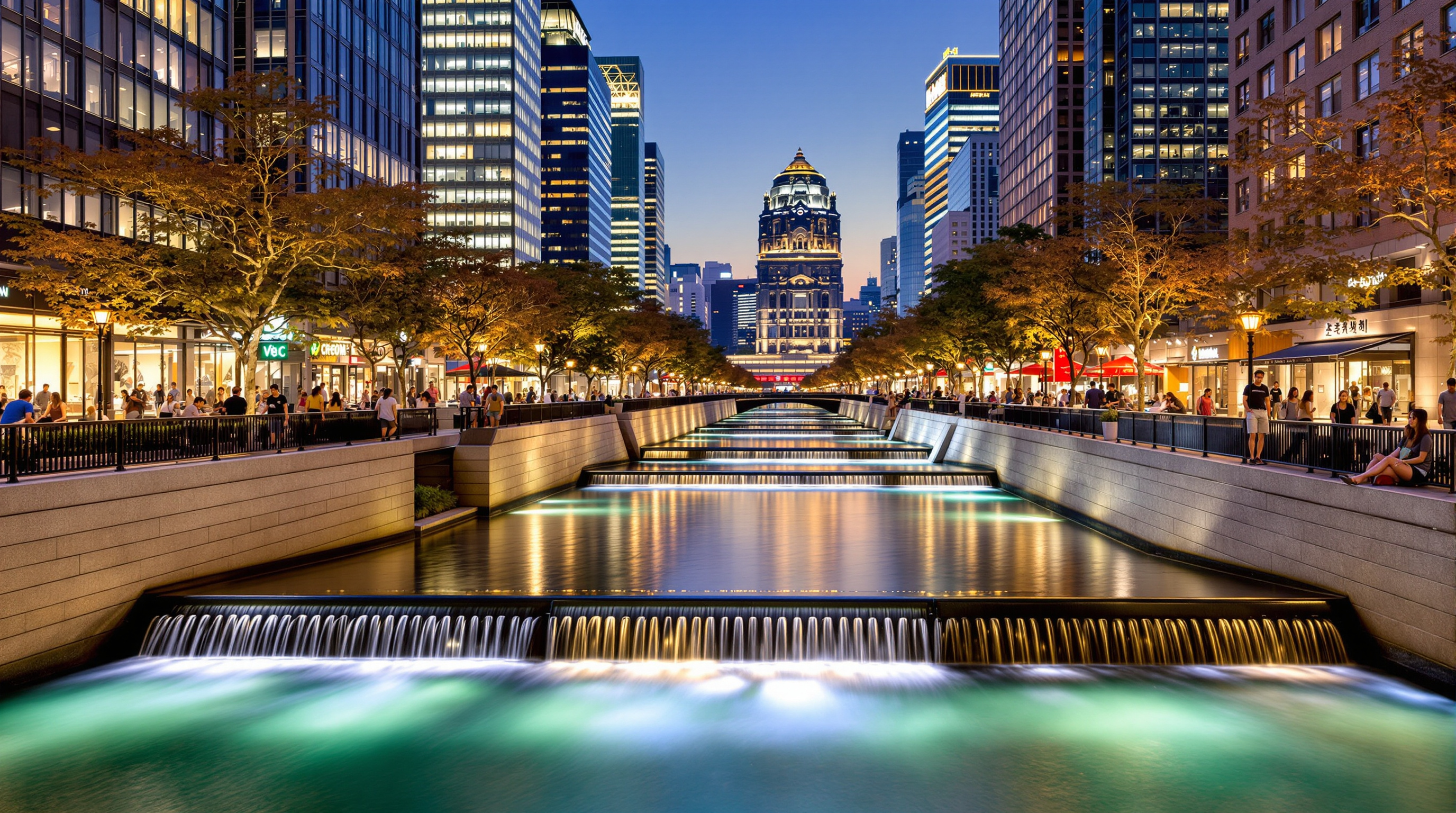
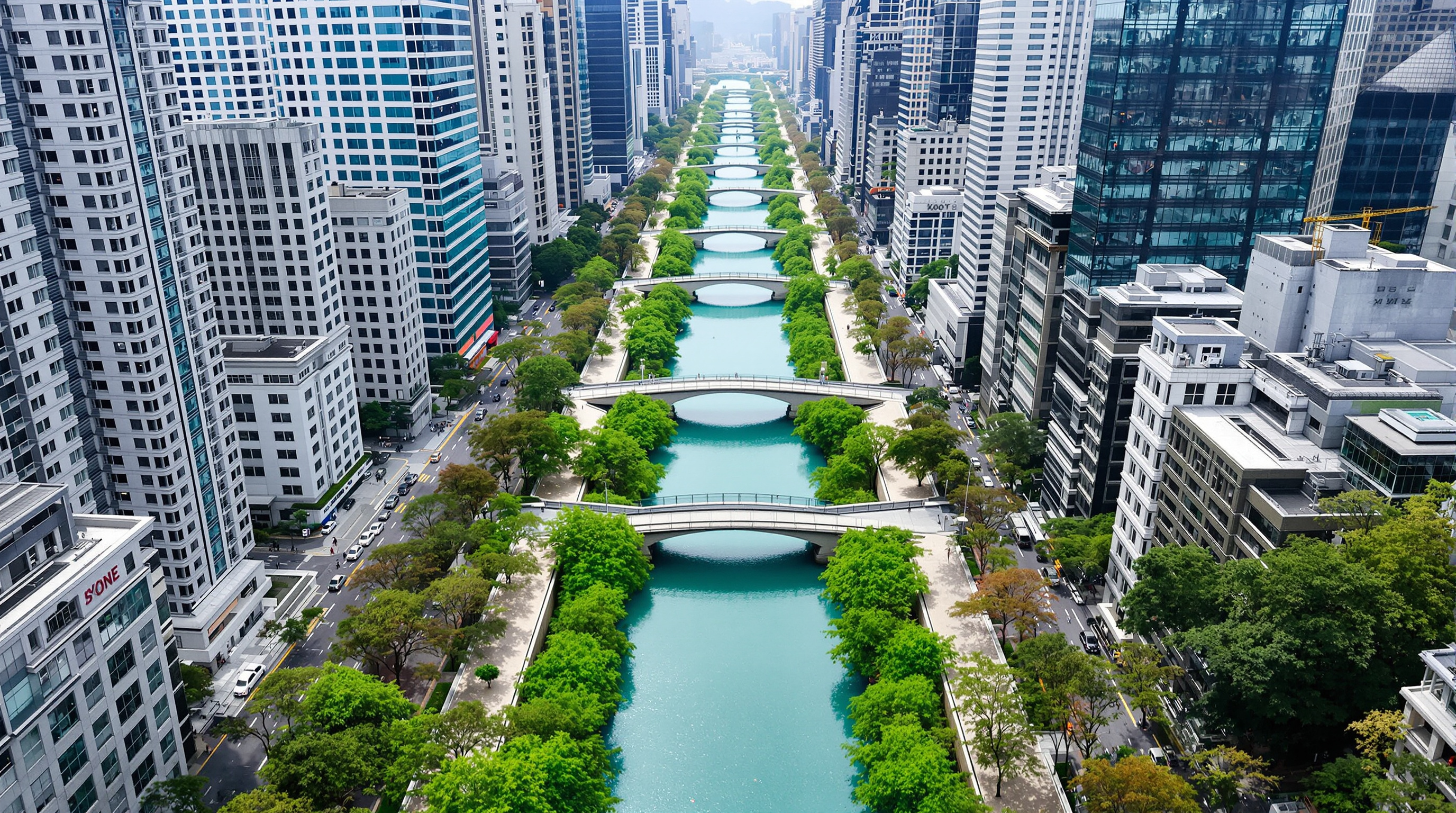
What Seoul did next is why the project belongs in any account of where architecture is going. Between July 2003 and its opening on 1 October 2005, the city removed the expressway and the deck beneath it and put the stream back — 5.8 kilometres of open water, terraced walkways and twenty-two new bridges, threaded through the densest real estate in the country. The central architectural act was not addition but subtraction: the most radical thing the designers did was take something away.
The most future-facing move a twenty-first-century city can make is sometimes to un-build. Cheonggyecheon proposed that the reversal of an infrastructural decision — the deletion of a highway — could itself be a work of design, and that the ground recovered belongs to water and pedestrians before it belongs to cars.
The question it poses
Marc Kushner's framing for this canon asks what a building tells us about the future of architecture. Cheonggyecheon's answer is uncomfortable for a profession trained to build: that the discipline's next frontier may lie in deciding what to remove. It sits at the head of a whole chapter of projects — New York's High Line, Madrid Río, Barcelona's superblocks, Seoul's own later Seoullo 7017 — that reclaim hard infrastructure for the public realm. But Cheonggyecheon is the most absolute of them, because it did not repurpose the highway; it erased it.
That erasure was politically improbable. When Mayor Lee Myung-bak launched the scheme in 2003, traffic engineers forecast gridlock and the corridor's merchants — thousands of them in the tool markets and textile shops lining the route — feared ruin. The counter-intuitive outcome became one of the most cited results in transport planning: metropolitan traffic did not seize up. Studies by the Seoul Development Institute found that although some parallel roads grew busier, the aggregate effect on citywide congestion was negligible, a real-world demonstration of "disappearing traffic" and the reversal of induced demand sometimes discussed under Braess's paradox. Remove the road capacity and a share of the trips simply evaporate, redistributing to transit, other times, or other routes.
Subtraction as design: the section
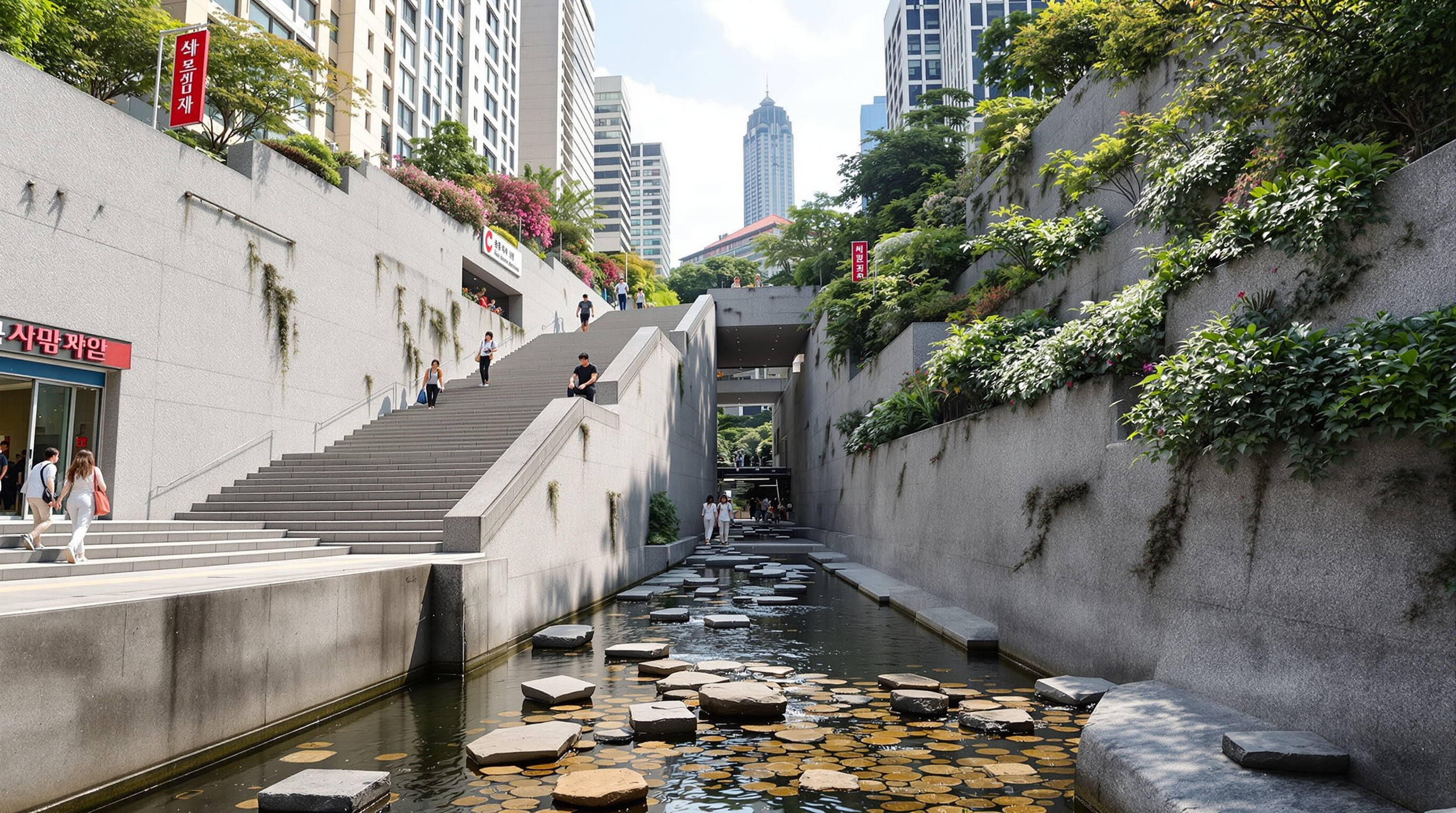
To understand the project you have to read it in section, because almost everything interesting happens vertically. The old condition was a three-layer stack: a buried box culvert at the bottom carrying the remnant stream and sewage, a surface road above it, and the elevated expressway on piers above that. The restoration collapsed the stack. Off came the viaduct; up came the deck; and the stream was re-exposed in a sunken channel roughly six metres below the surrounding streets.
The genius and the vulnerability of the design both live in this section. By pushing the water down and terracing the banks, the designers created a linear room below the traffic — a corridor where the noise, dust and speed of the city fall away and the dominant sounds become water and footsteps. The stepped edges are not merely picturesque; they are the flood strategy. In dry weather people walk close to the water on stone stepping-paths and low quays; in a storm the channel is engineered to swell up the terraces, and the scheme is dimensioned to handle a 200-year flood event, with capacity quoted around 118 mm of rainfall per hour. The park is designed to be periodically, deliberately, flooded and closed.
The awkward truth about the water
Here is the fact that every honest account of Cheonggyecheon must confront: the stream is pumped. The original watercourse, its catchment long since paved and plumbed into Seoul's sewers, could not deliver a reliable, clean flow. So the restored stream is fed artificially — roughly 120,000 tonnes of water a day lifted and treated from the Han River, its tributaries, and groundwater drawn from the city's subway stations, then released at the head of the channel to flow downstream by gravity.
This is why critics call it a water feature rather than a river, and the charge has force. A restoration that depends on continuous pumping is an ecosystem on life support; switch off the power and the "stream" is a dry trench. It consumes energy indefinitely and its hydrology is a designed fiction rather than a recovered nature. Annual maintenance has been reported at around ₩7.1 billion, a permanent operating cost the demolished highway never carried in quite the same way.
And yet the built results, measured empirically, are hard to dismiss. The daylit corridor functions as a cooling channel through the urban heat island, and the ecological rebound in the reconstructed banks has been striking.
| Indicator | Before / baseline | After restoration |
|---|---|---|
| Air temperature by the stream | ambient | 3.3–5.9 degrees C cooler than parallel roads 4–7 blocks away |
| Small-particle air pollution | 74 micrograms/m3 | 48 micrograms/m3 (about 35% lower) |
| Plant species | 62 | 308 |
| Fish species | 4 | 25 |
| Bird species | 6 | 36 |
| Total biodiversity (2003–2008) | baseline | reported up ~639% |
| Daily visitors | — | ~64,000 |
So the same feature — an artificially fed, heavily engineered channel — is both the project's weakest ecological claim and the engine of measurable public benefit. Cheonggyecheon refuses to be either a pure success or a pure fraud, and that ambiguity is precisely what makes it instructive.
Which past were they restoring?
The word "restoration" implies a return to some prior state — but which one? This is the subtlest critique in the scholarly literature, and it is an architectural question as much as a historical one. The design leans on a dynastic, pre-industrial imaginary: reconstructed stone bridges, references to the Joseon-era stream, a picturesque naturalism. What it largely edits out is the twentieth-century Cheonggyecheon — the shanty settlements of post-war refugees, the dense informal markets, the working-class industrial river that the covered culvert and the expressway actually replaced. Historians of technology have read the project as an "envirotechnical" negotiation in which a distant, flattering past was summoned and a recent, complicated one was quietly erased along with the concrete.
That editing has social consequences. Land prices within fifty metres of the water rose an estimated 30–50%, and the amenity that was sold as a democratic public gift also accelerated gentrification, pressuring exactly the small merchants and low-income residents whose city the restoration displaced. Political scientists have further argued that the restored stream became a vehicle for its sponsor: the project's speed and symbolism helped propel Lee Myung-bak from Seoul's city hall to the national presidency in 2008, and coalitions of ecologists who pushed for a slower, more genuinely ecological restoration were, on this reading, sidelined by an "environmental managerialism" oriented to political timelines.
Studio Matrx's editorial position is to hold these truths together. Cheonggyecheon is a landmark demonstration that a city can un-build a motorway and gain a beloved public place with real environmental performance — and it is a manicured, pumped, politically expedient landscape that airbrushed the poorer history it paved over. Both statements are true. The building's lesson is not that subtraction is automatically virtuous, but that removing infrastructure is a design act with the same freight of choices — what to keep, what to erase, whom it serves — as any act of construction.
Why it belongs in the canon
Strip away the politics and the pumps and one precedent remains: before Cheonggyecheon, no major city had removed a functioning downtown expressway on this scale and replaced it with open water and public space — and been vindicated by the traffic data. It changed what mayors believe is possible. San Francisco's Embarcadero had hinted at it after an earthquake forced the issue; Cheonggyecheon did it by choice, at the centre of a megacity, and turned the result into a global reference for highway removal, stream daylighting and blue-green infrastructure.
Where architecture goes next is, increasingly, backward and downward — into the buried creeks, the redundant viaducts, the over-engineered river channels of the twentieth century, asking which of them a warming, denser, less car-dependent city should quietly take apart. Cheonggyecheon is the flawed, luminous, load-bearing precedent for that whole movement. It proposed that the most forward-looking thing a city can build is sometimes the confident decision to un-build.
References
- Cho, M.-R. (2010). "The politics of urban nature restoration: The case of Cheonggyecheon restoration in Seoul, Korea." International Development Planning Review, 32(2), 145–165. Liverpool University Press. DOI: 10.3828/idpr.2010.05. (peer-reviewed; the central political critique — environmental managerialism vs. deep ecology)
- Kim, H. & Jung, Y. (2019). "Is Cheonggyecheon sustainable? A systematic literature review of a stream restoration in Seoul, South Korea." Sustainable Cities and Society, 45, 59–69. Elsevier. DOI: 10.1016/j.scs.2018.11.018. (peer-reviewed; synthesises 86 studies across environment, economy and equity)
- Author(s), Environmental History (2019). "Restoring and Re-Restoring the Cheonggyecheon: Nature, Technology, and History in Seoul, South Korea." Environmental History, 24(4). Oxford University Press / ASEH. DOI: 10.1093/envhis/emz032. (peer-reviewed; the "envirotechnical" reading of which past was restored)
- Busquets, J. (ed.) (2011). Deconstruction/Construction: The Cheonggyecheon Restoration Project in Seoul. Harvard University Graduate School of Design. (scholarly monograph; design and urban-analysis documentation)
- Landscape Architecture Foundation, "Cheonggyecheon Stream Restoration Project," Landscape Performance Series. landscapeperformance.org (primary-adjacent performance data: biodiversity, temperature, air quality; designer credited as SeoAhn Total Landscape)
- Seoul Metropolitan Government / Seoul Solution, project overview and Seoul Development Institute traffic and cost data (₩386 billion; 5.8 km; opened 1 October 2005; 120,000 t/day pumped supply). (primary source)
- "Cheonggyecheon." Wikipedia. en.wikipedia.org/wiki/Cheonggyecheon (tertiary reference; used to cross-check dates, dimensions and criticism summaries)
Part of The Future of Architecture in 300 Buildings — Studio Matrx's canon of the buildings asking where architecture goes next. Chapter 13: Landscape, Public Realm & Cultural Ground.
Export this guide
Related Guides — Deep-dive reading
Hunter's Point South Park: The Waterfront That Was Designed to Flood
SWA/Balsley, Weiss/Manfredi and Arup turned an abandoned Queens shoreline into an 11-acre park that yields to the East River instead of walling it out — a working prototype for the 'soft', adaptive, resilient public realm that a warming, rising-water century now demands.
The Future of Architecture+POOL: The Floating Pool That Wants to Filter a River Clean
Family and PlayLab's plus-shaped pool for New York's East River proposes a radical idea — a piece of public leisure that is also a piece of water infrastructure, swimming its own river water clean through the walls that hold it up. After sixteen years of crowdfunding, testing and delay, it is the definitive case study in architecture as civic utility.
The Future of ArchitectureACROS Fukuoka: Emilio Ambasz and the Building That Gave Its Park Back
Two decades before the vertical forest, Emilio Ambasz hid a million square feet of concert hall and offices under a fifteen-storey climbing garden — turning the oldest argument in cities, land value versus open space, into a single terraced hill in the heart of Fukuoka.
The Future of ArchitectureRelated Tools — Try Free
Acoustic Privacy (STC) Visualizer
Indian healthcare acoustic visualizer — compare wall assemblies and noise sources, see received SPL after STC attenuation, and check FGI 2018 / IS 1950 / NABH speech-privacy compliance with live dual-canvas waveform.
Acoustic ToolDesign Brief Generator
Answer 10 questions and generate a professional interior design brief PDF for your designer or architect.
Brief GeneratorFalse Ceiling Cost Estimator
Live ₹/sqft across 8 ceiling types — POP, gypsum, designer, metal, PVC, wooden — with cove and spot lighting for 20 Indian cities.
Cost Calculator