
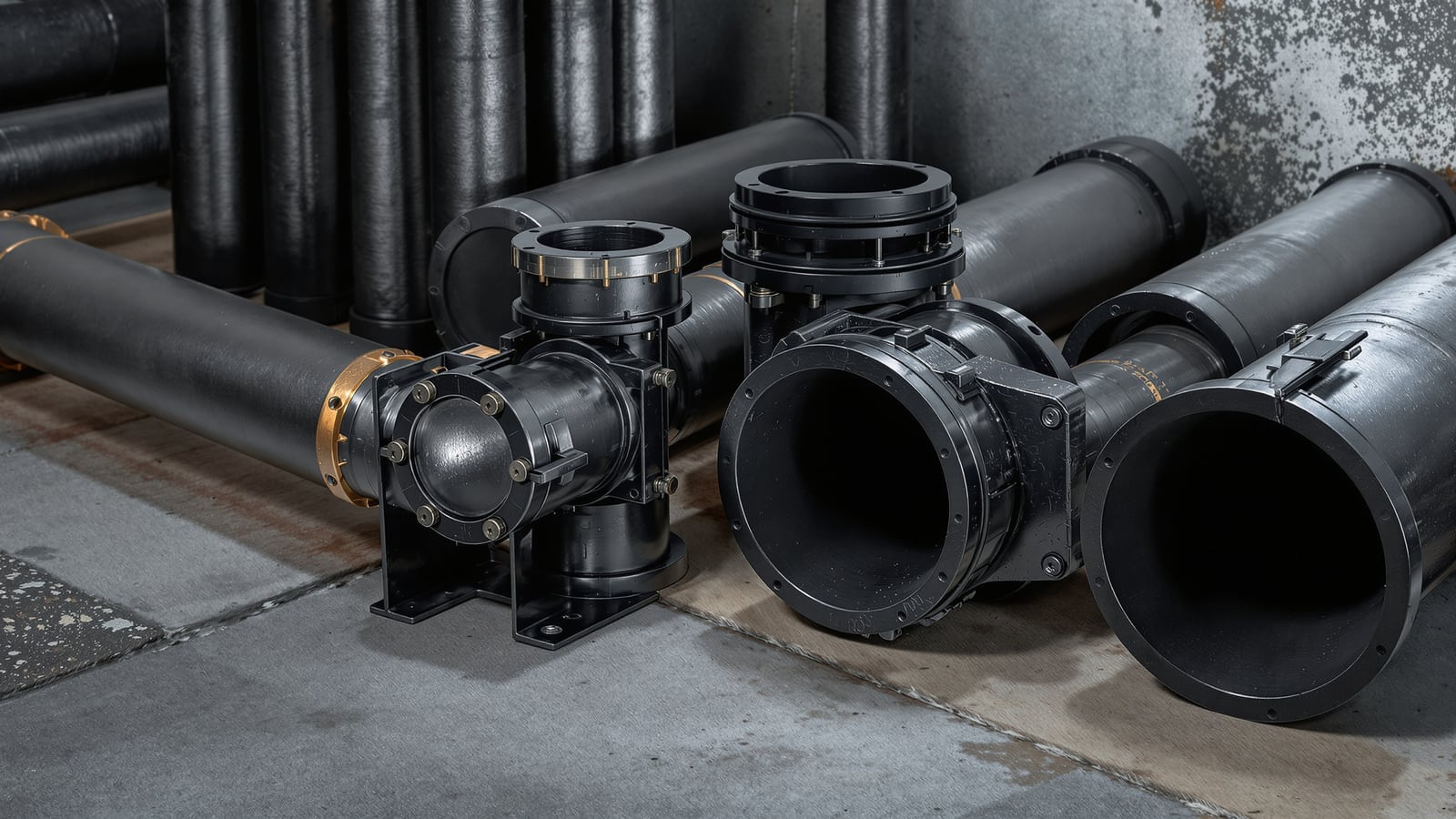
Cast Iron Pipes in India: The Quiet, Fire-Safe Soil Stack Material
A professional, India-first profile of cast iron drainage pipe — hub-and-spigot vs hubless (no-hub) jointing, the acoustic and fire advantages that keep it in premium high-rise soil stacks, sizes, corrosion, handling, indicative cost and the IS standards that govern it.
Plastic won the supply lines, but cast iron never fully left the drainage shaft. In premium apartments, five-star hotels and hospitals across India, the soil stack is still specified in cast iron for two reasons plastic cannot match: it is quiet and it is fire-safe. This Studio Matrx profile is a single-material deep dive — what cast iron drainage pipe is, how it joints, where it earns its price, and how to specify it.
Cast iron here means drainage pipe — soil, waste and vent (SWV) — not pressure supply. If you are placing a material within a whole system, start from the Plumbing Pipes Guide pillar. For the plastic it usually competes with on a stack, read our PVC Pipes profile. How these stacks are sized, vented and offset belongs to the forthcoming Drainage Systems Guide.
What cast iron drainage pipe actually is
Cast iron SWV pipe is grey cast iron formed into spigot-and-socket or plain-ended lengths for gravity drainage inside and below buildings. It carries no working pressure — it moves foul water, waste and vented air by gravity, so it is rated by class and wall thickness, not by a pressure number like uPVC or CPVC.
Two manufacturing routes dominate, and they map onto two Indian standards:
- Sand-cast pipe — poured into sand moulds. Covered by IS 1729. Heavier, rougher, the traditional hub-and-spigot article.
- Centrifugally cast (spun) pipe — metal spun in a rotating mould for a denser, more uniform wall. Covered by IS 3989. Finer bore and better tolerances; the basis of most modern hub-and-spigot SWV pipe in India.
Alongside these, the imported and premium market uses hubless (no-hub) cast iron — often called SML pipe after the European drainage type — jointed with stainless-steel coupling bands rather than caulked sockets. That style follows the European drainage standard EN 877 rather than an IS number.
Why it survives: quiet and fire-safe
Everything else about cast iron — the weight, the cost, the corrosion worry — is a tax you pay for two properties that matter enormously in a good building.
- Acoustic performance. A dense, thick metal wall damps the roar of a flushing WC and the drum of falling waste far better than thin plastic. On an upper-floor bedroom wall or a hotel corridor, a PVC stack broadcasts every flush; a cast iron stack is close to silent. The mass and internal damping of the metal absorb the impact energy of falling water instead of radiating it as noise. This is the single biggest reason cast iron is still written into premium residential and hospitality specs.
- Fire resistance. Cast iron is non-combustible and holds its shape at temperatures that melt or collapse a plastic stack. A plastic soil pipe passing through a fire compartment needs an intumescent fire collar at every floor slab to reseal the opening when the pipe burns away; a cast iron stack maintains compartment integrity on its own, simplifying passive fire protection in the shaft. In hospitals, hotels and high-occupancy towers this is a genuine life-safety argument, not a preference.
The professional short version: you specify cast iron on a stack when silence or fire compartmentation is worth more than the material premium — bedroom-adjacent stacks, hotel guest floors, hospitals, and tall towers where a plastic stack's fire collars multiply across every slab.
Two more properties come along for free: cast iron does not sag or creep between supports the way plastic can at drainage temperatures, and it is dimensionally stable — no significant thermal movement to detail for, unlike a tall PVC stack that needs expansion sockets.
Jointing: hub-and-spigot vs hubless
The joint is where cast iron systems really differ from one another, and it drives labour cost and site speed.
Hub-and-spigot (socketed). The spigot of one pipe enters the socket (hub) of the next. Historically the annular gap was packed with yarn and molten lead (caulked), which is slow, skilled and now largely obsolete. Modern practice uses a rubber gasket / compression joint seated in the socket, which is faster and needs no hot work. Sand-cast (IS 1729) and spun (IS 3989) pipe are both socketed types.
Hubless / no-hub (SML). Both pipe ends are plain. The joint is made externally with a coupling — an EPDM rubber sleeve inside a stainless-steel shear band tightened by worm-drive clamps. No sockets, no lead, no solvent. It is the fastest cast iron joint to make, is fully demountable for maintenance, takes less shaft width, and is the norm for imported EN 877 systems.
| Joint type | How it seals | Standard basis | Site characteristics |
|---|---|---|---|
| Caulked lead-and-yarn hub | Molten lead run into socket, caulked | Traditional IS 1729 | Slow, skilled, hot work; legacy only |
| Gasketed hub-and-spigot | Rubber ring compressed in socket | IS 1729 / IS 3989 | No hot work; moderate speed |
| Hubless (no-hub) coupling | EPDM sleeve + SS shear band clamp | EN 877 (SML) | Fastest, demountable, slim shaft |
The diagram contrasts the socketed joint with the hubless coupling.
Sizes, classes and specification
Cast iron SWV pipe is sold by nominal bore in millimetres, usually in 3 m lengths, in light (LA), medium and heavy grades depending on the standard and duty. The table gives indicative, real-world figures for gravity drainage service — confirm the exact class and wall against the current IS sheet before ordering.
| Nominal bore | Typical use on the stack | Wall / class note | Working condition |
|---|---|---|---|
| 50 mm | Waste branch (basin, sink, urinal) | Light/medium grade | Gravity, no pressure |
| 75 mm | Waste and small vent | Medium grade | Gravity, no pressure |
| 100 mm | Main soil stack (WC) | Medium/heavy grade | Gravity; most common stack size |
| 150 mm | Collector, tall / high-load stack | Heavy grade | Gravity; large DFU load |
| 200 mm+ | Basement / building drain header | Heavy grade | Gravity; buried or suspended |
Specification essentials for a professional stack:
- Call the standard and class by name — for example spun iron to IS 3989, medium grade — plus the jointing system (gasketed hub or hubless EN 877 coupling), and hold both to one manufacturer's system so pipes, fittings and couplings match.
- Support is not optional. Cast iron is heavy; every length needs a bracket, and hubless stacks need a support and a lateral restraint (a sway brace) at each floor so the couplings are not asked to carry load or take thrust at bends.
- Line the bore where the effluent is aggressive. For low-pH or industrial waste, use factory epoxy-coated or lined cast iron rather than bare metal.
Corrosion, weight and handling — the honest limits
Cast iron is not maintenance-free, and pretending otherwise is how stacks fail early.
- Corrosion. Bare cast iron rusts, and thin waste water plus foul gases attack it over decades. Modern pipe ships with a bituminous or epoxy coating inside and out; keep that coating intact and touch up cut ends. Buried cast iron in aggressive or saline soil needs external protection or a change of material. This is the property where PVC simply wins — plastic does not corrode.
- Weight and handling. A metre of 100 mm cast iron is heavy; lengths need two hands or lifting gear, cutting needs a chain snap-cutter or grinder, and site handling is slower and more hazardous than plastic. That labour and crane time is a real line item.
- Brittleness. Grey cast iron is strong in service but can crack if dropped or struck hard on site; handle and stack it with care.
The diagram shows where the material typically lands in a building — the reasoning, not a to-scale layout.
Note the hybrid that most real Indian projects settle on: cast iron for the vertical stack and collector where noise and fire matter most, with short plastic waste branches inside the flat where they are cheap, easy and out of earshot. You rarely specify a whole building in cast iron; you specify it where it pays.
Where it is used in India
- Premium residential towers — bedroom-adjacent and living-room-adjacent soil stacks, where flush noise would otherwise carry.
- Hotels and serviced apartments — guest-floor stacks, where acoustic comfort is a rated part of the product.
- Hospitals and labs — where fire compartmentation and durability against continuous use dominate.
- Retrofit into heritage and older RCC buildings — matching an existing cast iron system and preserving fire performance.
Indicative cost
Cast iron drainage is a premium line. As a rough, indicative guide for material at current Indian trade prices, expect spun/socketed pipe in the order of ₹450 to ₹900 per metre for 100 mm, rising with bore and grade; hubless EN 877 pipe with stainless couplings runs higher again. Add the heavier installation labour, brackets and lifting. Against a PVC stack, the fully installed cast iron stack can cost several times as much — which is exactly why it is reserved for the walls where quiet and fire safety justify it. Treat every figure here as indicative and confirm live quotes and the current class against the IS sheet before you price a job.
For where this pipe sits in the wider drainage design — stack sizing, venting, offsets and the connection to treatment — hand off to the Drainage Systems Guide, and compare the plastic alternative in the PVC Pipes profile. Studio Matrx guides give you the model; the local code and current IS sheet give you the numbers.
References
- IS 1729 — Sand cast iron spigot and socket soil, waste and ventilating pipes, fittings and accessories (specification).
- IS 3989 — Centrifugally cast (spun) iron spigot and socket soil, waste and ventilating pipes, fittings and accessories (specification).
- EN 877 — Cast iron pipes and fittings, their joints and accessories for the evacuation of water from buildings (basis of hubless / SML drainage systems).
- National Building Code of India (NBC) 2016, Part 9 — Plumbing Services for drainage, venting and sanitation provisions (confirm the current edition and referenced IS standards before specifying).
Export this guide
Related Guides — Deep-dive reading
GI Pipes in India: The Legacy Steel Water Pipe, Why It Rusts, and When It Still Makes Sense
Galvanised iron was the standard water pipe in Indian homes for decades. Here is what GI is, how its threaded joints work, why it corrodes and chokes flow, where it still earns its place, and how to read its sizes and IS 1239 classes.
PlumbingBuilding Plumbing Services Guide (India): MEP-Grade Water, Drainage & Riser Design
A professional, India-first reference to plumbing engineering for larger and commercial buildings — integrated design with MEP, multi-storey water distribution, and drainage and venting stacks.
PlumbingPlumbing Pipes Guide: Every Material & How to Choose (India)
The section pillar for plumbing pipe materials in India — the full family of thermoplastics, metals, iron, concrete and clay, which pipe belongs on hot supply, cold supply, drainage, underground and sewer duty, a comparison-at-a-glance table, sizing basics, jointing methods, and a plain-language method for choosing.
PlumbingRelated Tools — Try Free
Acoustic Privacy (STC) Visualizer
Indian healthcare acoustic visualizer — compare wall assemblies and noise sources, see received SPL after STC attenuation, and check FGI 2018 / IS 1950 / NABH speech-privacy compliance with live dual-canvas waveform.
Acoustic ToolApartment Video Door System Planner
Enter flats, entrances, floors and guard desk for a first-pass building intercom plan — door stations, indoor monitors, guard station, the right architecture and an indicative cost band.
Building PlannerDesign Style Finder Quiz
Answer 10 visual questions to discover your Indian interior style profile with materials and colours.
Interactive Quiz