
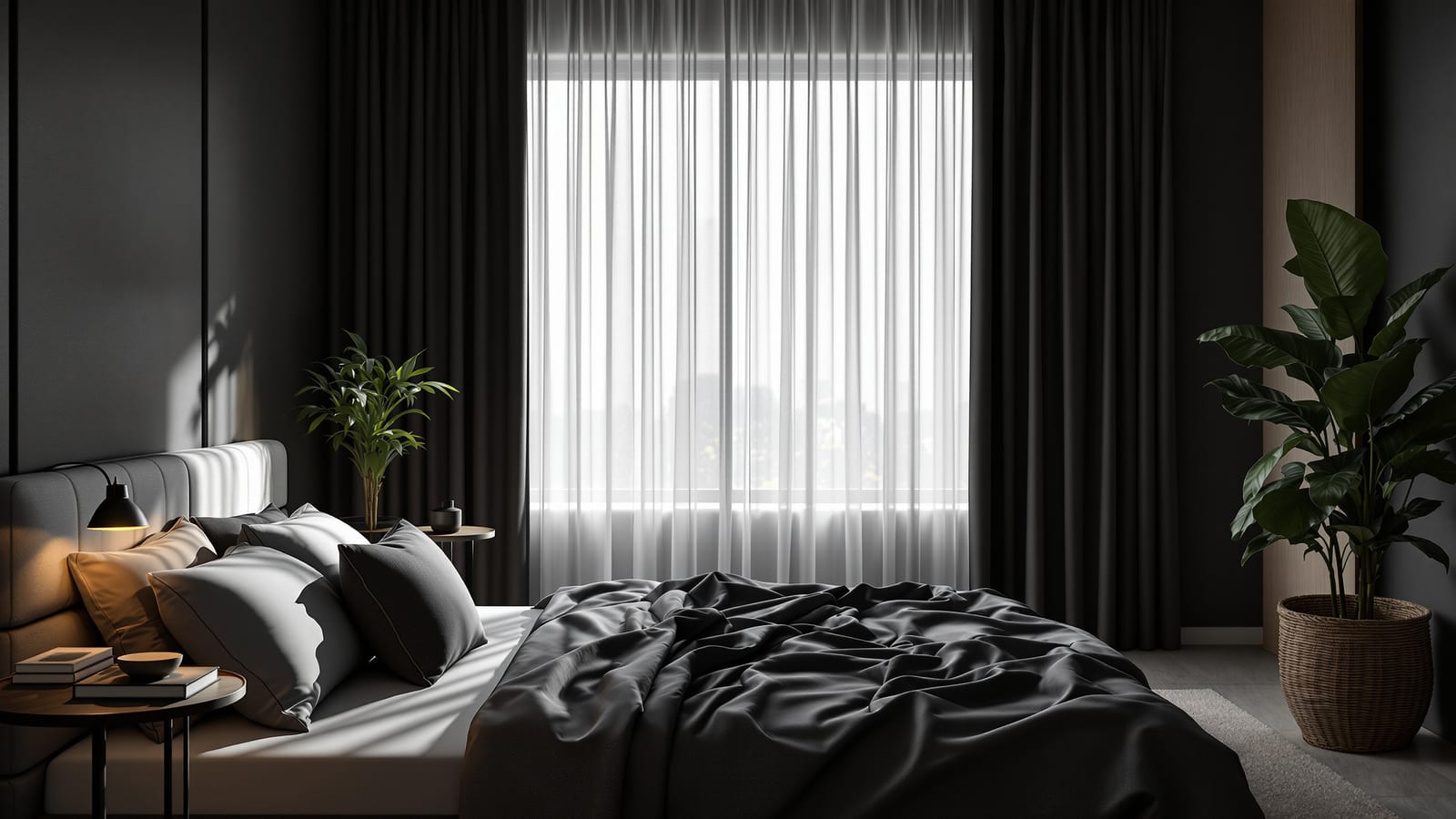
Home Theatre Curtains: Total Blackout and Better Sound (India 2026)
How to dress a media-room window and wall for cinema dark and cleaner sound — sealing every light gap, choosing heavy non-reflective fabric for acoustics, and motorising the whole thing for scenes, with honest Indian costs.
A home theatre is the one room where a curtain is not decoration at all — it is equipment. Every other room wants some light and some softness. The media room wants the opposite: cinema-grade darkness so the projector or panel can show true blacks, and a soft, dead acoustic so dialogue stays crisp and bass does not boom. The good news is that a single well-specified curtain can deliver a large share of both jobs at once, because the same heavy, dark, full fabric that kills light also absorbs sound.
This guide is about getting that one curtain right in an Indian home — whether your theatre is a converted bedroom in a flat or a dedicated basement room in a villa. It is less about which colour and more about how you seal, hang and weight the cloth.
In a normal room a little light leak is harmless. In a home theatre a single bright sliver beside the curtain washes out the screen and ruins the black levels you paid for. Total blackout is not a nicer version of blackout — it is a different, stricter job.
Total blackout: it is about the gaps, not the cloth
Most people buy a "blackout" fabric and assume the room will go dark. It will not — because light does not come through good blackout cloth, it comes around it. The real work is sealing the perimeter. Aim for these five rules on every window:
- Wall to wall, not window to window. Run the track the full width of the wall, not just across the glass. This removes the bright vertical strips that always appear at the sides of a window-width curtain.
- Ceiling to floor. Mount the track at the ceiling (or in a recessed pocket) and let the curtain pool slightly on the floor. A gap at the top or a hovering hem is a light leak.
- Generous overlap at the centre. Where two panels meet, overlap them by 10 to 15 cm so no seam of daylight survives between them. A single panel that draws fully one way avoids the centre gap entirely.
- Return the ends to the wall. Bend the track ends back to touch the side walls (a "return") so light cannot sneak behind the panel edge.
- Seal the layer behind. Add a side-channel blackout roller blind or a blackout-lined panel directly on the glass as a first layer, then the heavy theatre curtain in front. Two layers beat one for both light and sound.
A genuinely blackout cloth matters too — the dedicated blackout curtains guide covers coated vs three-pass weaves — but spend your attention on the perimeter. A mediocre fabric sealed perfectly beats a perfect fabric with a 5 mm gap.
Heavy, dark, non-reflective: the fabric brief
Three fabric properties matter in a theatre, and they happen to point at the same cloth.
- Heavy and full. Mass blocks light and absorbs sound. Go for a heavyweight velvet or a thick blackout-lined drape at generous fullness — 2.5x the track width, not the usual 2x — so the folds themselves trap sound. A flat, taut curtain reflects sound and looks cheap; deep folds are doing acoustic work.
- Dark and matte. The room should not bounce screen light back at you. Choose deep charcoal, navy, oxblood, forest or true black, in a matte, non-reflective finish. Avoid sheen, satin or anything metallic — a shiny curtain catches the screen and shows up as a grey glow in your peripheral vision.
- Acoustically absorbent. Cut pile fabrics like cotton or polyester velvet absorb mid and high frequencies far better than thin cloth. The deep velvet curtains guide explains why the pile and weight do this — in a theatre that absorption tames echo and keeps dialogue intelligible.
Velvet is the classic theatre cloth for exactly these reasons. The honest caveat for India: velvet holds dust and heat, so keep a vacuuming habit and remember a closed dark curtain on a sunny wall warms the room — a real consideration if your theatre shares a west wall and the AC is modest.
Curtains are not soundproofing — set the expectation
This is the most important caveat in the guide. A heavy curtain absorbs sound inside the room (less echo, clearer dialogue). It does very little to block sound from passing through the wall to the rest of the flat, or to stop your neighbour's noise getting in. Those are two different problems:
| Goal | What it does | What solves it |
|---|---|---|
| Absorption | Reduces echo and reflection inside the room | Heavy velvet curtains, full folds, soft furnishings |
| Blocking (isolation) | Stops sound passing through walls/doors | Mass in the wall, sealed solid-core door, acoustic gaskets |
Curtains are excellent at the first and weak at the second. The soundproof curtains guide is honest about that limit. If your real problem is the rest of the house hearing your action films at 11 pm, the curtain helps a little but the door, wall and door-bottom seal do the heavy lifting.
Acoustic wall curtains: dressing more than the window
A serious media room often runs heavy curtains along a whole wall, not just the window — and even across a blank wall — as acoustic treatment. Two reasons:
- Symmetry and reflection control. A floor-to-ceiling curtain on the side walls (especially the first reflection points beside and behind the seating) softens the early reflections that smear dialogue.
- A clean, dark surround. Running the same matte dark curtain across the front and side walls hides clutter, kills stray reflections of the screen, and makes the room feel like a cinema rather than a bedroom with a TV.
Combine this with the room's other absorption — a thick rug on a hard floor, an upholstered sofa, acoustic foam or fabric panels at the key reflection points, and a soft ceiling treatment. The curtain is one instrument in that kit, not the whole orchestra. The aim is a room that sounds slightly "dead" and warm, not echoey.
Motorise it: scenes make the room
This is the upgrade that makes a home theatre feel finished. A motorised, wall-to-wall track lets you build scenes:
- "Movie" scene — lights dim, blackout curtain glides shut, projector wakes, all from one tap or voice command.
- "Reset" scene — curtain opens, lights up, the room becomes a normal den again.
Mount a wired (mains) motor where you can — it is powerful, silent enough, and never needs recharging — and plan the cabling before the false ceiling closes. Battery-rechargeable motors retrofit a finished room but need topping up every few months. Tie the motor into the same Alexa, Google Home or Matter ecosystem your AV gear already uses so the scene is one command. The motorised curtains guide covers wired vs battery and ecosystem choices in full.
One detail people miss: in a dark room you want a quiet motor and a soft-start so the curtain does not jolt the silence during a film. Ask for a slow, near-silent motor specifically.
What a home theatre curtain costs in India
Treat these as honest ranges, not quotes — fabric, fullness, wall width and city move them a lot:
- Window-only blackout drape — a single sealed, blackout-lined window in heavy fabric typically lands in the low-to-mid thousands of rupees, more for velvet.
- Wall-to-wall, floor-to-ceiling velvet — the signature theatre look across a full wall climbs to the mid-to-high tens of thousands, driven by metres of fabric at 2.5x fullness plus stitching and lining.
- Acoustic side-wall curtains — add per-wall fabric and track cost again for each treated wall.
- Motorisation — a quiet wired motor and heavy-duty track adds a per-window cost on top, plus optional hub; battery motors cost more per unit but save the cabling.
The cost driver here is metres of heavy fabric at high fullness, not the print or colour. Price your fabric and fullness honestly before committing.
Price your media room before you buy. Use the curtain cost calculator to turn your wall width, drop and 2.5x fullness into fabric metres and a per-window figure, and the window treatment selector to confirm a heavy blackout-and-absorption setup is right for the room. Start from the complete curtain guide and the wider window treatments cluster to see how the theatre curtain fits the rest of your home.
The honest caveats
Three things worth stating plainly before you spend:
- A curtain alone will not make a true blackout if the room has other light sources — standby LEDs, a glowing AC display, light under the door. Blackout the curtain and tape over the stray LEDs and seal the door bottom.
- Heavy dark velvet warms a sunny room. If your theatre shares a hot west or south wall, the closed curtain helps darkness but adds to the cooling load — size the AC accordingly.
- Absorption has a limit. Over-curtain a room and it can go too "dead" and dull; the goal is controlled, warm sound, balanced with a few harder surfaces, not a padded cell.
Get the seal right, buy the weight, keep the surface matte and dark, and motorise the main track — and an ordinary Indian flat or villa room turns into a genuine cinema.
Export this guide
Related Guides — Deep-dive reading
Soundproof Doors in India: How Doors Leak Sound, STC Ratings, Seals & Real Costs
A door is the weakest acoustic link in any wall - and it usually leaks through the gaps, not the panel - so here is how to actually quieten a bedroom, home theatre or street-facing room, from a 1,500-rupee seal kit to a proper acoustic door.
Home Doors & EntrancesVelvet Curtains: Heavy, Luxe & Sound-Absorbing (India 2026)
Why velvet's sheer mass gives you near-blackout, thermal and acoustic benefits in one panel — plus the honest dust, heat and weight caveats for Indian homes, and what it costs per metre.
Window TreatmentsHotel-Style Curtains at Home: The Blackout + Sheer Luxe Look (India 2026)
How five-star hotels dress a window — full sheer plus total-blackout on one track, floor-to-ceiling and wall-to-wall, generous fullness, concealed rail and a wand at the bedside — and the exact spec to ask for, with Indian costs.
Window TreatmentsRelated Tools — Try Free
Curtain Cost Calculator
Get the fabric metres you need plus the total curtain cost by window size, fabric, pleat, lining and hardware.
Curtain CalculatorBlackout Level Estimator
Estimate how dark a room will actually get from a fabric, lining and fit — and why edge gaps matter most.
EstimatorAcoustic Curtain Calculator
Estimate how much noise and echo heavy, full curtains will dampen — and where they help vs where they can't.
Acoustic Tool