

Internship Readiness — How to Find, Choose, and Excel
Module 5 of the Student Foundations Track — Identifying the Right Firms for Your Interests, the Internship Application Package, the First-Week Protocol, Performance Expectations, How to Convert an Internship into a Long-Term Opportunity, and the Twelve-Test Internship-Readiness Diagnostic for Indian B.Arch Students
The internship is the bridge from architecture school to architectural practice. For most Indian B.Arch students, the first internship — typically taken in Year 4 between Sem 7 and Sem 8 — is the first encounter with how an architectural studio actually works: the briefing, the drawing, the client meeting, the site visit, the iteration, the deadline, the contractor's pushback, the building. A strong internship accelerates a student's development by several semesters of equivalent studio learning. A weak internship — undertaken at the wrong firm, performed without the protocols below, exited without converting feedback — wastes 4-6 months that the student cannot get back.
Module 5 is the working internship reference. It treats the internship as a high-leverage transition — not a coffee-fetching summer job, but a deliberate professional engagement that should produce, by its end, two things: portfolio-worthy work that you contributed to, and a conversion opportunity (full-time offer, return-internship invitation, or a strong referral). Both outcomes are achievable; both require the protocols below.
The orientation is towards Indian B.Arch / B.Des students applying for internships in Indian firms in 2026, with a focus on residential and small-to-mid-scale firms (which is where most Indian architecture students intern). The treatment is operational: how to identify the right firms, how to apply, how to perform, and how to convert.
"The intern who shows up at 9:30, asks the right questions before lunch, and leaves at 7:30 with a deliverable on my desk is the intern I keep. The intern who shows up at 10:30, asks no questions, and leaves at 6:30 with the same deliverable as yesterday is the intern I forget by their second week." — Principal architect, mid-size Bengaluru studio
1. The Five Firm Archetypes — Each Trains You Differently
Indian architecture firms vary enormously in scale, focus, and intern experience. Recognising the archetype changes how you apply, how you perform, and what you take away.
| Archetype | Size | Typical projects | Intern experience |
|---|---|---|---|
| Sole Practitioner | 1-3 people | Boutique residences, small commissions | High personal mentorship; broad scope; little process formality |
| Small Studio (Boutique) | 4-15 | Residences, small institutional, design-led commercial | Best mentor-to-intern ratio in the industry; deep design exposure |
| Mid-Size Practice | 16-60 | Mixed residential + institutional + commercial | Structured workflows; defined intern roles; formal mentorship |
| Large Corporate Practice | 60+ | High-rise residential, mixed-use, IT campuses, hospitals | Process-heavy; intern often on a single project for months |
| International / Specialist | Variable | Hospitality, urban design, conservation, computational | Highest credentialing value; most competitive entry |
Examples (representative, not endorsements):
| Archetype | Indian examples (2026) |
|---|---|
| Sole Practitioner | Independent practitioners with strong portfolios — Anupama Kundoo, Bijoy Jain (Studio Mumbai), early-career studios |
| Small Studio | Studio Lotus, sP+a, Sanjay Puri Architects, Sameep Padora & Associates, Studio Saar, Stapati |
| Mid-Size Practice | Morphogenesis, Studio Lotus expanding, Architecture Discipline, RMA Architects, Khanna Schultz |
| Large Corporate | Hafeez Contractor, Edifice Consultants, Architect Hafeez Contractor, Salient Dezigners |
| International / Specialist | Foster + Partners (India office), Gensler, AECOM, Perkins+Will (mostly via direct global recruitment) |
The student's discipline: match firm archetype to your internship goals. If you want deep mentorship, target small studios. If you want process exposure to large projects, target mid-size or corporate. If you want a credentialing line on your CV, target international. Each archetype has trade-offs; there is no universally "best" internship.
2. The Internship Application Package
Indian firms in 2026 typically expect four documents from internship applicants:
| Document | What it is | Length |
|---|---|---|
| CV / Resume | Single-page summary | 1 page A4 |
| Portfolio (PDF) | Curated work — internship version | 18-26 spreads, max ~25 MB |
| Cover Letter / Email | The why this firm statement | 200-300 words |
| Work Sample (optional) | One detailed project documentation | 4-6 spreads, separate or within portfolio |
CV Discipline
A B.Arch internship CV is one page, A4 portrait, with the structure described in the Student Resources Hub CV template. Header: name + role + institution. Sections: Education · Experience · Skills · Software · Languages · References. Avoid: photos (controversial; some firms prefer them, some do not — when in doubt, omit), excessive design (clean typography signals competence), any fluff.
Portfolio for Internship Application
Refer to Module 3 — Building Your Architecture Portfolio. For internship applications specifically:
- 4-6 strongest projects, not 10
- Each project in 2-4 spreads
- Open with your strongest project, not chronologically first
- Include process spreads (sketches, models, hand drawings) — firms care about how you think
- Customise the cover spread for the firm — name them
Cover Letter — The Most-Underestimated Document
The cover letter is the single most-discriminating document in the application. Most students send a generic letter to every firm; firms can tell. The letter that gets read carefully is specific to the firm.
The 200-300 word structure:
| Paragraph | Content |
|---|---|
| 1 (50 words) | Who you are — name, institution, year, dates available |
| 2 (100 words) | Why this firm — name 1-2 specific projects of theirs that drew you; demonstrate you have studied their work |
| 3 (75 words) | What you bring — 2-3 specific skills relevant to their practice; not a CV repeat |
| 4 (50 words) | Logistics — internship duration, stipend expectations (if any), availability for in-person interview |
The middle paragraph is where most cover letters fail. Generic praise ("I admire your innovative work") signals that the student has not actually studied the firm. Specific reference ("I was struck by how the courtyard at [project name] handles the climate while preserving the public-realm character") signals genuine interest.
Work Sample (Optional but Encouraged)
A 4-6 spread "deep-dive" of one project, separate from the main portfolio. Used when the firm asks for it (rare) or when you want to demonstrate process depth. Ideal for design-led firms (Studio Mumbai, RMA, Studio Lotus) that want to see how you think, not just what you produced.
3. The Outreach Protocol — Cold Email, Warm Referral, Portal
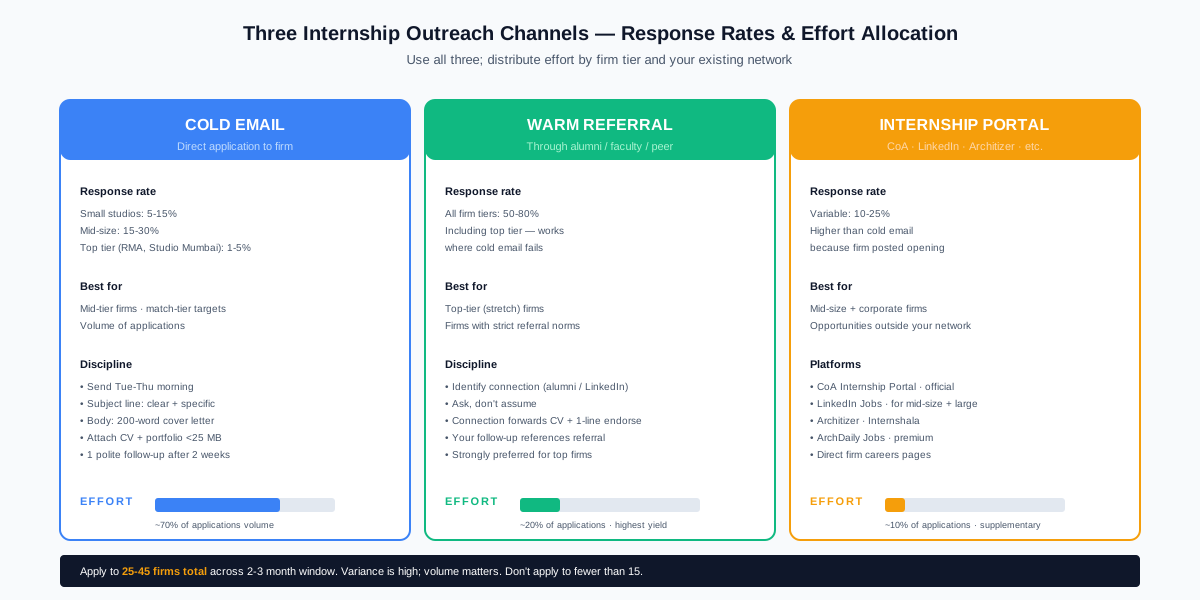
Three channels for internship outreach. Each has its own discipline.
Cold Email (Lowest Response, Most Common)
Direct email to the firm's careers / internships address, or (better) to a partner if findable. Response rate in 2026: 5-15% for design-led small studios; 15-30% for mid-size firms; 1-5% for top firms (RMA, Studio Mumbai, Morphogenesis).
Discipline:
- Send Tuesday-Thursday morning (highest response)
- Subject line: "Internship application — [Your name] · [Institution] · [Dates available]"
- Body: 200-word cover letter (above)
- Attachment: CV (PDF) + Portfolio (PDF, max 25 MB)
- Follow-up: one polite follow-up after 2 weeks if no response; not more
Warm Referral (Highest Response)
Email through a connection — your faculty, a senior, an alumnus of your institution working at the firm, a previous intern. Response rate: 50-80%.
Discipline:
- Identify the connection through alumni network, LinkedIn, or your faculty
- Ask the connection if they're willing to refer (do not assume)
- The referral itself: connection forwards your CV + portfolio with a one-line endorsement
- Your follow-up email to the firm references the referral by name
- Strongly preferred channel for top-tier firms
Internship Portals
Architectural job platforms in India (2026):
| Platform | Type | Notes |
|---|---|---|
| CoA Internship Portal | Official | Council of Architecture-run; institution-mediated |
| Architizer | Global | Job board with India listings |
| LinkedIn Jobs | Global | Strong for mid-size and large firms; weak for small studios |
| Internshala | Indian | Broader internships; some architecture |
| ArchDaily Jobs | Global | Premium / international firms |
| Foundation B / FoundationOne / etc. | Indian | Curated architecture-only |
| Direct firm careers pages | Direct | Best for top-tier firms (Studio Mumbai, RMA) |
The student's discipline: use all three channels. Cold-email broadly to the firm types you can credibly target; pursue warm referrals to the firms you most want; check portals for opportunities you would not have found.
How Many Firms to Apply To
| Priority tier | Firms to target | Realistic offer rate |
|---|---|---|
| Stretch (top design-led) | 5-10 | 1-3 offers if portfolio is strong |
| Match (mid-size + small studios you'd be happy at) | 15-25 | 5-10 offers |
| Safety (any firm willing to take you) | 5-10 | 3-7 offers |
Apply to 25-45 firms total over a 2-3 month application window. Do not apply to fewer than 15; the variance in response is too high.
4. The Interview — What to Expect and How to Prepare
Indian internship interviews in 2026 take three formats:
| Format | Typical setting | Duration |
|---|---|---|
| Portfolio review (in-person) | At the firm's office | 30-60 min |
| Portfolio review (video call) | Zoom / Google Meet | 30-45 min |
| Take-home assignment + interview | Brief assigned 2-7 days before; presented at interview | Brief 4-8 hrs work + 30-60 min interview |
Common Interview Questions
| Question | What they're testing |
|---|---|
| "Walk me through your strongest project" | Presentation skills + design judgement |
| "What drew you to our practice?" | Whether you've actually studied the firm |
| "Where do you see yourself in 3 years?" | Long-term commitment + ambition |
| "What software are you comfortable with?" | Stack alignment + honesty |
| "How do you work in a team?" | Collaboration capability |
| "Tell me about a project that didn't go well" | Self-awareness + growth mindset |
| "What's your design philosophy?" | Architectural identity (or lack of one) |
| "Why should we take you over the other applicants?" | Self-advocacy without arrogance |
Prepare 3-5 anecdote-style answers covering: (a) a project you led, (b) a project that failed, (c) a critique you absorbed and acted on, (d) a software you self-taught, (e) a conflict on a team. These cover most interview questions through analogy.
Salary / Stipend Expectations (India 2026)
Indian internship stipends vary widely. Approximate 2026 ranges:
| Firm type | Monthly stipend (₹) |
|---|---|
| Sole practitioner / very small studio | ₹0 - 5,000 (sometimes unpaid; ethical concerns) |
| Small studio (boutique) | ₹5,000 - 12,000 |
| Mid-size practice | ₹10,000 - 18,000 |
| Large corporate | ₹15,000 - 30,000 |
| International / specialist (in India) | ₹20,000 - 40,000 |
Unpaid internships at well-known firms remain controversial in India in 2026. The Council of Architecture has issued guidance recommending minimum stipends but enforcement is weak. The student's discipline: factor stipend against learning value. A high-learning unpaid internship at Studio Mumbai may be worth more long-term than a paid corporate internship; a low-learning unpaid internship at a sole practitioner is usually a poor trade.
5. The First-Week Protocol
The first week sets the tone for the entire internship. The protocols below are what produce strong impressions in the first 5 working days.
| Day | Protocol |
|---|---|
| Day 1 (Monday) | Arrive 15 min early. Dress one notch smarter than the average dress code. Introduce yourself to everyone you meet. Take notes from your first briefing. Ask: "What's the one thing I should know about working here?" |
| Day 2 | Recap your Day 1 notes with your supervisor. Confirm what you understood. Ask 2-3 specific questions. |
| Day 3 | First deliverable should be in progress. Ask for feedback on the approach before completing. |
| Day 4 | Deliverable complete. Self-review against what you'd want to receive if you were the supervisor. Submit. |
| Day 5 (Friday) | Ask: "What worked, what didn't, what should I do differently next week?" |
The first-week pattern that works: visible engagement, clear questions, prompt deliverables, willingness to receive feedback. The first-week pattern that fails: waiting for instructions, not asking questions, half-finished deliverables, defensive responses to feedback.
6. Daily Performance Expectations
After the first week, the daily protocols are:
| Discipline | What |
|---|---|
| Punctuality | Arrive at the agreed time; if late, message in advance. Never start the day with an excuse. |
| Communication | Daily stand-up (if the firm runs them); else, a 5-line end-of-day email summarising what you did + what's next. |
| Deliverable quality | Submit work that you would not be embarrassed to put in your portfolio. If it's not at that level, it needs another iteration. |
| Question asking | Ask 1-3 specific questions per day. Not "what do I do" but "for this drawing, should I follow X convention or Y?" |
| Time tracking | Maintain a personal log of hours per task. Useful for self-improvement and for the firm if asked. |
| Site visits | Volunteer for site visits; they are 10× as instructive as office work. |
| Documentation | Document your own contributions (with supervisor's permission for confidentiality) for portfolio. |
| Confidentiality | What you see at the firm stays at the firm. Do not post project work on social media without explicit permission. |
The intern who runs these eight protocols consistently is the intern whose name comes up first when the firm needs a junior architect post-graduation.
7. How to Ask for Feedback Productively
Most interns either ask for no feedback (and learn slowly) or ask in a way that prompts vague answers. The framework below produces actionable feedback.
| Bad question | Better question |
|---|---|
| "How am I doing?" | "What's one thing I could be doing better?" |
| "Was that good?" | "Did this drawing meet what you needed? What would have made it better?" |
| "Any feedback?" | "Specifically on the layout — did the proportions read right? Was there too much white space?" |
The discipline: ask specific, narrow, actionable questions. Specific questions get specific answers; broad questions get politeness.
Frequency: weekly check-in is the discipline. 15-minute Friday end-of-week conversation with your supervisor — what worked, what didn't, what's next. If your supervisor doesn't initiate this, you should.
8. Converting an Internship into a Long-Term Opportunity
The strongest internship outcome is a return invitation, full-time offer, or strong referral. Conversion is not luck; it's the result of explicit decisions in the final third of the internship.
The Final Third Protocol
Starting at the 2/3-point of the internship:
| Week | Activity |
|---|---|
| Week 8 (of 12) | Initiate explicit conversation with supervisor about post-internship interest |
| Week 9 | Clarify what would convert: specific skills, portfolio additions, project completion |
| Week 10 | Deliver against those criteria; document your contribution |
| Week 11 | Confirm supervisor's view; ask for written / verbal commitment |
| Week 12 | Final review meeting; understand the offer (full-time, return-internship, strong referral) |
Even if no offer comes, the explicit conversation produces clarity — and a strong referral, which is often more useful than a marginal full-time offer.
What Converts (Drawn from Indian Studio Hiring Patterns)
| Behaviour | Conversion impact |
|---|---|
| Strong portfolio addition during internship | High |
| Visible mentor relationship with senior | High |
| Site / construction-supervision exposure | Medium-High |
| Process discipline (file management, version control) | Medium-High |
| Cultural fit with firm | High |
| Proactive ownership of a small project / detail | Highest |
| Explicit interest in long-term role | Necessary, not sufficient |
| Excellent presentation at internal review | Medium |
The most-cited differentiator from Indian hiring partners: did the intern take ownership of something. Even a small detail — a drawing series, a furniture specification, a presentation template — that the intern made clearly theirs is the strongest conversion signal.
9. Twelve-Test Pre-Internship Readiness Diagnostic
Before applying to internships, run the following twelve tests. Failing more than three suggests further preparation is needed.
| Test | Question | Pass criterion |
|---|---|---|
| 1 | Is your CV current and one-page? | Yes — adapted to architecture format |
| 2 | Is your portfolio in a state worth sending? | Yes — minimum 4 strong projects, 18+ spreads |
| 3 | Have you identified 25-45 target firms across stretch / match / safety tiers? | Yes — list compiled |
| 4 | Have you researched at least the top 10 deeply? | Yes — for each, you can name a specific project + describe what drew you |
| 5 | Have you customised your cover letter for each top-10 firm? | Yes — no generic letters to top firms |
| 6 | Have you identified warm-referral connections through alumni network / faculty? | Yes — at least 3 firms you have a connection to |
| 7 | Are your software skills credible (AutoCAD + SketchUp + Photoshop minimum)? | Yes — Module 2 stack acquired |
| 8 | Can you walk through your strongest project in 5-7 minutes? | Yes — Module 4 presentation arc |
| 9 | Do you know your stipend expectations and how to negotiate? | Yes — clear range, willing to discuss |
| 10 | Have you scheduled the timing — when you can intern, for how long? | Yes — minimum 2 months, ideally 3-4 |
| 11 | Are your social-media profiles professional? | Yes — LinkedIn current; Instagram does not have potentially-controversial content |
| 12 | Do you have transportation / accommodation plans for the internship city? | Yes — logistics resolved |
Students who pass 10+ tests apply with materially higher conversion rates.
10. Companion Resources at Studio Matrx
- Module 3 — Building Your Architecture Portfolio — your internship portfolio
- Module 4 — Studio Jury Survival — applies to internship interviews
- Architecture Academy — Student Resources Hub — CV template
- Student Foundations Track — full 8-module curriculum
- Essential Soft Skills for Architects & Interior Designers — adjacent reference
- Winning Clients as a New Architect — practitioner-side counterpart for post-internship
11. References
Foundational Career-Pedagogy Texts
- Greusel, D. (2020). How to Get a Job in an Architecture Firm. Wiley. — US-context but widely applicable.
- Hyde, R. (Ed.). (2012). Future Practice: Conversations from the Edge of Architecture. Routledge.
Indian Industry References
- Council of Architecture (CoA), India — internship guidelines and stipend recommendations for B.Arch programmes.
- Indian Institute of Architects (IIA) — practice-pathway publications.
- Studio Lotus, RMA Architects, Morphogenesis, sP+a, Stapati, Studio Mumbai — public hiring statements and partner interviews (2024-26).
Peer-Reviewed Academic References — Architectural Career Trajectories
- Cuff, D. (1991). Architecture: The Story of Practice. MIT Press.
- Yaneva, A. (2009). Made by the Office for Metropolitan Architecture: An Ethnography of Design. 010 Publishers — on intern/junior experience in OMA.
- Imrie, R., & Street, E. (2011). Architectural Design and Regulation. Wiley-Blackwell.
Companion Studio Matrx Guides
See §10 above for the full cross-reference list.
Author's Note: The internship is the highest-leverage transition in B.Arch. It is the difference between graduating with theoretical knowledge of practice and graduating with practical fluency in it. The student who treats the internship as just a degree requirement undertaken at any firm that responds first is the student who underperforms in the post-graduation market. The student who treats it as a deliberate professional engagement — researched firms, customised applications, first-week protocol, explicit conversion conversation — is the student who graduates with options. The discipline above is the difference. Apply it.
Disclaimer: Stipend ranges, hiring practices, and firm characteristics evolve year-on-year; the data above reflects 2026 industry norms in India. Students should verify current expectations directly with target firms. Studio Matrx, its authors, and contributors accept no liability for outcomes based on this guide.
Export this guide
Related Guides — Deep-dive reading
Internship Interview Prep & Résumé Content for Architecture Students
The 2026 Working Reference for Indian B.Arch and B.Des Students — Building the One-Page Résumé (Twelve Sections), Writing the Cover Letter That Lands, the Five-Stage Interview Process, the Portfolio Walk-Through, the Sketch Test, Salary Discussion, Offer Evaluation, the Common Failure Modes, and the Sustained Discipline of Internship Application Across Year 3 and Year 4
Student FoundationsStudio Jury Survival — Presentation, Critique, Iteration
Module 4 of the Student Foundations Track — How to Present Your Work, Take Critique Without Defensiveness, Read Jury Feedback for the Underlying Question, Iterate Productively, and Survive Year-1 to Year-5 Studios with Your Architectural Voice Intact
Student FoundationsB.Des Interior Design — The Student Track
The 2026 Reference for the Indian B.Des Interior Aspirant — How It Differs from B.Arch, the Top Schools (NID · Pearl · Symbiosis · NIFT · Sushant), the Four-Year Curriculum, the Software Stack, FF&E and Materials Vocabulary, Studio Discipline, Portfolio Building, Internship Pathways, Career Trajectories, and the Long-Horizon Practice Map
Student FoundationsRelated Tools — Try Free
Cross-Ventilation Analyzer
Estimate airflow and air changes per hour (ACH) from room size, window areas, layout, and local wind — with NBC 2016 Part 8 compliance check.
Ventilation CalculatorHealing View Impact Calculator
Evidence-Based Design dashboard quantifying the recovery impact of nature view + daylight factor on analgesic use, length of stay, and HCAHPS patient-experience uplift. Calibrated against Ulrich 1984 (Science), Park & Mattson 2008, and the CHD EBD evidence base.
EBD CalculatorClient Brief Generator
8-section questionnaire that produces a professional design brief PDF with signature lines.
Brief Generator