
Septic Tank Sizer
IS 2470 Part 1 compliant — liquid capacity, two-compartment dimensions, inlet and outlet tees, plus soak pit sizing per IS 2470 Part 2 for 7 Indian soil types. Download a cross-section SVG for your drawing submission.
Inputs
Per-capita flow rate
IS 2470 min 24 h
IS 2470 Part 1:1985
Code of Practice for Design and Construction of Septic Tanks — Part 1: Small Installations. Bureau of Indian Standards.
Tank Sizing
Liquid capacity
1080
L
Detention vol
720
L
Sludge vol
360
L
Daily inflow
720
L/day
Length L
1.47
m
Width W
0.73
m
Liquid depth
1.00
m
Total depth
1.30
m
Soak Pit (IS 2470 Part 2)
Loam · load rate 30 L/m²/day
Filter bed
24.00
m²
Pit diameter
2.90
m
Pit depth
2.00
m
Pit volume
13.21
m³
Fill pit with 75 mm graded aggregate (40–65 mm) over a 150 mm layer of coarse sand. Provide min 15 m horizontal separation from any drinking water well or borewell. Moderate; typical alluvial soil response.
Reference
IS 2470 Part 1 Table 1 — Standard Tank Dimensions
Recommended sizes for small residential installations. For user counts between brackets, interpolate or round up to the next bracket. For 50+ users, derive dimensions from the IS 2470 formula.
| Users | Length L (m) | Width W (m) | Liquid Depth (m) | Capacity (L) |
|---|---|---|---|---|
| 5 | 1.50 | 0.75 | 1.05 | 1181 |
| 10 | 2.00 | 0.90 | 1.10 | 1980 |
| 15 | 2.00 | 0.90 | 1.30 | 2340 |
| 20 | 2.30 | 1.10 | 1.40 | 3542 |
| 30 | 2.70 | 1.30 | 1.60 | 5616 |
| 50 | 3.40 | 1.50 | 1.70 | 8670 |
Source: IS 2470 Part 1:1985 Table 1 — Recommended Sizes of Septic Tanks for Small Installations (Bureau of Indian Standards, 1985).
Method
The IS 2470 formula
IS 2470 Part 1:1985 Clause 6.2 prescribes the total liquid volume of a septic tank as:
Where P is the number of contributing persons, C is the sewage flow rate per person per day (L), T is the detention period in days (typically 1.0 for 24 h detention), N is the desludging frequency in years, and S is the sludge accumulation rate per person per year (typically 30 L).
The volume decomposes into two physically distinct components: detention volume (P × C × T — the liquid actively in the tank during one detention cycle) and sludge storage volume (P × N × S — the accumulated solids between desludging events).
The tank is divided into two compartments with first : second ratio of 2 : 1 by volume. The first compartment handles primary settlement (sludge + scum formation); the second compartment provides quiescent secondary settlement before the effluent leaves through the outlet tee. For user counts below 5, IS 2470 permits a single compartment.
The soak pit that receives the septic tank effluent is sized per IS 2470 Part 2 Clause 5.2 using the soil's permissible effluent load rate (L/m²/day): higher for sandy soils, lower for clay. The filter bed area is the daily effluent volume divided by the load rate. For soils with very low absorption (clay, black cotton), a dispersion trench or evapotranspiration bed replaces the soak pit.
FAQ
Septic tank and soak pit questions
What is the IS 2470 formula for septic tank capacity?
IS 2470 Part 1:1985 Clause 6.2 prescribes the liquid capacity as V = P × (C × T + N × S), where P is the number of contributing persons, C is the sewage flow rate per person per day (typically 90–135 L), T is the detention period in days (usually 1 day = 24 hours), N is the desludging frequency in years, and S is the sludge accumulation rate (typically 30 L per person per year for Indian dietary patterns). The detention volume and sludge volume add to give total tank liquid volume; freeboard of 300 mm is added above the liquid level.
What are the typical dimensions of a residential septic tank?
IS 2470 Part 1 Table 1 provides standard dimensions for 5 to 50 user installations. A 10-user domestic tank typically measures 2.0 m × 0.9 m × 1.3 m (liquid depth) with 300 mm freeboard, giving 2,340 L liquid capacity. Length-to-width ratio is recommended between 2:1 and 4:1 (2:1 is common); minimum liquid depth is 1.0 m below inlet invert; compartments are typically divided 2:1 (first:second). Our calculator computes both IS 2470 tabulated sizes and derived sizes from the formula.
Why are septic tanks divided into two compartments?
The first compartment (roughly 2/3 of the total volume) receives the incoming sewage; here, heavier solids settle to the bottom (sludge) and lighter fats/oils rise (scum). The smaller second compartment (1/3 of volume) allows secondary settlement of any remaining fine solids before the effluent leaves through the outlet tee. The compartment wall has a T-piece or opening at mid-depth to transfer liquid while retaining scum and sludge. Single-compartment tanks are permitted only for < 5 users per IS 2470; two compartments are standard for 5–20 users.
What is the soak pit and when do I need one?
A soak pit (IS 2470 Part 2) is a sub-surface pit that disperses the septic tank effluent into the ground through gravel filtration and natural soil absorption. It is required wherever municipal sewerage is unavailable. The pit size depends on effluent volume and soil percolation rate — sandy soils absorb effluent rapidly and need smaller pits (around 1 m² filter bed per 30 L/day); clay soils need much larger pits or alternative disposal (dispersion trench, evapotranspiration bed). In rocky or shallow water-table sites, raised dispersion fields may be required.
How often does a septic tank need desludging?
IS 2470 Part 1 recommends desludging every 1–2 years for residential installations; every 6 months for commercial (restaurants, offices). The actual frequency depends on household size, water use, and diet. For a 5-user family with typical Indian cooking (high vegetable fibre, seasonal oil use), 2 years is typical. Over-sized tanks can extend desludging to 3 years but cost more upfront. The calculator's desludging-frequency input adjusts sludge storage volume accordingly.
Can I use a septic tank inside a city like Bangalore or Pune?
Yes — many independent plots in Indian cities are outside trunk sewerage coverage, especially in peripheral wards and newly-developed areas. BBMP Bangalore, PMC Pune, and GHMC Hyderabad all permit septic tanks for individual plots where sewerage is unavailable, subject to setback requirements (typically 3 m from building, 5 m from property boundary, 15 m from water source). However, NBC 2016 Part 9 and individual state PWD sanitation codes may require upgrading to a biodigester tank or a DEWATS-based system for plots above certain size thresholds. Always verify local ULB sanitation bye-laws before specifying a septic tank.
What is the minimum distance between a septic tank and a drinking water well?
IS 2470 Part 2 and NBC 2016 Part 9 Section 2 Clause 2.6 require a minimum horizontal distance of 15 metres between any septic tank or soak pit and any drinking water well or borewell. This is the minimum; state PWD codes may require more. The 15 m figure is based on typical bacterial travel distance in soil — shorter distances risk contamination of the water supply. For lateritic or fissured rock soils where groundwater travels rapidly, increase the distance to 30 m and consult a hydrogeologist.
Should I use a biodigester or STP instead?
Biodigester tanks (DRDO bacterial technology) consume the solids biologically and reduce desludging frequency to 5+ years; they cost 2–3× a conventional septic tank. DEWATS (Decentralised Wastewater Treatment Systems) and mini-STPs provide treated water suitable for gardening, flushing, or groundwater recharge; they cost 5–10× a septic tank but produce reusable water. For a single residence with 5–15 users, a conventional IS 2470 septic tank with soak pit is the cost-optimal and code-compliant choice. For apartment buildings above 20 dwelling units or commercial projects, an STP is often required by state pollution control boards.
Designing for plots outside sewerage?
Studio Matrx has 78+ free tools for architects and interior designers — code compliance calculators, fee estimators, BOQ generators, and more. Plus a complete Virtual Office for Pro Members.
Septic Tank Design in India — A Working Reference for Architects
Septic tanks remain the dominant on-site sewage-treatment system for Indian residential plots outside municipal sewerage coverage. Roughly 30-40% of Indian urban plots and 70-80% of rural plots rely on septic-tank-with-soak-pit systems for sewage management. The architect's responsibility is to size the tank correctly per IS 2470 Part 1:1985, locate it in compliance with setback requirements (3 m from building, 5 m from boundary, 15 m from drinking water source per IS 2470 Part 2 and NBC 2016 Part 9), specify materials and detailing for 30-50 year life, and provide for desludging access.
When to Specify What — A Decision Framework
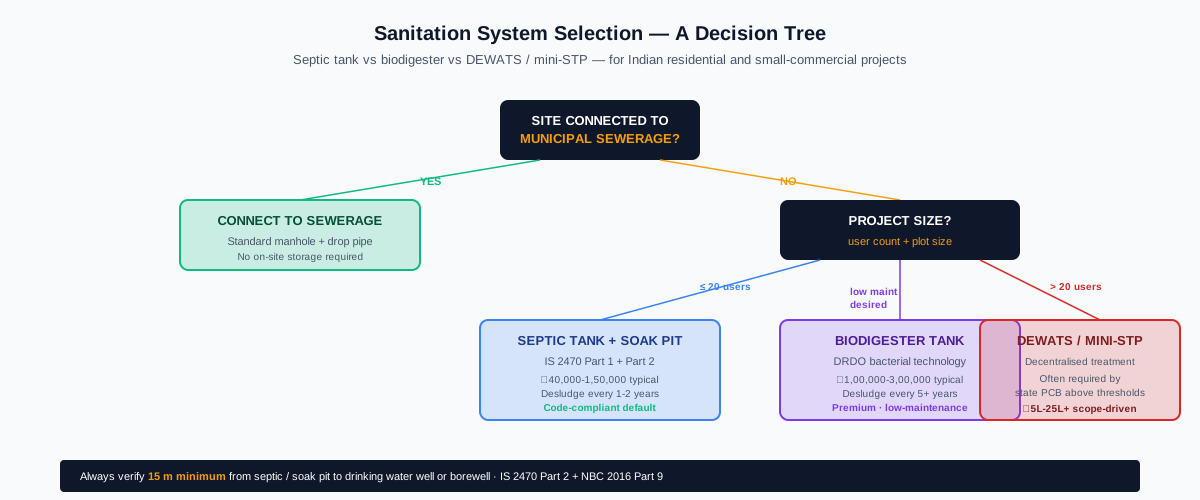
For independent residential plots ≤ 20 users with no sewerage connection, an IS 2470 Part 1 conventional septic tank with soak pit is the cost-optimal and code-compliant default. For low-maintenance preference (desludging every 5+ years instead of every 1-2 years), a DRDO biodigester tank is a 2-3× cost premium but reduces lifecycle hassle. For projects above ~20 users, larger plots, or where state pollution control boards mandate, DEWATS or mini-STP becomes necessary. Architects on commercial or apartment projects above 20 dwelling units should default to STP planning from the start.
Detailing That Matters
- Inlet and outlet tees — both must dip below the liquid surface to retain scum and floating solids. The inlet tee opens to mid-depth; the outlet tee opens 200-300 mm above the bottom (above the sludge layer).
- Two-compartment partition — required for ≥ 5 users. The partition wall has a 75-100 mm horizontal slot at mid-depth or a T-piece transferring liquid while retaining solids.
- Manhole covers — minimum 600 × 600 mm for desludging access. Always two: one above the inlet tee (sludge access), one above the outlet tee (effluent inspection).
- Vent pipe — minimum 50 mm diameter, projecting 600 mm above the tank cover, with a wire-mesh-covered cap. Vents methane and other anaerobic gases.
- Internal plaster — IS 2470 specifies 12-15 mm cement-mortar plaster in 1:3 ratio with waterproofing additive. Critical for tank longevity in aggressive sewage environment.
- Soak pit grading — coarse gravel (40-50 mm) at bottom, medium gravel (20-25 mm) in middle, fine gravel (10-12 mm) at top. The soil percolation rate (T-test) determines pit dimensions per IS 2470 Part 2.
Common Architect-Side Mistakes
- Locating septic tank too close to drinking water source — the 15 m minimum (IS 2470 Part 2) is non-negotiable. In lateritic or fissured rock soils, increase to 30 m.
- Single-compartment tanks for 5+ users — code violation; effluent quality suffers. Two compartments mandatory above 5 users.
- Inadequate soak pit sizing for clay soils — clay soils have very low percolation; standard soak pit dimensions designed for sandy soils will overflow within months. Use dispersion trench or evapotranspiration bed in heavy clay.
- No desludging access provision — manhole covers must be accessible from outside the building, with vehicle access for desludging tankers (minimum 3 m turn-around).
- Ignoring monsoon water-table rise — septic tanks installed below seasonal high-water-table fail in monsoon. Soil investigation should report seasonal water-table; raise tank if needed.
- Combining septic with rainwater drains — never. Septic tanks are sized for sewage flow only; rainwater overload causes overflow and effluent in the property.
Cross-References
- Septic Tank Design in India (Guide) — comprehensive design reference
- Residential MEP Coordination in India — sanitation in MEP context
- Rainwater Tank Sizer — companion sanitation tool
Disclaimer: Calculations follow IS 2470 Part 1:1985 and IS 2470 Part 2:1985. Local urban-local-body bye-laws and state pollution control board rules may have additional requirements; verify before specifying. Engage a qualified plumbing consultant for projects of significant scale. This page is for informational purposes only.
Related Guides — Deep-dive reading
Septic Tank Design for Indian Sites
IS 2470 Part 1 + Part 2, Soak Pit Design, Soil Percolation, and Decentralised Sanitation — A Comprehensive Guide for Architects and Plumbing Consultants
ConstructionWater Storage Tanks Guide for India: Sump, Overhead, Sizing, Materials & Fittings
The master overview of how an Indian home stores water — why storage exists at all, the sump to pump to overhead-tank to gravity chain, how much to hold, underground versus overhead placement, plastic versus RCC versus steel, food-grade and hygiene, the inlet-outlet-overflow-vent-washout fittings, and cleaning at a glance.
PlumbingBuilding Plumbing Services Guide (India): MEP-Grade Water, Drainage & Riser Design
A professional, India-first reference to plumbing engineering for larger and commercial buildings — integrated design with MEP, multi-storey water distribution, and drainage and venting stacks.
PlumbingRelated Studio Tools
Cross-Ventilation Analyzer
CIBSE AM10 + IS 3362-1977 + NBC 2016 Part 8 natural-ventilation calculator — wind and stack airflow with opening-type Cd, wind approach angle correction, ACH compliance, and a downloadable plan-flow SVG for submission drawings.
Ventilation CalculatorDaylight Factor Calculator
NBC 2016 Part 8 and IS 2440 compliant daylight factor calculator — window-to-floor area ratio, average DF via Littlefair/BRE formula, glass transmittance tables, and room-type benchmarks for residential, office, classroom, and hospital spaces.
Daylight CalculatorSetback Visualizer
20+ Indian city DCR / Building Bye-Laws built in (DDA, MCGM, BBMP, CMDA, GHMC, PMC, KMC, AUDA, Chandigarh…) — enter plot dimensions, get front/rear/side setbacks, ground coverage, FAR, and download a scaled SVG or PNG of the buildable footprint for your drawing submission.
Plot Visualizer