
 Lesson 0.1
Lesson 0.1 · Why Cities Need a Twin
A Living Model of the City
Imagine a 3D model of your whole city that is not frozen but alive — fed by real data so it shows the traffic, the air, the energy and the crowds as they actually are right now, and lets you test tomorrow before it happens; that living, connected model is an urban digital twin, and it is reshaping how cities are planned, designed and run
What if the city had a living mirror — a 3D model fed by real data, always current, where you could test a new road, a tower, or a heatwave before any of it touched the real street?
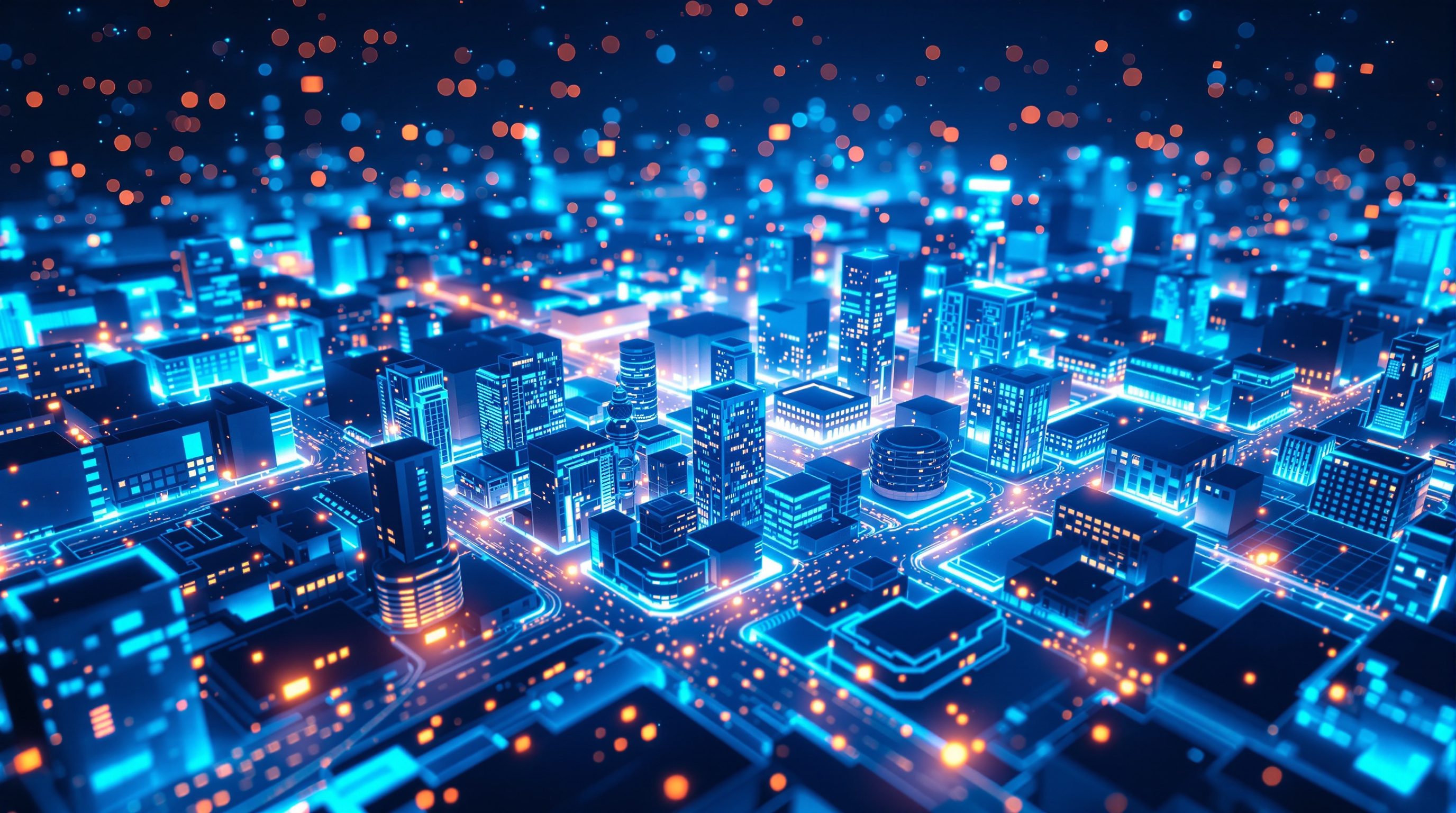
Picture the most detailed 3D model of your city you have ever seen: every building, street, tree and bridge, in three dimensions. Impressive — but dead. It shows the city as it was on the day it was made, and nothing more. Now imagine that same model wired to the living city: traffic sensors feeding it the jams as they form, air-quality monitors tinting the districts where pollution spikes, energy meters showing which blocks are drawing most power, weather and water and crowds all flowing in as data, in something close to real time. The model is no longer a snapshot; it is a living mirror of the city, changing as the city changes.
That is the leap at the heart of this course. A static 3D city model tells you what a place looks like. An urban digital twin connects that model to real-world data so it tells you what the city is *doing* — and, crucially, lets you *simulate* what it would do if you changed something: added a metro line, pedestrianised a street, built a tower that casts a shadow, or faced a flood. A digital twin is a living, connected digital counterpart of a physical thing, kept in sync by data and used to monitor, analyse, simulate and decide. Scale that idea up to a district or a whole city and you have an urban digital twin — one of the most ambitious and consequential ideas in how we plan, design and run cities today. This course is about what they really are, how they work, what they are good for — and the serious, often-ignored caveats that come with building a data-driven mirror of the places people live.
A living mirror of the city. Fed by data, tests tomorrow. But a mirror is also a watcher — whose city does it show?
What actually makes a twin a twin
The phrase 'digital twin' is used loosely, so the first thing to pin down is what separates a genuine twin from the things often mislabelled as one. A 3D model or a BIM model is a digital representation of geometry and information — valuable, but static: it does not change unless someone edits it. A digital twin adds two things that a static model lacks. First, a live data connection to the real-world thing it mirrors, so the twin stays in sync with reality as it actually is — the real traffic, the real temperatures, the real occupancy — rather than a designer's assumption. Second, the ability to simulate and feed back: to run analyses and scenarios on the model and use the results to inform decisions about the real city, sometimes in a loop where the physical and digital continuously update each other.
A useful way to hold it: model + live data + simulation + a feedback loop to decisions = digital twin. Strip out the live data and you have a nice visualisation. Strip out the simulation and you have a monitoring dashboard on a map. Strip out the feedback into real decisions and you have an expensive screen nobody acts on. A real twin has all of it, and that is exactly why real twins are hard — a point this course returns to honestly and often.
The 'twin' metaphor can be taken too literally, so treat it with care. An urban digital twin is never a complete, perfect copy of a city — a city is far too complex, and much of it (people's intentions, informal economies, the texture of daily life) cannot and should not be captured. A twin is always a purposeful simplification: a model of the aspects of the city relevant to some question — mobility, energy, flooding, shadow, air — fed by the data that bears on that question. Understanding that a twin is a model built for a purpose, not an omniscient copy, is the beginning of using one wisely and the antidote to the hype that surrounds them.
Model + LIVE data + simulation + feedback-to-decisions = twin. Drop any one and it's just a pretty screen.
Why cities are building twins
Cities face a brutal combination: they are growing fast, they are straining under traffic, pollution, heat, water stress and ageing infrastructure, and the decisions made about them are enormously expensive and hard to reverse. A new metro line, a drainage network, a masterplan, a flood defence — these cost fortunes, shape lives for decades, and are very difficult to undo if they go wrong. The promise of an urban digital twin is to bring evidence and foresight to those decisions: to see the city as it really is, not as officials assume it is, and to test interventions in the model before committing concrete and money to the street.
The value shows up across the life of the city. In planning and design, a twin lets you place a proposed building or masterplan in its real context and test its effects — the shadow it casts, the wind it funnels, the traffic it generates, the views it blocks — against live conditions rather than guesswork (Module 6). In operations, a twin fed by sensors helps run the city day to day: spotting congestion, managing energy and water, coordinating emergencies, monitoring assets (Module 7). In scenario planning, it lets a city ask 'what if' — what if we pedestrianise this district, add this bus route, or face a once-in-a-century flood — and compare outcomes before deciding (Module 4). And in engagement, a vivid, shared 3D model can help citizens and stakeholders actually understand and shape what is proposed, rather than squinting at 2D drawings (Module 8).
This is why twins have moved from research labs to real cities — Singapore, Helsinki and others have built city-scale twins, and India's large urbanisation and smart-city programmes make the idea especially relevant here (Module 10.3). But the promise is exactly that — a promise — and whether a twin delivers depends entirely on the quality of its data, the honesty of its modelling, the soundness of its governance, and whether anyone actually uses its outputs to make better decisions. The gap between the glossy vision and the working reality is wide, and closing it is what competence in this field means.
The perils: a mirror of the city is also power over it
An honest course has to say plainly what the brochures do not: an urban digital twin is not just a helpful tool but a concentration of data and power over a city, and that brings serious perils that a designer must understand. The first is surveillance and privacy. A twin fed by real-time data about movement, occupancy, cameras and sensors is, by its nature, a system that watches the city and the people in it. Who is being tracked, how finely, by whom, and with what safeguards, is not a technical footnote — it is a civil-liberties question at the heart of the system, and a poorly governed twin can become an instrument of surveillance.
The second peril is whose city the twin represents. A model encodes choices: which data is collected, which neighbourhoods are well-sensored and which are invisible, which questions the twin is built to answer and which it ignores. These choices can entrench bias and inequity — a twin optimised for traffic flow or investment value may quietly disadvantage the informal settlements, the street vendors, the pedestrians and the poor who do not show up in its data or its objectives. A data-driven mirror can make some people and activities hypervisible and others disappear, with real consequences for who the city is run for.
The third is the danger of false confidence and misuse — treating the twin as an oracle. A model is a simplification built on data that may be incomplete, out of date, biased or simply wrong, and its simulations carry real uncertainty. A beautiful, authoritative-looking 3D twin can lend a spurious air of objectivity to what are really contested political choices, and let decision-makers hide behind 'the model said so.' And there is the plain reality of twin-washing: many things sold as digital twins are just 3D models with a dashboard, bought for prestige, expensive to maintain, and quietly abandoned. This course treats the twin as what it is — a powerful decision-support tool that is only as good, and as fair, as the data, modelling and governance behind it — and insists that binding decisions, statutory data and the law stay with the accountable authorities, engineers and legal frameworks, never with the model alone. Module 8 (governance and ethics) and Module 9 (reality and limits) confront these head-on.
A twin watches the city. Who does it see? Who does it miss? Who controls it? A model is not an oracle.
What this course teaches — and what it defers
This course builds urban-digital-twin literacy as a practical, critical design skill. You will start with why cities need a twin — the living model, model-versus-twin, the landscape, the promise and perils (Module 0); then digital-twin foundations — what a twin is, the spectrum, twins across scales, the data loop (Module 1); modelling the city in 3D — city models and CityGML, levels of detail, semantic versus geometric, building the model (Module 2); the data that feeds the twin — GIS, IoT and real-time streams, BIM/reality capture/open data, integration (Module 3); simulation and analytics — simulating the city, mobility, energy/environment/climate, scenarios (Module 4); platforms and visualisation — platforms, game-engine and web visualisation, dashboards, open standards (Module 5); applications in planning and design — masterplanning, a project in context, environmental analysis, infrastructure (Module 6); operating the city — operations, resilience, asset management, net-zero (Module 7); people, governance and ethics — engagement, data governance, privacy/surveillance/equity, who controls the twin (Module 8); reality, limits and honesty — twin-washing, data quality and bias, cost and maintenance, when a twin is the wrong tool (Module 9); and practice and the future — the designer's role, getting started, India, becoming twin-literate (Module 10).
One firm boundary runs through all of it. An urban digital twin sits on statutory data, infrastructure engineering and the law, and it is decision-support, not a decision-maker. This course teaches the principles, the workings and the critical judgement, not the binding decision. It defers every binding result — planning approvals and statutory decisions, infrastructure and structural engineering, official/cadastral/survey data, and lawful data handling — to the planning authorities, qualified engineers, the official data custodians, and the governing law (including India's data-protection regime and municipal rules). Any figure, accuracy, cost or capability cited here is illustrative and depends heavily on context — treat it as a guide to the principle, not a specification — and always remember that a model can be wrong, biased or misused.
Studio Matrx is free and not-for-profit, and this course is written to be rigorous and honest — not a vendor pitch for smart-city technology but a clear, critical grounding in what urban digital twins are, what they can genuinely do, and the data-governance and equity questions they raise, mindful of the Indian context where the opportunity is huge and the governance stakes are high. Understand what makes a twin a twin, how the data and simulation work, what it is genuinely good for, and who it serves and who it might harm — and you will be able to engage with one of the most powerful and double-edged ideas in the future of cities.
Digital twin (model + live data + simulation + loop)
What actually qualifies as a twin versus a 3D model
The defining test, used throughout the course. A static model or a dashboard is not a twin; beware twin-washing. Modules 1, 9.
Planning authority & statutory process
Binding planning, zoning and approval decisions
A twin is decision-support; binding decisions stay with the accountable planning authorities and statutory process, never the model. Modules 6, 8.
Official / survey / cadastral data
The authoritative data of record
Legally binding geospatial, boundary and infrastructure data comes from the official custodians (incl. Survey of India) and surveyors, not a twin's working layers. Module 3.
Data-protection & governance law
Privacy, surveillance, consent and data rights
A twin's data handling must follow the governing law (incl. India's data-protection regime) and sound governance; privacy and equity are first-order, not afterthoughts. Module 8.
Workshop — tell a real twin from a 3D model, and ask who it serves
The two skills this course most wants to build are telling a genuine digital twin from a dressed-up 3D model, and asking the governance questions the hype skips. In this first workshop you will apply both to a real or proposed city-twin example.
Just a city-twin example you can read about and a notebook. No software — this is about seeing what makes a twin real and asking who it serves; the data, simulation and platforms come later.
Goal: a first, critical read of what makes a twin a twin and who it serves
Inputs: a real urban-digital-twin / smart-city example you can read about (or your own city's plans) + this lesson + a notebook
Time: ~40 minutes
- 1Find an example: pick a city digital twin or smart-city project you can read about (Singapore, Helsinki, an Indian smart-city, or your own city). Note what it claims to be.
- 2Apply the twin test: does it actually have (a) a 3D/city model, (b) a LIVE data connection, (c) simulation/analytics, and (d) a feedback loop into real decisions? Mark which it genuinely has vs. which are claimed or absent — and judge: real twin, or 3D model with a dashboard?
- 3Name the purpose: what question(s) is this twin built to answer (traffic? energy? flooding? investment? planning)? A twin is a purposeful simplification — so what is its purpose?
- 4Ask who it serves and who it misses: whose activities and neighbourhoods show up in its data and objectives, and whose might be invisible? What privacy or surveillance concerns does its data raise?
- 5Write a one-paragraph verdict: is this a genuine twin or twin-washing, what is it good for, and one governance or equity question you would insist be answered before trusting it — flagged as critical reasoning, not a technical audit.
You’ll walk away with
A one-page critical read of a real or proposed urban digital twin: the twin-test scorecard, its purpose, who it serves and misses, and one governance question — all framed as reasoning. Keep it; you will deepen it across the course.
Three altitudes on the same idea
Read the band that fits you — or all three.
An urban digital twin is the living context your project sits in — and increasingly the place planning decisions get made. A city twin lets you place a building or masterplan in its real surroundings and test its true effects (shadow, wind, traffic, views, energy) against live conditions, and lets authorities and citizens judge a proposal in a shared 3D model rather than 2D drawings. Learn what a genuine twin is versus a 3D model with a dashboard, how city data and simulation feed design decisions, and how to contribute your project's model into the wider twin. Stay critical: a twin is decision-support, not an oracle, and it encodes choices about whose city it represents. Defer binding planning decisions, infrastructure engineering and statutory/official data to the authorities, engineers and data custodians; own the design reasoning and a clear-eyed view of the model's limits.
Even at interior scale, the digital-twin idea is arriving — and the city twin is the outer ring of a nested set of models. The same principle (a model kept live by real data and used to simulate and decide) increasingly applies to buildings: a building digital twin fed by occupancy, energy and comfort sensors informs how spaces are used, conditioned and maintained, which bears directly on interior environment, wellbeing and operation. Understand how a building's data connects upward to district and city twins, what a twin genuinely adds over a static model, and the data-privacy duties that come with sensing occupied space. Coordinate binding building-systems and data-handling decisions with the engineers and the law; your domain is the humane, well-used, well-operated interior that the data should serve rather than merely surveil.
Urban digital twins sit at the crossroads of design, data, geospatial tech and city governance — a fast-growing field where critical, literate people are badly needed. Start with this lesson's core idea — that a model becomes a twin when live data keeps it current and simulation lets it look ahead, and that a twin is a purposeful simplification, never an omniscient copy — and build the real understanding: how city models and data and simulation work, what twins are genuinely good for, and the governance, privacy and equity questions they raise. You are not expected to build a city twin; you are expected to understand them, use their outputs critically, and ask who the twin serves. This is one of the defining ideas in the future of cities, and a distinctive, future-facing portfolio thread.
“An urban digital twin is basically a really good, detailed 3D model of a city — a virtual copy you can fly around in. If a city has built a nice 3D model of itself, it has a digital twin, and the twin is an objective, complete digital replica you can trust to tell you the truth about the city.”
Do it yourself
No tools needed — reason it through.
- 1What four things (model, live data, simulation, feedback loop) distinguish a digital twin from a static 3D model?
- 2Why is an urban digital twin always a 'purposeful simplification' rather than a complete copy of a city?
- 3Name three ways a twin adds value across a city's life (e.g. planning, operations, scenario planning, engagement).
- 4What are the main perils of an urban digital twin (surveillance, bias/equity, false confidence, twin-washing), and why do they matter?
- 5Why must binding decisions, statutory data and the law stay with accountable humans, not the model?
The one line to carry out
Peer-reviewed journals & authoritative standards
- 01Digital twin — Wikipedia — Digital twin, 2026.
- 02Smart city — Wikipedia — Smart city, 2026.
- 03Urban planning — Wikipedia — Urban planning, 2026.
To use the idea well we need the concept itself precisely — what a digital twin is in general, the spectrum from static model to living twin, how twins work at every scale from a product to a city, and the sense-model-act data loop that animates them. Next we build those foundations.
The author
Amogh N P
Architect, interior designer, and creative polymath. Studio Matrx began in his notebooks — his vision of design made honest, useful, and open to everyone. Its Academy is written and taught in his memory, and free, forever.
More about Amogh →