
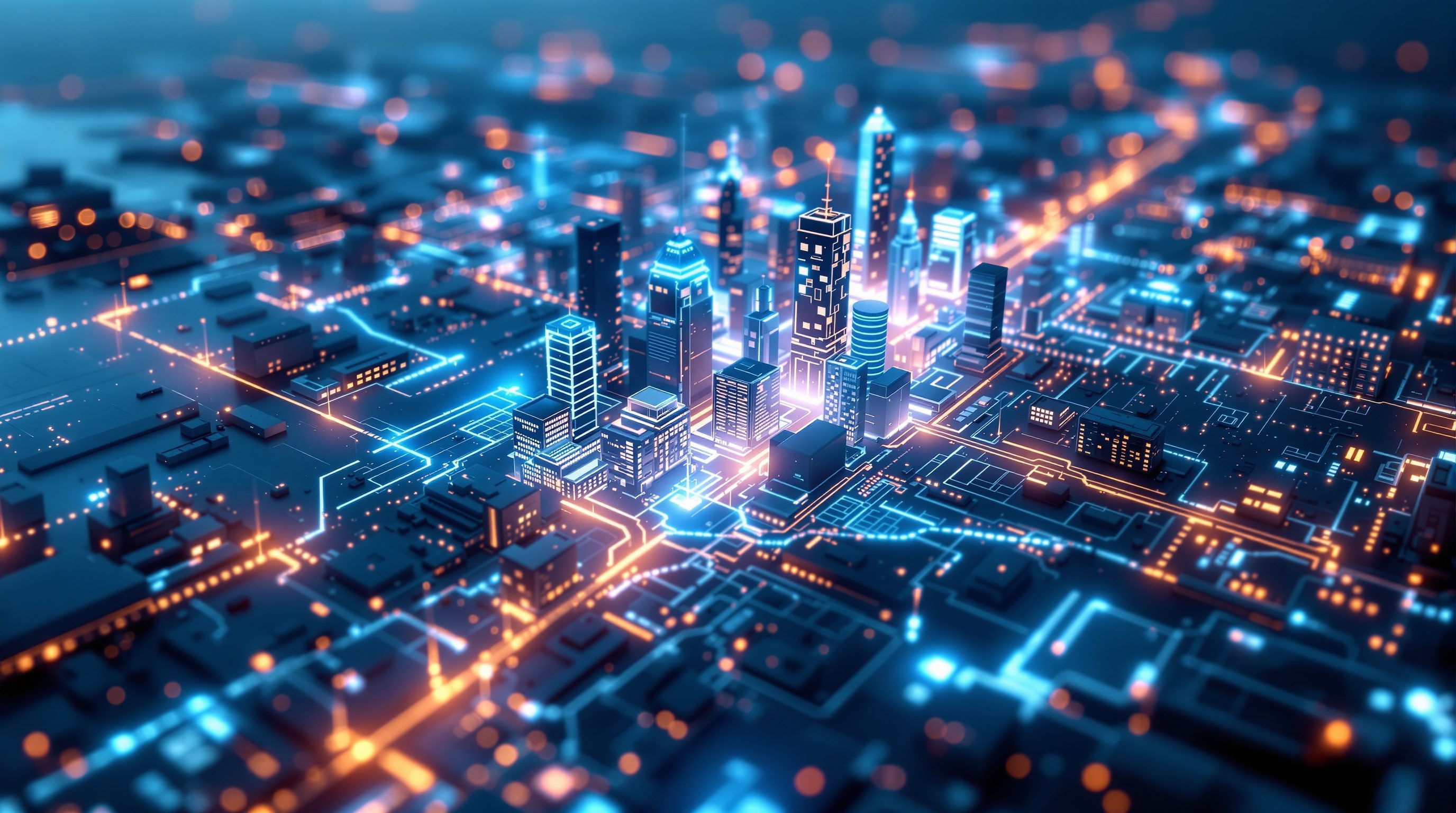
 Lesson 1.1
Lesson 1.1 · Digital Twin Foundations
What a Digital Twin Is
Before it is ever a city, a digital twin is a simple, powerful idea borrowed from aerospace and the factory floor - a virtual counterpart of a real thing, kept honest by a steady flow of data, and used to watch it, test it and make it work better
Long before anyone mirrored a city, engineers built a living copy of a spacecraft on the ground - so that when something went wrong 300,000 kilometres away, they could try the fix on the copy first.
A digital twin sounds futuristic, but the idea is old and the instinct behind it is simple: if you cannot safely experiment on the real thing, build a faithful counterpart you can experiment on instead, and keep that counterpart matching reality as closely as you can. When Apollo 13 was crippled in space, engineers on the ground worked the problem on simulators wired to match the real craft's condition - a physical stand-in kept in sync with the distant original. That is the seed of the whole idea.
Strip away the city, the sensors and the glossy 3D for a moment, because the concept is general and worth getting exactly right. A digital twin is a virtual counterpart of some physical thing, kept in step with it by a flow of data, and used to monitor what the thing is doing, simulate what it would do under different conditions, and help make it work better. That thing can be an engine, a pump, a building or an entire city. This lesson is about the bare idea - where it came from, what it actually means, and the three parts every twin is built from - so that when we scale it up to a city in the rest of the course, you know precisely what you are looking at and what you are not.
Engine, building, city - same three parts every time. Real thing, model, and the data arrows that keep them honest.
Born in aerospace, proven on the factory floor
The digital twin did not begin with smart cities or even with computers as we know them. Its lineage runs through aerospace and manufacturing, where the cost of being wrong about a physical asset is measured in lives and fortunes, and where the idea of a trustworthy stand-in earned its keep. The often-told origin is NASA's practice of building ground-based replicas of spacecraft - full simulators, kept matched to the real vehicle - so that problems in flight could be diagnosed and rehearsed on the copy before any instruction was sent to the crew. The Apollo 13 rescue is the vivid example: the fix was tried on the mirror on the ground before it was trusted in orbit.
The phrase and the modern framing came later, from the world of product manufacturing in the 2000s, where the idea was formalised as a pairing of a physical product with a detailed virtual model across the product's whole life - design, testing, operation, maintenance. The motivation was practical. If you can simulate how a turbine blade will fatigue, or how a pump will behave as its bearings wear, you can test a hundred what-ifs in software for the price of one physical trial, and you can predict a failure before it strands a customer. Manufacturers began running virtual counterparts of individual machines, fed by data from the real ones, to schedule maintenance and squeeze out performance.
What changed the idea from a specialist luxury into something widespread was not a breakthrough in modelling but a collapse in the cost of two things: sensing and computing. Cheap sensors and networks - the Internet of Things - made it affordable to stream the real-world state of an asset continuously, and cheap cloud and edge computing made it affordable to keep a model running against that stream. A twin is, in the language of engineering, a cyber-physical system: a physical process and its computational shadow bound tightly together. Hold on to the lineage, because it carries a warning. These ideas matured on engines and machines - bounded, well-instrumented, governed by known physics. A city is none of those things, and every difficulty in this course flows from stretching a factory-floor idea across something vastly messier, more human and more political.
Apollo: fix it on the ground copy first. That instinct, plus cheap sensors, is the whole origin story.
What the words actually mean
Here is a definition worth memorising, because the rest of the course leans on it: a digital twin is a virtual counterpart of a physical asset, process or system, kept in sync with it by a flow of data, and used to monitor, simulate and optimise the real thing. Every clause is load-bearing, so take them one at a time.
'Virtual counterpart' means more than a picture. It is a model that represents not just how the asset looks but how it behaves - enough of its geometry, its parts and its governing rules that you can reason about it and run it forward in software. 'Kept in sync by a flow of data' is the clause that separates a twin from an ordinary model: the counterpart is continually updated from the real asset so that it reflects the thing as it actually is now, not as it was designed or last edited. A model of your car is a drawing; a model fed live from your car's sensors is a twin of your car.
The final clause names the purpose, and twins are always built for a purpose. Monitor: see the current state - temperature, vibration, occupancy, flow - often more completely than you could by standing next to the asset. Simulate: ask what would happen if conditions changed, the load doubled, a part aged, the weather turned. Optimise: use what you learn to run the asset better - tune it, schedule its maintenance, decide its next move. A useful shorthand is that a twin lets you answer three questions about a real thing: what is it doing, what would it do, and what should we do about it.
Two disciplines must sit inside the definition from the start. First, a twin is a purposeful simplification - it models the aspects relevant to its questions and deliberately ignores the rest; it is never a complete copy, and treating it as one is the first mistake. Second, a twin is decision-support, not a decision-maker. It informs a human or a governed process; it does not hold accountability. Those two disciplines are easy to state on an engine and hard to hold on a city, which is exactly why we state them now.
The three parts: physical twin, virtual twin, and the data between
Every digital twin, at any scale, is built from three parts, and it is worth being able to point to each one. The first is the physical twin - the real thing itself, out in the world: the engine on the test bench, the chiller in the basement, the bridge over the river, the district of streets and buildings. This is the asset whose behaviour you actually care about. Nothing in the software matters if it drifts out of touch with this.
The second is the virtual twin - the model in software. At minimum it carries the asset's geometry and structure; in a mature twin it also carries behaviour, so it can be simulated rather than merely viewed. For an engine that might be a physics model of heat and stress; for a building, a BIM model enriched with systems data; for a city, a 3D model layered with rules about traffic, energy or water. The virtual twin is where you run experiments you could never run on the real thing.
The third part is the one people forget, and it is the part that actually makes a twin: the data connection binding the two together. In the richest form this connection runs both ways. Data flows from the physical twin to the virtual one - sensor readings, meter values, status reports - so the model stays current. And information flows back from the virtual twin to the physical one - an insight, a setting, sometimes an automated control action - so that what you learn in the model changes what the real asset does. When both directions are live and continuous, the pair genuinely co-evolve.
It helps to picture the three parts as two boxes and the arrows between them. Remove the arrows and you have a real asset and a detached model that no longer describe each other - which is precisely the state most systems sold as twins are actually in. The next lesson turns this picture into a spectrum, because the *strength and direction* of that data connection is what separates a static model from a living twin. For now, fix the anatomy: a physical twin, a virtual twin, and a data connection that ideally flows both ways. If you cannot point to all three, you are not yet looking at a twin.
Two boxes and the arrows between them. The arrows are the twin. No arrows = a model and a thing that forgot each other.
What a twin is for - and the honesty it demands
It is tempting to describe a digital twin by its technology, but the honest description is by its job. A twin exists to let you act on a real asset with more evidence and foresight than you would otherwise have - to see what you could not easily see, to test what you could not safely test, and to decide with the benefit of both. On an engine that means catching a failure before it happens and wringing out efficiency. On a building it means running comfort and energy well and spotting faults early. On a city, as later modules show, it means testing a road, a tower or a flood before committing concrete. The payoff everywhere is the same: fewer expensive surprises, and decisions rehearsed before they are real.
That payoff is real, but it is conditional, and a practitioner earns trust by naming the conditions out loud. A twin is only as good as the data feeding it: stale, sparse, biased or wrong data produces a confident model that is confidently mistaken. A twin is only as good as its modelling: the simplifications that make it tractable also make it blind to whatever they left out, and a simulation carries uncertainty that an authoritative-looking 3D view tends to hide. And a twin is only as good as the judgement around it: the same model that supports a wise decision can launder a poor one, letting someone say the model decided when a person did.
So the discipline to carry from this first lesson is a refusal to treat the twin as an oracle. It is a powerful instrument for monitoring, simulation and optimisation, and nothing more exalted than that. Binding outcomes belong to accountable people and lawful processes - the engineer who signs off, the authority that approves, the custodian of the official data, the law that governs how data about people may be used. In this course, as scale grows from a machine to a city, those stakes grow with it, and we will keep the line bright: the twin informs; humans and the law decide. Get the bare concept right, hold the three parts and the two disciplines in mind, and you are ready to see why not everything called a twin deserves the name.
Digital twin (virtual counterpart + live data + monitor/simulate/optimise)
The working definition used throughout the course
If you cannot point to a real asset, a model of it, and a live data connection binding them, you are not looking at a twin. Modules 1, 9.
Cyber-physical system / Internet of Things
The engineering framing a twin belongs to
A twin is a physical process bound to its computational shadow; cheap IoT sensing and computing are what made it practical. Illustrative, not a spec. Module 3.
Qualified engineer & accountable authority
Binding engineering and approval outcomes
A twin is decision-support; the binding call stays with the engineer who signs off and the authority that approves, never the model. Modules 6, 8.
Data-protection & governance law
Lawful handling of data about people and places
Any twin that senses occupied or public space must follow the governing law (incl. India's data-protection regime) and sound governance. Module 8.
Workshop - find the three parts, or prove they are missing
The core skill of this module is seeing past the word 'twin' to the thing itself. Here you practise on any asset you like - small and concrete is best for a first go - by locating its three parts and deciding whether a twin really exists.
No software - just an asset you can observe or read about and a notebook. This lesson is about seeing the concept clearly; the data, modelling and platforms come in later modules.
Goal: identify the physical twin, the virtual twin and the data connection for a real example
Inputs: one asset you can read about or observe (a car, a lift, a chiller, a machine, a building, or a city platform) + this lesson + a notebook
Time: ~35 minutes
- 1Pick an asset and write one sentence on what you would want to monitor, simulate or optimise about it - that is the twin's purpose.
- 2Find the physical twin: describe the specific real asset (not a category - a particular one) whose behaviour you care about.
- 3Find the virtual twin: is there a model of it, and does the model carry behaviour (can it be simulated) or only appearance (can it only be viewed)?
- 4Find the data connection: does real-world data flow into the model automatically and keep it current? Does anything flow back to the asset? Mark each direction present, claimed, or absent.
- 5Deliver a verdict: genuine twin, or model plus asset with no live link - and name one thing the model deliberately leaves out, to prove you are treating it as a purposeful simplification, not a complete copy.
You’ll walk away with
A one-page card for your chosen asset: its purpose, its three parts marked present/claimed/absent, a twin-or-not verdict, and one deliberate omission - framed as reasoning, not a technical audit. Keep it; you will reuse the method on a city in Module 0's workshop and beyond.
Three altitudes on the same idea
Read the band that fits you — or all three.
Treat the digital-twin idea as a precise tool, not a buzzword, and you will use it far better than most. For an urban designer the key move is to carry the exact definition - a data-synced virtual counterpart used to monitor, simulate and optimise - into every conversation about a city platform, and to ask where the three parts are: the real asset, the model, and the live data connection. Most of what you will be shown is a rich virtual twin with a thin or absent data connection. Knowing the origin in aerospace and manufacturing helps you judge what has genuinely been transplanted to the built environment and what is aspiration. Own the design reasoning and the critical read; defer binding infrastructure and planning decisions to the engineers, authorities and the law.
The clearest place to meet a real twin is at building scale, one ring in from the city - and that is your territory. A building digital twin pairs a BIM model with live data from occupancy, energy and comfort sensors to monitor how spaces actually perform, simulate changes, and tune operation. The same three parts apply: the physical building, the virtual model, and the data connecting them. Understanding the idea cleanly lets you specify what a building twin should watch, and insist it serve the humane use of space rather than merely surveil it. Sensing occupied space carries real privacy duties - coordinate the data handling with the engineers and the governing law, and keep the occupant, not the dashboard, at the centre.
This is the lesson to get word-perfect, because every later module builds on it. Learn the definition cold - a virtual counterpart of a physical thing, kept in sync by data, used to monitor, simulate and optimise - and be able to name the three parts: physical twin, virtual twin, and the data connection between them. Know the lineage (aerospace and manufacturing, made affordable by cheap sensors and computing) and the two disciplines (a twin is a purposeful simplification, and it is decision-support, not a decision-maker). You are not expected to build a twin; you are expected to recognise one honestly, explain why it is not an oracle, and always ask what it was built to do and what it leaves out. That clarity is a distinctive, future-facing thread in your portfolio.
“A digital twin is basically just a really detailed 3D model or a fancy simulation - if you have built a good virtual model of something, you have a digital twin of it, and the twin is an exact, complete digital replica of the real thing.”
Do it yourself
No tools needed - reason it through.
- 1In one sentence, define a digital twin using all four ideas: virtual counterpart, live data, the real asset, and monitor/simulate/optimise.
- 2Name the three parts of any digital twin, and say which one is the part people most often forget.
- 3Why did the digital-twin idea mature in aerospace and manufacturing before the built environment?
- 4Give one reason a twin is a 'purposeful simplification' rather than a complete copy of its asset.
- 5Why is a twin decision-support rather than a decision-maker, even when its model is excellent?
The one line to carry out
Peer-reviewed journals & authoritative standards
- 01Digital twin — Wikipedia - Digital twin, 2026.
- 02Cyber-physical system — Wikipedia - Cyber-physical system, 2026.
- 03Internet of things — Wikipedia - Internet of things, 2026.
- 04Simulation — Wikipedia - Simulation, 2026.
- 05Systems modeling — Wikipedia - Systems modeling, 2026.
We now have the bare concept and its three parts. But 'twin' covers a wide range of systems of very different maturity, and the difference hides in that data connection - does data merely flow in, or does it also flow back? Next we turn the connection into a spectrum, from a static model, to a one-way shadow, to a genuine two-way twin.
The author
Amogh N P
Architect, interior designer, and creative polymath. Studio Matrx began in his notebooks — his vision of design made honest, useful, and open to everyone. Its Academy is written and taught in his memory, and free, forever.
More about Amogh →