
 Lesson 0.2
Lesson 0.2 · Why Cities Need a Twin
From 3D Model to Digital Twin
A gorgeous 3D model of your city and a genuine digital twin can look identical on screen - the difference is invisible, it lives in whether the model is wired to the living city and whether anyone acts on what it shows, and learning to see that difference is the single most useful skill in this whole field
Two screens show the same shining 3D city. One is a twin and one is just a model - so what is the difference you cannot see?
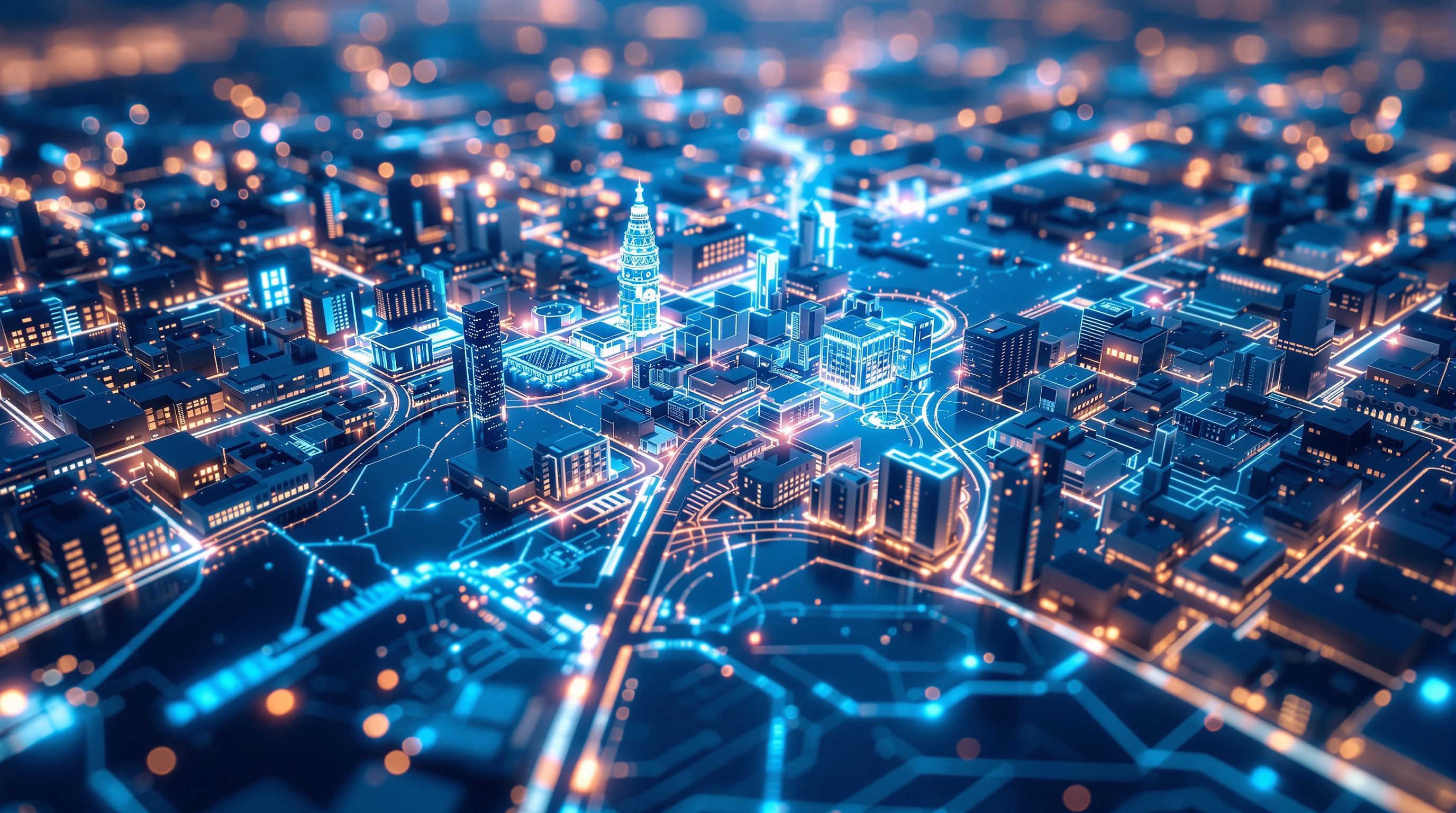
Put two laptops side by side. Both show the same city in stunning 3D - every tower, flyover, park and rooftop, shaded and navigable, beautiful enough to make a council chamber gasp. On the first, that is all it is: a frozen model, captured on the day the survey flew, as still as a photograph. On the second, the very same scene is breathing - the arterial roads flush amber where traffic is building this minute, a district glows as its evening energy load climbs, and a planner can drag a proposed tower onto a plot and watch the shadow it will throw at 4pm in December. The two look almost identical. Only one is a digital twin.
That invisible gap is the subject of this lesson, and learning to see it is the most practical skill the whole course can give you. The word 'twin' is thrown at anything with polygons and a dashboard, which is exactly why so much money is wasted and so much trust misplaced. So we are going to be precise. We will name the four ingredients that together turn a model into a twin - a model, a live data connection, simulation, and a feedback loop into decisions - and then walk the rungs in between, the visualisation and the dashboard, that each add one ingredient and stop short of a twin. And we will name the failure honestly: twin-washing, the selling of a 3D model with a dashboard as though it were the living, decision-changing system it is not. Get this distinction into your hands and you will never again be dazzled by a pretty render into mistaking a map for a mind.
Two identical 3D cities. One breathes (live data) and thinks ahead (simulation) and changes things (loop). The other is a photo. Learn to see which is which.
The line, drawn precisely
Start with the thing most people already picture when they hear 'digital twin': a detailed three-dimensional model of a city, or a BIM model of a building. It is genuinely valuable - it carries geometry, and often rich information attached to that geometry (what a wall is made of, which pipe runs where, how tall a block is). But it has one defining property: it is static. It shows the city, or the building, as it was at one moment - the day the data was captured or the model last edited - and it does not change on its own. Fly around it all you like; it is a photograph in three dimensions. That is a 3D model, and confusing it with a twin is the original sin of this field.
A digital twin adds two things a static model structurally lacks. The first is a live data connection to the real thing it mirrors, so the model stays in sync with reality as it actually is - the real traffic, the real temperatures, the real occupancy - instead of a designer's assumptions frozen in place. The second is the power to simulate and feed back: to run analyses and scenarios on the model, and then use what they show to change decisions about the real city, often in a continuing loop where physical and digital keep updating each other. Hold the whole test in one line: model + live data + simulation + a feedback loop into decisions = digital twin.
Why insist on all four? Because each does a distinct job. The model gives you a spatial, semantic place to put everything. The live data makes it honest - it describes the city that exists, not the one someone hoped for. The simulation gives it foresight - the ability to answer 'what if', not merely 'what is'. And the feedback loop is what makes any of it matter: a twin whose outputs never reach a decision is an expensive aquarium. Notice, too, what the definition refuses. A twin is never a complete copy of a city - a city is too complex, and much of it (intentions, informal life, meaning) neither can nor should be captured. A twin is always a purposeful simplification, built to answer particular questions with particular data. Keep the four-part test in your pocket and you can walk into any demo and ask the only questions that matter: where is the live data, what can it simulate, and whose decisions does it actually change?
Looks the same, is not the same. The twin-ness is invisible: it lives in the data feed and the decision loop, not the polygons.
The four ingredients, one by one
Take the four ingredients slowly, because the whole rest of the course is really an expansion of them. The model is the spatial backbone - a 3D city model, a BIM model of a building, or a GIS dataset with geometry. It is where everything else hangs: data streams attach to objects, simulations run over surfaces and networks, results display in place. Without a structured model you have numbers without a where; Modules 2 and 3 build this layer properly, including how much detail (level of detail) a purpose actually needs.
The live data connection is what separates a twin from a diorama. Sensors, meters, cameras, ticketing systems, weather stations and administrative feeds push current readings into the model - ideally close to real time - so it tracks the living city. 'Live' is a spectrum, not a switch: some twins update by the second, some hourly, some nightly, and the honest question is always whether the update rate matches the decision the twin supports. A flood twin that refreshes once a day is useless in a cloudburst. Module 3 is devoted to this feed: GIS, IoT streams, reality capture and the hard craft of integrating messy sources.
Simulation is the ingredient that lets a twin look forward rather than merely report. Feed the model rules and models of how the city behaves - how traffic flows, how wind moves between towers, how a district's energy demand rises with temperature, how water spreads when a drain backs up - and you can ask 'what if we change this?' and get an estimated answer before laying a brick. Simulation is where a twin earns its keep in design and planning; Module 4 covers it, and also its humility, because every simulation carries uncertainty.
The feedback loop is the ingredient most often missing and most easily faked. It means the twin's outputs actually reach a decision and, ideally, that the decision changes the city, which the twin then re-reads - a closed loop between digital and physical. A model can be gorgeous, live and simulatable and still be a twin in name only if nobody acts on it. Ask of any system: when this shows something, who does what differently? If the answer is 'nothing, but it looks great in presentations', you are looking at the fourth ingredient's absence - and, very often, at twin-washing.
The rungs in between: visualisation and dashboard
Between a dead 3D model and a living twin sit two useful, common, and frequently-mislabelled things. Naming them is the quickest way to stop being fooled, because each adds exactly one ingredient and stops short of the rest.
The first rung up is a visualisation: the 3D model made vivid and explorable - beautifully rendered, navigable, perhaps in a web browser or a game engine, maybe even in VR. It is a real improvement: people understand a place far better when they can fly through it than when they squint at 2D drawings, and for communication and early design that is genuinely valuable. But a visualisation adds presentation, not a pulse. It has no live data, so it still shows the city frozen on capture day. Calling it a twin is the commonest sleight of hand in a sales demo, precisely because it is the most impressive to look at and the cheapest to build.
The next rung is a dashboard: the model, or a map, wired to live data so you can watch current conditions - traffic now, air quality now, which assets are reporting faults now. This is a big step: it adds the live connection, the honesty of showing the city as it actually is. A good operations dashboard is a serious tool. But a dashboard, by itself, only tells you what is - it monitors, it does not model forward. Ask it 'what happens if we close this road for six months?' and it has nothing to say, because it cannot simulate and it has no loop designed to turn its readings into tested decisions. It is a window, not a workshop.
So the ladder reads: 3D model (geometry), then visualisation (+ a vivid view), then dashboard (+ live data), then - only when simulation and a decision loop are added on top - a digital twin. Most of what cities actually own today sits on the lower rungs, and that is not a scandal; a good dashboard beats a bad twin every time, and starting narrow is wise. The scandal is only in the mislabelling - buying a dashboard, calling it a twin, and then being surprised it cannot answer the questions a twin is supposed to answer. Know which rung you are standing on, and you can use each thing for what it is actually good for, and demand the missing ingredients before you pay twin prices.
Model -> visualisation (+view) -> dashboard (+live data) -> twin (+simulation +loop). Know your rung.
Twin-washing: the failure to watch for
Put the ladder and the four-part test together and you can name the commonest failure in this entire field: twin-washing - presenting a 3D model, a visualisation or a dashboard as a genuine digital twin it is not. It is the urban-tech cousin of greenwashing, and it wastes public money, misplaces trust, and quietly discredits the real idea when the shiny object fails to deliver.
It happens for understandable reasons. A photorealistic 3D city is thrilling in a pitch and relatively quick to produce; the live data integration, the validated simulation and the governance to turn outputs into decisions are slow, expensive, unglamorous and often politically awkward. So procurement buys the thrilling part, the brochure says 'digital twin', and a visualisation with a few live feeds is installed with great ceremony - and then struggles to answer a single real planning question, because the ingredients that would let it are absent. Prestige outruns capability.
You defend against twin-washing with the same four questions, asked plainly and without apology. Is there a genuine model? Usually yes. Is there a live data connection, and does its update rate match the decisions it claims to support? Often this is where the story thins - a handful of demo feeds, or data so stale it is decorative. Can it actually simulate - run a scenario and estimate an outcome - or does it only display the present? This is where most 'twins' quietly fail. And does anything in the real city actually change because of its outputs - is there a real feedback loop, with people who act on what it shows? A twin nobody acts on is, functionally, not a twin. If a system misses the last two, be honest about what it is: a valuable visualisation or dashboard, not a twin, and it should be bought, priced and judged as such.
None of this is cynicism about the technology - it is the opposite. The real idea is powerful enough that it does not need inflating, and treating it honestly is how you protect it. A narrow, genuine twin that truly closes the loop on one problem - a flood twin that actually reroutes emergency response - is worth more than a city-scale 'twin' that does everything in the brochure and nothing on the street. Through the rest of this course, whenever a platform or a vendor claims the word, run the four-part test in your head. Binding decisions, official data and the law stay with the accountable authorities, engineers and custodians regardless; your job as a designer is to know what you are actually looking at, and to insist the missing ingredients be named before anyone pays for a twin.
The four-part test (model + live data + simulation + loop)
Whether a system genuinely qualifies as a digital twin
The working definition used throughout the course. Miss any one ingredient and it is a model, visualisation or dashboard - not a twin. Modules 1, 9.
Maturity ladder (model / visualisation / dashboard / twin)
Classifying what a city actually owns today
Each rung adds one ingredient. Most real deployments sit below 'twin', which is fine - the failure is mislabelling, not the rung. Module 5.
Twin-washing
Selling a model, visualisation or dashboard as a twin
A first-order risk in procurement. Run the four-part test before paying twin prices; judge a dashboard as a dashboard. Module 9.
Official / survey / statutory data and engineering
Binding geometry, boundaries and infrastructure facts
A twin's working layers are not the record of account. Authoritative data and engineering stay with the custodians (incl. Survey of India) and qualified engineers. Module 3.
Workshop — run the four-part test and place a system on the ladder
This workshop turns the lesson into a reusable instrument. You will take one real or proposed 'digital twin' or smart-city system and decide, with evidence, exactly what it is - model, visualisation, dashboard or genuine twin - and whether the twin label is earned or twin-washing.
Just a system you can read about and a notebook. No software - this is about seeing precisely what a system is and naming it honestly.
Goal: classify a real system precisely and defend the verdict
Inputs: one city-twin / smart-city system you can read about (a vendor page, a city project, your own city) + this lesson + a notebook
Time: ~45 minutes
- 1Pick a subject: choose one system that is marketed as a digital twin (or claims twin-like abilities) and that you can read about in enough detail to judge. Note exactly what it claims to be and do.
- 2Score the four ingredients: for each of (1) a structured model, (2) a live data connection, (3) simulation, (4) a feedback loop into real decisions, mark present / partial / absent, and write one sentence of evidence for each mark - not a guess.
- 3Stress-test the live feed and the loop: for the data, ask whether its update rate matches the decisions claimed (a daily feed cannot support a flood response). For the loop, name one specific decision that changes because of the system, and who makes it - or admit you cannot find one.
- 4Place it on the ladder: using your scores, label it a 3D model, a visualisation, a dashboard, or a genuine twin - and state which ingredient(s), if any, would have to be added to move it up a rung.
- 5Write the verdict: one paragraph stating what the system actually is, whether the 'twin' label is earned or twin-washing, what it is genuinely good for at its real rung, and the one missing ingredient you would insist on before paying twin prices - framed as critical reasoning, not a technical audit.
You’ll walk away with
A one-page classification of a real system: the four-ingredient scorecard with evidence, its rung on the ladder, a twin-washing verdict, and the missing ingredient to demand. Keep it - you will reuse this instrument across the course.
Three altitudes on the same idea
Read the band that fits you — or all three.
The distinction between a 3D model and a twin decides what you can actually do with the city's model on your project. If the planning authority hands you a static 3D context model, you can check massing, shadows on capture-day geometry and views - real value, but frozen. If it is a genuine twin with live data and simulation, you can test your proposal against real traffic, real microclimate and real energy demand, and run scenarios before committing a line. Learn to ask, at the first meeting, which one you have been given: where is the live feed, what can it simulate, and whose decisions do its outputs reach. Your own BIM model is one of the inputs that feeds the city twin - deliver it well-structured. Remember the four-part test protects you too: do not let a dazzling visualisation of your scheme be mistaken, by you or a client, for validated simulation. Binding planning and engineering results stay with the authorities and qualified engineers; own the design reasoning and a clear read of what the model can and cannot tell you.
At building and interior scale the same four ingredients separate a BIM model from a building twin - and the stakes are personal, because the live data is about the people in the room. A BIM model of a fit-out is a static model: precise, informative, frozen. It becomes a building twin only when occupancy, comfort and energy sensors feed it live, when it can simulate how a space will perform, and when someone acts on what it shows - tuning conditioning, rethinking a layout that never gets used. That building twin is the innermost ring that nests up into the district and city twin. But notice the fourth ingredient cuts both ways here: live data in an occupied interior means sensing people, so the feedback loop must serve the occupants, not merely surveil them. Ask what is sensed, how finely and who sees it, and keep binding building-systems and data-handling decisions with the engineers and the law. Your domain is the humane, well-used space the data should improve, not a dashboard for its own sake.
If you take one transferable skill from this lesson, make it the four-part test - it is the fastest way to sound informed and avoid being fooled. Memorise it: model + live data + simulation + a feedback loop into decisions. Then practise spotting the rungs below a twin - the visualisation that only looks alive, the dashboard that only shows the present - because the world is full of both, mislabelled. You are not expected to build a twin; you are expected to walk into a demo, a lecture or a job interview and ask where the live data is, what the system can simulate, and whose decisions its outputs actually change. Learn the word twin-washing and use it carefully and fairly - not to sneer at useful visualisations and dashboards, but to insist that things be called what they are and priced accordingly. This single distinction, held precisely, marks you out as someone who understands the field rather than someone repeating its brochure.
“A digital twin is just the next, better version of a 3D city model - if you build a detailed, photorealistic 3D model of a city and put it on a screen with a few live data feeds, you have a digital twin. The fancier and more realistic the 3D, the more of a twin it is.”
Do it yourself
No tools needed - reason it through.
- 1State the four ingredients that together turn a model into a digital twin, and say what job each one does.
- 2What single ingredient does a visualisation add to a bare 3D model, and what does it still lack to be a twin?
- 3A dashboard shows live traffic on a city map. Why is it not yet a digital twin, and which two ingredients are missing?
- 4Define twin-washing in your own words, and give the four questions you would ask to detect it.
- 5Why can a visually plain system be a genuine twin while a photorealistic 3D city is not - what does realism have to do with it?
The one line to carry out
Peer-reviewed journals & authoritative standards
- 01Digital twin — Wikipedia — Digital twin, 2026.
- 02Building information modeling — Wikipedia — Building information modeling, 2026.
- 03Dashboard (computing) — Wikipedia — Dashboard (computing), 2026.
- 043D city model — Wikipedia — 3D city model, 2026.
- 05Simulation — Wikipedia — Simulation, 2026.
We now have the twin pinned down as four ingredients and can tell it from its look-alikes. Next we widen the lens to the field itself - the real city twins that exist, the range from a single-purpose twin to an integrated one, the actors who build them, and where India's programmes fit.
The author
Amogh N P
Architect, interior designer, and creative polymath. Studio Matrx began in his notebooks — his vision of design made honest, useful, and open to everyone. Its Academy is written and taught in his memory, and free, forever.
More about Amogh →