
Stage Lighting & Atmosphere
Light that makes the set visible, three-dimensional and full of feeling.
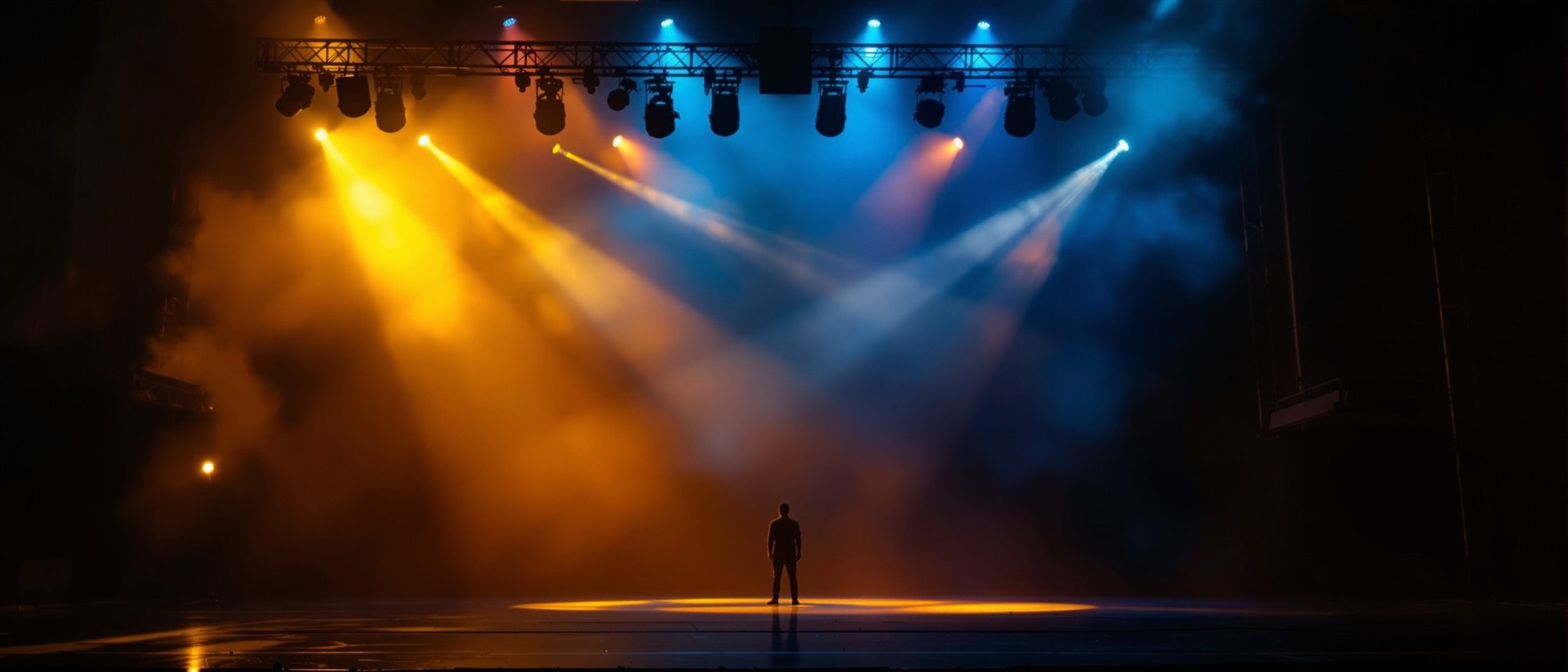
Light is the scenographer's most powerful and least tangible tool — it can reveal a set or hide it, flatten it or carve it in three dimensions, and above all give it mood. Learn the functions of stage lighting and the McCandless method, the lantern types, colour and gobos, and how angle, colour and intensity conjure atmosphere. (The architectural side lives in Lighting Design.) Try the atmosphere explorer below.
Learning objectives
By the end of this lesson, you will be able to — mapped to the course outcomes for Set Design:
Explain the functions of stage lighting and the McCandless method.
Identify the lantern types and beam-shaping tools.
Use angle, colour and intensity to create mood.
Light an atmosphere for a scene.
Functions & lanterns
Stage lighting gives visibility, form, composition and mood; the McCandless method lights each area with two beams (warm + cool) at 45°/90°.[3]
What light does
Stage lighting has four classic functions (after McCandless): VISIBILITY and selective focus, REVELATION OF FORM (modelling in 3D), COMPOSITION, and MOOD. The MCCANDLESS METHOD (1932) lights each acting area from TWO angles, each ~45° above the actor and ~90° apart in plan — one beam WARM (amber), one COOL (blue) — so they fill each other's shadows, model the face, and let mood and time of day shift by re-balancing warm against cool.[3]
Lighting the mood
Mood comes from colour, key, angle and intensity — front flattens, side sculpts, under-lighting turns sinister. Try the explorer.[3, 1]
Light a mood · pick an atmosphere
The lighting recipe
Warm amber light (low Kelvin), soft-edged fresnels, gentle front-and-side modelling, medium-low intensity — high-key but warm. A gobo of dappled light adds intimacy.
Mood is built from colour (warm/cool), key (high/low), angle and intensity — light is the scenographer's strongest tool.
Angle, colour, intensity
Mood comes from three controls. COLOUR: warm (low Kelvin, amber) feels intimate, cool (high Kelvin, blue) feels distant; HIGH-KEY (bright, even) is open and cheerful, LOW-KEY (dark, high contrast) is dramatic. ANGLE is decisive: FRONT light is flat and visible, SIDE light sculpts (dance), BACK light separates the figure from the background, TOP light isolates, and UNDER-LIGHTING (footlights throwing shadows upward) gives the classic sinister, unnatural look. INTENSITY and cue RHYTHM complete the grammar. Try the explorer below.[3]
At a glance
| Aspect | One | The other |
|---|---|---|
| McCandless pair | One beam warm (amber) | One beam cool (blue), ~45° / 90° apart |
| Soft vs hard | Fresnel: soft-edged wash | Profile: hard edge, takes a gobo |
| Colour mood | Warm (low K): intimate | Cool (high K): distant |
| Key | High-key: bright, even, cheerful | Low-key: dark, contrasty, dramatic |
| Angle | Side: sculpts · back: separates | Under-light: sinister, unnatural |
Key terms
Two beams per area at ~45° and ~90° apart, one warm and one cool — the classic lighting recipe.
A lantern giving a soft-edged, adjustable wash of light.
A lantern giving a hard, shapeable edge — can project a gobo.
A high-power steerable lantern that follows a performer.
A coloured filter that changes a lamp's colour.
A cut template placed in a profile to project a pattern (window, leaves, texture).
Light from below throwing shadows upward — the classic sinister, unnatural look.
Throwing moving image precisely onto a set's surfaces — light, image and form as one.
Studio task
Pick a scene and a mood, then write its lighting plot — the angle, colour and key — using the atmosphere explorer above. How would you re-light the same set to flip it from joyful to sinister?
Self-assessment
1. The McCandless method lights an acting area with —
2. Lighting a face from below (under-lighting) tends to read as —
3. A gobo is —
Recap
References & further reading
- [1]Pamela Howard, What is Scenography? Routledge, 2019.
- [3]Francis Reid, The Stage Lighting Handbook. Routledge; and Stanley McCandless, A Method of Lighting the Stage (1932). https://en.wikipedia.org/wiki/Stanley_McCandless
Further reading
- Francis Reid, The Stage Lighting Handbook. Routledge.
- Richard Pilbrow, Stage Lighting Design. Nick Hern Books.
- J. Michael Gillette, Theatrical Design and Production. McGraw-Hill.
Sources gathered and fact-checked June 2026. Published values vary by source, sample and method — treat as indicative and confirm against the cited standard before structural use.
The author
Amogh N P
Architect, interior designer, and creative polymath. Studio Matrx began in his notebooks — his vision of design made honest, useful, and open to everyone. Its Academy is written and taught in his memory, and free, forever.
More about Amogh →