
Set Construction & Materials
How a set is built, painted and changed.
A design on paper becomes a world on stage through a small vocabulary of built elements — the flat, the platform, the cyclorama, the gauze that turns from solid to transparent on a cue, and the wagons and revolves that change a scene in seconds. Learn how flats are built, the materials a workshop uses, the scenic-painting that fakes reality, and the rigging that keeps it safe and quick.
Learning objectives
By the end of this lesson, you will be able to — mapped to the course outcomes for Set Design:
Identify the scenic construction elements — flat, platform, cyc, gauze.
Choose materials for scenery by weight, strength and finish.
Apply scenic-painting techniques — texture, trompe-l'oeil, ageing.
Explain rigging, flying, safety and quick scene changes.
The scenic vocabulary
Built scenery uses a small kit — the flat, the platform, the cyclorama, the gauze — plus wagons and revolves for fast changes, in materials chosen to fly.[4]
Flats, platforms, cycs
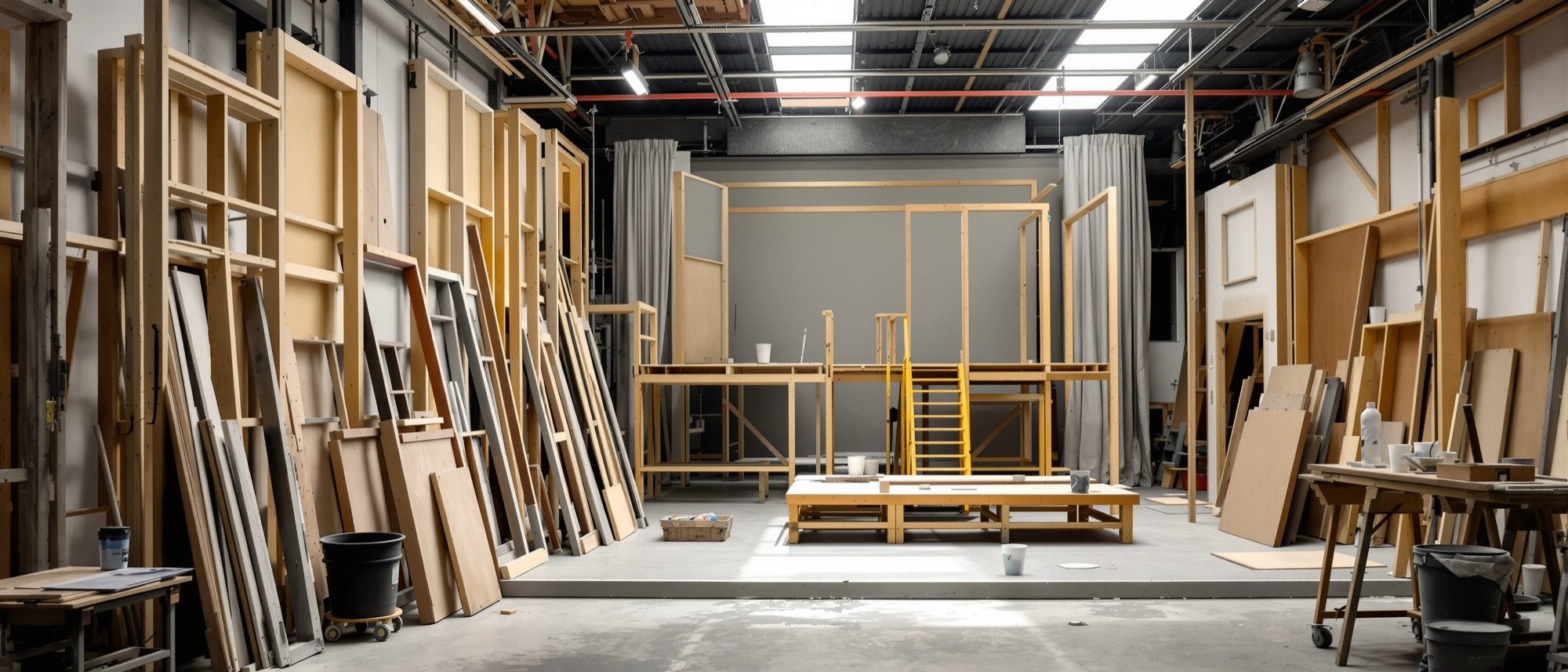
Built scenery uses a small kit. The FLAT is the basic vertical unit — a timber frame faced with canvas (a 'soft flat') or plywood (a 'hard'/Hollywood flat). The PLATFORM or rostrum raises the floor into levels. The BACKDROP or CYCLORAMA (cyc) is the great cloth or curved wall at the rear suggesting sky or infinity. The GAUZE or scrim is an open-weave cloth that reads solid when lit from the front and turns TRANSPARENT when the scene behind it is lit — the classic reveal.[4]
Painting & rigging
Paint does the illusion — base, texture, trompe-l'oeil, ageing — and scenery flies from the fly tower on counterweighted lines, with safety paramount.[4]
Faking reality
Paint does most of the illusion. The sequence runs BASE coat → TEXTURE → TROMPE-L'OEIL (the 'fool-the-eye' realism that paints depth, stone, wood or marble on a flat surface) → AGEING and distressing (dirt, wear and patina that make a new build look lived-in). A skilled scenic artist can turn a plywood flat into convincing stone — the set need only be real from the audience's distance, not in the hand.[4]
At a glance
| Aspect | One | The other |
|---|---|---|
| Vertical vs level | Flat: framed vertical scenery | Platform: a raised level |
| The back wall | Cyclorama: sky / infinity | Gauze: solid → transparent on cue |
| Fast change | Wagon: rolls a unit on | Revolve: swings the scene round |
| Material choice | Timber/ply: frames (light) | Foam/fibreglass: sculpted forms |
| Faking it | Trompe-l'oeil: paints the illusion | Ageing: makes new look lived-in |
Key terms
The basic vertical scenic unit — a timber frame faced with canvas or plywood.
A raised level on the stage floor.
A large cloth or curved wall at the rear suggesting sky or infinity.
Open-weave cloth — solid when front-lit, transparent when the scene behind is lit.
A wheeled platform that rolls a set unit on and off for a fast change.
A turntable in the stage floor that swings a new scene into view instantly.
'Fool-the-eye' scenic painting that fakes depth, stone or wood on a flat surface.
Raising and lowering scenery and lights from the fly tower on counterweighted lines.
Studio task
Design a single scene change for your set — decide whether to use a flying piece, a wagon or a revolve — and list the flats and platforms you would build, with a material and a paint finish for each.
Self-assessment
1. A gauze (scrim) is special because it —
2. The basic vertical unit of built scenery is the —
3. 'Trompe-l'oeil' in scenic painting means —
Recap
References & further reading
- [4]J. Michael Gillette, Theatrical Design and Production (scene construction). McGraw-Hill, 2012.
Further reading
- J. Michael Gillette, Theatrical Design and Production. McGraw-Hill.
- Bill Raoul, Stock Scenery Construction Handbook. Broadway Press.
- Lynn Pecktal, Designing and Drawing for the Theatre. McGraw-Hill.
Sources gathered and fact-checked June 2026. Published values vary by source, sample and method — treat as indicative and confirm against the cited standard before structural use.
The author
Amogh N P
Architect, interior designer, and creative polymath. Studio Matrx began in his notebooks — his vision of design made honest, useful, and open to everyone. Its Academy is written and taught in his memory, and free, forever.
More about Amogh →