
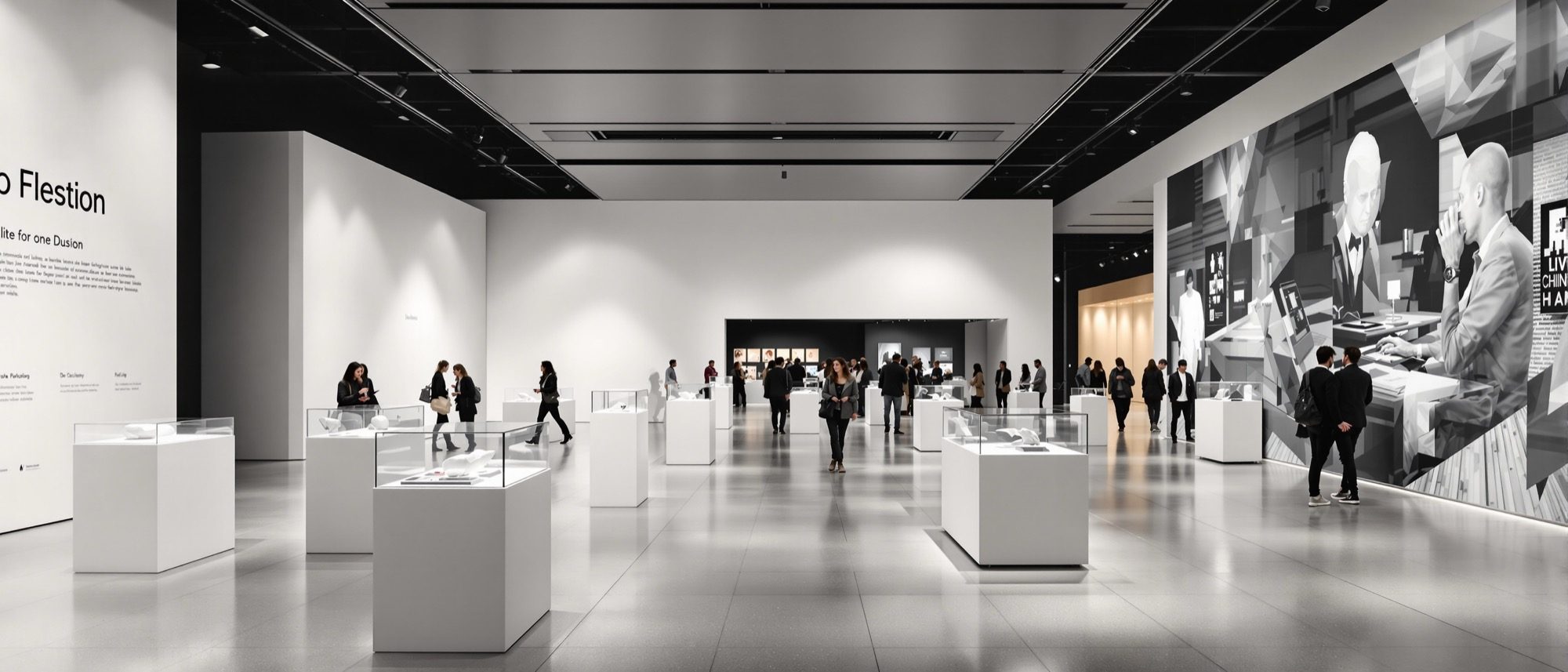
Exhibition & Event Design
The same craft, for a moving visitor — and back to architecture.
Scenography does not stop at the stage. The same skills — composing space, light, materials and narrative — design exhibitions, museums and themed environments, but for a moving visitor. Learn the visitor journey and display systems, signage and environmental graphics, and how this is the most direct bridge back to interior design and architecture.
Learning objectives
By the end of this lesson, you will be able to — mapped to the course outcomes for Set Design:
Design the visitor journey and use display systems.
Apply interpretation and immersive techniques to an exhibition.
Use signage, wayfinding and environmental graphics.
Relate scenographic skills back to architecture and interiors.
Exhibition design
The visitor journey is the spine; display systems (plinths, vitrines) carry the content; immersive environments borrow film and retail technique.[6]
Design for movement
Exhibition design's spine is the VISITOR JOURNEY — unlike the seated theatre spectator, the visitor MOVES, so the route, its sequence and its pacing are the design. David Dernie frames the field as narrative, performative and simulated space, served by display, lighting, colour, sound and graphics. DISPLAY SYSTEMS carry the content: PLINTHS (pedestals for objects), VITRINES (glazed cases), wall systems and mounts. INTERPRETATION — labels, panels and interactive media — explains it.[6]
Graphics & the crossover
Wayfinding and environmental graphics make a space navigable; and space, light, materials and circulation bridge scenography to architecture.[6, 1]
Words in space
A spatial design must be navigated, so WAYFINDING — the system of signage, architectural cues and circulation logic that helps a visitor orient — is integral, not an afterthought. ENVIRONMENTAL GRAPHIC DESIGN (EGD) integrates graphics, TYPOGRAPHY and signage into the built space; typography becomes an architectural element, and graphics 'brand' a space. Good wayfinding is invisible — you simply find your way.[6]
At a glance
| Aspect | One | The other |
|---|---|---|
| Audience | Theatre: a seated spectator | Exhibition: a moving visitor |
| Display | Plinth: raises an object | Vitrine: glazed protective case |
| Past vs inside | Traditional: walk past objects | Immersive: step inside the story |
| Navigation | Wayfinding: orient the visitor | EGD: typography & graphics in space |
| The bridge | Scenography: space that performs | Architecture: space we live in |
Key terms
The sequenced, paced route a moving visitor takes — the spine of exhibition design.
A pedestal that raises and presents an object.
A glazed display case protecting and presenting objects.
Labels, panels and media that explain an exhibition's content.
A themed space the visitor steps inside — scenography for a walking audience.
The system of signage and cues that helps a visitor orient and navigate.
Graphics, typography and signage integrated into built space.
Both shape space, light, material and circulation — the elective's bridge to the core.
Studio task
Design a small exhibition on a topic you love — sketch the visitor route, place a few plinths and vitrines along it, and add the wayfinding signs a first-time visitor would need. Note where it reuses your stage-design skills.
Self-assessment
1. The organising spine of an exhibition design is the —
2. A vitrine is a —
3. Exhibition design is the elective's clearest bridge to architecture because both —
Recap
References & further reading
- [1]Pamela Howard, What is Scenography? Routledge, 2019.
- [6]David Dernie, Exhibition Design. W. W. Norton / Laurence King, 2006. https://wwnorton.com/books/9780393732115
Further reading
- David Dernie, Exhibition Design. Laurence King.
- Philip Hughes, Exhibition Design. Laurence King.
- Craig Berger, Wayfinding: Designing and Implementing Graphic Navigational Systems. RotoVision.
Sources gathered and fact-checked June 2026. Published values vary by source, sample and method — treat as indicative and confirm against the cited standard before structural use.
The author
Amogh N P
Architect, interior designer, and creative polymath. Studio Matrx began in his notebooks — his vision of design made honest, useful, and open to everyone. Its Academy is written and taught in his memory, and free, forever.
More about Amogh →