
 Lesson 7.4
Lesson 7.4 · On the Site
Logistics, Power & the Real Site
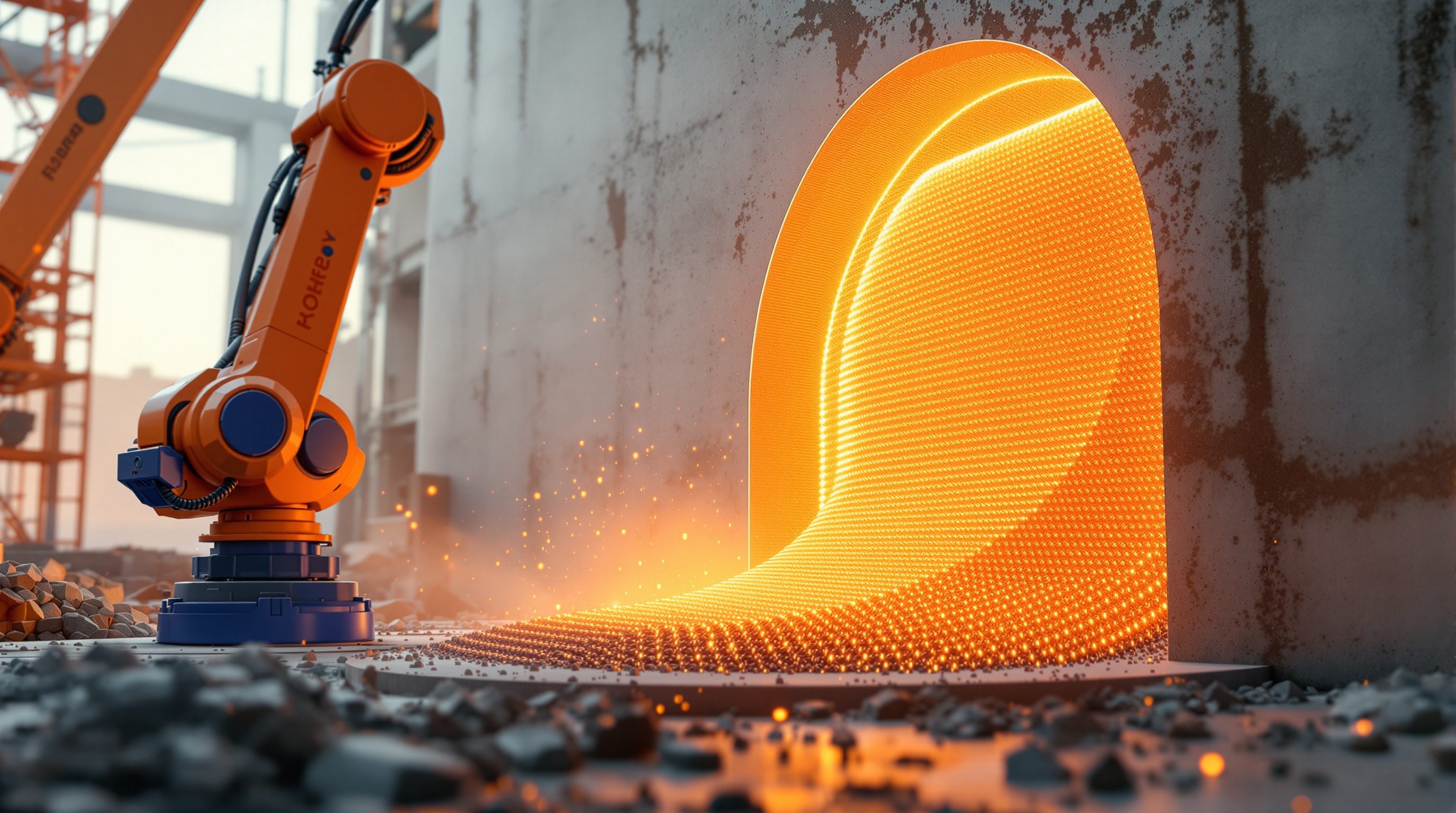
The demo works in a clean yard with pre-batched material, flat ground and ideal weather - then the same machine meets a real site of unreliable power, weather, mud, distance and blockages, and the gap between those two worlds is where most of the hype goes to die
The printer that built a flawless wall on YouTube sat idle for two days on the real job - the genset tripped, the special mortar was stuck in traffic, and then it rained.
Every glamorous capability in this course depends on a set of deeply unglamorous conditions being met, and on a real site they often are not. A machine that prints beautifully needs continuous power, a continuous supply of a fussy special material, weather it can work in, ground it can stand on and reach across, and an unblocked line from the mixer to the nozzle. Remove any one of these and the most advanced plant on site becomes an expensive paperweight.
This final lesson of the module is about those constraints, and about the single most important honesty in the whole field: the gap between a controlled demonstration and a messy real site. A demo is engineered to succeed - clean power, pre-batched material, flat ground, calm weather, the maker's own experts, short hoses, no other trades in the way. A real site offers none of that reliably. Understanding why so many impressive demonstrations fail to translate into routine, economical, real-world building comes down not to the cleverness of the robot but to the stubborn logistics around it - the same logistics that have always decided whether construction goes well or badly.
Demo = clean power, pre-batched material, indoors, flat slab, short hose, experts. Real site = genset trips, fussy supply, weather, mud, long pump line, first-timers. Same machine; the gap is logistics, not software.
Power and material supply: the appetite that must not pause
A building-scale printer or robot is a hungry machine, and its two appetites - for power and for material - have to be fed continuously, because a printed element in particular does not tolerate interruption well. Start with power. These machines draw significant electrical load for motion, pumping, mixing and control, and many real sites, especially early-stage plots in India and remote locations, do not have a reliable grid connection of the right capacity. That means generators - which must be sized correctly, fuelled, and reliable, because a power dip or trip mid-print is not a pause, it is a defect: the layers already down keep setting while the machine is stopped, and when it restarts the new material may not bond to the now-too-set surface, giving a cold joint or worse. A demo with clean mains power hides a problem a real site makes central.
Material supply is the harder appetite still. A printable concrete or mortar is not ordinary ready-mix: it is a specially formulated material with a narrow window of workability - an 'open time' during which it can be pumped and will still bond to the next layer - and it has to arrive, or be batched on site, in a continuous stream matched to the machine's rate of consumption for the whole duration of a print that may run for hours. Too slow and the machine starves and stops; too fast or stored too long and the material sets before it can be used. On a demo the material is pre-batched and ready; on a real site you must set up and run a reliable batching and delivery operation, often for a bespoke material whose ingredients and quality must be controlled tightly, sometimes in a place where the supply chain for those ingredients barely exists.
The deeper point is that printing turns a construction site into something like a small continuous-process plant, and continuous processes fail at their weakest supply link. The machine is only as good as the least reliable of its feeds. This is why serious deployments put so much effort into power redundancy, material logistics and contingency planning - and why the mix design, the material specification and the handling requirements are set by material specialists and the manufacturer and treated as binding, not improvised on site. The cleverness is in the nozzle; the success is in the supply.
Weather and curing: building with a material that is alive
Conventional concreting has always been at the mercy of weather, and printing inherits every bit of that sensitivity and adds more, because the material is exposed and unsupported as it is laid rather than held in formwork. A printable concrete is, in effect, a chemical reaction happening in the open air on a timetable, and temperature, humidity, wind and sun all change that timetable in ways that directly affect whether the print succeeds and whether the result is sound.
Consider the variables. Temperature changes how fast the material sets: too hot and it stiffens before it can be pumped or bonded, and dries too quickly at the surface; too cold and it sets too slowly to carry the layers above, risking sagging. Rain can ruin a fresh print outright, washing out or marking the surface and disturbing the chemistry. Wind and sun accelerate surface drying, which can cause cracking and poor interlayer bond. And the curing that follows - the slow gain of strength as the material hydrates - is itself weather-dependent and essential to the element's final performance; rush it or let it dry out wrong and the structure suffers. In a hot, variable climate like much of India's, these are not edge cases; they are the normal operating environment, and they narrow the windows in which a print can even be attempted.
This is a large part of why controlled environments are so attractive and why the field leans toward off-site and sheltered printing where it can: a tent, a shed or a factory removes the weather variable and widens the window dramatically, which is one more way the technology keeps being pulled toward the structured environment that robots love. On an open site, weather becomes a scheduling master - dictating when you can print, how you protect the work, and when you simply cannot proceed. And the binding honesty holds here too: the material's behaviour, its acceptable working and curing conditions, and the protection it needs are specified by the material specialists and manufacturer and verified by testing, because getting the chemistry and curing right is part of whether the element is structurally sound - an engineering matter, not a site convenience.
Printable concrete = chemistry in the open air on a clock. Hot, cold, rain, wind, sun all move the clock. Curing decides final strength. Weather is the scheduling master - or print under shelter.
Access, ground and the physical realities of the plot
Before a machine can print it has to get onto the plot, stand somewhere stable, and reach the whole of the work - and real sites make all three awkward in ways a flat demo yard never does. Access is the first gate: a large gantry or a heavy arm arrives on big trucks and often needs a crane to unload and assemble, and many real plots - a tight urban infill, a village lane, a sloping hillside, a site hemmed in by existing buildings - simply cannot take that traffic easily. If the machine cannot reach the plot, nothing else matters.
Ground is the next. The machine and any crane need firm, level bearing to stand on without settling or tilting, and a printer needs a flat, load-bearing base to print the first layer onto - usually a conventional foundation or slab prepared in advance, as Lesson 7.1 described. A real site may be mud, fill, slope or soft ground that needs working up before the machine can even be positioned, and any settlement under a gantry during a long print translates straight into a defective wall. Reach and footprint are the third: every machine has a working envelope - a gantry prints only within its frame, an arm only within its radius, a mobile machine only where it can position itself - and a real building's shape, its height, and the obstructions around it may not fit that envelope, forcing repositioning, multiple setups, or simply ruling the machine out for that geometry.
These physical realities explain a lot about where the technology genuinely fits today: relatively open sites, simpler forms within a machine's envelope, and projects big or repetitive enough to justify the access and setup effort. They also explain why a technology sold as liberating can in practice be quite constrained - the machine's needs shape what and where you can build with it, rather than the other way round. A clear-eyed designer treats access, ground and reach as early, hard questions - can the machine get here, stand here, and reach all of this? - and designs the project and its siting accordingly, or honestly concludes that conventional construction is the better answer for this plot. The ground and foundation design, as ever, belong to the geotechnical and structural engineers.
Pumping, feeding, and the gap the demo hides
Between the mixer and the nozzle runs a line that has to deliver a continuous, workable flow of material at the right rate, over the real distance and height of the job - and this line is one of the most common places a smooth demo turns into a stopped, spoiled print. Pumping a stiff, thixotropic printing material is genuinely demanding: pressure drops over distance and height, the material can set or jam in a long hose, bends and couplings are weak points, and a blockage mid-print is an emergency - clear it fast or the material sets in the line and the run is lost, along with whatever was on the wall. On a demo the hose is short and the distance trivial; on a real, spread-out site the line is long, routed awkwardly, and far less forgiving.
Step back and the pattern across this whole lesson becomes clear, and it is the honest heart of the module. A demonstration is engineered to succeed: a controlled yard or factory, clean reliable power, pre-batched material handled by experts, a short pump run, flat prepared ground, calm weather, no other trades underfoot, and generous time. A real site offers none of that reliably: uncertain power, a bespoke material that must be supplied continuously, weather that dictates the schedule, mud and slope and tight access, long pump runs, a workforce meeting the machine for the first time, and the relentless pressure of a programme and a budget. The machine is identical in both; almost everything around it is different. That difference - not a lack of cleverness in the robot - is why so many striking demonstrations have not yet become routine, economical, real-world building, and why honest practitioners judge the technology by how it performs on messy real sites, not in showpieces.
None of this is a reason for cynicism - the field is real, advancing and already useful in the right niches, as this course has consistently said. It is a reason for clear eyes. The constraints in this lesson are solvable, with serious logistics, redundancy, material discipline, sheltered or off-site working, and honest project selection - but they are solved by planning and graft, not by the next software update, and they are exactly what the hype omits. Carry this out of the module: on a real site, the machine is the easy part; power, material, weather, ground and the pump line are what decide whether automation actually builds anything, and the binding material, structural and safety questions stay, as always, with the specialists, the engineers and the codes.
Material specification & curing
Mix design, open time, handling and curing conditions
Set by material specialists and the manufacturer and verified by testing; getting chemistry and curing right is part of structural soundness, not a site convenience. Module 8.1.
Ground & foundation design
Bearing for the machine and the base it prints onto
A geotechnical and structural engineering responsibility; settlement under a machine during a print becomes a defect. Prepared before the machine arrives (Lesson 7.1).
Site logistics & power
Supply, delivery, power, access and contingency
A construction-management task: size and secure power and material supply, plan access and redundancy, and have a contingency for interruptions. Treat printing as a continuous process.
Electrical & plant safety
Generators, pumps and powered equipment on site
Follows electrical and plant-safety regulation and the manufacturer's requirements, alongside the site safety regime (Lesson 7.3). Binding, not optional.
Workshop - stress-test a demo against a real site
The module's most useful habit is turning demo scepticism into structured analysis. In this workshop you will take an impressive print demonstration and systematically work out what a real Indian site would throw at it.
A real demo or project to study and a notebook. No equipment - this is structured, clear-eyed reasoning about logistics and reality.
Goal: a clear-eyed demo-to-real-site gap analysis
Inputs: a real print demo or project you can read about or watch, this lesson, a notebook
Time: ~45 minutes
- 1Pick a demo: choose a real, impressive 3D-printed-building or construction-robot demonstration you can study. Note the headline claim.
- 2List the demo's hidden comforts: for each constraint - power, material supply, weather, ground/access, pumping - note what the demo almost certainly had easy (clean mains, pre-batched material, indoors, flat slab, short hose).
- 3Transplant it to a real site: pick a realistic plot (a sloping peri-urban plot on an unreliable grid in a hot, monsoon-prone region is a good stress test) and write what each constraint becomes there.
- 4Find the breaking points: identify the two or three constraints most likely to stop or spoil the job on your real site, and say why - what is the failure mode (cold joint from a power trip, washout from rain, blockage in a long hose)?
- 5Write the honest verdict: in a paragraph, say what the demo genuinely proved, what it hid, and what serious planning (not software) would be needed to make it work on your real site - or whether conventional construction is the better answer there.
You’ll walk away with
A one-page demo-to-real-site gap analysis: the demo's hidden comforts, what each constraint becomes on a messy real plot, the likely breaking points, and an honest verdict. It is the sharpest hype-versus-reality tool in the course; keep refining it.
Three altitudes on the same idea
Read the band that fits you — or all three.
Judge the technology, and the plot, by the real-site constraints - not the demo. Before committing to a printer or site robot on a project, ask the hard logistics questions early: is there reliable power or a plan for it; can a continuous supply of the special material be sourced and batched here; does the climate and the programme leave workable weather windows; can the machine get onto the plot, stand on firm level ground, and reach the whole of the building within its envelope; can the pump run reach? Design the siting, form and sequence to suit the machine's real needs, or conclude honestly that conventional construction fits this plot better. Treat the machine as the easy part and the logistics as the decider. Leave ground and foundation design to the geotechnical and structural engineers and the material specification to the material specialists and manufacturer.
Off-site and sheltered fabrication sidesteps most of these constraints - which is exactly why it suits interiors. Bespoke panels, moulds, screens and components are usually robotically fabricated or printed in a workshop or factory, where power, material, weather, ground and feeding are all controlled - the structured environment that makes the result reliable. That is a genuine advantage of the component scale you work at: you largely avoid the messy open-site problems that plague building-scale on-site printing. Your real-site concern shifts to delivery, handling and installation of the finished piece - transport, access, fit to an imperfect building - rather than the print itself. When you do commission work, reward fabricators with disciplined material control and process, and leave the mix, curing and any structural requirement to the specialists.
Learn to watch any impressive demo and immediately ask what a real site would do to it. Clean power becomes a generator that might trip; pre-batched material becomes a fussy supply chain that must never pause; a calm indoor yard becomes heat, rain and wind that move the material's chemistry and dictate the schedule; flat prepared ground becomes mud, slope and tight access; a short hose becomes a long, blockage-prone pump line. The machine is the same in the demo and on site; almost everything around it is different, and that gap - logistics, not cleverness - is why so many demonstrations have not become routine building. This is the clearest test of hype versus reality in the whole field, and being able to apply it marks a genuinely literate, clear-eyed practitioner.
“The technology is basically proven - we've all seen houses printed in a day - so rolling it out on real projects is now just a matter of scaling up and buying more machines. If the demo worked, the real site will work.”
Do it yourself
No tools needed - reason it through.
- 1Why is a mid-print power interruption a defect rather than just a pause, and what does that demand of a site's power supply?
- 2What is the 'open time' of a printable material, and why does it make continuous material supply so critical?
- 3Give three ways weather affects an exposed print and its curing, and explain why this pulls the technology toward sheltered or off-site work.
- 4Name the three physical-plot questions (access, ground, reach) a designer should ask early, and why each can rule a machine out.
- 5Explain the demo-to-real-site gap in your own words: why does a demo working not prove a real site will work, and what actually closes the gap?
The one line to carry out
Peer-reviewed journals & authoritative standards
- 01Concrete — Wikipedia - Concrete, 2026.
- 02Construction 3D printing — Wikipedia - Construction 3D printing, 2026.
- 03Construction management — Wikipedia - Construction management, 2026.
- 04Cement — Wikipedia - Cement, 2026.
- 05Heavy equipment — Wikipedia - Heavy equipment, 2026.
With the realities of deployment, quality, safety and the messy site in hand, the course turns from the site to the hard questions of whether it all adds up - structural performance and testing, codes and approval, the honest cost case and sustainability. That is the next module.
The author
Amogh N P
Architect, interior designer, and creative polymath. Studio Matrx began in his notebooks — his vision of design made honest, useful, and open to everyone. Its Academy is written and taught in his memory, and free, forever.
More about Amogh →