
 Lesson 9.1
Lesson 9.1 · Reality, Limits & Honesty
Hype vs Reality
Few fields attract as much breathless coverage as robots and printers that build - and learning to read any construction-tech claim critically, separating the genuine advance from the staged demo and the omitted conventional work, is the single most valuable skill this module can give you
A village printed in a weekend. A house built by robots in a day. The headlines are everywhere - so why is almost every building around you still made by hand?
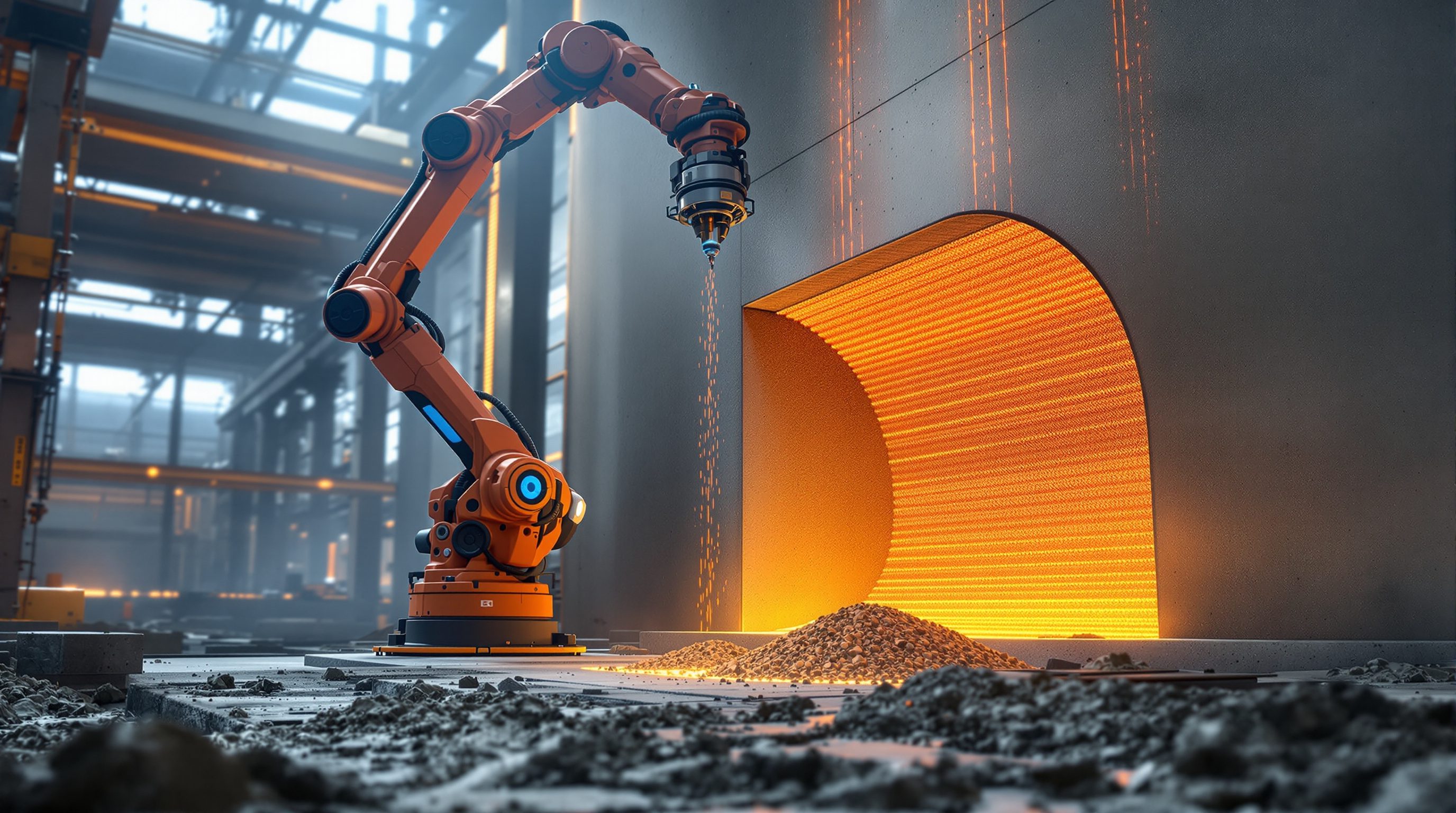
Open any feed and the future of construction seems to have already arrived: a house 3D-printed in 24 hours, the world's first printed school, a printed bridge, robots that will replace bricklayers, an entire neighbourhood printed for a fraction of the usual cost. The imagery is genuinely arresting - a nozzle tracing walls in smooth beads, a robotic arm placing brick after brick without tiring. It is easy to come away believing the revolution is done and only rollout remains.
Then you look up from the screen. The home you live in, the office you work in, the buildings going up down your street - almost all of them are being made the way they have been for decades: by people, by hand, slowly, in the weather. That gap between the headline and the street is the subject of this lesson. The technology is real and advancing, and this course has spent modules taking it seriously. But a serious education also means learning to read the claims critically - to see what a demonstration actually demonstrated, what the sensational number actually measured, and what quietly stayed conventional. This is not cynicism. It is literacy. The most useful thing you can carry out of this whole course is the ability to look at any construction-tech claim and calmly separate the genuine advance from the marketing.
Hype vs reality. The headline times a slice. Walk the whole building, find the rung, ask who benefits - then defer the binding questions to engineers.
Why this field is so hype-prone
Some fields attract exaggeration more than others, and robotic and printed construction sit near the top - for understandable reasons worth naming, because seeing the mechanism helps you resist it. First, the imagery is irresistible. A machine tracing a wall in glowing beads of concrete, or an arm laying brick with mechanical calm, is visually compelling in a way that a steel-fixer tying rebar is not. It makes a perfect clip, and clips travel. Second, the promise touches something real: construction genuinely is slow, costly, dangerous and short of labour in many places, so a machine that fixes all of that is a story people want to be true. Wanting it to be true is exactly the condition under which claims go unchecked.
Third, the money and attention that flow to a field reward spectacle. Startups need funding, funding follows buzz, and buzz follows superlatives - 'first', 'fastest', 'cheapest'. A company has every incentive to stage a striking demonstration and let the press supply the breathless framing; it has little incentive to add the deflating footnotes about foundations, reinforcement and approval. Journalists, working fast and rarely trained in construction, reprint the press release. The superlative compounds as it spreads.
Fourth, and most insidiously, the language is loose. 'Printed a house' can mean anything from 'printed the external walls of a single-storey demonstrator under ideal conditions with a crew of experts on hand' to far less. 'In 24 hours' usually times only the printing, not the weeks of conventional work on either side. 'A fraction of the cost' rarely specifies the fraction, the baseline, or whether it includes everything a real habitable building needs. None of this means the underlying technology is fake - it is real and genuinely advancing. It means the claims about it are systematically inflated by the structure of how news, funding and attention work. Once you see that structure, you stop being surprised by it, and you start reading every claim with the quiet question: what, precisely, is being measured here, and what is being left out?
What the headline leaves out
The most common distortion is not a lie but an omission, and it follows a predictable shape. Take the archetypal claim: a house 3D-printed in 24 hours. What the machine actually did, in almost every real case, is print the vertical walls - layer upon layer of a special concrete, with no formwork, which is genuinely impressive. What the headline omits is everything else a building is. The foundations were poured conventionally before the printer arrived, and concrete needs curing time the clock ignores. The steel reinforcement that gives the structure its safety was placed by hand, in and around the print, by conventional means - and as Module 4.3 argued, reinforcement is the central unsolved problem of the whole field, so its conventional handling is not a minor footnote. The floors and roof were built conventionally, because you cannot print horizontally into thin air. The windows, doors, plumbing, electrical wiring, mechanical services and every finish were installed the normal way, taking the normal time.
So the honest description of a '24-hour printed house' is usually: the walls were printed in about 24 hours of machine time, and the rest of the building - most of the work, most of the weeks, most of the cost - proceeded conventionally. The sensational number describes a slice, presented as the whole.
This is the single most useful audit move you can learn. When you meet any printed-building claim, mentally walk the whole building and ask of each part - foundations, structure and reinforcement, floors, roof, envelope, services, finishes - was this printed, or was it conventional? You will nearly always find that the printed portion is the walls, and sometimes not even all of them. The same discipline applies to robotics claims: a bricklaying robot that 'builds a wall' still needs humans to set it up, feed it, handle corners and openings, finish the work and tie it into the rest of the building. Naming what the machine did not do is not pedantry; it is how you recover the real, and still genuinely interesting, size of the advance from a headline designed to obscure it.
Walk the whole building. Foundations? conventional. Rebar? by hand. Floors, roof, services, finishes? conventional. Printed = the walls. The '24 hours' times a slice.
Prototype is not production
The deepest confusion in construction-tech coverage is the collapse of a long ladder into a single rung. There is an enormous distance between 'a machine did this once, in ideal conditions, with its makers present' and 'this is a repeatable, certified, economically viable way to build' - and headlines routinely report the bottom of that ladder as if it were the top.
It helps to hold the ladder explicitly. A staged demonstration is one unit, under chosen conditions, with the development crew on hand and a public-relations purpose. A prototype works, but not yet repeatably or to a certified standard. A pilot puts a few real units into the world, still with heavy expert support. Above that sit the rungs that actually make a method real and that demonstrations almost never address: code approval and certified testing for the method, so it can lawfully and safely be used; a genuine economic case against conventional construction in a specific market; and finally routine, repeatable production at scale by people who are not the inventors. Each rung is harder than the last, and the jump from pilot to certified, economically viable, routine production is where most promising construction technologies stall for years - or quietly never arrive.
This is why you should treat the word 'first' with particular care. 'World's first printed X' is usually a claim about a demonstration - the bottom rung - and tells you almost nothing about whether the method is ready for ordinary use. A useful reflex when you meet any claim is to ask: which rung is this, really? Is it a one-off demonstrator, or something a builder with no connection to the manufacturer can procure, get approved, and deliver economically today? Most coverage, honestly read, describes the lower rungs. That does not make the work unimportant - climbing those lower rungs is how a field progresses, and some of this genuinely will mature. It means a single impressive demonstration is evidence that something is possible once, not that it is ready, approved, affordable or routine. Keep the ladder in mind and the hype re-sorts itself into a sober, and still genuinely hopeful, picture of where the field actually stands.
A checklist for reading any claim
All of this condenses into a short, repeatable discipline you can apply to any construction-tech story in a minute, without needing to be an engineer. It is the practical heart of this lesson, and it will serve you long after the specific machines in today's headlines are obsolete.
First, name the claim precisely. What is the exact assertion - fastest, cheapest, first, strongest? Strip the adjectives and find the measurable statement underneath. Second, separate the frontier: is this robotics (a machine doing a building task) or 3D printing (forming the structure additively), or both? The two have different strengths and failure modes. Third, walk the whole building: for a printed structure, which parts were printed and which stayed conventional - foundations, reinforcement, floors, roof, envelope, services, finishes? For a robot, what did humans still have to do? Fourth, apply the unstructured-site lens from Module 1.3: did this happen off-site in a structured factory or on the messy open site, and how much expert support did the machine need? Automation behaves very differently in those two settings. Fifth, locate the rung: is this a staged demo, a prototype, a pilot, or genuinely approved, affordable, routine production? Sixth, ask who benefits from the framing and what the source is - a company press release, an independent report, a peer-reviewed study, a regulator.
Finally, and most importantly, know what to defer. Nothing in a marketing claim tells you whether a printed or robotically built element is structurally safe, properly reinforced, code-compliant or durable. Those are binding engineering questions that belong to qualified structural engineers, material specialists, certified testing and the governing codes - never to a press release, a demo video or your own inference from a photograph. A claim can be completely true about machine time and completely silent about safety. The competent reader holds both: genuine, literate interest in a real and advancing technology, and an unshakeable habit of asking what was measured, what was omitted, which rung this is, and what still needs a qualified engineer to verify. That habit, more than any fact about any particular printer, is what this lesson exists to give you.
Read any claim: name it, split robot/printer, walk the whole building, structured or unstructured, which rung, who benefits, what to defer to engineers.
Structural safety of the element
Whether a printed or robotically built part is actually safe
No demo, video or headline establishes structural safety. It is decided by a qualified structural engineer and certified testing against the governing codes. Module 8.1.
Reinforcement and durability claims
Tensile strength and long-term performance
Reinforcement is the field's central unsolved problem (Module 4.3); durability claims require evidence, not assertion. Treat any such claim as unverified until an engineer and testing confirm it.
Code approval and certified testing
Legal, safe use of a novel method
Codes for these methods are still maturing; approval follows the NBC India, the local authority and the engineer - never a manufacturer's marketing. Module 8.2.
Cost and time figures
What 'fastest' and 'cheapest' actually measured
Quoted times usually cover machine time only; quoted costs often omit the conventional majority of the build. Treat every figure as illustrative and source-dependent, not a specification.
Workshop - audit a real construction-tech claim to the ground
In Module 0 you did a first clear-eyed read of a construction-automation story. Now you sharpen it into a rigorous audit, applying the full checklist and writing the kind of honest assessment a client or studio could actually rely on.
A current construction-tech story or company page you can read, this lesson's six-step checklist, and a notebook. No equipment - the whole point is reasoning, not kit.
Goal: a rigorous, checklist-driven audit of one inflated claim
Inputs: a current news story or company page making a striking claim ('fastest', 'cheapest', 'first', 'printed in X hours') + this lesson's checklist + a notebook
Time: ~50 minutes- 1Pick a claim with a superlative or a sensational number - a printed house/school/bridge, or a construction robot - and write the exact claim down, adjectives stripped to the measurable assertion underneath.
- 2Separate the frontier (robotics, printing, or both) and then walk the whole building: list foundations, structure and reinforcement, floors, roof, envelope, services and finishes, and mark each as printed/robot-made or conventional. For a robot, list what humans still did.
- 3Apply the unstructured-site lens: off-site factory or open site? How much expert support did the machine need? Then locate the rung honestly - staged demo, prototype, pilot, or genuinely approved and routine production.
- 4Trace the source and the incentive: is this a company release, independent reporting, a peer-reviewed study, a regulator? Who benefits from the framing, and what does the number actually measure?
- 5Write a two-paragraph verdict: first, the genuine advance (state it generously - the real thing is interesting); second, exactly what the claim over-reached, which rung it really sits on, and the specific structural, reinforcement, code and cost questions you would route to a qualified engineer and the codes before trusting it as a real building.
You’ll walk away with
A one-page rigorous audit of a real claim: the precise assertion, the printed-vs-conventional walk-through, the unstructured-site read, the rung, the source and incentive, and an honest verdict separating the real advance from the over-reach - with the binding questions flagged for the engineers.
Three altitudes on the same idea
Read the band that fits you — or all three.
You will be pitched these technologies - by vendors, by clients who saw a video, sometimes by your own enthusiasm - and your value is to assess the claim soberly before it shapes a project. When a manufacturer shows a printed-house demo, walk the whole building and ask what was printed versus conventional, which rung on the demo-to-production ladder this really is, whether the method is code-approvable here, and whether the economics hold against conventional construction in your market. Use the technology where it genuinely fits (Module 9.2 and 9.4), not because it photographs well. Carry real, literate interest without credulity, and keep the binding structural, reinforcement, code and safety judgements with the qualified engineers and the governing codes - a marketing claim never settles them.
The hype in your corner of the field is gentler but still real: 'fully robot-made' furniture, '3D-printed' interiors, bespoke elements pitched as effortless. Apply the same audit. What did the machine actually form, and what was still finished, assembled, reinforced or installed by hand? Is this a repeatable production process you can actually commission and get delivered on schedule, or a one-off showpiece? Robotic fabrication and printing genuinely make striking bespoke panels, screens, moulds and components - the real advance is worth using - but read the claim precisely, confirm the process is production-ready for your timeline and budget, and coordinate any structural, fire or safety-critical requirement with the relevant specialists rather than trusting the sales reel.
This is the skill that will outlast every specific machine you study: reading a claim critically. Tomorrow's headlines will feature printers and robots that do not exist yet, and the exact facts you memorise will date - but the method here will not. Practise it: name the claim precisely, split robotics from printing, walk the whole building to find what stayed conventional, apply the unstructured-site lens, locate the rung from demo to routine production, and ask who benefits from the framing. Stay genuinely excited - the field is real and advancing and you should be literate in it - but immune to the superlatives. A graduate who can calmly deflate an inflated construction-tech claim, and explain exactly why, is far more valuable than one who repeats it.
“If a reputable outlet reports that a house was 3D-printed in 24 hours for a fraction of the normal cost, that must be basically accurate - journalists check these things, and the technology is clearly ready to roll out widely.”
Do it yourself
No tools needed - reason it through using the checklist.
- 1List the structural reasons this field attracts so much hype - the imagery, the real problem it promises to fix, the funding-and-attention incentives, and the loose language.
- 2Take the claim 'a house 3D-printed in 24 hours' and walk the whole building: name what was almost certainly printed and what almost certainly stayed conventional.
- 3Explain the difference between a staged demonstration, a prototype, a pilot and routine certified production - and why 'world's first' usually sits at the bottom of that ladder.
- 4Why should the words 'fastest' and 'cheapest' always prompt the question 'measured how, against what baseline, including what?'
- 5Name the four binding questions that no marketing claim can settle, and say who they belong to.
The one line to carry out
Peer-reviewed journals & authoritative standards
- 01Construction 3D printing — Wikipedia - Construction 3D printing, 2026.
- 023D printing / additive manufacturing — Wikipedia - 3D printing, 2026.
- 03Contour crafting — Wikipedia - Contour crafting, 2026.
- 04Construction robotics — Wikipedia - Construction robot, 2026.
Reading claims critically clears the ground; now we can ask the honest positive question. Where does robotic and printed construction genuinely work today, delivering real value rather than headlines? That is the next lesson.
The author
Amogh N P
Architect, interior designer, and creative polymath. Studio Matrx began in his notebooks — his vision of design made honest, useful, and open to everyone. Its Academy is written and taught in his memory, and free, forever.
More about Amogh →