
 Lesson 5.1
Lesson 5.1 · Other Printed Materials
Earth & Clay Printing
The oldest building material on earth meets the newest machine: printing walls from raw soil and clay promises near-zero embodied carbon and a genuinely local supply chain, but asks you to accept a material that is weaker, more weather-sensitive and smaller in scale than the concrete the printers were built for
Concrete printers were built for concrete. What happens when you fill the hopper with the soil already under the site - the cheapest, most local, lowest-carbon material there is, and also one of the weakest?
The dominant image of 3D-printed construction is grey concrete squeezed out in neat beads. But concrete carries a heavy carbon debt - cement is one of the largest single sources of human carbon emissions - and that sits awkwardly beside the sustainability story the technology likes to tell. So a quietly radical idea has taken hold: instead of trucking in cement, sand and aggregate, fill the printer with the earth already on site. Raw soil, clay, a little fibre, sometimes a small dose of stabiliser - mixed into a printable paste and stacked layer by layer into a wall.
This is not a gimmick; it is one of the most intellectually honest directions the field has taken. Humans have built with raw earth for thousands of years - cob, adobe, rammed earth, wattle-and-daub - across India, Africa, the Middle East and Europe, and much of it still stands. Earth printing takes that deep tradition and hands the placing to a machine. The appeal is real and specific: almost no embodied carbon, a supply chain that starts at your feet, a breathable and recyclable wall, and a thermal mass that suits hot climates. The catch is equally real: earth is weaker than concrete, far more sensitive to water, and harder to build tall or fast. This lesson is about holding both truths at once.
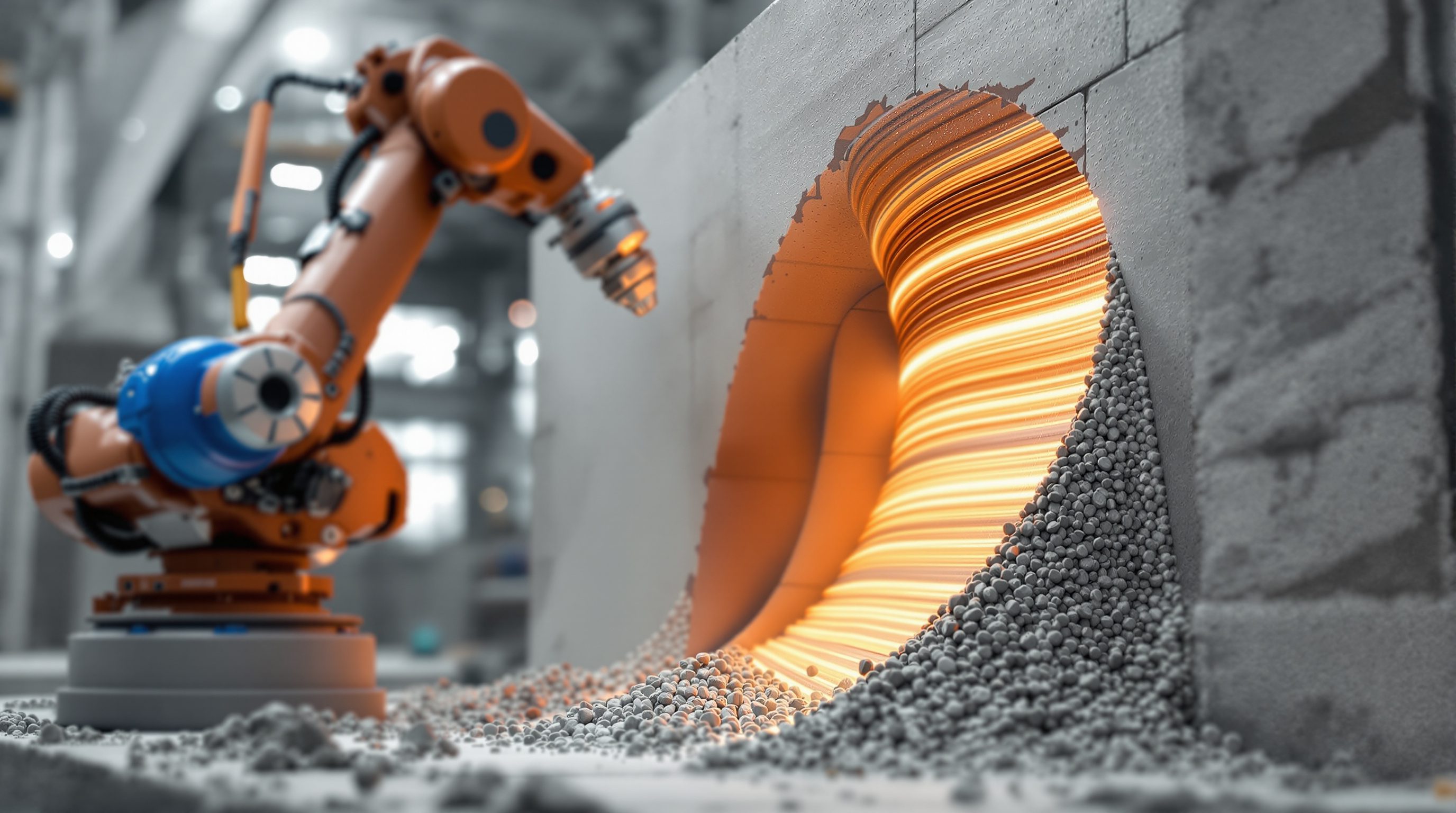
Earth printing: the cheapest, most local, lowest-carbon material - and one of the weakest. Good hat, good boots, low and wall-led. Tradition meets the nozzle.
The material under your feet - and why a printer likes it
Start with the material, because everything follows from it. "Earth" in construction means the mineral soil beneath the topsoil - a mix of clay, silt, sand and sometimes gravel. The clay is the key: its fine particles act as a natural binder, gripping the coarser grains together as the mix dries, much as cement binds aggregate in concrete but without the kiln-fired chemistry. Add water and you get a plastic paste; let it dry and you get a hard, surprisingly durable solid. Traditional earth building exploited this in several forms - cob (earth and straw hand-stacked), adobe (sun-dried bricks), and rammed earth (damp soil compacted in formwork) - and printing is, in effect, a fourth form: an earth paste placed in stacked layers by a nozzle rather than by hand or formwork.
Why does a printer suit earth at all? Because the extrusion-and-stacking logic of 3D concrete printing transfers almost directly. The machine needs a material that is soft enough to pump and extrude through a nozzle, yet stiff enough to hold its shape and carry the layers above the instant it leaves the nozzle - the same "pumpable then immediately self-supporting" balance that concrete printing lives or dies by (Module 4.2). A well-tuned earth mix, with the right clay content, water and additives, can hit that window. And because earth is cheap and abundant, the experimental cost of getting the mix wrong is low compared with specialist printable concrete.
The recipe is where craft meets science. Too much clay and the wall shrinks and cracks as it dries; too little and it will not bind. Too wet and the layers slump; too dry and they will not stick to each other, leaving weak cold joints between beads. Fibres - straw, hemp, natural or synthetic - are often added to control shrinkage cracking and add a little tensile toughness, exactly as straw has been added to cob and mud brick for millennia. Some mixes add a small amount of lime or cement to stabilise the earth against water, which improves durability and strength at the cost of some of the carbon saving. Getting this balance right for a particular local soil is the central practical challenge, and it is soil-specific: the earth from one site behaves differently from the next, which is both the charm and the difficulty of the material.
Soil = clay (binder) + silt + sand + fibre. Pumpable then self-supporting, like concrete printing - but the binder is clay, not cement. Recipe is soil-specific.
The sustainability case, and the tradition-meets-tech story
The reason earth printing draws so much attention is carbon. Cement production is responsible for a large share of global carbon emissions - on the order of several percent of the world total - because making clinker both burns fuel and releases carbon chemically from limestone. A printed concrete wall inherits that debt. A printed earth wall, by contrast, can have a tiny fraction of the embodied carbon: the soil is dug, mixed with water and perhaps a little fibre, and placed, with no firing and little or no cement. When the building's life ends, an unstabilised earth wall can in principle be broken up and returned to the ground or re-wetted and reused - a genuinely circular material. In an era when embodied carbon (the carbon locked into materials and construction, separate from operational energy) is finally being taken seriously, that is a powerful argument.
The supply chain is the second part of the case, and it is especially resonant in a country like India. Conventional construction trucks cement, sand and aggregate - sometimes over long distances, with sand mining itself an environmental and social problem. Earth printing can, in the ideal case, use the spoil already excavated for the foundations, turning a waste stream into the walls. Local material, local labour tuning the mix, minimal transport: the logistics story is compelling where materials are expensive to move or supply is constrained.
There is also a cultural dimension that matters more than it first appears. Earth building is not a foreign import in most of the world - it is the ancestral construction of vast regions, including large parts of India, and it often carries real thermal and comfort advantages in hot climates through its mass and breathability. Earth printing lets that tradition meet contemporary digital fabrication: the machine and the parametric model on one hand, a material your grandparents might recognise on the other. Handled well, this is not nostalgia but continuity - modernising a low-carbon vernacular rather than replacing it with imported concrete. Handled badly, it is a marketing veneer over the same unsolved problems. The difference lies in whether the strength, durability and code questions below are faced honestly.
Weaker, wetter, shorter: the limits you cannot wish away
Now the discipline. Earth's virtues come bundled with real, physical limits, and an honest designer names them first. The biggest is strength. Earth in compression is far weaker than concrete, and in tension it is weaker still - so an earth wall carries load only as a relatively thick, massive, compression-dominated element, much like old load-bearing masonry. This shapes everything: earth printing suits low-rise, wall-dominant buildings - single-storey homes, boundary walls, pavilions - not multi-storey frames or long spans. It does not dissolve the reinforcement problem that haunts printed concrete (Module 4.3); if anything it sharpens it, because earth bonds poorly to steel and the usual answer is to keep the structure within earth's modest compressive comfort zone and let a separate frame, ring beam or conventional elements carry what earth cannot.
The second limit is water. Earth's ancient enemy is rain and rising damp - unprotected, it erodes, softens and slumps. Traditional earth buildings survive by respecting "a good hat and good boots": a sound roof with generous overhangs to keep rain off the walls, and a raised, waterproof plinth to stop ground moisture wicking up. Printed earth needs the same respect, plus careful detailing, surface treatments or a small dose of stabiliser where exposure is unavoidable. This constrains where and how printed earth can be used, and makes detailing - not printing - the make-or-break craft.
The third limit is scale and speed. Earth mixes are often slower to build with than optimised printable concrete because each layer must gain enough stiffness before the next is added, and drying and shrinkage must be managed; build too fast and the fresh wall slumps. Weather on site intrudes doubly, since rain can damage a wall mid-print or mid-cure. The result is that printed earth, today, is best understood as a niche within a niche: a genuinely promising, low-carbon option for the right low-rise building in the right climate with the right detailing and an engineer's involvement - not a general substitute for concrete, and emphatically not a magic green replacement for conventional construction. The structural design, the choice of stabiliser, the durability detailing and any code approval belong to qualified engineers and specialists working with tested local soil, never to a hopeful assumption.
Where printed earth genuinely fits - and the Indian angle
So where does this leave a designer? With a clear, bounded opportunity rather than a revolution. Printed earth fits best where its strengths line up with the brief and its weaknesses are designed around: low-rise housing and community buildings in warm, relatively dry climates; walls and enclosures rather than frames and floors; projects where embodied carbon, local sourcing and a connection to vernacular building are genuine priorities, not afterthoughts; and contexts with the patience and expertise to tune a local soil and detail for weather. Several widely reported projects - low-carbon printed earth homes and demonstration dwellings by research groups and specialist firms in Europe and elsewhere - sit exactly in this space: single-storey, wall-led, carefully detailed, and explicit that they are exploring a sustainable vernacular rather than claiming to have beaten concrete.
India is a particularly interesting setting for this, and worth thinking about clearly. On one hand, the country has an immense, living tradition of earth building, abundant suitable soils, a hot climate where earth's thermal mass is an asset, and a strong sustainability and affordable-housing imperative - all of which favour low-carbon earth construction. On the other, the usual cautions bite hard: the technology is early and the economics unproven; printed earth competes with both cheap conventional masonry and cheap abundant labour that can already build in earth by hand; monsoon rain makes the water problem acute; and codes and approval for printed earth are immature. The honest reading is that printed earth in India is a promising research-and-pilot direction with real cultural and environmental logic, not a ready answer to the housing need.
For your practice, the constructive stance is literacy and judgement. Know what earth printing is, what it genuinely offers, and - most importantly - what it cannot do, so you can spot the right project for it and the many wrong ones. Treat any strength, durability or carbon figure you read as illustrative and soil-, mix- and climate-dependent, never a specification. And keep the binding decisions - the structural design, the reinforcement or frame strategy, the stabiliser and durability detailing, and code compliance - with the structural engineer, the material specialist testing the actual soil, and the governing codes. Your job is to bring the vision, the fit judgement and the detailing intelligence that lets a genuinely low-carbon material succeed rather than slump.
Printed earth fits: low-rise, wall-led, warm-dry climate, carbon + local priorities, good detailing. Not: frames, floors, tall, wet, fast. India: deep tradition + real cautions.
Soil testing & mix design
Whether a particular local earth is fit to print and build with
Every soil differs; the mix (clay content, fibre, stabiliser, water) must be designed and tested by a material specialist for the actual site soil, not assumed. Illustrative here.
Structural design & reinforcement/frame
How the earth wall carries load safely
Earth is weak in tension and bonds poorly to steel; the structural strategy - thickness, a separate frame or ring beam, height limits - is a qualified structural engineer's decision. Module 4.3; Module 8.1.
Durability & weather detailing
Protecting earth from water over the building's life
The "good hat and good boots" detailing, surface protection and any stabiliser belong to the designer and specialist together; get it wrong and the wall erodes. Binding, not optional.
Codes, standards & approval
Legal use of printed earth in a real building
Codes for printed earth are immature; approval follows the governing codes (NBC India), the authority and the engineer. Module 8.2; illustrative here.
Workshop - weigh a printed-earth project against concrete, honestly
The skill this lesson builds is holding the earth trade-off in your head at once - the carbon and locality on one side, the strength, water and scale on the other. In this workshop you take a real or imagined low-rise project and reason through whether printed earth genuinely fits, and what it would demand.
Just a project brief, the site's climate data and a notebook. No equipment - this is a reasoning and judgement exercise, not a print.
Goal: a clear-eyed fit judgement for printed earth on a real brief
Inputs: a low-rise project (real or imagined - a small home, community hall or pavilion), this lesson, the climate of the site, and a notebook
Time: ~45 minutes
- 1Name the brief and climate: describe the building (storeys, spans, use) and its climate (rainfall, humidity, temperature). Note how much embodied carbon and local sourcing genuinely matter to this client.
- 2Test the strength fit: is this low-rise and wall-dominant, within earth's compression comfort zone, or does it need frames, floors or long spans earth cannot do? Where would a separate frame, ring beam or conventional element be needed?
- 3Test the water fit: sketch the "good hat and good boots" - roof overhangs and a raised waterproof plinth - and identify every place the wall could meet rain or damp. How hard is weather protection here (think monsoon vs dry)?
- 4Compare with concrete and masonry: for this exact project, what would printed earth genuinely save (carbon, transport) and cost (strength, detailing effort, speed, risk) versus printed concrete or conventional masonry?
- 5Write a one-paragraph verdict: does printed earth fit this project, on what conditions, and - flagged explicitly - exactly which decisions (soil testing, structural/frame strategy, stabiliser, durability detailing, approval) you would hand to a structural engineer and material specialist.
You’ll walk away with
A one-page honest fit assessment of printed earth for a specific low-rise project: the carbon/local case, the strength and water limits, the comparison with concrete/masonry, and a clear list of what must be verified by engineers and specialists. Keep it for the Module 5.4 material-choice exercise.
Three altitudes on the same idea
Read the band that fits you — or all three.
Earth printing is a low-carbon, deeply local wall option - design to its strengths, never against its limits. It rewards compression-dominant, low-rise, wall-led forms in warm climates, and punishes anything that ignores water or reaches for height and span. The architectural moves that make it work are old and sound: generous roof overhangs (a good hat), a raised waterproof plinth (good boots), thick massive walls, and a separate frame, ring beam or conventional elements where earth cannot carry load. Treat embodied carbon and local sourcing as real design drivers, not marketing, and choose earth only where they genuinely matter and the detailing can protect it. Leave the structural design, the reinforcement or frame strategy, the stabiliser choice and code approval to the structural engineer and material specialist working with tested local soil; own the form, the climate logic and the weather detailing.
For interiors, earth and clay printing is most immediately useful for non-structural, expressive and healthy elements. Printed earth and clay make beautiful interior partitions, benches, niches, screens, feature walls and acoustic or thermal-mass elements, with a tactile, hand-made warmth and a breathable, low-carbon, humidity-buffering character that suits wellness-minded interiors. The same recipe craft applies - clay content, fibre, finish - and the same respect for water indoors (splash zones, bathrooms). Use printed clay where its texture, sustainability and comfort qualities add real value, and coordinate any load-bearing, fire or moisture-critical requirement with the relevant specialists. Your domain is inventive, tactile, genuinely low-carbon components and finishes that the process makes possible, not the building's structure.
Earth printing is the clearest lesson in the course that "3D printing" is not one material but many, each with its own logic. Swap concrete for earth and almost everything changes: the carbon plummets, the supply chain becomes local, the tradition runs back thousands of years - but the strength drops, water becomes the enemy, and scale shrinks. Learn to hold that trade-off honestly: earth printing is genuinely promising for the right low-rise, warm-climate, wall-led project with good detailing, and genuinely unsuited to frames, floors, height or neglecting the rain. It is a vivid case of matching material to purpose (Module 5.4) and of clear-eyed literacy - excited by a low-carbon vernacular meeting digital fabrication, honest that it is early, niche and no magic green replacement for conventional building.
“3D-printed earth houses are the sustainable future of construction - zero carbon, basically free because the material is just dirt, and ready to solve the housing crisis. We should be building whole earth-printed cities now.”
Do it yourself
No tools needed - reason it through.
- 1In earth printing, what role does clay play, and how is that like and unlike cement in concrete?
- 2Give the two strongest arguments for printed earth (carbon and supply chain) in concrete terms.
- 3Why does earth printing suit low-rise, wall-dominant buildings rather than multi-storey frames or long spans?
- 4Explain the "good hat and good boots" principle and why water is earth's central limit.
- 5Why is printed earth best seen as a promising niche rather than a general replacement for concrete - and what belongs to the engineer and material specialist?
The one line to carry out
Peer-reviewed journals & authoritative standards
- 01Rammed earth construction — Wikipedia - Rammed earth, 2026.
- 02Cob (earth and fibre building material) — Wikipedia - Cob (material), 2026.
- 03Embodied carbon in building materials — Wikipedia - Embodied carbon, 2026.
- 04Construction 3D printing — Wikipedia - Construction 3D printing, 2026.
- 05Building material — Wikipedia - Building material, 2026.
Earth trades strength for sustainability at the soft, low-carbon end of the material spectrum. Next we swing to the opposite end - metal, the strongest printable material, and polymer, the most versatile - and ask where printing them genuinely earns its place in a building.
The author
Amogh N P
Architect, interior designer, and creative polymath. Studio Matrx began in his notebooks — his vision of design made honest, useful, and open to everyone. Its Academy is written and taught in his memory, and free, forever.
More about Amogh →