
 Lesson 4.2
Lesson 4.2 · Printing with Concrete
Printable Concrete & Materials
Printable concrete has to do something ordinary concrete never attempts — flow like a liquid through a hose one moment and stand like a solid the next — and that balancing act, not the machine, is what really makes or breaks a print
The concrete that feeds a printer has to be two opposite things at once: wet enough to pump, and stiff enough to stand. Get that contradiction slightly wrong and the wall either clogs the hose or slumps into a puddle.
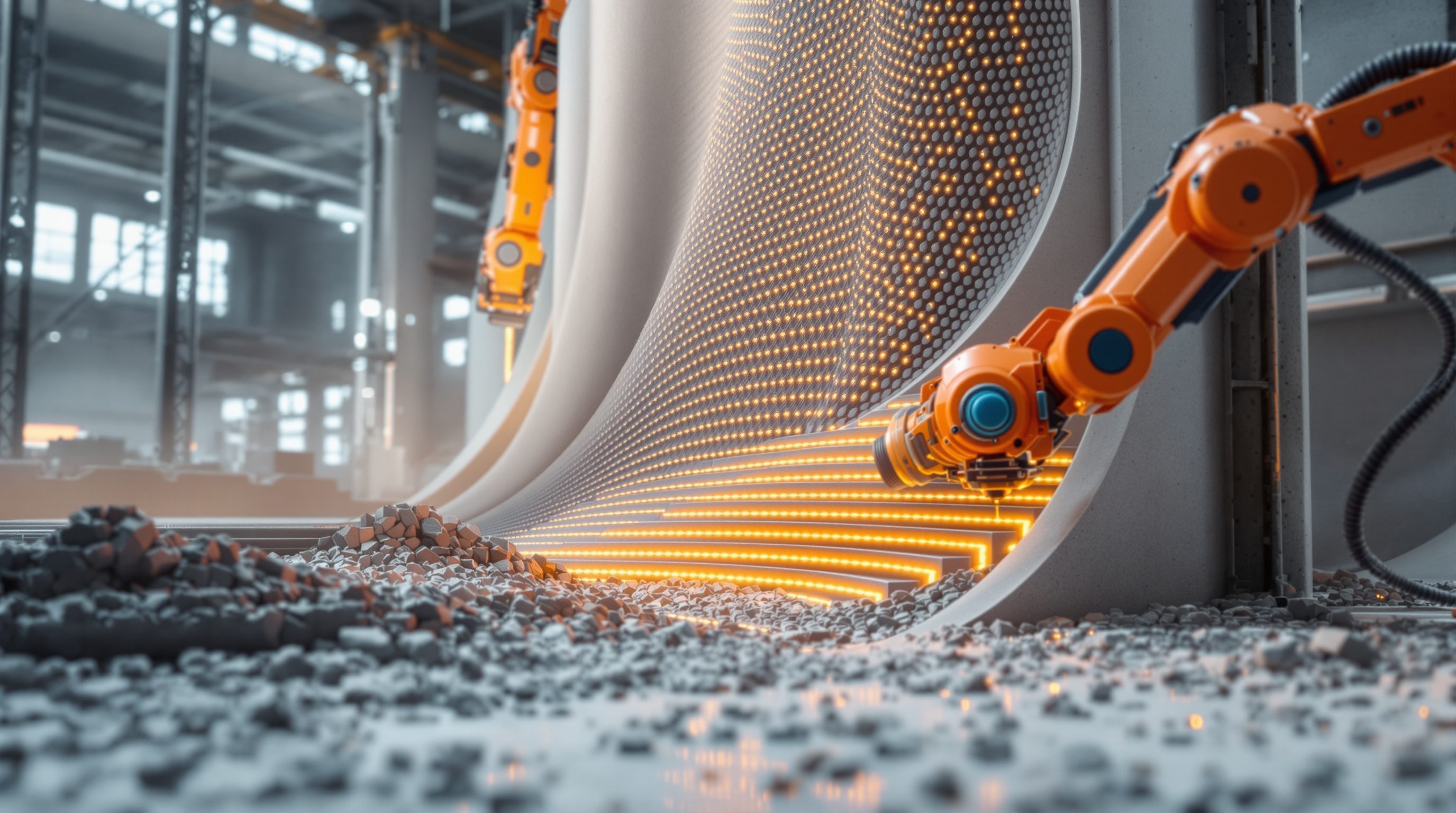
When people marvel at a concrete printer, they watch the machine. The harder and more interesting engineering is in the material. Ordinary concrete is poured into a mould, supported on every side until it hardens; printable concrete has no mould and no support, so it must pump smoothly through a hose, extrude cleanly from a nozzle, and then — within seconds — be stiff enough to hold its own shape and carry the weight of the next layers, all while bonding to the bead below. Ordinary concrete never has to do this. A printable mix is a carefully engineered compromise between flowing and standing, and that compromise is the real heart of 3DCP.
This lesson opens the material up. We look at the balancing act between pumpability and buildability, the crucial ideas of open time and set control, and the uncomfortable tension between making a mix printable and making it strong and durable for the long term. We look at what goes into these mixes — fine aggregates, cement, admixtures, fibres, and increasingly supplementary cementitious materials and lower-carbon binders — and why a printable mix is so different from the concrete you would order for a conventional slab. Throughout, the binding point holds: mix design, strength and durability are determined by material specialists and certified testing, not assumed from a recipe.
Printable concrete = pumpable AND buildable, set on cue. Fine binder-rich mix, lots of admixture, no big stones. Printable fights strong/durable/cheap/low-carbon. Specialists + testing decide.
Pumpable yet buildable: the central contradiction
Every printable concrete lives between two demands that pull in opposite directions. Pumpability is the ability to flow: the mix must move through a pump and a long hose without separating, blocking or tearing, which wants a wetter, more fluid, more lubricated material. Buildability is the ability to stand: the moment the bead leaves the nozzle it must hold its shape and support the beads stacked on top without slumping, which wants a stiffer, more cohesive material. A mix tuned for easy pumping tends to slump; a mix tuned to stand tends to clog. Printable concrete has to be both, in sequence, within minutes — fluid in the hose, stiff on the wall.
The property that captures this is rheology — how a fresh, semi-liquid material flows and resists flow. Printable mixes are engineered to have a low enough resistance to flow under the pressure of pumping, but a high enough resistance to flow (and a rapid early stiffening) once deposited and at rest. A useful intuition is a material that flows when pushed hard but holds firm when left alone, then quickly gains stiffness. Achieving this is a matter of the binder, the fine aggregates, the water content, and above all the admixtures — chemical additives that modify flow, stiffening and set. Superplasticisers keep it fluid under pumping; viscosity modifiers stop it separating; accelerators and other agents make it stiffen quickly after deposition.
This is why a printable mix cannot simply be ordinary concrete pushed through a nozzle, and why mix design for printing is a specialist field in its own right. The window is narrow and unforgiving: a batch that is slightly too wet bulges and collapses; slightly too dry and it will not pump or the beads will not knit. Temperature, humidity and time all shift the balance during a print. The machine and the mix must be tuned together, and the result validated by testing — which is precisely why the strength, stability and acceptability of any printable concrete is a determination for material specialists and certified testing under the governing standards, not a figure a designer should assume. Understanding the contradiction, though, is the key that makes everything else about printable concrete make sense.
Open time and set: printing against the clock
Printing is a race against chemistry. Two timing properties govern whether a print succeeds. The first is open time: the window during which a freshly laid bead is still receptive enough for the next bead to bond to it properly. Lay the next layer within the open time and the beads knit into a reasonably continuous wall; wait too long and the surface has stiffened or dried, and the new bead sits on top rather than joining, creating a weak 'cold joint' at the layer interface. Open time depends on the mix and on conditions — heat and dry air shorten it, so the same mix behaves differently in a Chennai summer and an air-conditioned lab.
The second is set and early strength gain: how fast the deposited concrete stiffens from a soft, shapeable state to one stiff enough to carry the load of the layers above. This is the buildability clock. If it sets too slowly, the lower layers stay soft and the whole wall slumps or buckles as it grows taller — the taller the wall, the more load the bottom beads must carry before they harden. If it sets too fast, pumping becomes impossible and open time vanishes, so layers will not bond. The mix must therefore stiffen fast enough to build height but not so fast that it clogs or refuses to join — another narrow, engineered window.
Designers rarely control these directly, but understanding them explains a great deal of real 3DCP behaviour: why prints are often paused or staged to let lower courses gain strength, why print speed and layer height are matched to the mix, why weather stops or reshapes a print, and why the layer interface — the product of open-time management — is such a recurring theme in strength and durability. It also explains why accelerators and retarders, dosed precisely and sometimes even at the nozzle, are central to the craft. All of this is set by the material specialist and the system, validated by testing, and sensitive to the real site — a reminder that the printed wall's quality is decided as much by timing and conditions as by the model. Any time, temperature or set figure is illustrative and mix- and condition-specific, never a specification.
Two clocks: OPEN TIME (bond the next bead in time) and SET (stiffen enough to carry load). Heat shortens both. Miss them -> cold joints or slump.
Printability versus strength and durability
Here is the uncomfortable part that honest teaching must name: the things that make a mix easy to print can work against its long-term strength and durability. Printable mixes are typically rich in fine material and binder and use little or no coarse aggregate, because a nozzle cannot extrude large stones and beads need to be fine and cohesive. But coarse aggregate is part of what makes conventional concrete strong, dimensionally stable and economical; a binder-rich, fine mix can shrink more, crack more, cost more and carry more embodied carbon per unit of strength. High doses of admixtures, needed for the rheology, add their own cost and complexity. And the layered structure itself introduces interfaces that can reduce strength and let water in, affecting durability, freeze-thaw behaviour and the protection of any embedded steel.
So a printable mix is a compromise on several axes at once: pumpable versus buildable, fast-setting versus well-bonded, and — across all of it — printable versus strong, durable and economical. Pushing any one property tends to disturb the others. This is a central reason the field is still maturing: achieving a mix that prints reliably AND meets structural and durability requirements AND is affordable AND is low-carbon is genuinely hard, and doing it repeatably on a real site harder still. It is also why printed concrete cannot simply inherit the decades of codes, standards and confidence built around conventional concrete; its fresh and hardened behaviour differ, and standards for printed concrete are still being developed.
For a designer the lesson is humility and deference. You do not specify a printable mix from a table; you work with a material specialist and the system supplier, and you rely on certified testing to establish that a given mix meets the strength, durability and code requirements for a given use. What you can usefully carry is the understanding that the mix is a hard-won balance, that it is not free or equivalent to ordinary concrete, and that durability and watertightness at the layer interfaces deserve explicit attention in detailing. Treat any strength, shrinkage or durability figure as illustrative and specialist-determined, and keep the binding verification where it belongs — with testing, the specialists and the governing standards.
What goes in — SCMs, lower-carbon mixes and alternatives
A printable concrete is usually best thought of as a fine, cohesive mortar-like mix rather than the stony concrete of a slab. The typical ingredients are a binder (most often Portland cement, the most carbon-intensive component), fine aggregate (sand, sized so it extrudes cleanly), water, and a suite of admixtures for flow, cohesion, set and early strength. Fibres — steel, glass or polymer — are frequently added to control cracking and add some tensile toughness, though, as the next lesson stresses, fibres are not a substitute for structural reinforcement. The exact proportions are proprietary and tuned to the machine.
Because cement carries a heavy carbon footprint and the construction sector is under real pressure to decarbonise, much current work aims at lower-carbon printable mixes. The main lever is supplementary cementitious materials (SCMs) — by-products such as fly ash and ground granulated blast-furnace slag, and materials like silica fume and calcined clays — which replace a portion of the cement, often improving cohesion and flow while cutting embodied carbon. Geopolymers and other alternative binders, which avoid Portland cement altogether, are an active research frontier for printing, as are recycled and local aggregates and even earth-based printable materials (covered in Module 5). These matter especially in India, where both the carbon stakes and the availability of SCMs like fly ash are significant.
But decarbonising a printable mix collides with all the constraints above: an SCM or alternative binder must still give the right rheology, open time, set, strength and durability, and changing one ingredient shifts the whole balance. This is frontier material science, not a settled menu, and the performance of any particular low-carbon printable mix — structural and environmental alike — must be established by testing and specialists, not assumed from the promise of the ingredient. For the designer, the useful literacy is this: printable concrete is a fine, engineered, binder-rich material whose recipe is a balancing act; lower-carbon versions are real and important but still developing; and every claim about a mix's strength, durability or carbon is something to verify with material specialists, certified testing and the governing standards, in the Indian context as much as anywhere.
Printable mix = fine mortar: binder + sand + admixtures (+ fibres). Cut carbon with SCMs / geopolymers - but every swap disturbs the balance. Test, don't assume.
Mix design and fresh properties
Pumpability, buildability, open time and set of a printable concrete
These are engineered, proprietary and condition-sensitive; established by material specialists and the system supplier, not chosen by the designer from a table.
Hardened strength and durability
Whether a printed concrete meets structural and durability requirements
Compressive and tensile behaviour, shrinkage, watertightness and interface performance must be confirmed by certified testing under the governing standards. Module 8.1.
Supplementary cementitious materials and low-carbon binders
Replacing cement to cut embodied carbon
SCMs, geopolymers and alternative binders are real but still developing for printing; their performance is test-determined, not assumed from the ingredient.
Standards for printed concrete
Acceptance criteria for a printed element
Standards specific to printed concrete are still maturing; printed mixes do not automatically inherit conventional concrete codes. Defer to the material specialist and governing standards (NBC India, relevant IS codes).
Workshop — map the printable-concrete balancing act
You will build a simple 'tension map' of a printable mix to internalise why it is a compromise and where a designer must defer to specialists. No lab, no chemistry — just structured reasoning about competing demands.
Paper and a documented printable product or project to reason about. No materials testing - that is exactly the part this workshop teaches you to defer.
Goal: a one-page map of the competing demands on a printable mix
Inputs: this lesson + a real printed project or printable-concrete product you can read about + paper
Time: ~40 minutes
- 1List the demands on a printable mix in two columns: 'wants to flow' (pumpability) and 'wants to stand' (buildability), noting what each pulls toward (wetter/stiffer, more/less admixture).
- 2Add a third axis below: long-term needs - strength, durability, watertightness, cost, carbon - and note where printability works AGAINST each.
- 3Place open time and set on a simple timeline and mark what goes wrong if each is too short or too long (cold joints vs slump; clogging vs collapse).
- 4Mark one decarbonisation move (an SCM like fly ash, or a geopolymer binder) and note which other properties it might disturb, flagging that this needs testing.
- 5Write a short note: which of these decisions a designer can make, and which MUST go to a material specialist and certified testing. Be honest that most are the latter.
You’ll walk away with
A one-page tension map of a printable mix - flow vs stand vs durable/cheap/low-carbon, with open time and set on a timeline - and an explicit list of what must be deferred to material specialists and testing.
Three altitudes on the same idea
Read the band that fits you — or all three.
Treat printable concrete as a specialist, engineered material — not ready-mix you can pour into a nozzle. It is a fine, binder-rich mix balanced between pumpable and buildable, with a narrow open time and set window, and that balance is in tension with long-term strength, durability and carbon. Practically, this means early collaboration with the system supplier and a material specialist, realistic expectations about what a given mix can achieve structurally, and explicit attention to durability and watertightness at the layer interfaces in your detailing. Where carbon matters, ask about SCMs and lower-carbon binders, but understand they are still developing and must be tested. Own the design intent and the coordination; defer mix design, strength, durability and code compliance to material specialists, certified testing and the governing standards.
For printed interior components, the mix decides the look, feel and longevity as much as the form. The fine, mortar-like printable mixes give the characteristic layered texture and a particular surface quality; they can crack or shrink if mishandled, and the layer lines can admit water, so finish, sealing and placement matter. If a piece lives outdoors or in a wet area, durability at the interfaces is a real question. Work with the fabricator on what their mix can do, including colour and surface options and any fibre content, and treat structural or fire-critical uses as out of your remit and into the engineer's. Your value is specifying pieces whose material reality — texture, weight, durability — is understood, not assumed from a glossy render.
Understand that the material, not the machine, is the hard part of 3DCP. Printable concrete must be pumpable yet buildable, with a controlled open time (so beads bond) and set (so the wall stands), and these demands pull against each other and against long-term strength, durability and cost. It is a fine, binder-rich mix with heavy use of admixtures, quite unlike ordinary stony concrete. Lower-carbon versions using SCMs like fly ash or geopolymer binders are an important, active frontier — especially relevant in India — but changing an ingredient disturbs the whole balance, so everything must be tested. Carry the idea of a narrow, hard-won, engineered window, and the habit of deferring actual mix performance to material specialists and certified testing. That is exactly the clear-eyed material literacy this course wants.
“Printable concrete is basically normal concrete — you just make it a bit thicker or thinner so it comes out of the nozzle. Any good concrete mix could be printed with the right machine.”
Do it yourself
No tools needed — reason it through.
- 1Explain the contradiction a printable concrete must satisfy, and define pumpability and buildability.
- 2What are 'open time' and 'set', and what goes wrong if each is too short or too long?
- 3Why does making a mix more printable often work against its long-term strength, durability or cost?
- 4Why can you not simply print ordinary ready-mix concrete, and how does a printable mix differ in its ingredients?
- 5What are SCMs and geopolymers, why do they matter for lower-carbon printing, and why must any such mix still be tested?
The one line to carry out
Peer-reviewed journals & authoritative standards
- 01Concrete — Wikipedia — Concrete, 2026.
- 02Cement — Wikipedia — Cement, 2026.
- 03Supplementary cementitious material — Wikipedia — Supplementary cementitious material, 2026.
- 04Geopolymer — Wikipedia — Geopolymer, 2026.
- 05Embodied carbon — Wikipedia — Embodied carbon, 2026.
Even a perfectly balanced mix leaves concrete's deepest limitation untouched: it is weak in tension, and a building needs tension resistance to be safe. How you get steel or its equivalent into a layered print is the hardest question in the field — and the next lesson.
The author
Amogh N P
Architect, interior designer, and creative polymath. Studio Matrx began in his notebooks — his vision of design made honest, useful, and open to everyone. Its Academy is written and taught in his memory, and free, forever.
More about Amogh →