
 Lesson 3.2
Lesson 3.2 · The Storefront & Entrance
Window Display
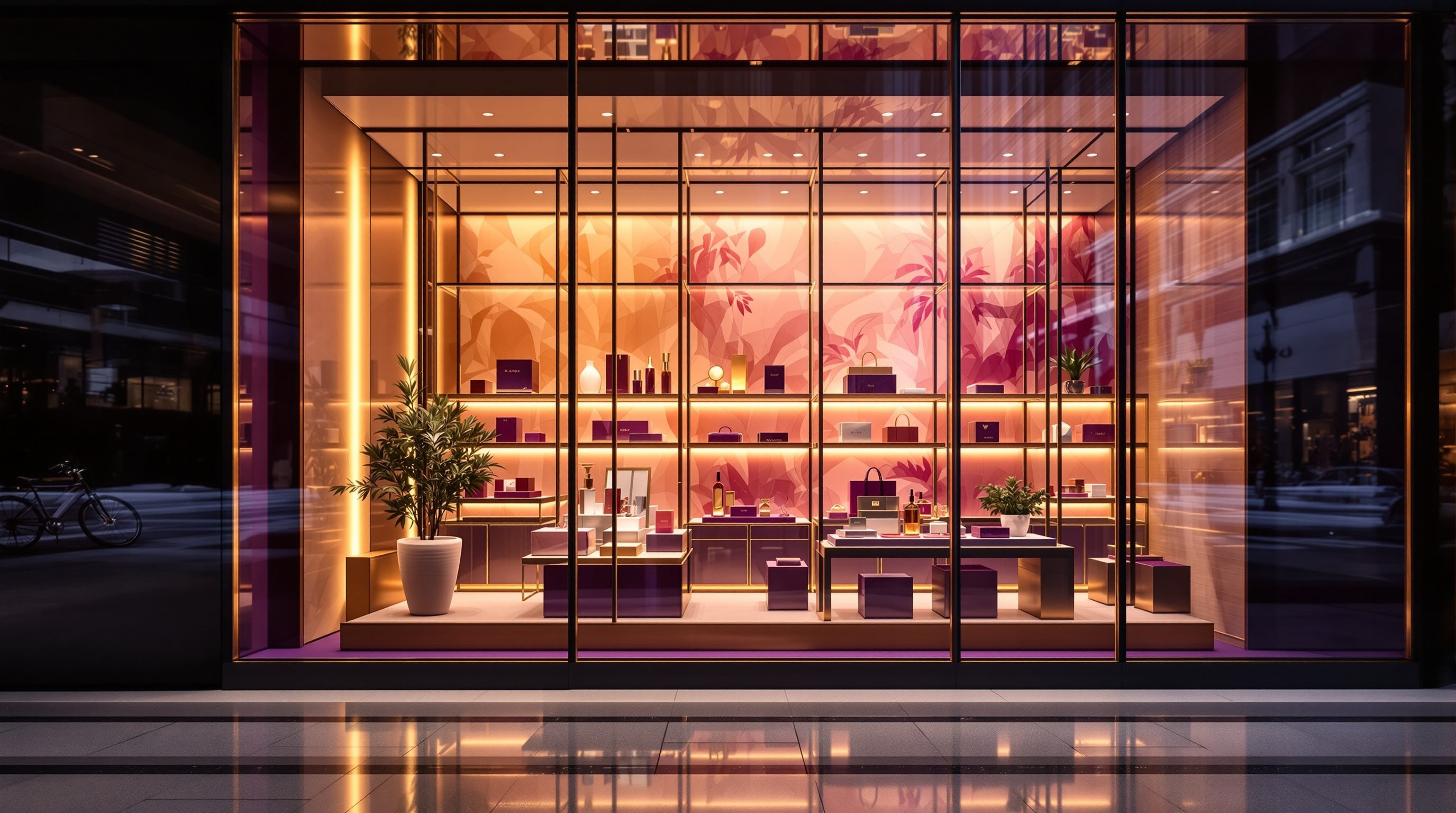
A window is a stage, and dressing it is theatre with a commercial purpose - it must stop a moving person in the street, tell a single clear story in a heartbeat, and turn the glance it steals into a reason to come inside and buy
A window has one job no other part of the store has: to stop a person who was walking somewhere else.
Everything behind the glass can take its time, but the window cannot. It has to interrupt a stranger who is mid-stride, mid-thought, on their way to somewhere else, and make them stop, look, and want. That is an extraordinary thing to ask of a single framed scene - and it is why dressing a window is one of the oldest and most theatrical crafts in all of retail. A great window is not a shelf that happens to face the street; it is a stage, lit and composed, telling one clear story to a moving audience that did not buy a ticket.
And it sells. The window is the store's most public performance and one of its sharpest commercial tools: it announces what is new, it sets the season, it dramatises the brand, and it converts the stream of passers-by the shopfront caught into actual footfall through the door. Done well it stops people, pulls them in, and plants a desire before they have even entered. Done badly - crammed, confused, dusty, dark, trying to show everything and therefore showing nothing - it does worse than nothing, because a tired window actively tells the street the store is tired too. This lesson treats the window as exactly what it is: theatre with a commercial purpose. We will work through its stopping power, the discipline of telling a single story, the rhythm of seasonal and thematic change, the choice between open-back and closed-back windows, and how to compose a display that does the one job only the window can do.
Window = theatre. One hero, one story, lit. Would a stranger stop? If not, start again.
Stopping power: the one job of the window
The window's defining task is stopping power - the ability to interrupt a moving person and make them pause. Every other element of the store works on people who are already stationary or already inside; the window alone has to act on someone in motion, often looking elsewhere, at the edge of their attention. So the first question to ask of any window is brutally simple: would this make a busy, distracted stranger actually stop? If not, it has failed at the only thing it uniquely exists to do, no matter how tasteful it is.
Stopping power comes from a small number of levers, and the biggest is a single strong focal point. The eye is caught by one clear thing, not by an even field of many things - so a powerful window has a hero, a dominant element the composition is built around, usually placed at or near eye level where a standing adult naturally looks. Scale helps: something unexpectedly large, or a bold simple form, reads from across a street where fine detail does not. Contrast helps - light against dark, colour against neutral, one lit object in shadow. Movement and surprise help, because the human eye is wired to notice change: a rotating element, a kinetic piece, a striking or witty image, something that breaks the expected. And light is decisive - a bright, well-lit window pulls powerfully against a dull street, especially at dusk, while a dim window disappears.
The enemy of stopping power is clutter. A window that tries to show the whole shop - every product, every price, a dozen competing messages - gives the eye nowhere to land and so stops no one; it reads as visual noise and the brain filters it out. The discipline is subtraction: decide the one thing this window is about, build a clear focal hierarchy around it, and ruthlessly remove everything that dilutes it. A window is judged at a glance and at speed, so it must be instantly legible - one idea, one focus, grasped in a second. Editing a window down to its one strong move is harder and more valuable than filling it, and it is the difference between a window that decorates the street and a window that stops people on it.
Would a distracted stranger STOP? One hero, eye level, light and contrast. Clutter stops no one.
Telling a story, not stacking product
A window that merely displays products is a missed opportunity; a window that tells a story is a selling tool. The difference is that a story gives the goods a meaning, a mood and a reason to want them beyond the bare object. A single dress on a stand is a product; the same dress on a mannequin mid-stride, bag in hand, against a backdrop that suggests a particular evening or place, surrounded by a few well-chosen props, is a little scene the passer-by can imagine themselves inside - and that imagining is where desire starts. The window is narrative space, and the craft is to say something with the merchandise, not just to present it.
Good window storytelling is disciplined in the same way stopping power is: one story per window. A window with a clear single theme - a season, an occasion, a colour, a concept, a new arrival - is legible and memorable; a window trying to tell three stories at once tells none. The props, backdrop, colour palette and arrangement should all serve that one idea and the hero product it frames. Props earn their place only if they build the story and point back to the goods - a common failure is props so clever they upstage the merchandise, so the passer-by remembers the window but not what was for sale. The goods are always the point; the story is how you make them wanted.
Storytelling is also how the window expresses the brand and does work the rest of the store cannot. A window can be witty, romantic, austere, provocative or warm, and in choosing a voice it tells the street who the brand is - a luxury house's restrained single-object window and a value retailer's abundant, energetic window are two different stories told to two different shoppers, both correct for their brand. The window is where a retailer gets to be most creative and most public at once. And because it faces the world, it carries a responsibility: good retail tells honest, appealing stories that serve the shopper's genuine desire and show the goods truthfully - it does not mislead about what is inside or stoop to manipulative tricks. Tell one true, tempting story per window, built around a hero the passer-by can want, and the glass starts selling.
One story per window. Props serve the goods, never upstage them. A scene you can imagine yourself into.
Seasonal and thematic change: the window as a living calendar
A window is not a fixture to set once; it is a living, changing performance, and the rhythm of its change is part of its power. A window that never changes stops being seen - regular passers-by stop noticing it, exactly as we stop hearing a constant sound - and worse, an unchanged or faded window signals a shop standing still. A window that changes regularly, on the other hand, gives people a reason to look again each time they pass, keeps the store feeling current and alive, and lets the retailer ride the calendar of desire: new arrivals, the turn of a season, and the festivals and occasions that drive so much retail spending.
The retail year is a calendar of themes, and in India that calendar is especially rich - the festive run from Ganesh Chaturthi and Onam through Navratri, Dussehra and Diwali, then the wedding season, Christmas and New Year, Pongal, Sankranti, Holi, and the back-to-school and monsoon-to-summer turns - each a moment when windows change to meet a surge of shopping with the right mood, colour and merchandise. A window that speaks to the festival or season a shopper is already thinking about feels timely and relevant, and relevance converts. Planning windows as a calendar ahead of time - themes, merchandise, props and changeover dates mapped across the year - is a core part of the visual-merchandising discipline, not a last-minute scramble.
Change also has a practical and commercial discipline. Windows are expensive to dress in labour and props, so a retailer balances impact against the cost and effort of frequent change; chains often roll out a central window scheme to every store on a schedule, with a kit of props and a planogram, so that one design cascades nationally (the brand's design standard again). A designer planning for changeable windows builds the stage for it: flexible lighting on a track, easy access to dress the window safely, durable reusable props, and backdrops or graphics that can be swapped quickly. And through every change, the window must keep its discipline - one story, one focus, real stopping power - because a seasonal window still has to do the window's one job. Treat the window as a calendar of stories, refreshed on a planned rhythm, and it stays a living draw rather than a dusty frame.
Change = reason to look again. Ride the festive calendar. Plan themes ahead; build the stage to swap fast.
Open-back versus closed-back windows
One structural choice shapes every window: is it closed-back or open-back? A closed-back window has a solid wall behind the display, sealing it off from the shop floor - it is a true stage, a box the designer controls completely. An open-back window has no back wall; the display sits on a low platform or floats in front of the glass, and the passer-by sees straight past it into the living store beyond. Each is a legitimate choice with distinct strengths, and the decision ripples through how the window works and how the store reads.
The closed-back window gives total control. Because it is a sealed stage, the designer commands the backdrop, the lighting, the colour and every element, with no distraction from the shop behind and no stray daylight or clutter leaking in. It can be dramatically and precisely lit, it can tell a bold, graphic, fully art-directed story, and it screens a busy or messy sales floor from the street. This is why luxury, fashion and concept retailers often favour closed-back windows - they want a perfect, controlled, theatrical frame. The costs are real: a closed back walls the shop off from the street (less see-in transparency and less natural light), it takes floor depth, and it demands more effort and skill to dress and light well.
The open-back window trades control for transparency and life. With no back wall, the passer-by sees the display and the living store at once - the people, the activity, the depth of merchandise - which is itself a powerful draw and keeps the maximum see-in openness the last lesson prized. It lets daylight flood in, makes a small shop feel bigger and more connected to the street, and is cheaper and simpler to maintain. The costs are loss of control and risk of clutter: the shop floor becomes the window's backdrop whether you like it or not, so the area behind the glass must be kept immaculate and considered, lighting has to balance window and interior, and daylight and reflections can wash the display out. Many stores run a hybrid - a half-height backing, a partial screen, or a movable panel - to get some control while keeping some see-through. The right choice follows the brand and goods: reach for closed-back when you need a controlled theatrical stage and can afford to wall off the street; reach for open-back when transparency, daylight, visible life and a connected, generous feel serve the store better.
Display-window electrical & lighting (NBC 2016 + specialists)
Lighting loads, track/fittings, heat in a glazed box, ventilation
Principles here; wiring, loads and any heat/ventilation design for a sunlit display window from the current code and the electrical/lighting specialist.
Glazing safety & public-realm projection bye-laws
Safety glass, anything projecting toward or overhanging the footpath, illuminated displays
Defer glazing-safety and any projection or illumination touching the public realm to the code and local bye-laws. Lesson 3.1, 3.4.
Brand window standard / central scheme
Window planogram, props kit, changeover calendar, story themes
For branded / rolled-out retail the brand's window scheme and calendar often govern - design within them. Benchmarks (e.g. change frequency) calibrate to brand and market.
Workshop — dress a window with stopping power
A window is best learned by composing one against its one job. In this workshop you will design a single window display - as a sketch or a simple model - that tells one story, builds one focal point, and is honestly edited for stopping power.
Paper and pen, or a shoebox and found objects for a quick model. No budget or software needed - this is about story, focus and the stop.
Goal: one window that would stop a moving stranger
Inputs: a store type and brand, a season or occasion, this lesson, paper or a shoebox-scale model
Time: ~60 minutes
- 1Choose the brief: the store and brand, the merchandise to feature, and the season, festival or occasion the window speaks to. Write the ONE story this window tells in a single sentence.
- 2Decide open-back or closed-back and justify it against the brand and goods - a controlled theatrical stage, or a see-through to the living store?
- 3Compose the display: place ONE hero at eye level, build a triangular focal arrangement (tall centre, lower flanks), and add only props that serve the story. Mark where the light falls.
- 4Edit ruthlessly: list everything in the window and remove anything that does not build the one story or the one focus. Fewer, stronger elements beat a full window.
- 5Pressure-test stopping power and plan the change: would a distracted passer-by actually stop, and grasp the story in a second? Note one sharpening change, and say when and to what theme this window would change next.
You’ll walk away with
A sketch or simple model of one window with a short rationale: the one-sentence story, the open/closed-back choice, the focal composition, what you edited out for stopping power, and the next seasonal change - plus any glazing/electrical/bye-law item you would verify.
Three altitudes on the same idea
Read the band that fits you — or all three.
You build the stage the window performs on, and that is an early, structural decision. Whether the windows are closed-back or open-back changes the facade, the floor depth given to display, the structural backing and the daylight and see-in the store gets - so it must be resolved with the brand and interior designers up front, not retrofitted. Provide what changeable windows need: safe access to dress them, power and a lighting track, backing or mounting points, and glazing and ventilation that manage glare, heat and condensation on a sunlit display window. For chains, design a window system that can carry the brand's central schemes across every store. Defer glazing-safety, electrical, and any projection or illumination that touches the public realm to the codes, the specialists and the local bye-laws.
Window dressing is visual merchandising at its most theatrical, and it is squarely your craft. You decide the story, the focal hero, the composition, the props, the palette and the lighting that give a window stopping power - and you plan the seasonal and thematic calendar that keeps it alive. Design for the one job (stop a moving stranger), build one clear story per window around an eye-level hero, edit ruthlessly against clutter, and light it to pull against the street and at dusk. Plan for change: flexible track lighting, reusable props, quick-swap backdrops, and a calendar of themes mapped to the retail and festive year. Work to the brand's window standards and any central scheme, and keep every window honest and on-brand.
The window is the most fun piece of retail to study, because it is pure, visible craft - go and read windows. Walk a high street or a mall and ask of each window the only question that matters: did it make you stop? Work out why or why not - was there one clear hero, or a cluttered field of everything; one story, or none; was it lit and alive, or dim and dusty; open-back showing the living store, or closed-back as a controlled stage? Notice how windows change with the season and festivals. Then try dressing one yourself, even a shoebox model: pick one story, build a triangular focal composition around a hero at eye level, light it, and strip out everything that dilutes the idea. You are learning the discipline of stopping power and single-story clarity - the heart of window craft.
“A good window display means filling the window with as much merchandise as possible - the more products and prices you show, the more chances something catches a shopper's eye and the more you sell.”
Do it yourself
No tools needed - reason it through.
- 1What is 'stopping power', and why is it the window's one unique job among all the parts of a store?
- 2Name three levers that give a window stopping power, and explain why clutter destroys it.
- 3Explain the difference between displaying product and telling a story in a window, and why props must serve the goods.
- 4Why should a window change on a planned seasonal and thematic rhythm, and give two Indian retail moments a window might ride?
- 5Contrast open-back and closed-back windows - one strength and one cost of each - and when you would choose each.
The one line to carry out
Peer-reviewed journals & authoritative standards
- 01Display window — Wikipedia — Display window, 2026.
- 02Visual merchandising — Wikipedia — Visual merchandising, 2026.
- 03Mannequin — Wikipedia — Mannequin, 2026.
- 04Merchandising — Wikipedia — Merchandising, 2026.
The shopfront caught the eye and the window told the story - now the stranger has to actually cross the line and come in. Next we study the entrance and the threshold: the invitation that turns a looker into a shopper.
The author
Amogh N P
Architect, interior designer, and creative polymath. Studio Matrx began in his notebooks — his vision of design made honest, useful, and open to everyone. Its Academy is written and taught in his memory, and free, forever.
More about Amogh →