
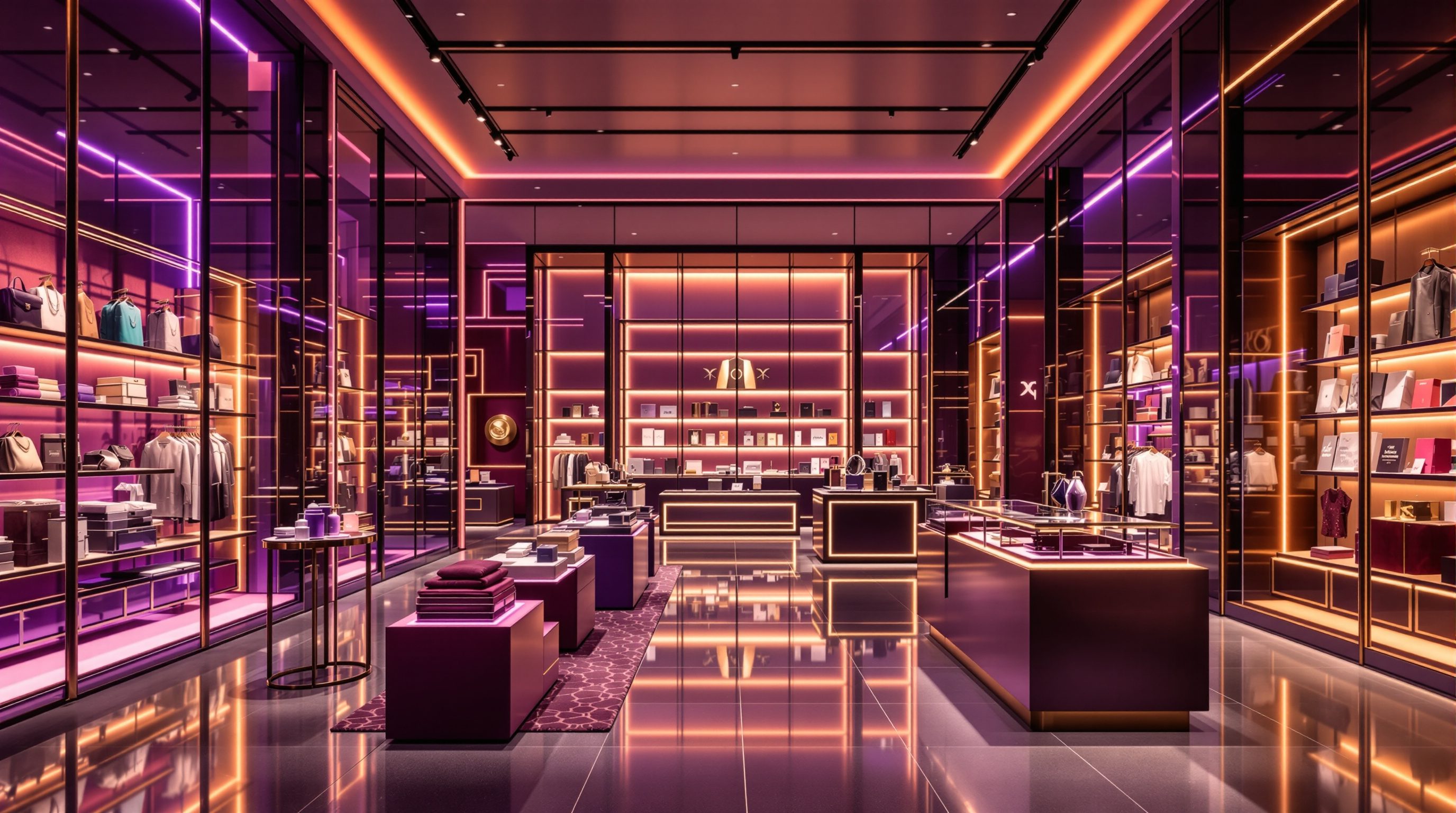
 Lesson 1.4
Lesson 1.4 · Understanding Retail & the Shopper
Omnichannel & the Connected Store
The store you design no longer stands alone - it is one node in a connected system where online and offline blur into a single customer journey, and that changes what a shop is actually for
Your customer does not think in channels. They saw it on their phone at breakfast, checked it in store at lunch, and bought it in bed at midnight - and to them it was all one shop.
A shopper today rarely lives on one side of the online-offline line. They discover a product on Instagram, read reviews on the brand's app, drop into the store to see and touch it, order a different size to their door, return the one that did not fit at the till, and next month reorder online in seconds. To that shopper there are no separate channels - there is just the brand, met wherever is convenient, and an expectation that it all joins up: that the store knows what the website knows, that what they bought online can be returned in the shop, that stock is stock wherever it sits. This seamless, single-customer world is what the industry calls omnichannel, and it has quietly rewritten what a physical store is for.
For the retail designer this is not a footnote - it reshapes the brief. The store is no longer a self-contained box of stock that rings up its own sales; it is one node in a connected system, and it takes on new jobs: showroom, collection and returns point, endless aisle, fulfilment hub, and above all the place where a brand becomes a physical, human experience that no screen can match. This lesson explains the connected store: what omnichannel really means, the new jobs the store performs, how online and offline reinforce rather than cannibalise each other, and - the part that matters most to you - how all of this changes the way you plan and design retail space. Design for the connected store, and the physical shop stops competing with the internet and starts completing it.
One customer, many channels. Store = showroom + collect + return + endless aisle + fulfil + experience.
What omnichannel really means
It helps to be precise about the word. A multichannel retailer simply sells through more than one channel - a shop and a website - but often runs them as separate businesses with separate stock, prices, teams and even brands-within-the-brand. Omnichannel goes further: it treats all the channels as one integrated system organised around a single customer, so the experience is seamless and continuous no matter how the shopper moves between them. The customer's basket, wishlist, order history, loyalty and preferences follow them from app to store to call centre; stock is visible and usable across the whole network; and a journey can start in one channel and finish in another without friction. The shift from multichannel to omnichannel is the shift from "we have a shop and a website" to "we have one relationship with each customer, expressed through whichever channel suits them at the moment."
The reason this matters is that shoppers now simply expect it, and the expectation is unforgiving. They expect to check online whether the local store has an item in stock before making the trip; to buy online and pick up or return in store; to stand in the shop, find their size is out, and have it shipped home without leaving empty-handed; to be recognised as the same person online and off. A retailer whose channels do not join up - where the store cannot see the online order, where online prices and shop prices clash, where stock is trapped in silos - now feels broken to the customer, however good each channel is alone. Omnichannel is, at bottom, meeting the customer's reasonable expectation that a brand is one thing.
This is why the tired "online versus physical" framing is wrong, and why the so-called retail apocalypse was never the whole story. Online did hollow out routine, price-driven, commodity transactions - the things a screen does better and cheaper - and that genuinely hurt stores built only for those transactions. But it did not kill physical retail; it changed the store's job, pushing it toward what online cannot do and folding it into a connected system where it plays new and valuable roles. Understanding omnichannel as one integrated system serving one customer, rather than a set of rival channels, is the mental shift on which everything else in this lesson rests - and on which the connected store's design depends.
Multichannel = separate silos. Omnichannel = one customer, one system, met wherever suits.
The store's new jobs
Inside an omnichannel system the physical store takes on a portfolio of jobs beyond simply holding stock and ringing up sales - and each has design consequences. The most important is the store as showroom and experience: the place to touch, try, compare and be advised, and to encounter the brand as an immersive, three-dimensional world worth the trip (the heart of Module 7). As routine buying migrates online, this becomes the store's core reason to exist - which is why even digital-native D2C brands, from eyewear to mattresses to fashion, open physical stores, and why the term showrooming has flipped from a threat (people browsing in store then buying cheaper online) to a strategy (the store as a deliberate showroom that drives sales across all channels).
Then come the connective jobs. Click-and-collect or BOPIS (buy online, pick up in store) lets customers order online and collect in the shop - convenient for them, and valuable to the retailer because collectors frequently buy something extra while there, so the collection point is a footfall and basket opportunity, not just a locker. Returns run the same way: buy-online-return-in-store is a major service, and again a chance to re-engage and re-sell rather than lose the customer to a courier. The endless aisle lets a shopper in a physical store order any item in the entire range - sizes, colours, products not held on site - through staff or a screen, so a modest floor can sell an unlimited catalogue and never turn a customer away empty-handed. And the store increasingly doubles as a fulfilment node: ship-from-store and local delivery use shop stock and location to fulfil online orders fast, turning the shopfloor and stockroom into a mini-warehouse for its catchment.
Each of these jobs asks something of the design, and they sometimes pull against each other - experience wants openness and calm, fulfilment wants efficient back-of-house and staff movement, collection wants a clear, quick, findable counter that does not clog the entrance. The connected store's plan has to accommodate this portfolio deliberately rather than bolting it on: a well-placed, legible collection and returns point; space and systems for the endless aisle; back-of-house sized and organised for fulfilment as well as replenishment; and a shopfloor that leans firmly into experience and service, because that is the store's irreplaceable contribution. Recognising these jobs is the first step; planning for them is the design work.
Online and offline reinforcing each other
The deepest idea in omnichannel design is that, done well, online and offline reinforce each other rather than compete - and the evidence for this is strong enough to change how you value a store. Two shopper behaviours make the point. ROPO - research online, purchase offline - is enormous: customers routinely research, compare and decide online, then come to the store to see, confirm and buy, especially for considered purchases like furniture, appliances and jewellery. The reverse, showrooming (see in store, buy online), also happens, but for an omnichannel retailer both are simply the same customer buying from the same brand, so the channel that closes the sale matters far less than that the brand captured it at all.
This leads to the halo effect: opening a physical store measurably lifts a brand's online sales in that catchment, and a strong online presence drives footfall to the store. The shop acts as a three-dimensional advertisement, a trust-builder and a service point that makes the whole brand more credible and present; the website extends the store's range and convenience infinitely. Counting a store's contribution only by the sales rung up at its own till badly undervalues it, because it ignores the online sales the store's presence generates, the returns and collections it services, the customers it acquires and retains, and the fulfilment it performs. Retailers increasingly measure stores on their total contribution to the connected system, not their standalone takings - a reframing that, incidentally, rescues many stores that look marginal on their own numbers but are vital to the network.
Data is the connective tissue that makes all this work. Loyalty programmes, apps and unified customer records let the brand recognise the same person across channels, personalise, and understand the whole journey - which channel discovered, which advised, which closed. This is powerful and, handled carelessly, intrusive, so the designer's stance is to enable the *service* benefits of connection - recognising the customer, joining up the journey, making help and stock seamless - while treating the collection and use of personal data as a matter for the retailer, their systems teams and the current data-protection law and privacy specialists, not something to bake naively into a store. The design principle is simple and optimistic: stop pitting the channels against each other, and instead design the store to play its unique part in a system where every channel makes the others stronger.
What this means for store design
Pulling it together, designing for the connected store changes the brief in concrete, plannable ways. First, plan for the connective jobs from the start, not as afterthoughts: a clearly located, easy collection and returns point that is quick to find and use but does not choke the entrance or the decompression zone; provision for the endless aisle (staff devices or a considered in-store ordering point); and a back-of-house sized and organised for fulfilment and click-and-collect staging as well as ordinary replenishment - in a connected store the stockroom often grows and gets busier, not smaller, even as the shopfloor leans into experience. These are real areas that consume plan and must be designed in, and they trade against selling space, so they are a conscious commercial decision (lesson 1.3).
Second, lean the shopfloor into what only physical can do. If routine transactions migrate online, the store's square footage is best spent on experience, service, discovery and brand - fewer SKUs shown better, more space to try and be advised, more reason to visit and linger and return. This is liberating: freed from having to stock and sell everything (the endless aisle covers the long tail), the store can edit, curate and stage, becoming more of a brand and experience space and less of a warehouse. Technology should be woven in to *serve* the customer and join the channels - stock visibility, easy ordering, recognition, frictionless payment and returns - not gadgetry for its own sake, and always integrated so it feels like one brand rather than a bolt-on kiosk.
Third, keep the through-line: the connected store still succeeds by serving the shopper. Omnichannel is ultimately about meeting the customer's reasonable expectation that a brand is one seamless thing, met however suits them, and the store's irreplaceable role is to be the human, sensory, trustworthy, experiential point in that system. Design it to play that role superbly - and to perform its connective jobs smoothly - and the physical store is not a casualty of the internet but its indispensable partner. Defer the binding specifics as ever - the data and privacy handling to the law and specialists, the systems and POS integration to the technology team, fire, egress and accessibility for the new collection and fulfilment areas to the codes and consultants - and design the connected store as one confident, coherent part of a single customer journey.
Plan the connective jobs in. Lean the floor into experience. Tech serves the customer. Still: serve the shopper.
Data protection & privacy
Customer recognition, loyalty, tracking, footfall analytics
Enable the service benefits of connection, but defer the collection, consent and use of personal data to the current data-protection law, the retailer's systems team and a privacy specialist. Module 9.
Systems, POS & integration
Unified stock, orders, endless aisle, payment integration
The technology that joins the channels is specified with the retailer's IT and systems teams - the designer plans for it spatially and makes it coherent, not defines it. Module 9.
Fire, egress & accessibility of new areas
Collection points, expanded back-of-house, fulfilment staging
New connective areas still meet the current code, NBC 2016, accessibility standards and bye-laws for egress, access and servicing - confirm with the consultants. Modules 2, 9.
Workshop — audit a store as a connected node
Omnichannel becomes concrete when you look at a real store as one node in a system. In this workshop you will audit how well a store performs its connective jobs and leans into experience, and propose the design moves that would make it a better-connected store.
A store from an omnichannel brand and a notebook (browse the brand's app or site alongside to test seamlessness). This is about reading the connected system, not specifying technology.
Goal: audit a store's omnichannel design and propose improvements
Inputs: a store from a brand that also sells online + this lesson + a notebook
Time: ~45 minutes
- 1Map the connective jobs: does the store offer click-and-collect and in-store returns, an endless aisle or in-store ordering, and any sign it fulfils online orders? Note where each happens physically and how easy it is to find and use.
- 2Assess the collection and returns point: is it clearly located and quick, without clogging the entrance or decompression zone, and does it re-engage the customer (tempting goods nearby) or just dispense parcels?
- 3Judge the experience lean: is the shopfloor spent on experience, service and discovery, or is it still a dense box of stock trying to do a job the website does better? Note SKU density and how much room there is to try and be advised.
- 4Check the seamlessness: does it feel like one brand continuous with its website and app - consistent look, staff who can see online orders, integrated tech that serves rather than distracts - or does it feel siloed and broken?
- 5Write a one-page connected-store audit and propose the three highest-impact design moves to make it a better node: for example, relocating collection, adding endless-aisle provision, resizing back-of-house, or converting selling space to experience - noting where data, systems or code specifics must defer to specialists.
You’ll walk away with
A one-page connected-store audit: a map of the store's connective jobs, an assessment of its collection point, experience lean and seamlessness, and three prioritised design moves - with a note on what must defer to the systems, privacy and code specialists.
Three altitudes on the same idea
Read the band that fits you — or all three.
Omnichannel reshapes the plan you set, because the connective jobs need real, well-placed space in the shell. Collection and returns points, endless-aisle provision and, above all, a back-of-house sized for fulfilment and click-and-collect staging all consume area and demand good servicing, delivery access and staff circulation - in a connected store the stockroom and goods handling often grow, which affects floor-plate allocation, loading and servicing from the base-build up. Position entrances, back-of-house and servicing so collection is easy and fulfilment efficient without clogging the shopfront. For chains, bake the connected-store template into the prototype and rollout (Module 10), and defer data, systems and the binding fire, egress and accessibility of the new areas to the specialists and codes.
You choreograph how the connected jobs feel on the shopfloor and how the store leans into experience. Design a legible, quick collection and returns point that re-engages rather than just dispenses; weave the endless aisle and technology in so they serve the customer and feel like one brand, not bolted-on kiosks; and spend the freed shopfloor on experience, service, discovery and brand - fewer SKUs shown better, more room to try and be advised. Keep the store the human, sensory, trustworthy node in the system, ensure any tech joins the channels seamlessly, and leave data-privacy and systems integration to the specialists while you make the connected experience coherent and warm.
Watch omnichannel in your own shopping - you already live it. Notice when you research online and buy in store (ROPO), collect or return an online order at a till, or have staff order an out-of-stock size to your door (endless aisle). See how the best brands make it feel like one seamless shop and the worst feel broken and siloed. Then look at how stores are changing physically: collection counters, fewer SKUs shown better, more experience and service space, busier back-of-house. You are not expected to integrate POS systems or write a data policy yet; you are expected to understand that the store is one node in a connected system, what its new jobs are, and how that reshapes the design brief.
“Online shopping and physical stores are rivals in a zero-sum fight - every sale online is a sale lost to the shop - so the internet is steadily killing physical retail, and designing stores is a shrinking, backward-looking field.”
Do it yourself
No tools needed - reason it through from the lesson.
- 1Distinguish multichannel from omnichannel, and explain why customers now find a siloed retailer feels broken.
- 2Name four new jobs the store performs in an omnichannel system beyond holding stock and ringing up sales.
- 3Explain ROPO and the halo effect, and why they mean online and offline reinforce rather than cannibalise each other.
- 4Why does counting a store only by the sales at its own till undervalue it in a connected system?
- 5Give three concrete ways designing for the connected store changes how you plan and use retail space.
The one line to carry out
Peer-reviewed journals & authoritative standards
- 01Omnichannel — Wikipedia — Omnichannel, 2026.
- 02E-commerce — Wikipedia — E-commerce, 2026.
- 03Retail technology — Wikipedia — Retail technology, 2026.
- 04Customer experience — Wikipedia — Customer experience, 2026.
That completes our grounding in retail and the shopper - how they behave, the brand and customer they are aimed at, the business that judges the store, and the connected system it lives in. Next, in Module 2, we turn that understanding into a plan: store planning and layout, where the selling machine takes its physical shape.
The author
Amogh N P
Architect, interior designer, and creative polymath. Studio Matrx began in his notebooks — his vision of design made honest, useful, and open to everyone. Its Academy is written and taught in his memory, and free, forever.
More about Amogh →