
 Lesson 8.1
Lesson 8.1 · Retail Typologies
Fashion & Apparel
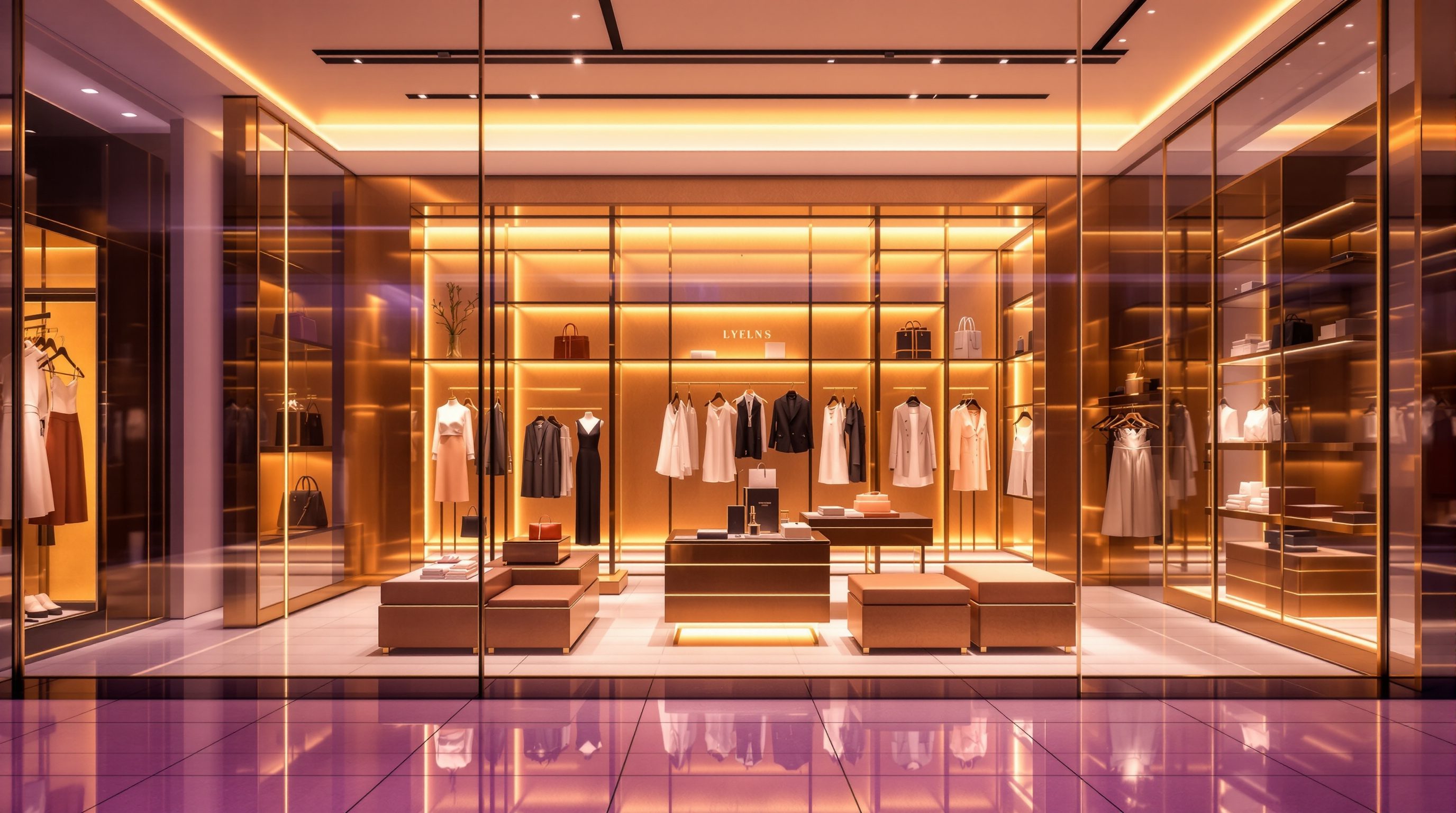
Fashion retail is the try-and-touch typology - a store built to let people handle clothes, imagine themselves in them, and seal the decision in the fitting room, all while changing its face every few weeks to keep feeling new
In a clothes shop the sale is almost never made on the shop floor. It is made, or lost, in a small curtained room most designers treat as an afterthought.
Watch how people actually buy clothes and a pattern appears that no amount of beautiful merchandising can override. They drift in, drawn by a window that styled a whole look rather than a single garment. They touch - fashion is the most tactile retail there is, and a shopper who cannot feel the weave, check the drape and hold a sleeve against their arm will rarely commit. They build a small armful of maybes. And then they disappear into the fitting room, where the real decision happens: in front of a mirror, half-dressed and slightly vulnerable, deciding not whether the garment is nice but whether it is them. Everything upstream - window, layout, light, the way collections were grouped - exists to get a full armful into that room; everything about that room decides how much of it comes back out bought.
That is why fashion is its own typology with its own rules. It is the try-and-touch journey, organised around handling, imagining and the fitting room as the true point of sale, and it is the most restless format in retail - a fashion floor that looks the same in March and October has failed, because newness is the product. This lesson designs for that reality across the whole range: the weekly-refreshed, high-density world of fast fashion; the assisted, curated calm of the premium and luxury boutique; and everything between. Different brands, wildly different stores - but one underlying craft of helping a person handle, try and believe.
Fashion = try-and-touch. Floor feeds the fitting room. The room IS the till. Build for refresh.
Handle, imagine, try: the apparel journey
Fashion retail is built on a simple behavioural truth: people buy clothes by touching them and by picturing themselves wearing them, and the store exists to make both easy. Unlike a supermarket run or a quick electronics purchase, buying apparel is a slow, sensory, self-referential act - the shopper is not just assessing a product, they are auditioning a version of themselves. Good fashion design serves that from the window in. The window styles a whole look, head to toe, because fashion sells outfits and identities, not garments - a styled mannequin lets a passer-by imagine the life the clothes belong to, which is what actually pulls them across the threshold.
Inside, the first job is to let people handle freely. Fashion is intensely tactile, and fixtures are designed around touch: rails at a height where a hand naturally flicks through hangers, tables where knitwear can be picked up and unfolded, face-outs that show a garment front-on so its cut reads at a glance, and enough breathing room that clothes are not crushed into an undifferentiated wall of fabric. Density is a brand decision - a fast-fashion floor is deliberately dense and abundant, a luxury boutique deliberately sparse and edited - but either way the shopper must be able to get a hand on the goods without a fight. A garment no one touches is a garment no one tries, and a garment no one tries is rarely sold.
The second job is to let people imagine and accumulate. Mirrors placed through the floor (not only in the fitting room) let a shopper hold a piece against themselves and keep browsing; good light that renders colour and fabric honestly stops the nasty fitting-room surprise that kills trust; and a layout that keeps the shopper moving and picking up builds the armful of maybes that the fitting room will convert. The whole floor, in other words, is a feeder system for the fitting room - every fixture, sightline and styling cue is working to get more garments, on more shoppers, into that room, because that is where apparel retail actually converts.
Window styles the LOOK. Floor lets them HANDLE + IMAGINE. It all feeds the fitting room.
The fitting room is the point of sale
If there is one lesson that separates people who understand fashion retail from people who merely decorate it, it is this: in apparel, the fitting room is the real point of sale, and it is routinely under-designed. Study after study and every experienced retailer's instinct agree that shoppers who try something on convert at a dramatically higher rate than those who do not - the fitting room is where intention becomes purchase. Yet it is often shoved into a dark back corner, cramped, badly lit, short of hooks and mirrors, with a queue and a bored attendant. That is leaving money on the table in the one place it is easiest to pick up.
Design the fitting room as the emotional heart of the store, not its service tail. Start with the things that are almost free and almost always wrong: enough hooks (a shopper brings an armful - give them somewhere to put it), a seat (for the companion, the bag, the trying-on of shoes), a large mirror inside the room and a three-way or better mirror just outside for the social, turn-and-look moment, and a door or curtain that actually gives privacy. Then get the lighting right, because this is where lighting earns or loses the sale: flat, cool, overhead-only light casts shadows, greys the skin and flatters nothing, so layer a soft, warm, vertical wash at face height with good colour rendering so people look and feel good - honestly good, not deceptively so. Size the room generously; a cabin you cannot turn around in or raise your arms in breaks the spell.
The experience around the room matters as much as the box itself. A civilised queue, a clear count of garments in and out (loss prevention handled with dignity, not suspicion), an attendant who can fetch another size without the shopper re-dressing, and a smooth hand-off to the till so the just-decided purchase is not lost to a long checkout line. In premium and luxury formats this becomes full clienteling - a named associate, a styled selection waiting, a drink. Across the whole range, the principle holds: design for the moment of decision, because that is the moment you are actually in business for.
Newness is the product: refresh and the seasonal clock
Fashion retail runs on a clock no other typology keeps so fast. Apparel sells newness - the reason to return is that there is something new to see - so a fashion store is designed to change its face constantly, and the design must be built for change rather than permanence. This is a structural difference from, say, a bookshop or a hardware store, and it shapes everything from fixture choice to lighting to the very planning of the floor.
The rhythm has layers. At the top is the seasonal change - spring/summer and autumn/winter, plus the resort and festive drops that matter enormously in India, where the wedding and festival calendar (Diwali, Eid, the wedding season) drives huge apparel spikes and demands whole stores be re-dressed in festive merchandise and mood. Beneath that is the weekly or fortnightly refresh that fast fashion made famous: new deliveries constantly, the front of the store re-merchandised so a regular visitor always sees something fresh, the hero looks rotated on the power wall. The faster the brand's cycle, the more the store is effectively a stage reset again and again.
Designing for refresh changes your specification. Fixtures should be flexible and reconfigurable - movable rails, adjustable shelving, modular tables, a kit of parts the visual-merchandising team can re-lay without a contractor - because a floor that is hard to change will ossify. The lighting should be on flexible track so spotlights can follow the merchandise as it moves, not stay fixed over an empty spot. The window and the front zone are designed explicitly as quick-change stages. And the store must be planned so that the visual-merchandising team can execute a refresh overnight or in quiet hours without closing. Permanence is the enemy here; the well-designed fashion store is a framework built to be endlessly, easily renewed, because the day it stops feeling new is the day regulars stop coming back.
One practical consequence is that the fashion store is never really finished at handover - it is handed to a visual-merchandising team who will re-dress it week after week, so the designer's job includes making their job possible: clear zones that can be re-themed, mannequins and busts that can be restyled, graphics and signage on swappable systems, and a stockroom-to-floor flow that supports constant replenishment. Design the store as an instrument the merchandisers can play, not a fixed composition they must fight, and the refresh that keeps fashion alive becomes effortless rather than a battle.
Newness IS the product. Build for change: movable rails, track light, quick-change window. Festive drops matter in India.
From fast fashion to the luxury boutique
The word fashion covers a huge range of stores that share a journey but differ completely in how they pull its levers, and a designer has to read where on that spectrum a brief sits. At one end is fast fashion: high density, abundant and self-service, priced to move, refreshed weekly, with a wide entrance, a strong value-and-newness message up front, efficient open-plan floors, lots of fitting rooms to handle volume, and fixtures chosen for flexibility and heavy use. The design job is throughput and freshness - expose a lot of merchandise, keep it feeling new, move crowds smoothly, and make the fitting room high-capacity. The store is generous and busy by design, and looks it.
At the other end is the luxury boutique: low density, highly edited, where the sparseness itself signals value - each piece given space and light like an object in a gallery. Here the levers invert. Service is one-to-one and the architecture supports it - a place to sit, to be brought pieces, to be styled; the fitting room becomes a generous, beautifully finished salon; the materials and craftsmanship of the fit-out (stone, timber, bespoke joinery, controlled light) carry the brand's price and positioning before a single tag is read. Footfall is lower and conversion-per-visitor, basket value and relationship matter more than volume. The window shows restraint and intent, not abundance. Between these poles sit mid-market and premium, blending self-service with assistance, moderate density with some editing.
For the Indian designer the range is especially rich: the D2C brand opening its first physical boutique, the great mall flagship, the multi-brand premium store, the ethnic-wear house whose festive and bridal business demands dressing rooms and consultation space closer to luxury service than fast-fashion speed. The craft is to locate the brief on the spectrum and pull every lever - density, service, material, light, fitting-room lavishness, refresh rhythm - consistently to that position. A luxury fit-out with a fast-fashion fitting room, or a value brand drowning in costly finishes it cannot afford, both fail by incoherence. Read the brand, find its place on the range, and design the whole store to one honest voice.
Accessibility of fitting rooms & circulation
Accessible fitting-room size, door/turning clearances, counter heights
Principles here; every binding dimension from the current accessibility standards, local bye-laws and an accessibility consultant. Module 5.
Fire safety & egress (NBC 2016)
Occupant load on busy fashion floors, exits, travel distance from fitting rooms
Dense fast-fashion floors need a fire/life-safety specialist to verify occupant load and egress against the current code. Modules 2, 9.
Fitting-room lighting & colour rendering
Illuminance and colour-rendering targets that flatter skin and render fabric honestly
Illustrative design guidance - calibrate with a lighting designer; aim for honest, warm, high-CRI vertical light, not deceptive flattery. Module 6.
Brand design standards
The apparel brand's fixture kit, density, fitting-room spec and refresh rulebook
For branded and rolled-out fashion, the brand standards govern much of the fit-out - design within them. Modules 7, 10.
Workshop - audit a fashion store's journey to the fitting room
Fashion retail rewards designers who understand that the sale happens in the fitting room. In this workshop you will audit a clothing store you can visit as a feeder-system-plus-decision-room, and redesign its weakest link.
A clothing store you can visit, a notebook, a phone camera (ask before photographing interiors), and a tape or a pacing estimate. No software needed.
Goal: read an apparel store as a journey engineered to get armfuls into the fitting room
Inputs: a clothing store you can visit + this lesson + a notebook and phone camera
Time: ~60 minutes
- 1Start at the window and entrance: does the window style a whole LOOK (head-to-toe, an identity to imagine) or just hang product? Note the first pull and whether the entrance invites touch.
- 2Walk the floor as a feeder system: can you comfortably HANDLE the clothes (rail heights, face-outs, breathing room)? Are there mirrors out on the floor to imagine with? Does the light render colour honestly? Rate how well the floor builds an 'armful of maybes'.
- 3Audit the FITTING ROOM hard - this is the point of sale: count hooks, check for a seat, judge the mirror inside and the three-way outside, assess the light on your own face, test privacy and room to move. Score each out of five and note what is missing.
- 4Place the store on the RANGE from fast fashion to luxury boutique, and check for coherence: do density, service level, materials, fitting-room lavishness and refresh rhythm all line up with its price position, or does something contradict?
- 5Redesign the weakest link: write the single change (almost always in or around the fitting room) that would most improve conversion, and sketch it - with approximate, clearly-illustrative dimensions you would then verify against the accessibility standard.
You’ll walk away with
A two-page audit: the window-to-floor feeder system, a hard scorecard of the fitting room, the store's place on the fashion range with a coherence verdict, and one sketched redesign of the weakest link with the conversion rationale. Flag any dimension as to-be-verified against code.
Three altitudes on the same idea
Read the band that fits you — or all three.
For the apparel store your shell decisions quietly govern the fitting-room-led journey and the brand's refresh habit. Give the fit-out a floor plate with enough depth to site a generous fitting-room cluster away from the window yet easy to reach, and plan servicing so constant deliveries and seasonal re-dresses can happen without disrupting the floor or blocking egress. Provide flexible power and lighting track so the visual-merchandising team can re-lay the store at will, and daylight handled so it flatters rather than fades stock. For chains rolling out many apparel stores, the fitting-room count, stockroom ratio and shopfront are the repeatable variables. Defer fire egress, fitting-room accessibility dimensions and signage permissions to the current codes, the accessibility consultant and the brand's design standards.
Fashion retail is your richest canvas, and the fitting room is the single highest-leverage thing you will design. Make the floor a feeder to it - rails and face-outs at the right heights, mirrors through the space, honest colour-rendering light, density tuned to the brand's place on the range. Then lavish real attention on the fitting room most designers neglect: hooks, a seat, a generous mirror inside and a flattering three-way outside, warm vertical face-light, privacy and size. Build the whole fit-out for refresh - movable fixtures, flexible track, a quick-change window - and let materials and editing carry the brand's price position honestly. Coordinate lighting and accessibility with the specialists; work within the brand's design rulebook.
Next time you are in a clothes shop, watch the fitting room, not the displays - it is where the subject is really taught. Notice how the store got you to pick things up (the styled window, the touchable rails, the mirrors that let you imagine), and then judge the fitting room hard: enough hooks? a seat? a flattering light or a greying overhead glare? room to move? That gap between a beautiful floor and a neglected cabin is the commonest, costliest mistake in apparel retail. Then place the store on the range - fast fashion to luxury boutique - and see how density, service, material and refresh all line up (or fail to) with its price. You are learning to read a typology by its deepest logic: the journey to a small curtained room.
“A fashion store sells by having a beautiful shop floor - great fixtures, styling and displays; the fitting room is just a functional back-of-house necessity where people change.”
Do it yourself
No tools needed - reason it through from the apparel journey.
- 1Explain why the fitting room, not the shop floor, is usually the real point of sale in fashion retail, and name three cheap fixes that improve it.
- 2Why does a fashion store window style a whole 'look' rather than show a single garment? Connect it to how people buy clothes.
- 3What does it mean to design a fashion store 'for refresh', and name three specifications that support constant change.
- 4Place fast fashion and a luxury boutique at opposite ends of a spectrum: how do density, service, material and refresh differ, and why?
- 5How should festive and wedding seasons shape the design of an Indian apparel store across the year?
The one line to carry out
Peer-reviewed journals & authoritative standards
- 01Boutique — Wikipedia - Boutique, 2026.
- 02Visual merchandising — Wikipedia - Visual merchandising, 2026.
- 03Retail design — Wikipedia - Retail design, 2026.
- 04Flagship store — Wikipedia - Flagship store, 2026.
Fashion asks the shopper to slow down, touch and try. The next typology asks the opposite - speed, routine and a scientifically engineered path - as we move from the boutique to the supermarket aisle.
The author
Amogh N P
Architect, interior designer, and creative polymath. Studio Matrx began in his notebooks — his vision of design made honest, useful, and open to everyone. Its Academy is written and taught in his memory, and free, forever.
More about Amogh →