
 Lesson 7.2
Lesson 7.2 · Brand, Identity & Experience
Experiential & Destination Retail
In the online age the store no longer sells by holding stock - it sells by being worth the trip, offering the embodied, social, sensory experience a screen never can
Anything can be bought from a screen now. So the only question that matters for a store is: why would anyone make the trip?
For most of history the store held the goods, and that was reason enough to go. E-commerce ended that bargain. Today almost anything is a tap away, delivered tomorrow, often cheaper - so the routine, price-driven transaction has left the building for the screen. The stores that died in the so-called retail apocalypse were the dull boxes of shelves whose only offer was availability; once a website could offer that better, they had nothing left to say.
The stores that thrive flipped the question. Instead of asking how to stock and sell, they ask why anyone should come at all - and answer with what a screen cannot copy: the weight of a thing in your hand, the smell of the leather, an expert looking you in the eye, a brand world you can stand inside, a class, a club, a place to meet. This lesson is about designing that reason - experiential and destination retail, from a styling service to an immersive flagship to a store that becomes a genuine part of a community - and about the discipline that keeps it honest: an experience that dazzles but does not sell is a very expensive advertisement. Give people a reason to visit, and make sure that reason still leads to the sale.
Old store held the stock. New store earns the trip - touch, help, immersion, community - and still sells.
Why the store must earn the trip
For most of retail history the store had a near-monopoly on the goods: if you wanted the thing, you went to the shop that had it. E-commerce ended that. Today almost anything can be bought from a screen, delivered tomorrow, often cheaper, without leaving the sofa - so the routine, price-driven, I-just-need-it transaction has largely migrated online. This is the real meaning of the so-called retail apocalypse: not that physical retail is dying, but that the dull box of shelves whose only offer was availability has lost its reason to exist. If a store does nothing a website cannot do, the website wins on convenience and price every time.
The response that has kept physical retail alive and interesting is to flip the question. Instead of asking "how do we stock and sell the goods," the experiential store asks "why should anyone make the trip at all?" - and answers with something the screen cannot copy. You can look at a product online, but you cannot touch its weight, feel the fabric, smell the leather, hear how the speaker actually sounds, or try it against your own body and light. You can read reviews, but you cannot get an expert to look you in the eye and solve your problem. You can watch a brand's videos, but you cannot stand inside its world, be surprised by it, or share the moment with other people in the room. The physical store's enduring advantage is embodied, social, sensory, human experience - and experiential retail is the deliberate design of that advantage.
This reframes the designer's task. In the online age the store is no longer justified by holding stock; it is justified by being worth visiting - a place to discover, touch, try, learn, be immersed, be served and belong, which then leads to buying (here and often later online too). The lesson does not abandon the selling machine of the earlier modules; it raises the bar on it. The window still pulls people in, the layout still guides them, the display still tempts - but now, on top of all that, the store must give a reason to leave the house. Design that reason well and the trip becomes the brand's strongest asset; design it poorly, or not at all, and the store is a warehouse the customer has no reason to enter.
The old question: how do we stock the goods? The new one: why should anyone make the trip at all?
Immersive, interactive experience and retailtainment
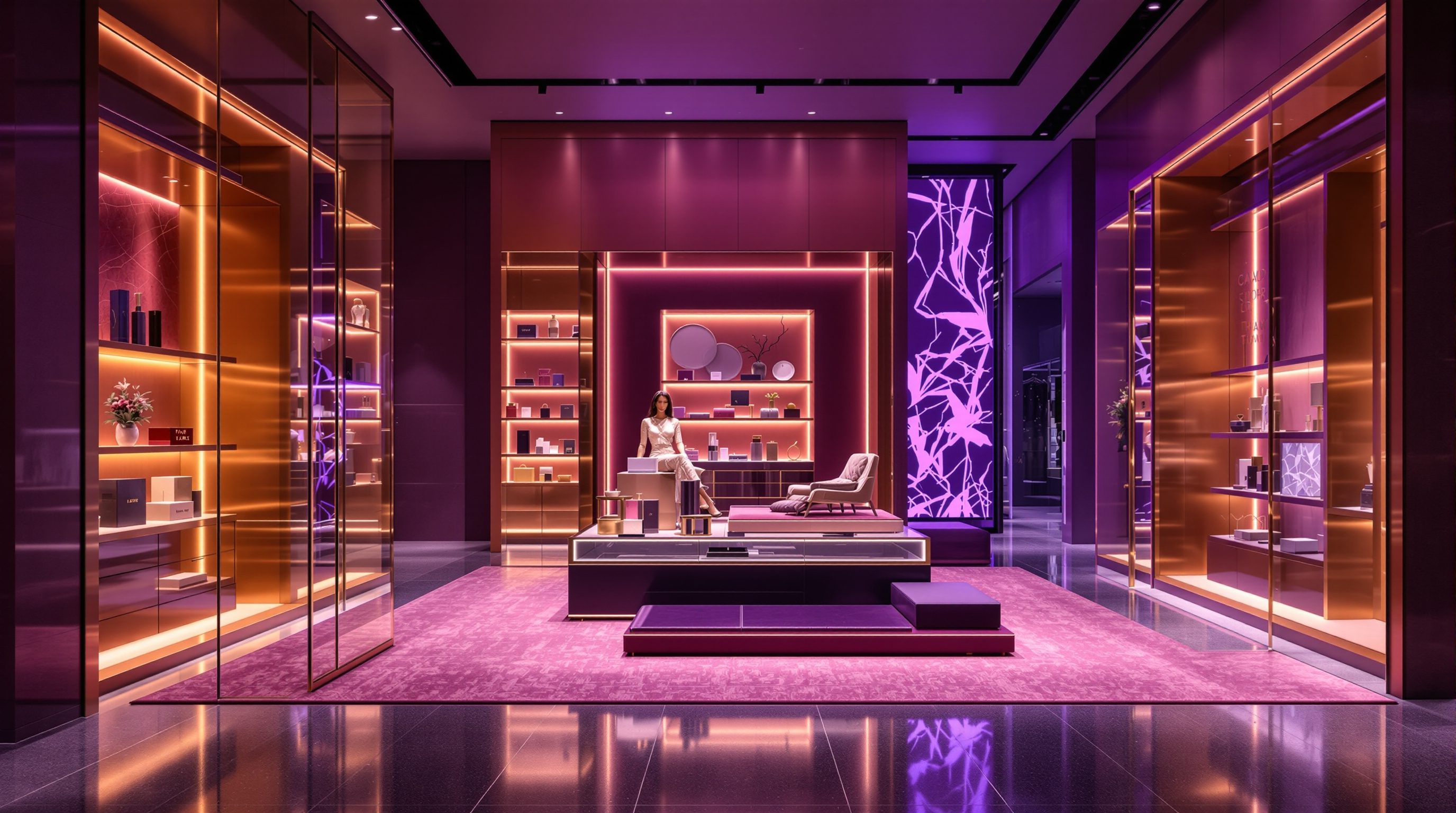
Experiential retail spans a spectrum, from small human touches to full immersive spectacle, and good design chooses the right point for the brand and budget rather than reaching reflexively for the biggest gesture. At the modest end are experiences woven into ordinary shopping: expert advice and personal styling, the chance to touch and truly try, a repair or customisation bar, a tasting, a demonstration, a comfortable place to sit and consider. These cost little, serve the shopper directly and are often the highest-return experiences of all because they solve real problems a screen cannot. At the richer end are immersive brand worlds and retailtainment - the fusion of retail and entertainment - where the store becomes an environment to explore, play in and photograph: a flagship's dramatic set-pieces, interactive installations, digital mirrors and configurators, a climbing wall in a sportswear store, a coffee experience inside a bookshop, a fragrance journey you walk through.
Interactivity is the thread that turns a passive display into an experience: letting the shopper do something - build, taste, test, customise, play, learn - converts them from spectator to participant, deepens memory and dwell, and gives them a story to tell and share. In India this can be beautifully culture-specific: a saree draped on you by an expert, a spice or sweet tasting, a live demonstration of a craft, a festive installation the whole family photographs. Digital and physical increasingly blend here - screens that extend the range beyond what is stocked, apps that recognise you, augmented mirrors - but the technology should serve the experience, not replace the human warmth that is physical retail's real edge. A gimmick that dazzles once and annoys thereafter is worse than no technology at all.
The designer's job across this spectrum is to compose experiences that are true to the brand, appropriate to the format, genuinely useful or delightful to the shopper, and operable by real staff day after day. An experience that only works with a specialist present on launch day, or that breaks after a week of real use, is theatre, not retail design. The best experiences also flow naturally within the store's selling logic rather than sitting in a walled-off "experience zone" that shoppers admire and then leave - they are stitched into the path so that discovery, play and trial lead smoothly toward advice, decision and purchase. Retailtainment is a powerful tool, but it is a means to a branded, selling end, not an end in itself.
Community, events and the store as destination
The most durable form of experiential retail turns the store from a place you visit for a product into a destination you visit for its own sake - somewhere with gravity in people's lives, a reason to come even when you are not shopping. This is achieved less through one-off spectacle than through community and programming: events, workshops, classes, talks, launches, clubs, exhibitions, a good cafe, a place to meet. A bookshop that hosts author evenings and a children's story hour, a running store that runs a weekly club, a cookware shop with a demonstration kitchen and classes, a paint or hardware store with weekend DIY workshops, a fashion label whose store doubles as a gallery for local artists - each gives people a recurring reason to return and a relationship with the brand that a transaction never builds.
This draws directly on the idea of placemaking: a store that becomes a genuine third place, neither home nor work, where a community gathers, earns a loyalty and word-of-mouth that advertising cannot buy. The commercial logic is real even though the immediate event may not ring the till: a customer who comes weekly for the club, learns in the classes, meets friends there and trusts the staff will buy far more over time, and will choose this brand over a cheaper click. For Indian retail this is fertile ground - the shop as a social and festive place is deeply rooted, from the bazaar to the neighbourhood store where people linger and talk, and modern experiential retail can build on that grain rather than importing a purely transactional model.
Designing for destination changes the brief in concrete ways the designer must anticipate. The store needs flexible space that can convert from selling floor to event space and back - movable fixtures, clear sightlines that can open up, power and AV where events happen, storage for stacking chairs. It needs a comfortable heart - seating, a cafe, a lounge - that invites lingering, which trades some selling area for dwell and loyalty, a trade to make consciously and defend commercially. It needs to handle the operational reality of events: crowd flow, acoustics, service, and the fire and egress implications of gathering people, which must be checked against the current code and a specialist because occupancy changes the life-safety picture. Get this right and the store stops competing with the website on the website's terms and starts offering what no screen ever will: a place, and people, worth showing up for.
A destination has gravity - people come even when they are not shopping. That is loyalty money cannot buy.
Balancing experience with selling
For all its appeal, experiential retail carries a specific and expensive danger: experience that does not sell. It is easy to be seduced by the spectacle - the installation everyone photographs, the flagship that wins design awards and floods social media - and to forget that a store, however experiential, is still a commercial building that must earn its keep. There are two failure modes. The dull box that offers no experience loses to the website. But the theme park that offers dazzling experience with no selling logic - beautiful, busy, buzzing, and quietly losing money - fails just as surely, and is harder to catch because it looks like success. Footfall and photos are not sales; a store full of people taking pictures and buying nothing is a very costly advertisement.
The discipline is to tie every experience to a commercial job and, wherever possible, to a measurable one. An experience can legitimately serve several ends: it can draw people in (footfall), make them stay longer (dwell), help them decide and buy now (conversion, basket), build the brand and bring them back (loyalty, repeat), or drive sales that complete later online (halo). Each of those is defensible, and some experiences - a flagship's brand theatre - are justified more by brand-building and media value than by that store's own till. What is not defensible is experience justified by nothing but its own splendour. The honest designer, working with the retailer, names the job each experience is meant to do and how it would be known to have worked, and designs the experience to flow toward that outcome rather than dead-ending in spectacle.
Crucially, experience and selling are not opponents when the design is good; the best experiential retail sells more precisely because the experience serves the shopper and the brand. Touching and trying reduces doubt and returns; expert help closes the sale and builds trust; an immersive world deepens belief and price tolerance; a community brings people back. The trap is only sprung when experience is bolted on as decoration or spectacle divorced from the selling and brand logic. So design experiences that are true to the brand, useful or delightful to the shopper, operable every day, stitched into the selling path, and answerable to a commercial purpose - and the store becomes both a place worth the trip and a business worth running. Next we look at one of the most powerful ways to make an experience cohere: telling the brand's story through the store.
Fire safety, occupancy & egress (NBC 2016)
Events and gatherings change occupant load, exits and travel distance
Destination retail with events must re-check life-safety against the current code with a specialist - occupancy is not the same as a normal shop. Modules 2, 9.
Food, beverage & licensing
In-store cafe, tasting, demonstration kitchen
F&B and events bring hygiene, extract and licensing rules - defer to the current regulations, local authority and the relevant specialists. Module 8.
Experience metrics & benchmarks
Footfall, dwell time, conversion, repeat visits, social reach
Tie each experience to a job and calibrate targets to the brand, format and market - illustrative, as of 2026, never a universal rule. Modules 1, 8.
Workshop — design a reason to visit
Experiential retail begins with the new question: why make the trip? In this workshop you will take a real brand that could sell online and design a compelling in-store experience for it, then stress-test that the experience actually sells rather than merely dazzles.
A brand and a sketchbook. This is about designing a defensible experience, not building it; no software needed.
Goal: one designed in-store experience, tied to a commercial job
Inputs: a brand or category that sells largely online + this lesson + a sketchbook
Time: ~60 minutes
- 1Name the trip: for your chosen brand, write down why a shopper should visit the store rather than buy from the screen - what embodied, social, sensory or human thing can the store offer that a website cannot? Be specific to this brand.
- 2Choose your point on the spectrum: decide whether the right answer is a modest human experience (advice, trial, tasting, repair), an interactive or immersive zone, or a full destination with community and events - and justify the choice by the brand and a realistic budget.
- 3Design the experience: sketch it and describe how a shopper moves through it, what they get to do (touch, try, build, taste, learn, meet), and how staff run it every ordinary day - not just on launch with a specialist present.
- 4Stitch it to the sale: show how the experience flows into the selling path - how discovery, trial or play leads toward advice, decision and purchase - rather than dead-ending in a walled-off experience zone.
- 5Assign the commercial job: state which job this experience does (footfall, dwell, conversion, basket, loyalty, or later online sales) and how the retailer would know it worked. If you cannot name a job, redesign it - you have a theme park, not retail.
You’ll walk away with
A one-page experience concept: the reason to visit, its point on the spectrum, a sketch of the experience and shopper flow, how it links to the sale, and its commercial job and success measure. Keep it - designing a defensible reason to visit is a core modern retail skill.
Three altitudes on the same idea
Read the band that fits you — or all three.
Destination and experiential retail change the base-build brief, and that is architect territory. Flexible, event-capable space needs generous clear spans, movable rather than fixed elements, and sightlines that can open up; a cafe, lounge, workshop or demonstration kitchen adds servicing, power, water, extract, AV and acoustic demands the shell must anticipate. Gathering people for events changes the occupancy, so egress, exit capacity and fire strategy must be re-checked against the current code with a life-safety specialist. Design the vessel to flex between selling floor and event space, coordinate the experiential ambitions early, and defer all binding fire, accessibility and structural specifics to the code and consultants.
Composing the experience within the store is your craft, from the smallest human touch to the immersive set-piece. You design the styling and advice points, the touch-and-try moments, the interactive and demonstration zones, the immersive brand world, the comfortable heart that invites lingering - and you stitch them into the selling path so discovery leads to decision, not to a dead-end spectacle zone. Keep experiences true to the brand, useful or delightful to the shopper, and operable by ordinary staff every day, not just on launch with a specialist present. Use technology to serve warmth, not replace it, and design flexible fixtures so the floor can convert for events.
Experiential retail is the most exciting frontier of the field, and you can study it in every good store you visit. Ask the new question everywhere: why would I make this trip rather than tap my phone? Notice what the store offers that a screen cannot - touch, trial, expertise, immersion, community - and how (or whether) that experience leads you toward buying. Watch for the two traps: the dull box with no reason to visit, and the theme park full of photos and empty baskets. Train yourself to tie any experience you imagine to a commercial job - footfall, dwell, conversion, loyalty - so you learn early that experience and selling must serve each other.
“Experiential retail means making the store as spectacular and Instagrammable as possible - big installations, dramatic set-pieces and buzz - and the more wow, the better the store.”
Do it yourself
No tools needed - reason it through.
- 1Explain why the 'dull box of shelves' lost its reason to exist, and how experiential retail answers the question 'why make the trip?'
- 2Give three things a physical store can offer that a website fundamentally cannot, and explain why each is hard to copy on a screen.
- 3What is retailtainment, and why should the experience still be stitched into the selling path rather than kept in a separate zone?
- 4How does community and events turn a store into a destination, and why is that loyalty valuable even when the event itself does not ring the till?
- 5Describe the two failure modes of experiential retail and explain how tying each experience to a commercial job avoids them.
The one line to carry out
Peer-reviewed journals & authoritative standards
- 01Experience economy — Wikipedia — Experience economy, 2026.
- 02Customer experience — Wikipedia — Customer experience, 2026.
- 03Placemaking — Wikipedia — Placemaking, 2026.
- 04Retail apocalypse — Wikipedia — Retail apocalypse, 2026.
A reason to visit is most powerful when the whole store hangs together as one coherent world. Next: storytelling and theming - telling a brand's story through the store, from window to till, without tipping into kitsch.
The author
Amogh N P
Architect, interior designer, and creative polymath. Studio Matrx began in his notebooks — his vision of design made honest, useful, and open to everyone. Its Academy is written and taught in his memory, and free, forever.
More about Amogh →