
 Lesson 6.1
Lesson 6.1 · Water-Sensitive Design
Water-Sensitive Urban Design
Designing sites and streets to slow, soak and store the rain where it falls - treating water as an asset in the landscape rather than a nuisance to pipe away as fast as possible
Conventional development treats rain as an enemy - get it off the site and into a pipe as fast as possible. That is exactly why our streets flood and our aquifers empty.
Watch what happens to rain when it falls on a normal modern development. It lands on roofs, roads and car parks - hard, sealed surfaces that let none of it soak in - and it runs off, fast and all at once, into gutters, drains and pipes engineered to do one thing: carry the water away as quickly as possible, off the site and into a distant sewer or river. The whole logic is speed and removal. Rain is treated as a nuisance, a hazard, something to be flushed out of sight before it can cause trouble. And for a long time, on a single plot, that logic seemed to work.
But scale it up across a whole city of sealed surfaces and fast pipes and the logic turns on itself. All that water, rushed off every plot at once, arrives downstream together in a sudden flood the drains cannot hold - so the streets flood anyway, just somewhere else and someone else's problem. Meanwhile the water that used to soak gently into the ground and refill the aquifers never gets the chance; it is gone downstream before it can infiltrate, so the groundwater beneath the city keeps falling. Fast drainage causes flooding AND drought at the same time. Water-sensitive urban design (WSUD) is the deliberate reversal of this: design the site and the street to slow the rain down, let it soak in, store it, clean it and use it - keeping water on site and in the landscape as an asset, rather than racing to pipe it away as waste.
Fast-pipe model: seal surfaces -> rush rain to pipes -> flood downstream AND aquifer falls. WSUD: slow it + spread it + soak it + store it. Management train: source -> site -> regional. Water = visible asset. BUT still need overflow for the extreme + maintenance + never compromise health.
Why fast drainage causes both flooding and drought
To see why water-sensitive design matters, look hard at what conventional 'good drainage' actually does. The traditional engineering goal was simple and, in its own terms, successful: get rainwater off surfaces and out of the area as fast as possible, through gutters, gullies and underground pipes, so nobody has wet feet and nothing floods locally. This is sometimes called the 'pipe-and-pave' or 'grey' drainage model, and for a single building on a rainy day it works fine.
The trouble appears when you seal a whole landscape this way. Natural ground - soil, grass, trees - absorbs a large share of the rain that falls on it, letting it soak slowly into the earth to recharge groundwater, and releasing the rest gradually over hours or days. A developed surface does the opposite: roofs, tarmac and concrete are impervious, so almost all the rain becomes surface runoff, and the pipes send it downstream immediately. The result is a flood hydrograph with a sharp, high peak - a huge volume of water arriving all at once - instead of the natural slow trickle. Multiply that across every plot in a catchment and the combined peak overwhelms the drains and the rivers downstream. The flooding was not prevented; it was concentrated, accelerated and exported to whoever is downhill.
At the same time, this model quietly creates the opposite problem. Water that is rushed away can never soak in, so the groundwater recharge the aquifer depends on simply stops. In a city that also pumps hard from those same aquifers - as many Indian cities do - the water table falls year after year. So the very same fast-drainage design that causes flash floods in the monsoon also deepens the water scarcity that grips the same city in the dry season. It is a striking contradiction: too much water and too little, caused by one design mistake. Fast pipes move a local nuisance into a shared disaster and throw away a resource in the process. Water-sensitive design begins by rejecting the premise - rain is not a nuisance to be removed at speed but water to be slowed, soaked and kept - and everything else follows from that reversal.
The four verbs of WSUD: slow, spread, soak, store
Water-sensitive urban design can be summed up in four verbs that are the exact opposite of 'pipe it away fast': slow it, spread it, soak it, store it. Each undoes one part of the conventional model.
Slow it. Instead of smooth channels that speed water up, WSUD uses rough, planted, gently-sloped routes - swales (shallow vegetated ditches), check dams, and long grassy paths - that deliberately slow the flow. Slower water does less damage, has time to drop its silt, and gives every later step time to work. Spread it. Rather than concentrating runoff into one fast pipe, WSUD spreads it thinly across many small features distributed over the site - a principle called source control, dealing with rain where it lands rather than collecting it all and dealing with it at the bottom. Many small soakaways beat one big drain. Soak it. Wherever the ground and the water table allow, WSUD lets water infiltrate into the soil - through permeable paving, rain gardens, soakaways and unsealed ground - recharging groundwater and shrinking the volume that ever becomes runoff at all. Store it. What cannot soak away is held - in ponds, tanks, wetlands, basins and the soil itself - to be released slowly, long after the storm has passed, or captured and used, linking straight back to the rainwater harvesting of Module 3.
The organising idea behind these verbs is the management train: a sequence of features that treats water in stages as it moves through the site, from small source controls near where rain falls (green roofs, water butts, permeable paving), through site controls (rain gardens, swales), to larger regional controls (ponds, wetlands, basins) that serve a whole neighbourhood. Each stage slows, cleans and reduces the water so that less, cleaner and slower water reaches the next - and far less reaches the public sewer or river than under the old model. Crucially, these are mostly soft, green, low-energy, often gravity-fed features - which is exactly what the course's energy-water discipline wants: they work with the landscape and gravity rather than pumps and power.
Water as an asset in the landscape, not a hidden pipe
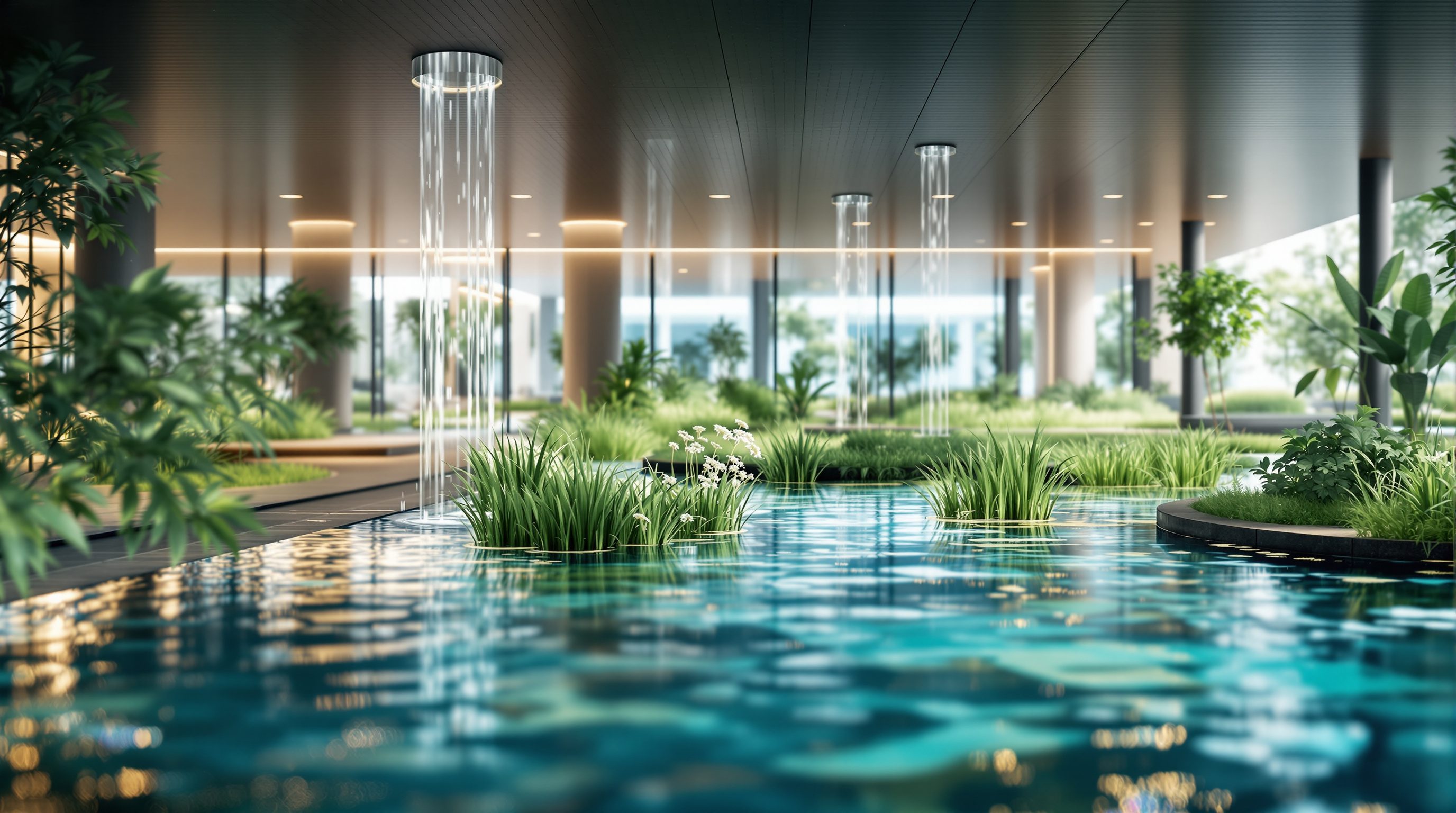
The deepest shift in water-sensitive design is not technical but perceptual: it moves water from hidden infrastructure to be buried and forgotten to a visible asset that shapes the place. Conventional drainage is invisible by design - pipes underground, water gone. WSUD brings water back to the surface, into rain gardens, swales, ponds and wetlands that are part of the landscape people see and use. This is sometimes the hardest idea for a designer trained to think of drainage as a purely engineering nuisance, but it is where the real value lies.
A well-designed water-sensitive landscape does many jobs at once, which is why it earns its space. The same rain garden that soaks up runoff also cools the air, supports pollinators and birds, cleans pollutants from the water, and looks beautiful; the same pond that stores stormwater also creates habitat, amenity and a cooler microclimate; the same permeable, planted street that manages the monsoon also shades pedestrians and calms traffic. This bundle of co-benefits - water, biodiversity, cooling, amenity, health - is what people mean by green infrastructure or blue-green infrastructure, and it is the reason WSUD is worth doing even before you count the flood and recharge benefits. Water becomes a design generator, not an afterthought hidden below ground.
For the designer this means water enters the project at the very start, with the site plan and the landscape, not at the end as a drainage calculation handed to an engineer. Where does rain fall, where does it want to go, where can it soak, where can it be stored and seen, how does it connect the building to the ground - these become site-planning questions. It also means honouring context: India's stepwells, temple tanks and johads were precisely this - water made visible, central and celebrated in the landscape, storing the monsoon for the dry season - so water-sensitive design in India is partly a revival of deep local wisdom, not a foreign import. But the disciplines still hold: reduce demand and impervious area first, keep the systems low-energy and gravity-fed, and leave the binding drainage capacity, water-quality and any contamination questions to qualified drainage and public-health engineers under the governing codes. WSUD reframes water as an asset; it does not exempt you from getting the safety and the numbers right.
The honest limits: not a substitute for engineering or the disciplines
Water-sensitive urban design is powerful, but an honest account has to name its limits, because it is easy to oversell. First, WSUD complements conventional drainage; it rarely replaces it entirely. Green features handle frequent, ordinary rain superbly, soaking and slowing the common storms that make up most of the year. But in an extreme, once-in-decades downpour - and India's monsoon and cloudbursts can be ferocious - the soil saturates, the ponds fill, and the site still needs a safe overflow route and, usually, a conventional piped system for the rare event that exceeds what the green infrastructure can hold. The competent design is a hybrid: green infrastructure for the everyday, engineered capacity for the extreme, and always a designed safe overflow. Treating WSUD as a total replacement for drainage engineering is a dangerous mistake.
Second, these systems are not fit-and-forget. A rain garden, swale or permeable pavement that is not maintained - silt cleared, plants tended, surfaces kept from clogging - will slowly fail, and a clogged permeable pavement drains no better than tarmac. WSUD trades some capital simplicity for an ongoing maintenance commitment, and a design that does not secure that maintenance is a design that will disappoint. Third, context decides everything: infiltration only works where soils are permeable and the water table is not already at the surface; in heavy clay or high-water-table sites you store and slow rather than soak, and in contaminated ground you may not want to infiltrate at all. There is no universal recipe.
And the course's three disciplines still outrank the technique. Reduce demand first: the cheapest stormwater to manage is the runoff you never create, so minimising impervious area - fewer sealed surfaces, smaller car parks, green roofs - comes before any treatment train. Mind the energy: WSUD's great virtue is that it is mostly low-energy and gravity-fed, so keep it that way and be suspicious of pumped, powered 'solutions' that undo the benefit. Never compromise health: standing water can breed mosquitoes (a serious concern in India), stored or infiltrated water can be contaminated, and cross-connections between stormwater and any potable system are dangerous - so the binding water-quality, mosquito-control, drainage-capacity and public-health decisions belong to qualified engineers and health authorities under the codes, never to enthusiasm. Water-sensitive design is a genuinely better way to treat rain, done with discipline and honesty about what it can and cannot do.
Slow, spread, soak, store
The four verbs of WSUD
Reverse the fast-pipe model: slow the flow (swales, check dams), spread it (many small source controls), soak it (infiltration where soils allow), store it (ponds, wetlands, tanks) for slow release or reuse. Modules 3.2, 6.3.
The management train
Treat water in stages across the site
Source control near where rain falls, then site control, then regional control - each slowing, cleaning and reducing water so less, cleaner, slower water reaches the next stage and the public system. Mostly low-energy and gravity-fed. Module 6.4.
Green plus grey hybrid
WSUD complements, rarely replaces, drainage
Green infrastructure handles frequent rain; engineered capacity and a designed safe overflow are still needed for the extreme event, especially in India's monsoon. Binding drainage-capacity and hydraulic design belong to qualified engineers under NBC India, IS and local codes.
Health and maintenance are not optional
Standing water, contamination, upkeep
Standing water can breed mosquitoes; stored or infiltrated water can be contaminated; systems clog if unmaintained. Mosquito-control, water-quality and cross-connection decisions belong to qualified public-health and drainage specialists. Modules 8.3, 9.3.
Workshop - map where the rain goes on a site you know
Water-sensitive thinking begins with watching where rain actually goes on a real site and imagining slowing it down. In this workshop you will map a site's surfaces and runoff and sketch a first water-sensitive redesign - qualitatively, as reasoning, not as drainage engineering.
Just a site you know and a notebook or printed plan. No drainage software needed - this workshop is about seeing runoff and imagining the slow-soak-store reversal by hand; the binding drainage-capacity, infiltration, water-quality and mosquito-control decisions always stay with qualified drainage and public-health engineers and the codes.
Goal: a first water-sensitive read and redesign of a real site
Inputs: a site you know (home, campus, street, plot) + this lesson + a notebook or a printed plan
Time: ~45 minutes
- 1Map the surfaces: sketch the site and shade every impervious surface (roofs, roads, paving, car park) versus every permeable one (soil, grass, planting). Estimate roughly what fraction is sealed.
- 2Trace the rain: draw where rain runs when it lands - the flow paths, the low points, where it collects, and where it finally leaves the site (drain, road, sewer). Note how fast it leaves.
- 3Find the demand-reduction: identify impervious surfaces that could simply be reduced or unsealed (smaller paving, green roof, permeable surface) - the runoff you never create needs no managing.
- 4Place a management train: mark where you could slow it (swale, rough route), soak it (rain garden, permeable paving, soakaway - if soils allow), and store it (a pond, tank or planter, ideally visible and gravity-fed), from small source controls to a larger shared feature.
- 5Write a one-paragraph reflection: how the site could move from fast-pipe to slow-soak-store, where a safe overflow for the extreme monsoon event must remain, the maintenance it would need, and what a drainage and public-health engineer would have to confirm - flagged as reasoning, not specification.
You’ll walk away with
A one-page water-sensitive read of a site: its impervious-versus-permeable surfaces, its runoff paths, the impervious area that could be cut first, a sketched slow-soak-store management train, and the overflow, maintenance and specialist checks needed - framed as reasoning.
Three altitudes on the same idea
Read the band that fits you — or all three.
Bring water into the site plan from the first sketch: design the ground, the roofs and the landscape to slow, soak and store the rain rather than pipe it away, and treat that water as a visible asset. Minimise impervious area first (that is demand-reduction for stormwater - the runoff you never create needs no managing), then compose a management train across the site: source controls near where rain falls (green roofs, permeable paving, water butts), site controls (rain gardens, swales), and shared regional controls (ponds, wetlands, basins) that can serve a whole cluster of buildings. Favour low-energy, gravity-fed, planted systems over pumped ones, and always design a safe overflow for the extreme event WSUD cannot hold. Coordinate early with landscape architects and civil/drainage engineers, and revive the local heritage - stepwells, tanks, johads - as living precedent, not decoration. Defer the binding drainage-capacity, infiltration, water-quality, mosquito-control and contamination decisions to qualified drainage and public-health engineers under the NBC, IS and local codes; own the water-shaped site strategy and the discipline that keeps it low-energy and safe.
Water-sensitive design is mostly a site-and-landscape scale, but the interior connects to it at the edges - and the first lever is still using less. The runoff a site must manage starts with the water demand of the building, so water-efficient fixtures and less-thirsty interiors reduce the whole system's load, and roofs and courtyards you influence can feed rainwater harvesting and rain gardens rather than drains. Think about how thresholds, courtyards, light wells and terraces meet the ground and the rain: can a terrace drain to a planter instead of a downpipe, can a courtyard hold and show water as stepwells and tanks always did, can interior planting be irrigated from captured rain. Keep any water feature healthy - no stagnation, no mosquito breeding, no cross-connection to drinking water. Your domain is the water-efficient, healthy interior and its thoughtful connection to the landscape's water; leave the drainage engineering, infiltration and water-quality judgements to the qualified specialists and the codes.
Water-sensitive urban design is one of the clearest, most visual ideas in the whole field - and a strong portfolio thread - so learn it well. The core is a reversal: conventional development seals surfaces and pipes rain away as fast as possible, which causes flooding downstream and drought on site at the same time (fast water cannot soak in to recharge the aquifer). Water-sensitive design does the opposite - slow it, spread it, soak it, store it - using sustainable drainage (SuDS): rain gardens, swales, permeable paving, ponds and wetlands arranged as a management train from small source controls to larger shared features, treating water as a visible asset that also cools, greens and beautifies a place. Learn the four verbs, the management train, and the honest limits: it complements rather than replaces drainage engineering, needs maintenance, depends on soil and water table, and never overrides the three disciplines - reduce impervious area and demand first, keep it low-energy and gravity-fed, and never compromise health (standing water and mosquitoes, contamination, cross-connections are real risks for specialists to resolve). India's stepwells and tanks are WSUD centuries early - a heritage to revive.
“Good drainage means getting rainwater off the site and into the pipes as fast as possible, so it never causes flooding or standing water. Water-sensitive design with rain gardens and soakaways is a nice green add-on, but proper engineered pipes are what really prevents floods.”
Do it yourself
No tools needed - reason it through.
- 1Explain how fast, piped drainage causes both flooding downstream and drought (groundwater depletion) on site at the same time.
- 2Name the four verbs of water-sensitive urban design and give an example feature for each.
- 3What is the SuDS management train, and why does treating water in stages beat one big drain at the bottom?
- 4Why is WSUD best understood as a green-plus-grey hybrid rather than a total replacement for drainage engineering?
- 5How do the three disciplines (reduce demand first, mind the energy, never compromise health) apply specifically to stormwater and WSUD?
The one line to carry out
Peer-reviewed journals & authoritative standards
- 01Water-sensitive urban design — Wikipedia - Water-sensitive urban design, 2026.
- 02Sustainable drainage system — Wikipedia - Sustainable drainage system, 2026.
- 03Green infrastructure — Wikipedia - Green infrastructure, 2026.
- 04Surface runoff — Wikipedia - Surface runoff, 2026.
If a whole city adopts this thinking at once - every roof, street and park designed to absorb, store and slowly release water - you get an idea big enough to have its own name: the sponge city. Next we scale up.
The author
Amogh N P
Architect, interior designer, and creative polymath. Studio Matrx began in his notebooks — his vision of design made honest, useful, and open to everyone. Its Academy is written and taught in his memory, and free, forever.
More about Amogh →