
 Lesson 6.3
Lesson 6.3 · Water-Sensitive Design
Landscape & Water
The working parts of water-sensitive design - rain gardens, bioswales, ponds and wetlands, water-wise planting and permeable surfaces - the landscape reimagined as the building's water infrastructure
The landscape around a building is usually treated as decoration to be watered. Reimagine it as the building's water infrastructure - and it starts giving water back instead of only taking it.
Look at how landscape and water usually relate in a modern building. The landscape is ornamental - lawns, imported ornamental plants, tidy beds - and its relationship to water is entirely one-way: it consumes water, often a great deal of it, pumped or piped in to keep thirsty, ill-suited plants alive through a dry season they were never meant for. Meanwhile, the rain that falls on the site is treated as a separate problem, drained away as fast as possible through pipes. Water goes out to the landscape and rain goes away from the site, and the two never meet. It is a strange, wasteful arrangement, and it is the norm.
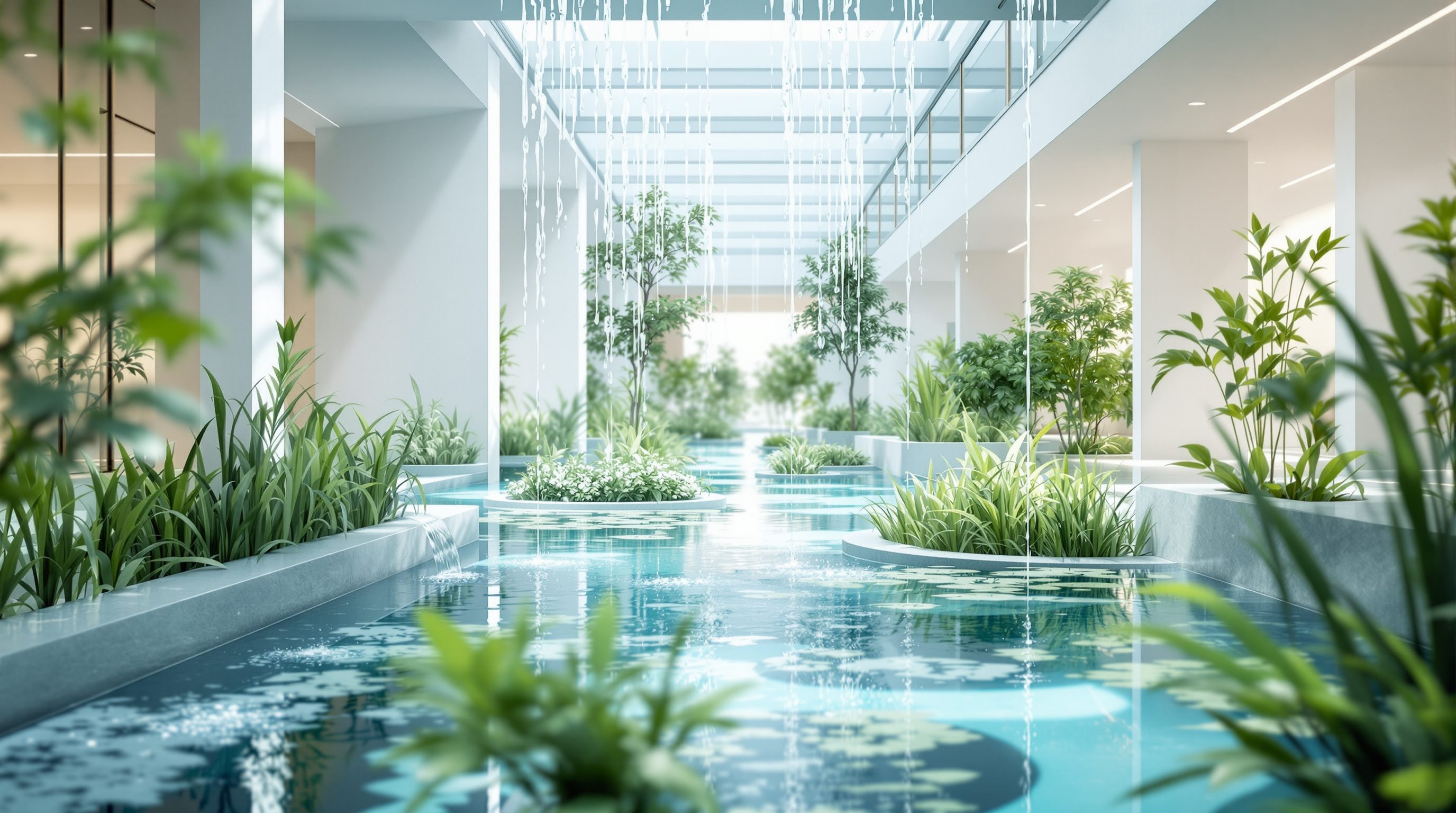
Water-sensitive design proposes something far more elegant: make the landscape the building's water infrastructure. The same ground that surrounds the building can slow, soak, store and clean the rain that falls on the site - through rain gardens, bioswales, ponds and wetlands - while the planting itself can be chosen to need almost no irrigation at all, so the landscape stops being a drain on water and starts managing it. Done well, the landscape becomes the working machinery of the four verbs from Lesson 6.1 - slow, spread, soak, store - built from soil, plants and water rather than pipes and pumps, mostly low-energy and gravity-fed, and beautiful and alive as it works. This lesson opens the toolbox: the specific landscape elements that make water-sensitive design real, and the honest judgement each one needs.
Landscape = the building's water infrastructure. SOAK/SLOW: rain gardens + bioswales. STORE/CLEAN: ponds + constructed wetlands. DESIGN OUT DEMAND: xeriscape planting + permeable surfaces. Compose to fit soil + water table + climate + space. Disciplines: reduce demand/runoff first + low-energy + drain within a day (no mosquitoes) + reused water safe.
Rain gardens and bioswales: the soaking-and-slowing toolkit
The two workhorses of water-sensitive landscape are the rain garden and the bioswale, and understanding them well covers most of the everyday toolkit. Both do the same essential job - catch runoff, slow it, let it soak in, and clean it as it passes through soil and plants - and both are simply shallow, planted depressions in the ground, which is what makes them so cheap, low-energy and repeatable.
A rain garden is a shallow, planted basin positioned to receive runoff - from a roof downpipe, a paved area, a road edge - and let it pool briefly and soak into the ground. Water flows in, spreads across the planted depression, and infiltrates through a bed of free-draining soil while the plants and soil microbes filter out pollutants; within a day or so the surface is dry again. A rain garden turns a downpipe that used to feed a drain into a small, living soak-away that recharges groundwater, removes pollution, supports insects and birds, and looks like a garden rather than a drain. It is perhaps the single most useful, accessible water-sensitive feature at building scale.
A bioswale is essentially a rain garden stretched into a line: a shallow, gently-sloping, planted channel that conveys runoff slowly along its length while soaking and cleaning it as it goes - the water-sensitive replacement for a kerb-and-gutter or a concrete drain. Because it is rough with vegetation and gently graded, water moves slowly, drops its silt, and infiltrates along the way, so a swale both moves water where it needs to go and treats it en route. Swales are ideal along roads, car parks, paths and property edges - anywhere a conventional design would have put a hard channel.
Both depend on things the designer must get right and must defer where it becomes technical: the soil must drain (infiltration only works in suitable, permeable ground - heavy clay or a high water table changes everything), the feature must be sized for the runoff it receives, it needs an overflow for when it fills, and it must be maintained or it silts up and stops working. And a warm-climate caution matters in India: these features are designed to drain within a day or so precisely so they do not become standing water that breeds mosquitoes - a permanently wet, un-draining pit is a failure, not a rain garden. Get the soil, sizing, overflow and maintenance right - deferring the binding infiltration and drainage-capacity judgements to qualified engineers - and rain gardens and swales are the reliable, low-energy heart of the water-sensitive landscape.
Ponds and wetlands: storing and cleaning at the bottom of the train
Where rain gardens and swales soak and slow water across the site, ponds and constructed wetlands sit at the larger, downstream end of the management train, doing the work of storing water and cleaning it more thoroughly - and, at the same time, delivering some of the richest ecological and amenity value of any water-sensitive feature.
A stormwater pond (or detention/retention basin) is a designed water body that collects runoff from a larger area, holds it, and releases it slowly - flattening the flood peak by storage rather than infiltration, which makes ponds useful even where soils drain poorly and infiltration is limited. A detention pond fills during a storm and empties slowly afterward, sitting dry between storms; a retention pond holds a permanent pool of water. Both buy time, turning a sudden flood surge into a slow, manageable release, and a permanent pond adds habitat, cooling and beauty.
A constructed wetland goes further, and links directly to Module 5's natural treatment: it is a shallow, planted, marshy system - reeds, rushes, wetland plants in a lined or unlined bed - through which water moves slowly and is cleaned by plants, soil and microbes, the way a natural marsh cleans water. In the water-sensitive landscape, constructed wetlands both store stormwater and treat it - removing sediment, nutrients and some pollutants - and they are among the most biodiverse, beautiful and low-energy features available, cleaning water through living process rather than machinery. This is exactly the kind of natural, gravity-driven treatment the course's energy discipline favours.
Ponds and wetlands carry their own honest cautions, sharpened in the Indian context. They occupy space, which is scarce and costly in dense cities. They demand careful design and maintenance - inlets and outlets that work, silt removal, planting that thrives - or they degrade into stagnant, polluted, unsightly water. And the health caution is serious: permanent water bodies in a warm climate can breed mosquitoes, so vector management (planting, water movement, sometimes fish, careful edge design) is essential, and any wetland treating contaminated water must protect people and the groundwater beneath it. So while ponds and wetlands are the storing-and-cleaning heart of the landscape train and echo India's magnificent tank-and-lake heritage, the binding decisions - treatment performance, whether treated water is safe for a use, mosquito control, and drainage capacity - belong to qualified water-treatment, drainage and public-health engineers under the governing codes, never to enthusiasm about a beautiful pond.
Water-wise planting and permeable surfaces: designing out demand
The features so far manage the rain that falls; the other half of the landscape-and-water story is designing the landscape so it needs almost no added water in the first place - which is demand-reduction, the first discipline, applied to the ground. This is where water-wise planting and permeable surfaces come in, and they may matter most of all, because the cheapest landscape water is the water the landscape never asks for.
Water-wise or drought-tolerant planting - often called xeriscaping - means designing the planting to thrive on the local climate's own rainfall, with little or no irrigation, by choosing plants suited to the place (frequently native or locally-adapted species), grouping plants by their water needs so you never over-water the whole garden to satisfy the thirstiest corner, improving the soil to hold moisture, and mulching to cut evaporation. The contrast is stark: a conventional lawn or bed of thirsty ornamentals in a hot, dry Indian climate can consume enormous quantities of water to survive a season it is unsuited to, while a well-designed xeriscape of appropriate species can look lush and alive on the rain alone. In a water-scarce country, choosing plants that fit the climate rather than fighting it is one of the highest-leverage water decisions a designer makes - and it directly reduces the demand that all the capture and reuse systems must otherwise serve.
Permeable surfaces attack the problem from the other side - not by needing less water but by refusing to create runoff. Every conventional sealed surface - tarmac, concrete, solid paving - turns rain into runoff to be managed; a permeable surface (permeable paving, gravel, porous concrete, planted grids, or simply unsealed ground) lets rain soak straight through where it falls, so it never becomes runoff at all, recharging the ground beneath. Replacing sealed paving with permeable paving in car parks, paths and courtyards is one of the simplest, most effective water-sensitive moves, and it is pure source control: the runoff you never create needs no rain garden, no swale, no pond, no pipe. The honest cautions are modest but real: permeable surfaces need soils that drain and must be maintained or they clog (a silted permeable pavement is just expensive tarmac), and water-wise planting needs the right species and establishment care. But together, water-wise planting and permeable surfaces embody the discipline that governs the whole module - reduce demand and runoff first - and they do it with the lowest energy and cost of any tool in the box.
Composing the landscape as one water system - with judgement
The real skill is not knowing the individual features but composing them into one working water system matched to the specific place - and doing so with honest judgement about what fits where. The features are not interchangeable or universally applicable; each suits particular conditions, and the art is choosing and arranging them so the landscape as a whole slows, soaks, stores and cleans the site's water while asking almost none in return.
A good composition follows the management train from Lesson 6.1 across the actual ground. Rain lands on roofs and paved areas; permeable surfaces let much of it soak where it falls; downpipes and paved edges feed rain gardens and bioswales that soak and clean the rest as it moves; and what remains gathers in ponds or wetlands at the low point of the site, stored and cleaned before it slowly leaves or is reused. Meanwhile the planting throughout is water-wise, so the landscape needs little or no irrigation, and where captured or stored water is reused, it goes to that low-grade irrigation need - fit-for-purpose matching in the landscape. The pieces connect into a sequence, each handing slower, cleaner, less water to the next.
But judgement decides everything, and this is where honesty matters. Soil and water table govern whether you can soak (infiltrate) or must store - clay and high water tables push you toward ponds and storage rather than rain gardens and soakaways. Climate governs planting and the balance of storing versus soaking - India's concentrated monsoon means large storage capacity and robust overflows, while the long dry season rewards water-wise planting and stored reuse. Space governs ambition in dense cities. Contamination may rule out infiltration where the ground or the water is polluted. And the health caution runs through all of it: features must drain or move water so they do not breed mosquitoes, and any water reused or infiltrated must be safe. So the designer composes the landscape water system - the vision, the sequence, the fit to place, the low-energy and demand-first discipline - while deferring the binding results to specialists: the infiltration rates and drainage capacity to drainage engineers, the treatment performance and whether reused water is safe to water-treatment and public-health engineers, the mosquito control to health authorities, all under the codes. Reimagined this way, the landscape stops being decoration watered by the building and becomes the building's living, low-energy water infrastructure - which is the whole promise of water-sensitive design made physical.
Rain gardens and bioswales
The soaking-and-slowing toolkit
Shallow planted basins and channels that catch runoff, slow it, soak it and clean it through soil and plants - low-energy, gravity-fed source and site control. Must have draining soil, correct sizing, an overflow, maintenance, and drain within a day so they do not breed mosquitoes. Modules 6.1, 8.3.
Ponds and constructed wetlands
Storing and cleaning at the train's end
Ponds store runoff and release it slowly (flatten the flood peak even in poorly-draining soils); constructed wetlands store and treat water through living process. Rich in habitat and amenity. Treatment performance, reuse safety and mosquito control are binding decisions for qualified specialists. Modules 5.1, 6.2.
Water-wise / xeriscape planting
Design out irrigation demand
Climate-suited, drought-tolerant, often native planting grouped by water need, with improved soil and mulch, thrives on local rainfall with little or no irrigation - demand-reduction applied to the ground, high-leverage in water-scarce India. Modules 7.1, 10.3.
Permeable surfaces
Create no runoff in the first place
Permeable paving, gravel, porous surfaces and unsealed ground let rain soak where it falls, so it never becomes runoff - pure source control and groundwater recharge. Need draining soils and maintenance or they clog. Binding infiltration and drainage decisions belong to qualified engineers. Module 6.1.
Workshop - design a water-sensitive landscape for a real site
The landscape-and-water toolkit becomes real when you compose it for an actual place. In this workshop you will design a first water-sensitive landscape for a site you know - choosing and arranging features to fit its soil, climate and space - qualitatively, as reasoning, not as drainage or treatment engineering.
A site you know, a sketch plan and a notebook. No drainage or treatment software needed - this workshop is about composing the landscape water toolkit by hand and fitting it to a real place; the binding infiltration, drainage-capacity, treatment-performance, reuse-safety and mosquito-control decisions always stay with qualified drainage, water-treatment and public-health engineers and the codes.
Goal: a first water-sensitive landscape composition for a real site
Inputs: a site you know + this lesson + a sketch plan + a notebook
Time: ~50 minutes
- 1Read the ground: note the site's likely soil (does it drain, or is it clay?), its climate (how concentrated is the rain, how long the dry season?), its space, and any contamination - because these decide whether you soak or store, and what planting fits.
- 2Design out demand: replace thirsty lawn and ornamentals with water-wise, climate-suited (xeriscape) planting grouped by water need, and replace sealed paving with permeable surfaces where soils allow - the water and runoff you never create.
- 3Soak and slow: place rain gardens where downpipes and paved edges shed runoff, and bioswales along paths, roads or edges to convey, soak and clean water - sized for their catchment, with an overflow, and designed to drain within a day.
- 4Store and clean: if there is space and runoff to justify it, place a pond or constructed wetland at the low point to store and treat what remains, and note any water that could be reused for the low-grade irrigation need (fit-for-purpose).
- 5Write a one-paragraph reflection: how the landscape now manages the site's water while asking for almost none, why your feature choices fit this soil and climate, the maintenance and safe overflow required, and the infiltration, treatment, reuse-safety and mosquito-control checks a specialist must confirm - flagged as reasoning.
You’ll walk away with
A one-page water-sensitive landscape design for a real site: its soil, climate and space read; the water-wise planting and permeable surfaces that design out demand; the rain gardens, swales, ponds or wetlands that soak, slow, store and clean; and the maintenance, overflow and specialist checks needed - framed as reasoning, not specification.
Three altitudes on the same idea
Read the band that fits you — or all three.
Design the landscape as the building's water infrastructure from the start, not as decoration added at the end. Compose a management train across the actual ground: permeable surfaces so rain soaks where it falls, rain gardens and bioswales fed by downpipes and paved edges to soak and clean the rest, and ponds or constructed wetlands at the low point to store and treat what remains - each handing slower, cleaner, less water to the next, mostly low-energy and gravity-fed. Cut demand and runoff first: water-wise, drought-tolerant (xeriscape) planting suited to the climate needs little irrigation, and permeable surfaces create no runoff to manage - the cheapest water and the cheapest stormwater of all. Let soil, water table, climate, space and contamination decide which features fit where (clay and high water tables mean store rather than soak). Design features to drain within a day so they do not breed mosquitoes, and defer the binding infiltration, drainage-capacity, treatment-performance, reuse-safety and vector-control decisions to qualified drainage, water-treatment and public-health engineers under the NBC, IS and CPHEEO norms and local codes.
The landscape-and-water story reaches interiors at courtyards, terraces, planters and indoor planting - and the first move is still to design out water demand. Choose water-wise, climate-suited planting for courtyards, terraces and interior gardens so they need little irrigation, group plants by water need, and improve soil and mulch to hold moisture - the interior and its immediate landscape asking for less is demand-reduction applied to your scale. Where you shape terraces and courtyards, let them drain to a planter or a small rain garden rather than straight to a pipe, and consider feeding interior planting from captured rain (fit-for-purpose matching). Keep any interior or courtyard water feature healthy and moving - no stagnation, no mosquito breeding (a real concern in warm India), no cross-connection to drinking water. Your domain is water-efficient, climate-appropriate planting and healthy water at room and courtyard scale; the drainage, infiltration and treatment engineering belong to the qualified specialists and the codes.
Landscape-and-water is the most tangible, buildable part of water-sensitive design, and a rich portfolio subject - learn the toolkit and, more importantly, the judgement. The core idea: the landscape can be the building's water infrastructure rather than decoration that only consumes water. The soaking-and-slowing tools are rain gardens (shallow planted basins that catch runoff and let it soak in and be cleaned) and bioswales (rain gardens stretched into gently-sloping planted channels that convey, soak and clean water). The storing-and-cleaning tools are stormwater ponds (store and slowly release, flattening the flood peak) and constructed wetlands (store and treat water through plants and microbes - low-energy natural treatment). The demand-designing-out tools are water-wise / xeriscape planting (climate-suited, drought-tolerant, little irrigation) and permeable surfaces (rain soaks through where it falls, creating no runoff). The skill is composing these into one system fitted to the place - soil, water table, climate, space and contamination decide which fits where. And the disciplines rule: reduce demand and runoff first, keep it low-energy and gravity-fed, and never compromise health (features must drain so they do not breed mosquitoes; reused water must be safe) - with binding results left to specialists. India's tanks and stepwells are this heritage made monumental.
“Making a landscape water-friendly is mostly about adding water features - a nice pond, some rain gardens - and keeping the garden green and lush. As long as it looks green and has some water features, the landscape is being water-sensitive and sustainable.”
Do it yourself
No tools needed - reason it through.
- 1Describe a rain garden and a bioswale - what each does and how they differ - and the conditions both need to work.
- 2How do stormwater ponds and constructed wetlands differ in what they mainly do, and why is a pond useful even where soils drain poorly?
- 3Explain why a lush green lawn can be less water-sensitive than a xeriscape, and what water-wise planting actually involves.
- 4Why are permeable surfaces described as pure source control, and what is their main limitation?
- 5What conditions (soil, water table, climate, space, contamination, health) decide which landscape water features fit a given site?
The one line to carry out
Peer-reviewed journals & authoritative standards
- 01Rain garden — Wikipedia - Rain garden, 2026.
- 02Bioswale — Wikipedia - Bioswale, 2026.
- 03Constructed wetland — Wikipedia - Constructed wetland, 2026.
- 04Xeriscaping — Wikipedia - Xeriscaping, 2026.
One rain garden, one pond, one water-wise garden helps a little; the real power of all this appears when it is coordinated across the site, the block and the city. Next we ask why water regeneration works best integrated at scale.
The author
Amogh N P
Architect, interior designer, and creative polymath. Studio Matrx began in his notebooks — his vision of design made honest, useful, and open to everyone. Its Academy is written and taught in his memory, and free, forever.
More about Amogh →