
 Lesson 5.4
Lesson 5.4 · Treating Water Naturally
The Living Machine
At the most ambitious edge of natural treatment sits a genuinely thrilling idea - treating a building's wastewater inside a designed, visible ecosystem, a chain of planted, living tanks often under glass where plants, microbes, snails and fish clean the water in plain, beautiful sight - and it is inspiring and real, but it is also complex, energy-using and maintenance-hungry, its performance varies, and like every system in this course its water is only as safe as verified testing and qualified specialists confirm it to be
Imagine a greenhouse where a chain of ponds full of plants, snails and fish quietly turns your building's sewage back into clean water - in plain, beautiful sight. That idea is real. It is also not magic.
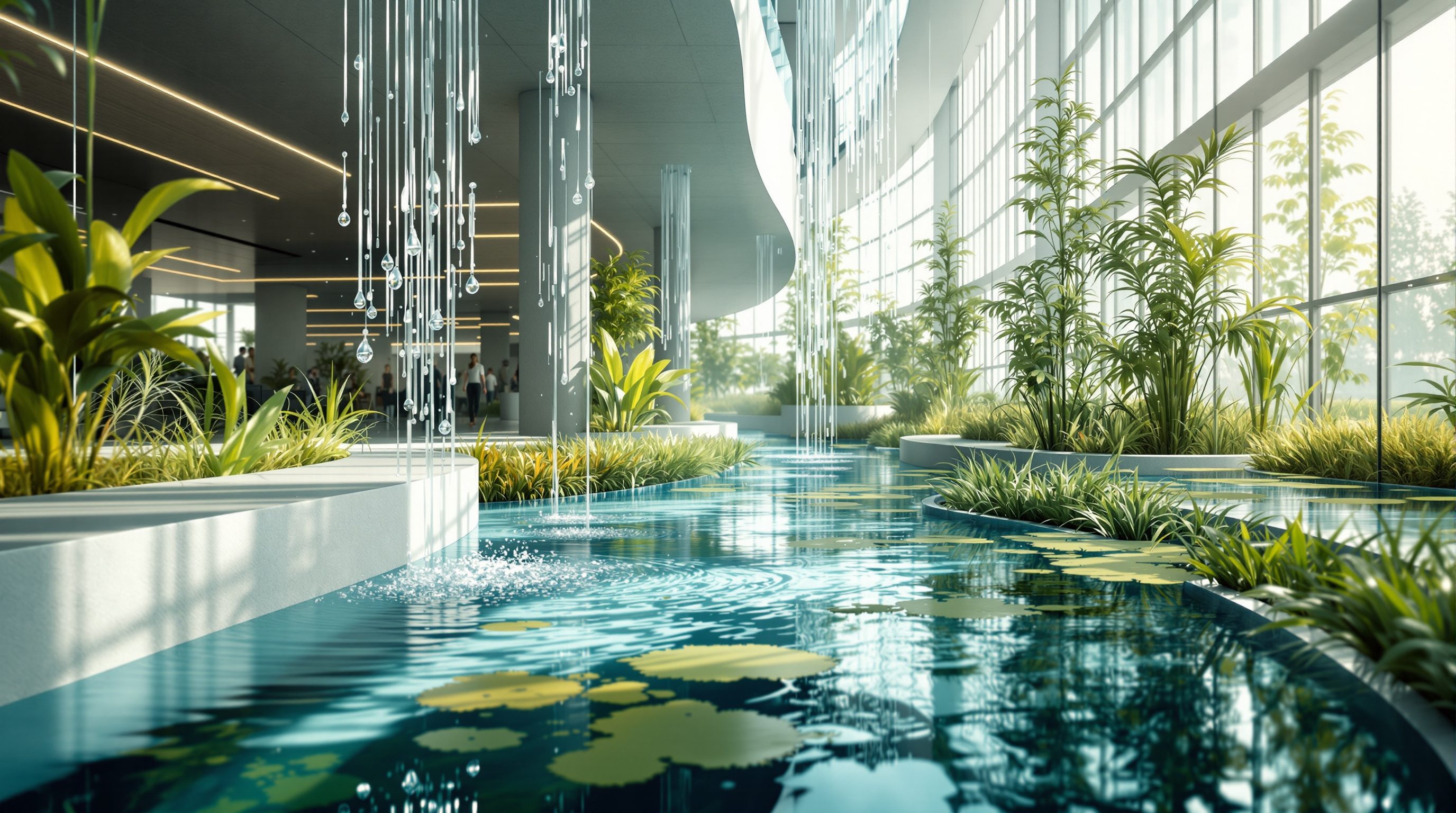
Walk into certain eco-centres, schools and green office buildings and you will find something that looks less like a sewage works and more like a botanical greenhouse: a sunlit row of large tanks brimming with reeds, water lilies and lush greenery, alive with snails, microbes and sometimes fish, the water moving gently from one tank to the next. What you are looking at is the building's wastewater being cleaned - not hidden underground or shipped to a distant plant, but treated in the open, as a designed, living ecosystem, in a space people can walk through and admire. This is the Living Machine (also called an eco-machine or ecological treatment system), and it is the most ambitious and romantic expression of everything this module has taught: microbes eating pollution, arranged not as a single wetland but as a whole engineered ecosystem.
The idea, pioneered by the ecological designer John Todd, is genuinely inspiring, and it captures the regenerative imagination like little else - treatment turned from a hidden cost into a visible, beautiful, educational asset that brings nature into the heart of a building. It is real, it is built, and it works when it is done well. But this final lesson of the module has a specific job: to hold that inspiration and the honesty together. A Living Machine is a wonderful vision and a legitimate option, but it is not a magic box. It is complex; it still uses energy for pumping, aeration and often greenhouse heating; it needs genuinely skilled care to keep its many living parts healthy; its performance varies like any living system; and - the discipline that never lifts - its water is only as safe as verified testing and qualified specialists confirm. Inspiration and honesty, together, are the point.
Living Machine = wastewater treated inside a designed, visible ecosystem (a greenhouse of living tanks): anaerobic -> aerated eco-tanks (plants + microbes + snails + fish) -> clarifier -> polishing wetland. APPEAL: visible, educational, beautiful, closed-loop, works in cold. HONEST: still uses energy (aeration/pumps/heat), complex + needs skilled care for years, performance varies. 'Natural' + 'beautiful' are NOT 'safe' - VERIFY by testing + specialists.
What a Living Machine actually is
A Living Machine takes the principle behind a constructed wetland - microbes and plants cleaning water - and scales it up into a deliberately designed, multi-stage ecosystem, usually housed indoors under glass so it can work year-round. Understanding its anatomy makes the ambition concrete and demystifies the greenhouse full of plants.
Rather than a single planted bed, a Living Machine is a sequence of connected tanks, each engineered to be its own little ecosystem doing a particular job, with the water flowing from one to the next and getting progressively cleaner. A typical chain begins with an anaerobic stage - a sealed tank where oxygen-free microbes knock down the heavy organic load cheaply, exactly the anaerobic biology from the previous lesson. The water then passes into the heart of the system: a series of open, aerated ecological tanks, often called eco-tanks or aquaria, brimming with life. Here plants root at the surface with their roots dangling into the water, aeration keeps the tanks oxygen-rich, and a deliberately diverse community of organisms - bacteria and other microbes, algae, snails, zooplankton, sometimes fish - forms a working food web that consumes the pollution and the microbes that feed on it. This engineered biodiversity is the signature of the approach: the designer is not just growing reeds but assembling an ecosystem. After the eco-tanks, the water usually passes through a clarifier where remaining solids settle out, and often a final polishing wetland or filter that gives it a last cleaning before it leaves.
So a Living Machine is best understood as a chain of designed ecosystems doing in sequence, and in the open, what a wetland does in one buried bed - anaerobic breakdown, then aerated ecological treatment, then clarification, then polishing. Housing it in a greenhouse serves two purposes: it keeps the biology warm and active through cold seasons (removing the climate limit that handicaps outdoor natural systems), and it turns the treatment into a visible, walk-through space. It is, in the truest sense, the biology of this module made architectural - treatment you can see, arranged as an ecosystem you can design. That is exactly what makes it thrilling, and it is worth being clear-eyed that this ambition is also what makes it complex, which the honest sections below take up. But first, the appeal deserves its due, because it is real and it matters.
Living Machine = a CHAIN of designed ecosystems, often under glass. 1 anaerobic tank (knock down load) -> 2 aerated eco-tanks (plants + microbes + snails + fish = a food web eating pollution) -> 3 clarifier (solids settle) -> 4 polishing wetland. A wetland's biology, scaled up, visible and warm year-round.
The real appeal - treatment as a visible, living asset
It would be easy for a hard-nosed course to skip straight to the caveats, but the appeal of the Living Machine is genuine and worth taking seriously, because it points at something regenerative design gets right: infrastructure can be more than a hidden cost. Understanding why the idea captivates people is part of judging it well.
The first and most powerful appeal is visibility. Conventional treatment hides water's dirty secret underground and out of town, which lets everyone forget where their water goes and how much effort cleaning it takes. A Living Machine does the opposite: it puts the whole cycle in plain, beautiful sight, so the people using the building can literally watch their wastewater become clean again. This makes it extraordinarily educational - a school or a public building with a Living Machine teaches the water cycle and the value of water more vividly than any lesson, turning a treatment plant into a piece of environmental storytelling. The second appeal is beauty and biophilia: instead of concrete tanks, you get a lush, green, living space that brings nature into the building, with all the well-documented benefits of contact with greenery and water for the people inside. Treatment becomes amenity - a garden that happens to clean sewage.
The third appeal is the on-site closed loop it makes tangible: the building treats its own water, on its own site, visibly, rather than exporting the problem, which is the regenerative ideal made real and immediate. The fourth, practically, is that housing the ecosystem in a greenhouse lets a natural, biological approach work in climates too cold for an outdoor wetland, extending the reach of low-chemical, ecological treatment. And there is a fifth, quieter appeal: a Living Machine embodies a worldview - that we can work with living systems rather than only against them, designing with nature's processes - which resonates deeply with the regenerative philosophy and with a long human tradition, strong in India, of integrating water into the built and cultivated landscape. For all these reasons the Living Machine is not a gimmick to be dismissed; it is a legitimate, sometimes wonderful choice that can make a building's water regenerative in the fullest, most visible sense. The honesty that follows is not a refutation of this appeal - it is what keeps the appeal from curdling into wishful thinking.
APPEAL: visible (watch sewage become clean) + educational (teaches the water cycle) + beautiful/biophilic (nature indoors) + a tangible on-site closed loop + greenhouse lets it work in cold + embodies a work-WITH-nature worldview. Treatment turned from hidden cost into amenity. Real, not a gimmick.
What built examples teach - and what they do not
Living Machines are not a thought experiment: real ones have been built and run for years at eco-centres, schools, universities, visitor centres and some commercial buildings around the world. Rather than fabricate specific numbers or projects, it is more honest and more useful to draw the general lessons that built experience teaches - and to be equally clear about what those examples do not prove.
The first lesson is that they can genuinely work: well-designed, well-run Living Machines have treated real wastewater to good standards over long periods, so this is a proven approach, not a fantasy. The second lesson, though, is that they work when well-designed and well-maintained - built experience repeatedly shows that success depends heavily on competent ecological engineering up front and on skilled, ongoing care afterward, and that the systems reward attention and punish neglect. The third lesson is that most celebrated examples are, in part, showcases: they are often flagship, demonstration or educational installations where the visibility and the story are as much the point as the litres treated, and where a committed institution funds the design, the greenhouse and the expert upkeep. That does not diminish them, but it does mean the glossy showcase is not automatically a template for a routine, budget-constrained, unstaffed building. The fourth lesson is that performance varies - like any living system, a Living Machine's output fluctuates with load, season, maintenance and the health of its ecosystem, so it needs the same monitoring and verification as any other treatment.
What built examples do *not* prove is just as important. A beautiful, functioning Living Machine at a well-funded eco-centre does not prove that the same approach will succeed cheaply, unattended, on a tight budget, or in a context without the skills to maintain it - and it certainly does not prove that any given system's water is safe for a particular use, which remains a matter for testing, never for reputation. The honest reading of the built record is therefore encouraging but disciplined: Living Machines are a real, proven, sometimes superb option that works when it is properly designed, funded, staffed and verified - and a poor choice, like any complex system, where those conditions are not honestly met. Admire the examples; learn the conditions of their success; and do not mistake a showcase for a guarantee.
Built examples teach: (1) they CAN work - proven, not fantasy; (2) only when well-designed + well-maintained; (3) many are SHOWCASES (funded, staffed, story matters as much as litres); (4) performance VARIES. They do NOT prove it works cheap/unattended, nor that any system's water is safe - that's testing, not reputation.
The honest reality - performance, maintenance and health
The Living Machine is the most seductive idea in this module, and seduction is exactly when discipline matters most, so this closing section states the honest reality plainly. None of it refutes the appeal; all of it keeps the appeal safe and real.
First, it still uses energy. A Living Machine is a natural approach, but it is not a zero-energy one: the aerated eco-tanks need air blown in, water is pumped between stages, and the greenhouse that keeps it working in the cold may need heating - so the energy-water-nexus discipline applies fully. A Living Machine can be low-energy, but it is not automatically so, and its energy must be counted honestly, not waved away because the system looks green. Second, it is complex and maintenance-hungry. It is not one bed but a chain of interacting living ecosystems, each of which must be kept healthy, and that demands genuinely skilled, knowledgeable care - understanding the biology, the food web, the plants and the machinery - sustained for years, not just at the ribbon-cutting. A neglected Living Machine, like any living system, degrades, and its many parts give many things to go wrong. Third, performance varies with load, season and ecosystem health, so it does not deliver an effortless, constant, guaranteed water quality; it must be monitored.
And fourth, above all, the absolute discipline of this entire course applies undiminished: a Living Machine's water is only as safe as verified testing and qualified specialists confirm it to be. A lush, beautiful, living treatment garden is emotionally persuasive - it *looks* clean and natural and safe - and that very persuasiveness is a hazard, because 'natural' does not mean 'safe' and 'beautiful' proves nothing about pathogens. Whether the water from any Living Machine is fit for any given use is determined by laboratory testing against the standards and by qualified public-health and water-treatment engineers, its reuse must be plumbed, separated and labelled to the same rigorous standard as any other non-potable supply, and the binding design and safety determinations belong to specialists under the governing codes (NBC India, IS, CPHEEO and the health regulations) - not to how convincing the greenhouse looks. So end the module where it began: the Living Machine is a genuinely thrilling, real and sometimes wonderful way to make a building's water regenerative and visible - to be pursued with real enthusiasm, and held, exactly like every other system, to the disciplines of reducing demand first, counting the energy, and never, ever compromising health.
It still uses energy
The energy-water nexus
Aeration, inter-stage pumping and greenhouse heating all draw energy; a Living Machine can be low-energy but is not automatically so. Count the energy honestly rather than assuming green means zero. Modules 9.2, 8.2.
Complex and maintenance-hungry
The operating reality
A chain of interacting living ecosystems needs skilled, knowledgeable care sustained for years, not just at launch; performance varies and must be monitored. Secure the upkeep before committing. Module 8.4.
Beautiful is not safe
The absolute discipline
A lush, natural-looking treatment garden is persuasive but appearance proves nothing about pathogens. Fitness for a use is decided by verified testing and qualified public-health and water-treatment engineers under NBC India, IS and the health regulations - never by looks. Modules 5.1, 8.3.
A showcase is not a template
Reading built examples
Many celebrated Living Machines are well-funded, well-staffed demonstration projects; their success does not prove the approach works cheaply, unattended or without skilled maintenance. Match honestly to your real budget and skills. Module 5.3.
Workshop - judge a Living Machine for a real building
This capstone workshop for the module asks you to hold inspiration and honesty together for a specific building: could a Living Machine genuinely work here, what would make it wonderful, and what honest conditions and safety checks would it demand? You reason to a judgement and hand the binding decisions to specialists.
A real building, a notebook, and the natural-vs-mechanical criteria from Lesson 5.3. No engineering software. All binding ecological/treatment design, sizing, and any determination that the water is safe for a use stay with qualified public-health, water-treatment and ecological engineers and the governing codes (NBC India, IS, CPHEEO).
Goal: an honest judgement of whether a Living Machine fits a real building, its appeal and its real conditions
Inputs: a real building or project (a school, eco-centre, office, campus, resort) + this lesson + the natural-vs-mechanical criteria from 5.3
Time: ~50 minutes
- 1Reduce first and size the task: list the demand-reductions that should come before any treatment, and describe roughly the wastewater load a Living Machine here would serve.
- 2Map the appeal: identify what a Living Machine could add to THIS building beyond treatment - visibility, education, biophilia, amenity, a tangible closed loop - and where physically it could live (a greenhouse, atrium, courtyard).
- 3Count the honest costs: name the energy it would use (aeration, pumping, any greenhouse heating), the space and money it needs, and - critically - who would provide the skilled care to keep its ecosystems healthy for years.
- 4Weigh it against the alternative: using the 5.3 criteria, ask honestly whether a Living Machine genuinely fits better than a simpler natural or mechanical option here, or whether its appeal is outrunning its fit and maintainability.
- 5Write the inspiration-and-honesty verdict: a short recommendation that states both the genuine appeal and the honest conditions, and lists exactly what verified testing and qualified specialists must confirm about performance and safety before any reuse - under the codes. Frame explicitly as reasoning.
You’ll walk away with
A one-page verdict on a Living Machine for a real building: the reduced load, the mapped appeal, the honest energy/space/skill costs, a fit judgement against simpler options, and an explicit list of what specialists and verified testing must confirm before reuse. A reasoning capstone, not a treatment design.
Three altitudes on the same idea
Read the band that fits you — or all three.
A Living Machine treats a building's wastewater inside a designed, visible ecosystem - a chain of planted living tanks, often under glass - and it is a genuinely powerful way to make water regenerative, educational and beautiful, provided you hold the inspiration and the honesty together. Understand its anatomy (anaerobic stage, aerated ecological tanks with an engineered food web, clarifier, polishing wetland) and its real appeal (visibility, biophilia, on-site closed loop, cold-climate reach via a greenhouse, treatment as amenity). Then design honestly: it still uses energy (aeration, pumps, greenhouse heating), so count it; it is complex and needs skilled care sustained for years, so secure that upkeep before committing; and its performance varies, so plan monitoring. Reduce demand first so the system is small. Above all, never let the persuasive, natural beauty substitute for proof: its water is only as safe as verified testing confirms. Own the architectural integration, the amenity and the strategy; defer sizing, ecological engineering, and any safe-reuse determination to public-health, water-treatment and ecological engineers and the codes (NBC India, IS, CPHEEO).
A Living Machine is where treatment and interior space meet most directly - it can be an inhabited, planted, beautiful room - so an interior designer has a real role in making it work as amenity while respecting that it is still sewage treatment. If a building has or wants one, you help make the greenhouse or atrium a genuinely good space: light, planting, circulation and the biophilic experience of watching water cleaned. But hold the discipline behind the beauty: it is a living treatment system that uses energy and needs skilled care, not a decorative water feature. Keep the load small with efficient, low-flow fixtures upstream. And treat any water it returns for flushing or irrigation as a strictly non-potable supply - separated, labelled, never cross-connected - and never assume it is safe because it emerged from a lush, natural-looking system; its fitness for a use is verified by testing and specialists. Your domain is the healthy, low-load interior and the amenity of a living space; the treatment engineering and its safety belong to specialists and the codes.
The Living Machine is the most ambitious idea in this module and a perfect final test of water literacy: can you feel its genuine inspiration and keep your honesty at the same time? Know what it is - wastewater treated inside a designed, visible ecosystem, a chain of tanks (anaerobic, then aerated ecological tanks full of plants, microbes, snails and fish, then a clarifier and polishing wetland), often under glass so it works year-round. Know its real appeal: it makes treatment visible, educational, beautiful and biophilic, a tangible on-site closed loop and a work-with-nature worldview. Know what built examples teach - they can genuinely work, but mainly when well-designed, well-funded, well-staffed and well-maintained, and many are showcases, and performance varies. And know the honest reality that never lifts: it still uses energy (aeration, pumps, greenhouse heat), it is complex and maintenance-hungry, and its water is only as safe as verified testing and specialists confirm - because 'natural' and 'beautiful' do not mean 'safe'. Holding inspiration and honesty together, exactly here where the idea is most seductive, is what makes you genuinely water-literate.
“A Living Machine is the ultimate green solution - a self-sustaining natural ecosystem that cleans a building's sewage with no energy, no chemicals and little maintenance, and because it is a beautiful living system full of plants and fish, the water it produces is naturally pure and safe. If you can afford one, it is always the best, greenest way to treat water.”
Do it yourself
No tools needed - reason it through.
- 1Describe the anatomy of a Living Machine - the sequence of stages - and what each stage does.
- 2Give four genuine appeals of the Living Machine idea beyond simply cleaning water.
- 3What do real built examples teach about when Living Machines succeed, and what do they NOT prove?
- 4Explain why a Living Machine is not a zero-energy, low-maintenance system, despite being 'natural'.
- 5Why is a beautiful, lush, natural-looking treatment system a potential health hazard, and what actually determines whether its water is safe?
The one line to carry out
Peer-reviewed journals & authoritative standards
- 01Living machine — Wikipedia - Living machine, 2026.
- 02Constructed wetland — Wikipedia - Constructed wetland, 2026.
- 03Ecological sanitation — Wikipedia - Ecological sanitation, 2026.
- 04Sewage treatment — Wikipedia - Sewage treatment, 2026.
That completes treating water naturally - from constructed wetlands and the biology beneath them, through the honest natural-versus-mechanical trade-off, to the Living Machine's inspiring, disciplined vision. Next the course zooms out from the treatment system to the whole site and city, where water is shaped by design at landscape scale.
The author
Amogh N P
Architect, interior designer, and creative polymath. Studio Matrx began in his notebooks — his vision of design made honest, useful, and open to everyone. Its Academy is written and taught in his memory, and free, forever.
More about Amogh →