
B.Arch CurriculumFree, forever
A tribute to Amogh N P
Interior Services III — Advanced Services
The advanced building-services course — fire safety, security, surveillance and communication, the integrated building management system, and room acoustics — and the life-safety companion to the plumbing and electrical services courses. It is unusually strict about the folklore, because getting these systems wrong costs lives, not just comfort. In fire it separates the two jobs everyone blurs: DETECTION (a fire alarm that warns people to leave, using smoke detectors that catch a fire early because most deaths are from smoke, or heat detectors where smoke and dust would false-alarm them) and SUPPRESSION (sprinklers and extinguishers that fight the fire) — and it insists you need both, plus passive protection and, above all, a clear means of escape. It kills the two most dangerous fire myths: that all the sprinklers go off at once, when in fact each head opens individually as its own heat-burst bulb bursts, so only the heads over the fire operate and the water damage is far less than the fire; and that any extinguisher works on any fire, when fires are classed (in India, IS 2190: A solids, B liquids, C gases, D metals, E electrical, F cooking oils) and the agent must match — water is for Class A only and is dangerous on electrical or oil fires, CO2 suits electrical and liquids, dry powder is the versatile ABC all-rounder, and wet chemical is for kitchen oil. In security it is equally blunt: a CCTV camera does not prevent crime, it deters and it records evidence, and an unmonitored or fake camera is security theatre, so real security is layered as deter, detect, delay and respond, with access control, intruder alarm, surveillance and perimeter protection as distinct jobs, and a public-address system as a genuine life-safety tool because a calm, intelligible voice evacuates a building better than a siren. It explains the integrated building management system as exactly that — INTEGRATION, not a phone app or a pile of gadgets — a common layer that lets the fire alarm unlock doors, stop the air-conditioning dampers, start smoke extraction and recall the lifts as one coordinated response, while being honest that 'smart' adds cybersecurity risk, commissioning effort and new points of failure, so more automation is not automatically better. And it teaches room acoustics properly, with Sabine's formula for reverberation time (RT60 equals nought point one six one times the volume divided by the total absorption), the absorption coefficient, and the discipline of TUNING the reverberation to the use — short for speech, longer for music — because more absorption is not always better and a dead, over-damped room is a fault, while blocking sound to the next room is a different job that needs mass, not soft foam. It closes on integrating all of it into real building layouts and sections, with life safety first. Throughout, the systems are understood as engineering with consequences, and the folklore is named as folklore.
Course byAmogh N P· Architect & interior designer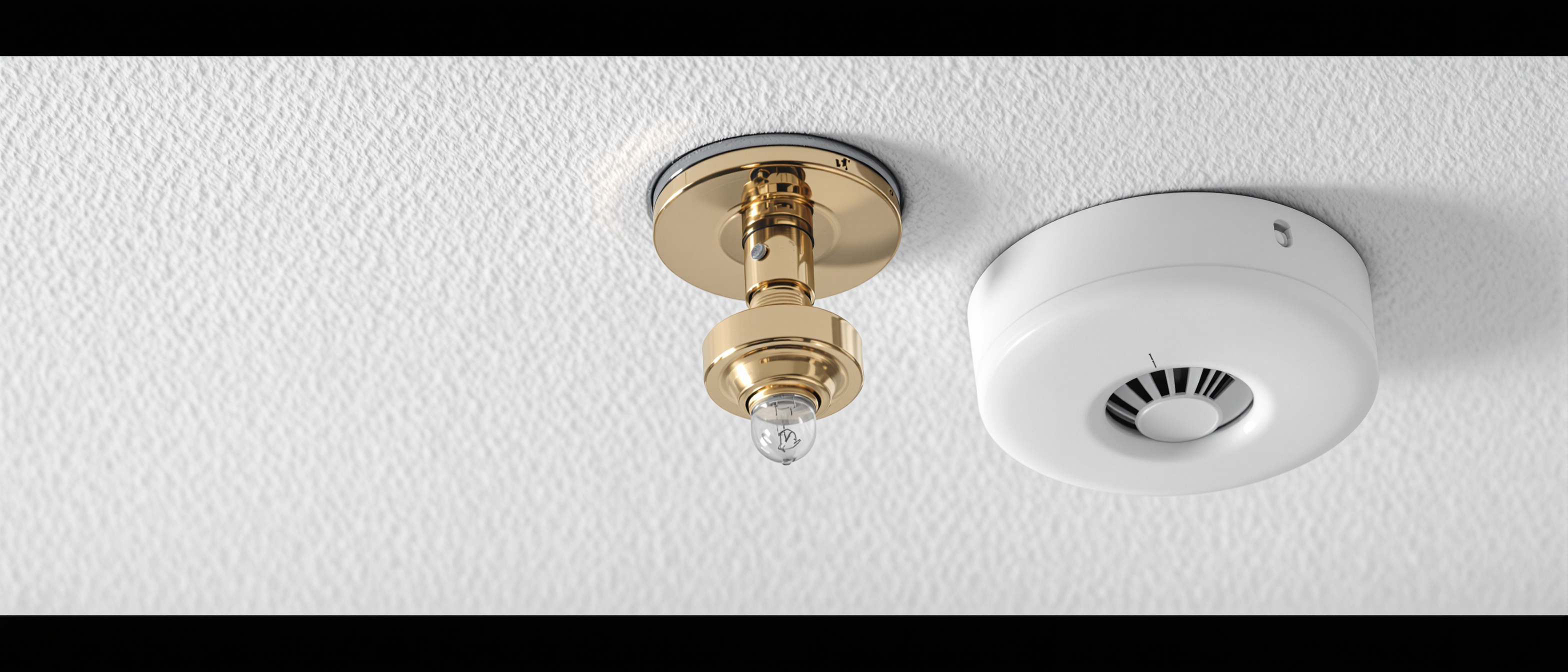
The syllabus
5 units · 5 liveThe advanced building-services course — fire safety, security and surveillance, integrated building management and room acoustics, and the life-safety companion to the plumbing and electrical services courses. All 5 units are live as full interactive lessons, each with original zoomable diagrams, a self-assessment quiz and a study task — and each honest about the folklore: that detecting a fire and fighting it are different jobs; that sprinklers open one at a time, not all at once; that the extinguisher must match the fire class; that a CCTV camera deters and records but does not prevent; that an IBMS is integration, not a phone app; and that reverberation is tuned to the use with Sabine's formula, because a dead room is a fault, not a goal.
Unit 1 — Fire Safety: Detection & Suppression
LiveStatutory fire codes; passive vs active protection and the escape route; detection (smoke vs heat detectors) vs suppression; sprinklers activate individually; extinguisher classes (IS 2190) matched to fire class.
Unit 2 — Security, Surveillance & Communication
LiveLayered security (deter, detect, delay, respond); access control, intruder alarm, CCTV and perimeter protection; CCTV deters and records but doesn't prevent; security theatre and false alarms; PA as life-safety.
Unit 3 — Integrated Building Management Systems
LiveThe Integrated Building Management System as integration not gadgets; shared sensors; fire triggering doors, dampers, smoke control and lifts; commissioning, cybersecurity and manual fallback caveats.
Unit 4 — Room Acoustics & Sound Insulation
LiveReverberation, echo and resonance; Sabine's formula (RT60 = 0.161 V/A) and the absorption coefficient; tuning RT to the use (speech vs music); absorption vs insulation and the mass law.
Unit 5 — Service Integration & the Case Study
LiveIntegrating all services in shared voids and risers; proving the fit in section; life safety governs; the live multi-storey case study; services designed together, not squeezed in.
Course outcomes
What you will be able to doUnderstand fire-safety standards and the basics of planning fire detection, suppression and escape.
Explain fire detection vs suppression, sprinkler and extinguisher types by fire class, and passive protection.
Describe security, surveillance and communication systems and their honest roles (deter, detect, delay, respond).
Explain the integrated building management system and how services share sensors and act together.
Apply room acoustics (Sabine's formula) and integrate services into building layouts and sections, life-safety first.
The author
Amogh N P
Architect, interior designer, and creative polymath. Studio Matrx began in his notebooks — his vision of design made honest, useful, and open to everyone. Its Academy is written and taught in his memory, and free, forever.
More about Amogh →Do all the sprinklers really go off at once?
No — that's a Hollywood myth. Each sprinkler head is held shut by its own heat-sensitive glass bulb, so only the heads directly over the fire open, controlling it while it's small and using a tiny fraction of a fire hose's water. That precision is the spirit of this course: detecting a fire and fighting it are different systems; the extinguisher must match the fire class (water on an electrical or oil fire is dangerous); a CCTV camera deters and records but doesn't stop anyone; an IBMS is the integration of your systems, not a pile of gadgets; and you tune reverberation to the use with Sabine's formula, because a dead room is a fault. Read the five units, try the building-systems decoder and the reverberation explorer, and learn the advanced services as the life-safety engineering they are.
The curriculum is free, forever