
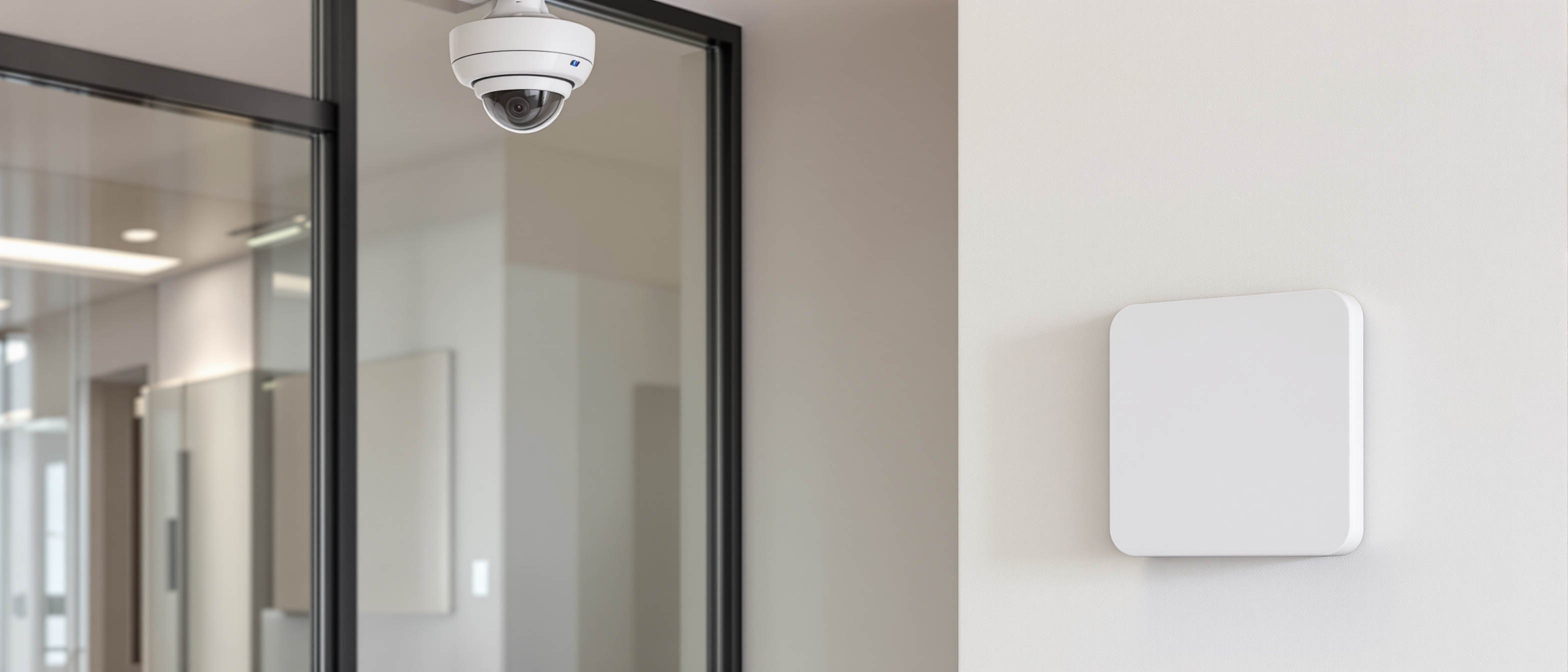
Security, Surveillance & Communication
A camera doesn't prevent crime — real security is layered
A camera on a wall feels like security — but a camera stops nobody. Real security is layered: deter, detect, delay, respond, with access control, intruder alarm, surveillance and perimeter protection as distinct jobs. CCTV mostly deters and provides evidence; an unmonitored or fake camera is ‘security theatre’ that can even reduce safety through false confidence. This unit sorts the systems out honestly — and ends on the public-address system as a genuine life-safety tool, because a calm, clear voice evacuates a building better than a siren.
Learning objectives
By the end of this lesson, you will be able to — mapped to the course outcomes for Interior Services III:
Describe the layered security model — deter, detect, delay, respond — and its distinct systems.
Explain honestly what CCTV does (deter and record) and does not (prevent), and what security theatre is.
Explain access control, intruder alarm, perimeter protection and public-address / communication systems.
Security is layered
Security is a chain of layers — deter, detect, delay, respond — not one device, and only as strong as its weakest link. Access control (who enters), intruder alarm (detect a break-in), CCTV (see/record) and perimeter protection are distinct jobs.[1]
Security is layers
Real security is not one device but LAYERS: DETER (make a target look hard — lighting, visible measures), DETECT (know an intrusion is happening — alarms, sensors, CCTV), DELAY (slow the intruder — locks, doors, barriers) and RESPOND (someone acts — guard, police). No single product is 'security'; the layers work together, and a chain is only as strong as its weakest link. Design the whole chain, not a gadget.[1]
CCTV, honestly
A CCTV camera deters and provides evidence — it does not physically stop anyone, and only helps live if someone is watching. ‘Security theatre’ (a fake or unmonitored camera, an unanswered alarm) looks safe but does little, and false alarms plague intruder systems.[1]
It deters and records
'A camera is security / CCTV stops crime' is a MYTH. A camera does not physically stop anyone; its real value is DETERRENCE (a visible camera makes a target less attractive) and EVIDENCE (a recording for investigation afterwards). It only helps live if someone is actually WATCHING it. So CCTV is one layer — detect and deter — not a whole security system.[1]
Communication
Communication systems carry announcements and, critically, emergency messages. A public-address system, intercoms and emergency phones let a building speak to its occupants — and a calm, intelligible voice evacuates people better than a siren alone.[1]
A voice, especially in emergency
Communication systems carry announcements and, critically, EMERGENCY messages. A PUBLIC-ADDRESS (PA) system, intercoms and emergency phones let a building speak to its occupants. In a fire or emergency, a calm, clear, INTELLIGIBLE voice message evacuates people far better than a siren alone, telling them what to do and where to go — which is why PA is a life-safety system, and why its ACOUSTIC intelligibility (Unit IV) matters as much as its volume.[1]
At a glance
| Aspect | The fact | The folklore |
|---|---|---|
| Security | Layered — deter, detect, delay, respond | A single device or camera |
| A CCTV camera | Deters and records evidence | Prevents crime / stops intruders |
| A fake/unmonitored camera | Security theatre — looks safe, does little | Still good protection |
| Access control vs intruder alarm | Who-enters vs is-someone-breaking-in | The same thing |
| Intruder alarms | Plagued by false alarms — design matters | Always reliable |
| PA / communication | A life-safety tool — a clear voice evacuates | Just for announcements |
Key terms
Security as a chain of layers, not one device: make the target hard, know when it's attacked, slow the attacker, and have someone respond — as strong as its weakest link.
The system deciding WHO may enter where and when (cards, PINs, biometrics) and logging it — must fail SAFE (unlock) in a fire so people can escape.
Sensors (door contacts, motion, glass-break) that DETECT a break-in and alert — it stops no one, and false alarms from poor design are its main weakness.
Cameras that let a space be watched and recorded — mainly DETERRENCE and EVIDENCE, not prevention; it only helps live if someone is watching.
Measures that LOOK protective but do little (fake or unmonitored cameras, unanswered alarms, propped-open access doors) — sometimes reducing safety through false confidence.
A communication system for announcements and, critically, clear emergency evacuation messages — a life-safety tool whose acoustic intelligibility matters.
Study task
Design a layered security scheme for one small building — a shop, a clinic, a home — using the deter-detect-delay-respond model. For each layer, name the specific system doing the work (perimeter and lighting to deter, alarm and CCTV to detect, locks and doors to delay, a guard or monitoring to respond), and be explicit that the CCTV’s real value is deterrence and evidence, not prevention. Identify one place where a lazy design would create ‘security theatre’ — a camera nobody watches, a reader on a propped door — and fix it. Finally, note how the access-controlled doors must behave in a fire (fail-safe, unlocked) so security never traps people, and where the public-address system reaches for evacuation.
Self-assessment
1. What does 'real security is layered' mean?
2. What does a CCTV camera actually do?
3. What is 'security theatre'?
4. How do access control and intruder alarm differ?
5. Why is a public-address system a life-safety tool?
Recap
References & further reading
- [1]Security, surveillance and communication systems — layered security, access control, intruder alarms, CCTV (deterrence/evidence), perimeter protection and PA (Vivian Capel, Security Systems and Intruder Alarms; Constant & Turnbull, CCTV). https://www.bis.gov.in/
Further reading
- Vivian Capel, Security Systems and Intruder Alarms.
- Mike Constant & Peter Turnbull, The Principles and Practice of Closed Circuit Television.
- National Building Code of India — security and life-safety provisions.
Sources gathered and fact-checked June 2026. Published values vary by source, sample and method — treat as indicative and confirm against the cited standard before structural use.
The author
Amogh N P
Architect, interior designer, and creative polymath. Studio Matrx began in his notebooks — his vision of design made honest, useful, and open to everyone. Its Academy is written and taught in his memory, and free, forever.
More about Amogh →