
Fire Safety: Detection & Suppression
Detecting a fire and fighting it are different jobs — and escape comes first
Fire safety is where folklore turns dangerous, so this unit is blunt. Detecting a fire and fighting it are different jobs — a fire alarm warns people to leave, while sprinklers and extinguishers attack the fire — and you need both, plus passive protection and, above all, a clear means of escape. Then it kills the two myths that get people hurt: that all the sprinklers spray at once (they don’t — each head opens on its own), and that any extinguisher works on any fire (it doesn’t — the agent must match the fire class, and water on an electrical or oil fire is dangerous).
Learning objectives
By the end of this lesson, you will be able to — mapped to the course outcomes for Interior Services III:
Explain the statutory basis of fire safety and the split between passive protection and active systems.
Distinguish fire detection (smoke vs heat) from suppression (sprinklers and extinguishers).
Bust the 'all sprinklers at once' and 'any extinguisher on any fire' myths, and match agents to fire classes.
Codes, passive & active
Fire safety is statutory (the National Building Code, IS standards), and its first priority is the means of escape. Protection has two halves: passive (fire-rated compartments and doors that contain) and active (detect and fight) — you need both.[1]
Codes and the priority
Fire safety is governed by STATUTORY codes — India's National Building Code (NBC) and IS standards, plus local bye-laws — not by preference. And its FIRST priority is the means of ESCAPE: the protected routes, exit widths, travel distances and signage that let people get out. Every detection and suppression system exists to protect that escape. 'The alarm is the fire safety' is a MYTH — the alarm buys time for the escape, which is the point.[1]
Explore — the building-systems decoder
The advanced-services palette in one place — fire, security and automation systems. Filter by domain; each card shows what the system actually does and the folklore corrected, graded VERIFIED, NUANCED or MYTH.
Building-systems decoder · what each system really does
Each system shows what it actually does and the folklore corrected — graded VERIFIED, NUANCED or MYTH.
Smoke detector
Early fire detection
Does: Senses smoke particles (ionisation or optical) to raise the alarm EARLY — before flames spread — and trigger the wider fire response.
Honestly · Most fire deaths are from SMOKE, not flame, so early smoke detection saves lives. It detects and warns; it does not fight the fire (that is suppression).
Heat detector
For smoky/dusty areas
Does: Triggers on a set temperature or a rapid temperature RISE — used where a smoke detector would false-alarm.
Honestly · Not a replacement for smoke detection: it responds later (heat lags smoke), so it goes only where smoke or dust are normal — kitchens, boiler rooms, dusty stores.
Sprinkler system
Automatic suppression
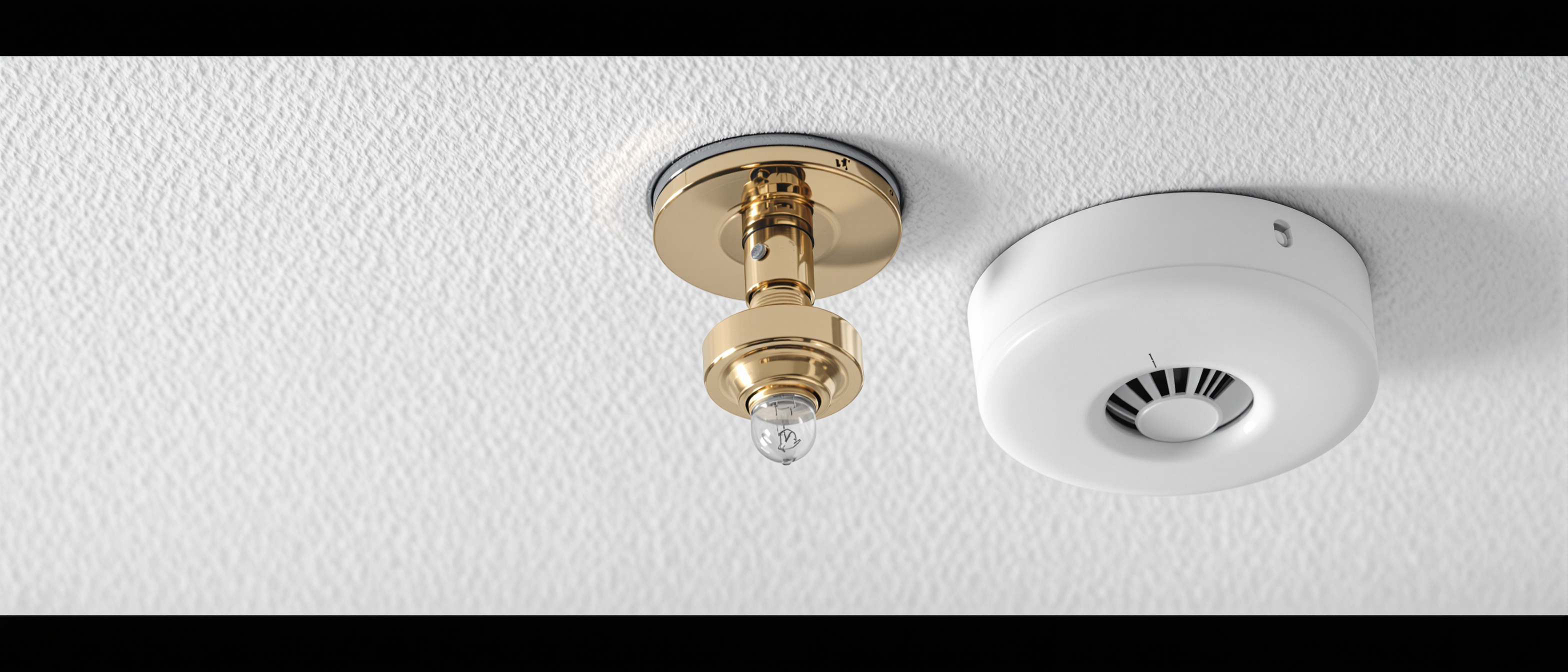
Does: Ceiling heads that spray water automatically onto a fire; the standard active suppression for larger buildings.
Honestly · 'All the sprinklers go off at once' is a MYTH from films: each head opens INDIVIDUALLY when its own glass bulb bursts from heat, so only the heads over the fire operate — and the water damage is far less than the fire.
Water extinguisher
Class A only
Does: Cools and soaks ordinary combustibles — wood, paper, cloth (Class A fires).
Honestly · 'A fire extinguisher works on any fire' is a dangerous MYTH: WATER is for Class A only, and is DANGEROUS on electrical fires (conducts) and on burning liquid or oil (spreads it). Match the agent to the fire class.
ABC dry-powder extinguisher
The Indian all-rounder
Does: Dry chemical powder that smothers Class A (solids), B (liquids) and C (gases) fires — the most common extinguisher in India.
Honestly · Versatile and widely fitted, but the powder makes a mess and can damage electronics; for a clean electrical-area result, CO2 is often better. Still, no extinguisher covers every class.
CO2 extinguisher
Electrical & liquids
Does: Discharges carbon dioxide that displaces oxygen and leaves NO residue — suited to electrical equipment and flammable liquids.
Honestly · Non-conducting and residue-free, so it is the choice around electronics and switchrooms; it does not cool much, so a Class A fire can re-ignite after the gas disperses.
Wet-chemical extinguisher
Kitchen oil fires
Does: A special agent that cools and forms a soapy seal over burning cooking oils and fats (Class F/K) in kitchens.
Honestly · The correct choice for a deep-fat-fryer fire — where water would explode the burning oil. Kitchens with fryers need this, not a general extinguisher.
Fire compartment (passive)
Contain and buy time
Does: Fire-rated walls, floors and self-closing doors that CONTAIN a fire and smoke to one area for a rated time — passive fire protection.
Honestly · The quiet half of fire safety: it buys the time to escape and stops fire spreading, working with no power or trigger. Never wedge a fire door open — it defeats the compartment.
Access control
Who gets in
Does: Controls WHO may enter where and when — via cards, PINs, biometrics or mobile credentials — and logs it.
Honestly · It manages entry and keeps a record; it is not surveillance and not an alarm. In a fire, access-controlled doors must fail SAFE (unlock) so people can escape.
Intruder alarm
Detect a break-in
Does: Sensors (door contacts, motion detectors, glass-break) that raise an alarm when an intruder is detected.
Honestly · It DETECTS and alerts; it does not stop anyone. False alarms are its real weakness — poor design or placement causes most call-outs — so sensible zoning and setting routines matter as much as the sensors.
CCTV / surveillance
See and record
Does: Cameras that let a space be watched and RECORDED for monitoring and evidence.
Honestly · 'A camera is security / CCTV prevents crime' is a MYTH: it mainly DETERS and provides EVIDENCE after the fact; an unmonitored or fake camera is 'security theatre'. Real security is layered: deter, detect, delay, respond.
Perimeter protection
The boundary line
Does: Detects intrusion at the site or building BOUNDARY — fence sensors, beams, buried cables — the outer layer of security.
Honestly · The first layer of the deter-detect-delay-respond chain: catch the intruder at the edge, before the building. It complements, not replaces, the inner layers.
Public address / comms
Voice, especially in emergency
Does: A public-address and communication system for announcements — and, critically, for clear EMERGENCY evacuation messages.
Honestly · In an emergency a calm, intelligible voice message evacuates a building better than a siren alone — which is why PA is a life-safety system, and its acoustics (intelligibility) matter.
Integrated Building Management System
The systems, working together
Does: A common platform that INTEGRATES HVAC, lighting, fire, security and access so they share sensors and act together.
Honestly · The whole point is INTEGRATION, not gadgets: the fire alarm can unlock doors, stop AC dampers, start smoke extraction and recall lifts — one coordinated response instead of five separate systems.
Shared smart sensors
Sense once, use many times
Does: Occupancy, daylight, temperature and CO2 sensors whose data is SHARED across systems (lighting, HVAC, security) rather than duplicated.
Honestly · Integration's foundation: one occupancy sensor can dim lights, set back the AC and arm security for an empty zone. Fewer sensors, more coordination.
'Smart building' automation
Integration, not an app
Does: Automated control of a building's systems for comfort and efficiency, managed from a central interface.
Honestly · 'Smart = a phone app and more gadgets' is a MYTH: value comes from good INTEGRATION and careful COMMISSIONING (a badly-tuned system wastes energy), and 'smart' also adds cybersecurity risk and failure points. More automation is not automatically better.
Detection isn’t suppression; a camera isn’t security; an IBMS isn’t an app — and life safety comes first.
Detection
A fire alarm detects a fire and warns everyone to leave — a different job from suppression. Smoke detectors catch fires early (most deaths are from smoke); heat detectors go only where smoke or dust would false-alarm them.[1]
Detect and warn
A FIRE ALARM SYSTEM detects a fire and warns everyone to leave, and triggers the wider response (suppression, smoke control, lift recall). It links detectors and call points to a control panel and to sounders and beacons. Its job is DETECTION and WARNING — telling people to escape — which is different from SUPPRESSION (fighting the fire). Both are needed; confusing them is a common and dangerous error.[1]
Suppression
Sprinklers do not all go off at once — each head opens individually over the fire. And an extinguisher does not work on any fire: match the agent to the class (water is Class A only; water on electrical or oil is dangerous).[1, 2, 3]
Each head, on its own
'When a fire starts, all the sprinklers spray at once' is a Hollywood MYTH. Each sprinkler HEAD is held shut by a heat-sensitive glass bulb; only when the heat at THAT head bursts its bulb does that one head open. So in a real fire only the few heads directly over it operate, controlling the fire while it is small — and the water they use is a tiny fraction of what a fire brigade's hoses would, so water damage is far less than fire damage. Sprinklers save lives and property.[1, 2]
At a glance
| Aspect | The fact | The folklore |
|---|---|---|
| Fire safety's first priority | The means of ESCAPE (protected routes, exits) | The alarm |
| Detection vs suppression | Detect+warn (alarm) vs fight (sprinkler/extinguisher) — need both | The same job |
| Smoke vs heat detectors | Smoke catches fires early; heat is for smoky/dusty areas | Interchangeable |
| Sprinklers | Each head opens individually over the fire | All go off at once |
| A fire extinguisher | Works only on its matched fire class | Works on any fire |
| Water on an electrical/oil fire | Dangerous — use CO2, powder or wet chemical | Fine — water fights all fire |
Key terms
Passive = fire-rated compartments and doors that contain fire with no trigger; active = alarms, detectors and suppression that detect and fight it — both are needed.
An area bounded by fire-rated walls, floors and self-closing doors that holds fire and smoke for a rated time, buying escape time and limiting spread. Never wedge the door open.
Smoke detectors catch fires early (most deaths are from smoke); heat detectors respond later and go only where smoke/dust would false-alarm (kitchens, dusty stores).
Each head is held shut by a heat-sensitive bulb and opens only when the fire heats THAT head — not all at once; the water used is far less than the fire's damage.
A solids, B liquids, C gases, D metals, E electrical, F cooking oils — the extinguishing agent must match the class; water is Class A only.
Water (Class A only), CO2 (electrical/liquids, no residue), ABC dry powder (versatile all-rounder), wet chemical (kitchen oil) — the wrong agent can make a fire worse.
Study task
Take one floor of a small building and lay out its fire safety. Mark the protected escape route and exits first, and check the travel distance to a safe exit. Show the passive protection (which walls and doors are fire-rated compartments) and the active systems (where smoke detectors go, where a heat detector is needed instead, and where sprinklers cover). Then, for the kitchen and an electrical/server area, specify the correct extinguisher by fire class — and write one sentence on why the wrong choice (water on the electrical or oil fire) would make it worse. The test is that someone could escape safely, and the fire be fought correctly, from your plan.
Self-assessment
1. What is fire safety's first priority?
2. How do detection and suppression differ?
3. What actually happens when a fire reaches a sprinklered ceiling?
4. Why is 'any extinguisher works on any fire' dangerous?
5. Where does a heat detector belong instead of a smoke detector?
Recap
References & further reading
- [1]Fire safety in buildings — National Building Code of India (Part 4, Fire and Life Safety), passive vs active protection, detection and suppression (NBC; V.K. Jain, Fire Safety in Buildings; Basics Fire Safety, Birkhauser). https://www.bis.gov.in/
- [2]Sprinkler systems — individual head activation and effectiveness (John L. Bryan, Fire Suppression and Detection Systems; NFPA references). https://www.nfpa.org/
- [3]Fire classes and extinguisher selection (IS 2190) — Class A-F and matched agents (water/CO2/dry powder/wet chemical); water is dangerous on electrical/oil fires. https://www.bis.gov.in/
Further reading
- V.K. Jain, Fire Safety in Buildings.
- Helmerking & Diana, Basics Fire Safety (Birkhauser).
- John L. Bryan, Fire Suppression and Detection Systems.
Sources gathered and fact-checked June 2026. Published values vary by source, sample and method — treat as indicative and confirm against the cited standard before structural use.
The author
Amogh N P
Architect, interior designer, and creative polymath. Studio Matrx began in his notebooks — his vision of design made honest, useful, and open to everyone. Its Academy is written and taught in his memory, and free, forever.
More about Amogh →