
B.Arch CurriculumFree, forever
A tribute to Amogh N P
Interior Design Studio IV — Vernacular Crafts
The big fourth-semester studio, and the one where a designer's conscience is formed: an eight-credit, field-based studio on vernacular crafts — their processes, their communities, and the honest, respectful way to bring them into modern interiors. It runs from understanding what the vernacular actually is, through mapping India's craft traditions, into real field research and documentation, the craft economy and its hard realities, and finally the innovation and collaboration that let a living craft enter a contemporary room without being flattened into a motif. And because few subjects carry more romantic folklore, it grades every claim against the evidence — with a duty of respect, because these are livelihoods, not curiosities. Vernacular building is NOT primitive: it is empirically-refined, climate-responsive building science, and the studio can show you the physics — the courtyard that cools by the stack effect on a windless night, the jaali that turns a hot breeze into a cooling draught while giving privacy, the thick mud or stone wall that works as a thermal battery, the stepwell that cools by evaporation in dry air. It is honest about the canon, too: Bernard Rudofsky's 1964 MoMA exhibition 'Architecture Without Architects' rightly legitimised the vernacular, but its title misleads — vernacular is not designer-less, it has deep authorship in master builders and craftspeople, which is why Paul Oliver's 1997 Encyclopedia, and Amos Rapoport's critique of the picture-book as 'primitivist', are the necessary correction. It insists that Indian crafts are not frozen or timeless — Blue Pottery and Bidri are Persian-derived, Madhubani moved onto paper only in the 1960s, Ajrakh relocated to Ajrakhpur after the 2001 Bhuj earthquake — and that 'handmade' means mastery and singular variation, not lower quality: the interlocked korvai border of a Kanchipuram sari and the even silver channels of Bidri inlay are precision no machine matches cheaply. It teaches Geographical Indications precisely — the GI Act of 1999 came into force in 2003 and Darjeeling tea became the first GI in 2004, and India now has six hundred-plus GIs of which three hundred-plus are handicrafts — while being honest that a GI protects a craft's NAME and origin as a community right, not its technique, and that registration alone puts no money in an artisan's pocket without enforcement and enrolment. On the economy it refuses to print a comfortable number: estimates of India's artisan workforce range from roughly six or seven million in narrow official counts to figures cited as high as two hundred million, and the truth is uncertain because the work is informal and undercounted — but the direction is clear and verified, that the artisan captures the smallest share of the retail price while middlemen and retail capture the most, and that direct-to-consumer, cooperative and cluster models (SEWA from 1972, Dastkar from 1981, Jaipur Rugs) are what raise the maker's share. It treats field research as serious method, not tourism: ethnographic observation, interviews and oral history, measured drawing where the section reveals the construction, step-by-step process and tool documentation, the anthropometry and ergonomics of the maker's own body at the loom or wheel, material and seasonality research, and value-chain mapping — all governed by the one ethic that matters, that research is PARTICIPATORY not extractive, that consent, credit, compensation and collaboration are not optional, and that the maker is a co-author, not a subject. It is clear-eyed about knowledge and ownership: most craft knowledge is community-held and inter-generational, so it falls outside conventional single-author copyright and patent, which is exactly what enables appropriation; India's Traditional Knowledge Digital Library (set up in 2001 by CSIR with AYUSH) is a defensive record that won back the wrongly-granted turmeric patent in 1997 but confers no positive ownership; and using a community's motifs without credit or benefit — the Warli case is the textbook example — is legally often permissible and ethically not. It closes where the syllabus points, on collaboration and incorporation done right: the four C's of credit, consent, compensation and collaboration; the cautionary tale of Hassan Fathy's New Gourna, an 'authentic' mud village its intended residents largely rejected because it was imposed rather than co-authored; and the truth that documenting a craft does not preserve it — only a living livelihood and an evolving market do. Throughout, the craft is met with respect, and the folklore is named as folklore.
Course byAmogh N P· Architect & interior designer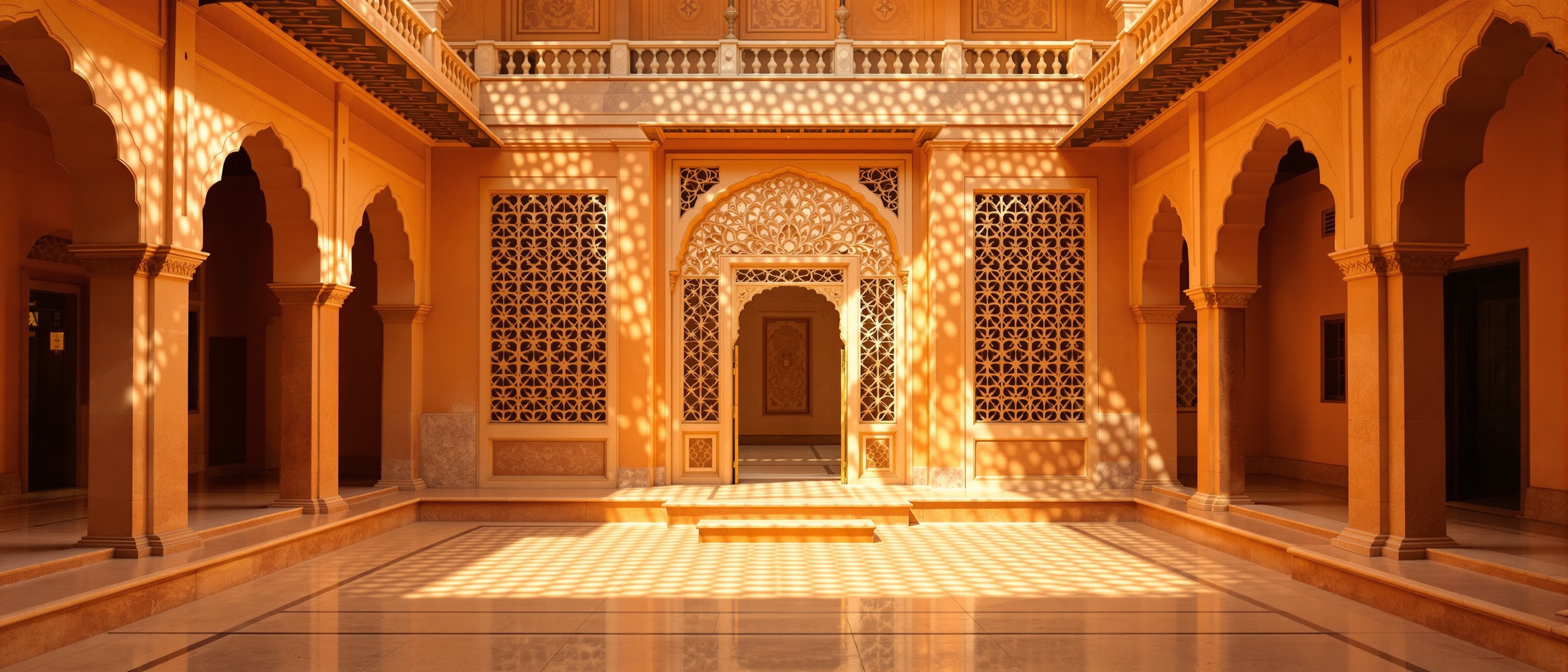
The syllabus
5 units · 5 liveThe big fourth-semester studio — vernacular crafts, their communities, and the honest, respectful way to bring them into modern interiors. All 5 units are live as full interactive lessons, each with original zoomable diagrams, a self-assessment quiz and a studio task — and each honest about the folklore: that vernacular is climate-responsive science, not 'primitive'; that a GI protects a craft's name, not its technique or the artisan's income; that crafts are living and evolving, not frozen, and 'handmade' means mastery, not defect; that the artisan captures the smallest share of the price; that most craft knowledge falls outside conventional IP; and that the line between collaboration and appropriation is credit, consent, compensation and collaboration. Field research is treated as serious method, and the craft is met with respect.
Unit 1 — Understanding the Vernacular
LiveWhat vernacular is and why it is not 'primitive'; the climate science of courtyard, jaali, thermal mass and stepwell; the honest reading of 'Architecture Without Architects' (Rudofsky, Oliver, Rapoport).
Unit 2 — India's Craft Map & Traditions
LiveIndia's crafts region by region and medium by medium; traditional building elements; what a GI does and doesn't protect; the myths that crafts are frozen and that handmade is inferior.
Unit 3 — Field Research & Documentation
LiveEthnographic field research (participant observation, interviews, oral history); extractive vs participatory ethics; measured drawing and the section; process, tool, anthropometry and material documentation.
Unit 4 — Issues, Economy & Indigenous Knowledge
LiveThe craft value chain and the artisan's small share; the honest workforce range; direct/cooperative/cluster models; community-held knowledge and the IP gap; TKDL, GI and appropriation.
Unit 5 — Innovation & Collaboration
LiveBringing craft into modern interiors honestly; the four C's vs appropriation; collaboration models; the New Gourna lesson; why documenting a craft does not preserve it.
Course outcomes
What you will be able to doCollect, assimilate and integrate knowledge of a vernacular craft holistically — its community, materials, process and setting.
Be sensitive to the craft and its makers, and produce collective, collaborative design rather than extractive design.
Conduct field research and ethnographic study, develop documentation tools, and analyse a craft as a method of inquiry.
Represent the craft and the design process both graphically (measured drawing, mapping) and verbally, with method.
Understand traditional craft practice, its process and its issues — economic, legal and cultural — from field evidence.
Reciprocate and sensitise with the craft community, and incorporate the craft into modern interiors honestly.
The author
Amogh N P
Architect, interior designer, and creative polymath. Studio Matrx began in his notebooks — his vision of design made honest, useful, and open to everyone. Its Academy is written and taught in his memory, and free, forever.
More about Amogh →Does a GI tag protect the artisan?
Less than you'd hope. A Geographical Indication guards a craft's NAME and origin as a community right — but it is not a patent, it does not protect the technique, and by itself it puts no money in an artisan's pocket without enforcement and enrolment. That precision is the spirit of this studio: vernacular building is climate-responsive science, not 'primitive'; Indian crafts have always evolved, and 'handmade' means mastery; the maker captures the smallest share of the price while middlemen take the most; most craft knowledge falls through the IP net; and the line between honouring a craft and appropriating it is credit, consent, compensation and collaboration. Read the five units, explore the craft atlas and the value-chain tool, and learn to work with a craft community — not on it.
The curriculum is free, forever