
Innovation & Collaboration
Craft into the modern interior — with credit, consent and compensation
Everything so far leads here: bringing a vernacular craft into a modern interior without flattening it. The line between honouring a craft and appropriating it is four words — credit, consent, compensation, collaboration — and it matters precisely because much appropriation is legal and still wrong. This unit shows what ‘done right’ looks like, warns with the cautionary tale of a beautiful village its own residents rejected, and ends on the truth that outlasts the studio: documenting a craft does not preserve it. Only a living livelihood, allowed to evolve, does.
Learning objectives
By the end of this lesson, you will be able to — mapped to the course outcomes for the Vernacular Crafts studio:
Apply the four C's — credit, consent, compensation, collaboration — to a designer-artisan project, and avoid appropriation.
Incorporate a vernacular craft into a modern interior as a living element, not a flattened motif or pastiche.
Draw the right lessons from New Gourna and from Baker/Doshi/Correa about working with, not imposing, the vernacular.
Explain why documenting a craft does not preserve it — only a living livelihood and an evolving market do.
Collaboration, not extraction
Appreciation vs appropriation comes down to the four C’s — credit, consent, compensation, collaboration — versus extraction. Done right (Dastkar, SEWA, Jaipur Rugs, Raw Mango) the artisan is named, paid and central; and beware the ‘noble artisan’ trap of aestheticising hardship.[1, 2, 3]
Appreciation vs appropriation
The workable line between appreciation and appropriation is four C's: CREDIT, CONSENT, COMPENSATION and COLLABORATION — working WITH a craft community, naming and paying them — versus EXTRACTION, lifting motifs, techniques or labour without attribution, permission or fair pay. The maker is a co-author, not a source of free material. This is a principled position, not a legal one: much appropriation is legal (the IP gap of the last unit), and still wrong.[1]
Craft into the modern interior
Bring craft in as a living element with its maker present — a hand-block-printed textile, a Dhokra piece, a reinterpreted jaali — not a mass-printed motif. Baker, Doshi and Correa adapted vernacular intelligence; and Fathy’s New Gourna warns against imposing an ‘authentic’ image.[4, 5]
A living element, not a motif
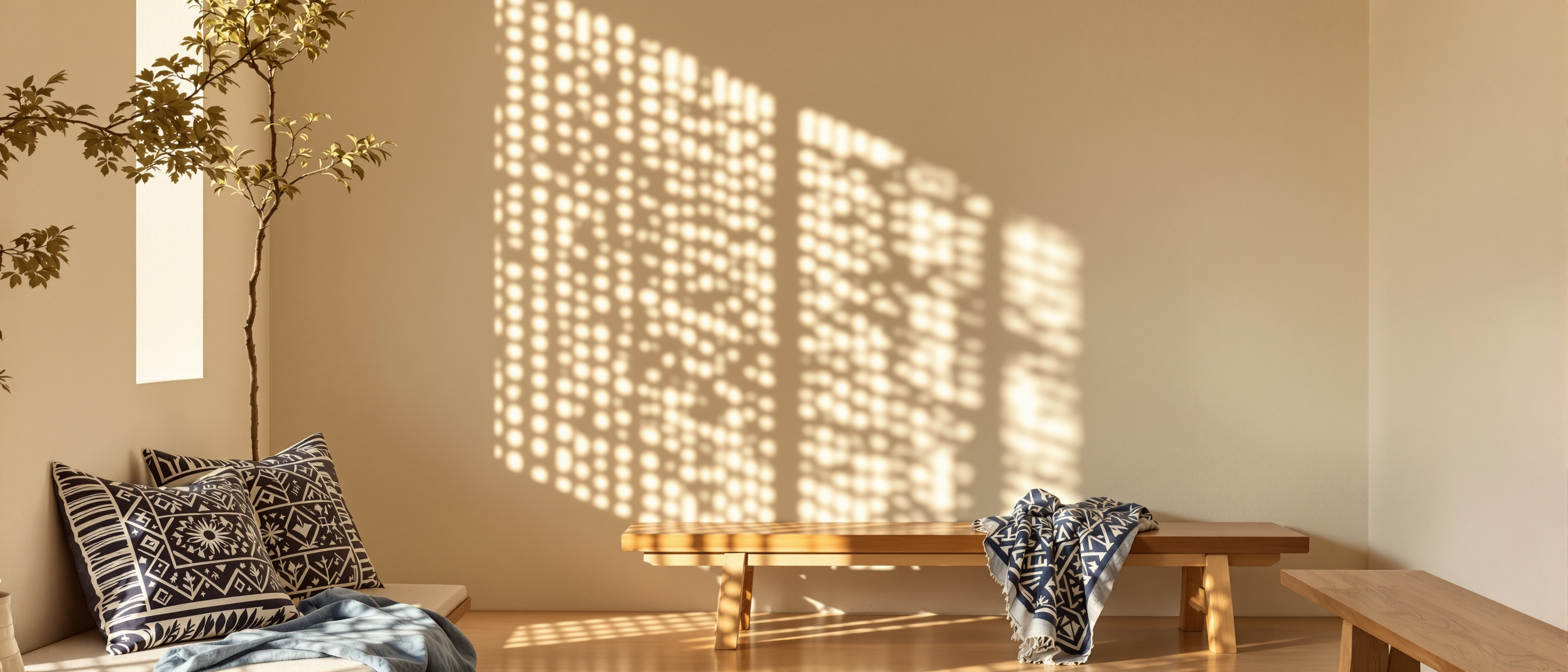
Incorporating a vernacular craft into a modern interior means bringing it in as a LIVING element with its maker credited and paid — a hand-block-printed textile, a Dhokra piece, an Athangudi-tile floor, a jaali reinterpreted as a room divider — not flattening it into a mass-printed 'ethnic' motif. The test: is the actual craft (and maker) present, or just a picture of it? Contemporary Indian practice (from Studio Mumbai to countless interior designers) shows craft can be modern without being pastiche.[2]
At a glance
| Aspect | The fact | The folklore |
|---|---|---|
| Using a craft | Credit, consent, compensation, collaboration | Lift the motif and move on |
| The artisan | A named, paid co-author | A source of free material |
| Craft in an interior | A living element with its maker present | A mass-printed 'ethnic' motif |
| Admiring the vernacular | Economic partnership | Aestheticising hardship (the noble-artisan trap) |
| Working with the vernacular | Adapt its intelligence (Baker, Doshi, Correa) | Impose an 'authentic' image (New Gourna) |
| Documenting a craft | Records it — preservation needs a living livelihood | By itself preserves it |
Key terms
Credit, consent, compensation, collaboration — the working line between appreciating a craft (with its community) and appropriating it (extraction).
Using a community's motifs, techniques or labour without attribution, permission or fair benefit — often legal because of the IP gap, but ethically wrong.
Romanticising makers as picturesquely 'authentic' — aestheticising hardship and denying them agency, modernity and fair pay; the same error as Rudofsky's 'primitivism'.
Hassan Fathy's mud-brick village (Egypt, mid-1940s) largely rejected by its intended residents — the cautionary tale of 'authentic' vernacular imposed without community authorship.
Laurie Baker's brick-on-edge bond that creates an internal cavity, cutting brick and mortar use by roughly 30% and improving thermal performance — vernacular intelligence adapted.
A craft kept alive by continued practice, transmission and a fair market — the opposite of a documented-but-dead 'museum' craft; revival means livelihood plus evolution.
Studio task
Design one interior element or small space that brings your chosen craft into a contemporary room — a screen, a surface, a piece of furniture, a wall — and defend it against the four C’s. State how the actual maker would be credited, consulted, paid and collaborated with, so the craft is present as a living element and not a lifted motif. Show, in a sketch or a section, how the craft is used with respect for its own logic (not just its look). Then write the honest closing paragraph this whole studio has been building toward: how your proposal supports a livelihood and lets the craft keep evolving — because documenting it, or admiring it, was never going to be enough; only a living, fairly-paid, adapting practice keeps a craft alive.
Self-assessment
1. What are the four C's that separate appreciation from appropriation?
2. What is the real lesson of Hassan Fathy's New Gourna?
3. How should a vernacular craft enter a modern interior?
4. Why doesn't documenting a craft preserve it?
5. What did Baker, Doshi and Correa do with the vernacular?
Recap
References & further reading
- [1]Appreciation vs appropriation — the four C's (credit, consent, compensation, collaboration) and the 'noble artisan' critique (cultural-appropriation and design-ethics scholarship). https://en.wikipedia.org/wiki/Cultural_appropriation
- [2]Designer-artisan collaboration done right — Dastkar (1981, Laila Tyabji), SEWA (1972, Ela Bhatt), Jaipur Rugs (Nand Kishore Chaudhary), Raw Mango (Sanjay Garg, Chanderi); Handmade in India (Ranjan & Ranjan, NID). https://en.wikipedia.org/wiki/Dastkar
- [3]The romantic/'primitivist' trap in reading the vernacular and the artisan (Amos Rapoport, as summarised in architectural scholarship).
- [4]Practitioners who adapted the vernacular — Laurie Baker (rat-trap bond, COSTFORD), B.V. Doshi (Pritzker 2018, Sangath, Aranya), Charles Correa ('form follows climate', Tube House 1961), Didi Contractor (adobe, Kangra). https://www.archdaily.com/1031171/laurie-bakers-legacy-and-the-democratization-of-indian-architecture
- [5]Hassan Fathy, Architecture for the Poor / New Gourna (from the mid-1940s) — the Nubian vault revived, and the village largely rejected by its intended residents (cautionary tale). https://daily.jstor.org/hassan-fathy-and-new-gourna/
Further reading
- Hassan Fathy, Architecture for the Poor: An Experiment in Rural Egypt (University of Chicago Press).
- Gautam Bhatia, Laurie Baker: Life, Work & Writings (Penguin).
- Aditi Ranjan & M.P. Ranjan, Handmade in India (Mapin/COHANDS, 2007).
Sources gathered and fact-checked June 2026. Published values vary by source, sample and method — treat as indicative and confirm against the cited standard before structural use.
The author
Amogh N P
Architect, interior designer, and creative polymath. Studio Matrx began in his notebooks — his vision of design made honest, useful, and open to everyone. Its Academy is written and taught in his memory, and free, forever.
More about Amogh →