
 Lesson 6.2
Lesson 6.2 · Lighting and Acoustics
Electric Light: Layers, Glare and the LED
Why one ceiling tube flattens a room, and how three layers of light bring it back to life
One tube on the ceiling is not a lighting scheme. It is a compromise.
Almost every Indian room begins the same way: a single tube light or LED panel screwed to the centre of the ceiling, throwing the same flat wash everywhere. The room is lit, but it is not designed. Faces look tired, corners go dead, textures vanish, and there is no way to soften the mood at night. The fix is not a brighter bulb. It is more than one kind of light, in more than one place, on more than one switch.
A single sad ceiling tube over a flat grey room on the left; an arrow to the right where the same room glows in three labelled layers — a cove wash (ambient), a lamp pooling on a desk (task) and a spot grazing a textured wall (accent).
The three layers: ambient, task and accent
A room that feels good almost always has light working in three roles at once.
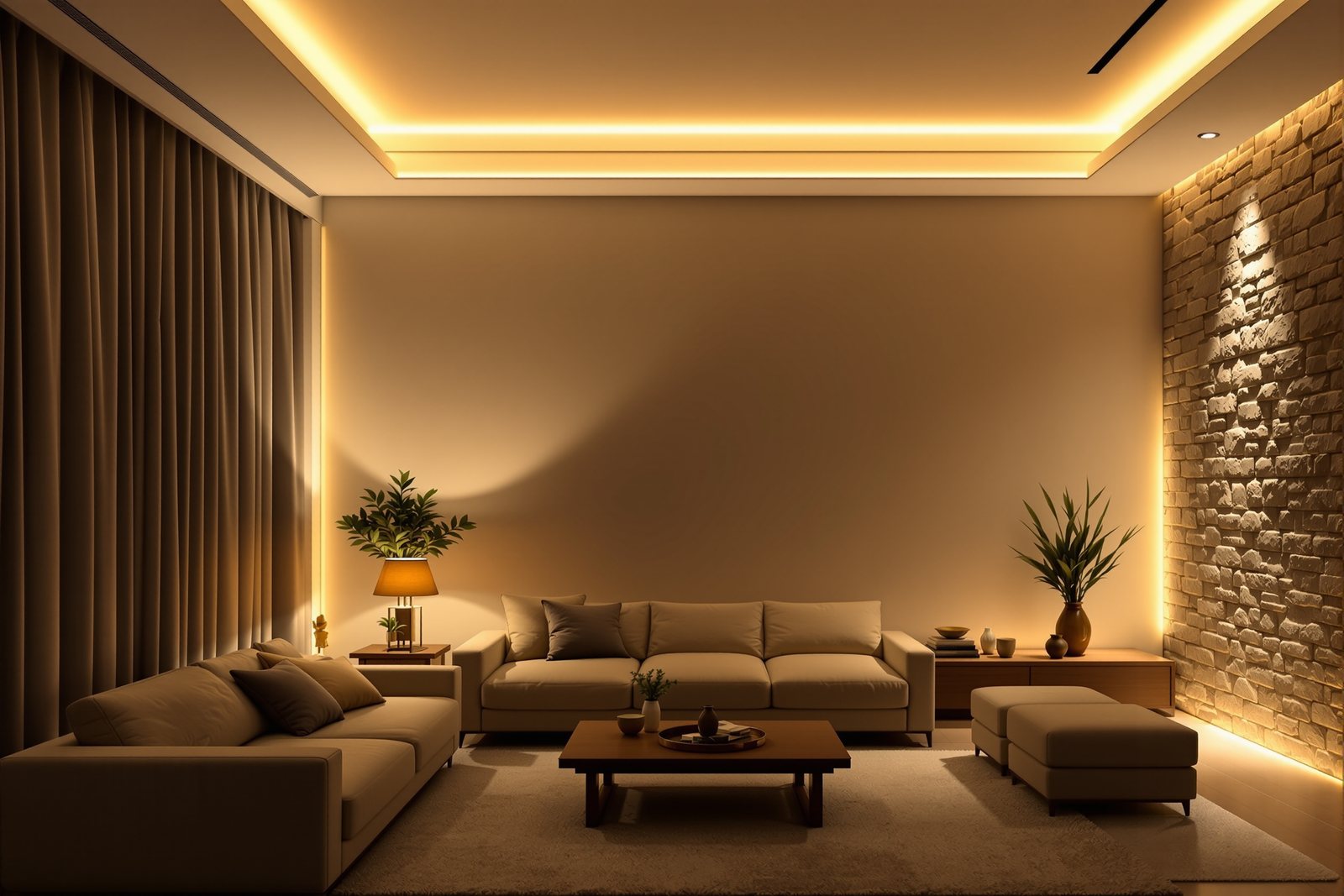
Ambient light is the soft, general fill that lets you move around and see the room comfortably — the background glow you stop noticing. In Indian homes this is usually the ceiling panel or tube, but it does its job far better as cove light bouncing off a false ceiling, or as several recessed downlights spread across the room rather than one harsh source in the middle.
Task light is focused light delivered exactly where you do something demanding with your eyes: the kitchen counter where you chop, the study desk where you read, the dressing mirror, the bedside for a book. Ambient light alone is almost never enough here.
Accent light is the drama — the optional layer that gives a room depth and intent. It washes a textured stone wall, grazes a painting, or glows from a cove to lift the ceiling. Accent light is what separates a room that is merely visible from a room that feels composed.
The shift from one light to these three layers is the single biggest upgrade most homes can make, and it usually costs less than people fear.
Why one central source flattens a room
When all the light pours from one bright fitting in the centre of the ceiling, every surface receives light from roughly the same direction and the same height. That uniformity is exactly the problem.
Texture only reads when light skims across it at an angle — a single overhead source hits everything head-on, so a beautiful kadappa wall or a woven jute panel looks as flat as paint. Faces fare even worse: top-down light drops hard shadows into the eye sockets and under the nose and chin, which is why family photos taken under a bare ceiling tube look so unflattering. And because there is only one source on one switch, you cannot dial the room down for the evening — it is either full glare or darkness.
Layers solve all three at once. Light arriving from different heights and directions reveals form and texture, fills the harsh shadows a single source casts, and — when each layer sits on its own switch — lets you mix a bright working scene or a low, warm evening scene from the very same fittings.
This is the perfect moment to play with the Lighting Layer Mixer further down: switch the ambient, task and accent layers on and off over one room scene and watch the same room go from flat and clinical to layered and full of depth.
Lux and lumens: measuring the right thing
Two words get confused constantly, and the difference matters.
A lumen measures the total light a fitting emits — it is a property of the bulb or panel, printed on the box. A lux measures the light actually landing on a surface — one lux is one lumen spread over one square metre. Lumens describe the source; lux describes the result on your counter, your page, your floor. The same 1000 lumen lamp gives plenty of lux up close and very little across a large room, which is why you plan to a lux target on the surface, not to a lumen count in the air.
Rough working targets for an Indian home:
- Living room, general: about 150 to 200 lux — comfortable, relaxed, never clinical.
- Kitchen counter and study desk: about 300 to 500 lux — focused task zones where detail and safety matter.
- Bathroom mirror: task light around the mirror at roughly 300 lux on the face, not a single point on the ceiling behind your head.
Notice the counter and desk want two to three times the living-room level. You cannot reach that with ambient light alone without making the whole room glaring and harsh — which is precisely why task light exists as its own layer.
Defeating glare: light the task, not the eyes
Glare is light so bright or so badly placed that it hurts to look at or washes out what you are trying to see. It is the most common fault in real homes, and it is almost always avoidable.
The core rule is simple: light the task, not the eyes. A bare bulb or an exposed bright LED chip anywhere in your normal eyeline is the enemy. The fixes:
- Shield or recess the source. Recessed downlights, fittings with deep baffles, and cove light hidden behind a false-ceiling lip all keep the bright chip out of view while letting the light through. You see the lit surface, not the lamp. - Never put a bare bulb in the eyeline. If you can see the glowing element from where you sit or stand, expect glare. Diffusers, shades and louvres exist for exactly this. - Aim accent light at the surface, so the wall or art glows and the fitting stays discreet.
Lighting engineers rate this with a measure called UGR (Unified Glare Rating) — you do not need the maths, just the instinct behind it: a lower number means a more comfortable, better-shielded scheme. Trust the test of looking around the room and asking, can I see any naked bright source from where I normally sit? If yes, shield it.
Placing task light, and reading an LED fitting
Task light has one more trap: your own head. If the light comes from straight behind you, your head and shoulders cast a shadow onto exactly the work you are trying to see. So get task light from the side or the front — an under-cabinet strip in front of the kitchen counter, a desk lamp to the side of your writing hand so the page is not shadowed, vertical lights on either side of a mirror rather than one fitting above it.
For the fitting itself, the LED is now the default everywhere, and rightly so: it is highly efficient, runs cool, lasts for years, switches on instantly with no warm-up flicker, and — crucially — dims smoothly when paired with the right driver. The old CFL and tube-light era is over.
Learn to read an LED fitting like a designer:
- Lumens, not watts. Watts told you brightness in the old filament days; with LEDs, watts only measure power drawn. Read the lumen figure for actual brightness.
- Beam angle. A narrow beam (around 24 deg) makes a tight accent spot; a wide beam (60 deg and up) gives broad ambient wash. Match the beam to the job.
- A good driver. The driver is the small power unit behind the LED. A cheap one flickers and dies early; a good one runs quietly and dims cleanly.
- Dimmable. Check the fitting and driver are marked dimmable if you want evening control.
Finally, plan the wiring as carefully as the fittings: put each layer on its own switch and circuit with dimmers where you can. Independent control is what turns three layers into a room you can actually conduct.
Hands-on
Ambient alone lights the room but leaves it flat; the task pool gives you somewhere to work; the accent wash on the textured wall is what suddenly gives the room depth. Three layers, three switches — that is the whole idea.
Three altitudes on the same idea
Read the band that fits you — or all three.
Take your living room as it is tonight, lit by one ceiling source. You feel it is flat but cannot say why. The cheapest transformative move is not a brighter panel — it is two added layers. Add a floor lamp or two table lamps for warm ambient pools at sitting height, and aim a small accent light (a discreet wall spot or LED strip in a niche) at your one textured wall or favourite artwork. Keep the ceiling source but put it on a dimmer and pull it down to roughly 150 lux for the evening. You have just gone from one flat scene to three; the room now has depth, and you can choose its mood. Total spend is often a few thousand rupees and no civil work.
When you design a room, draw a reflected ceiling plan that shows every fitting, then specify the three layers explicitly and — this is where schemes succeed or fail — specify the switching and circuiting so each layer is independent and dimmable. Plan to surface lux targets, not lumen counts: model roughly 300 to 500 lux on work surfaces and 150 to 200 lux ambient, and choose beam angles and fitting spacing to hit them without glare. Detail cove returns deep enough to hide the LED chip and the driver, and confirm dimmable drivers up front — a forgotten non-dimmable driver is a callback. Coordinate fitting positions with the false-ceiling and the furniture layout early, before the electrician chases conduits, because moving a recessed downlight after the ceiling is closed is expensive and ugly.
Train your eye to name the layers. Walk into any room — a café, a friend's flat, a hotel lobby — and silently label each source as ambient, task or accent, then ask which layers are missing. Most ordinary Indian rooms are pure ambient with no task and no accent, which is exactly why they feel flat. Sketch a simple plan and mark where you would add a desk task light from the side and an accent grazing a wall. Then push further: estimate the lux on a surface and reason about it — a 60 deg LED downlight 2.4 m above a counter spreads its lumens over a much wider patch than a 24 deg spot, so the lux on the counter is lower. Reasoning from lumens, beam angle and distance to lux on a surface is the core lighting skill, and it is just geometry.
“A brighter bulb in the ceiling will fix a room that feels flat and gloomy.”
Run the method yourself
Spend an evening becoming the lighting designer of one real room. These steps move from seeing the problem to fixing it on paper.
- 1Stand in your living room with only the ceiling light on. Look at a textured wall and at a person's face, and write down what you notice — flat surfaces, hard shadows under the eyes, dead corners. This is your 'before'.
- 2Open the Lighting Layer Mixer and toggle the ambient, task and accent layers on and off over the room scene one at a time. Watch how the same room shifts from flat to layered, and note which single layer adds the most depth — usually accent.
- 3Pick your two hardest-working surfaces (kitchen counter, study desk, or mirror) and decide where a task light should sit so your own head will not shadow the work — from the side or the front, never straight behind you.
- 4Read the box or label of any LED fitting you own. Find the lumen figure (not the watts), the beam angle if listed, and whether it says dimmable. Decide whether that fitting belongs in an ambient, task or accent role.
- 5Sketch a quick plan of the room and mark three layers: ambient (dimmed ceiling or cove), task (your side-lit work surfaces) and accent (one wall or artwork). Note next to each which switch or dimmer it should sit on so you can control them independently.
From one switch to a room you can conduct
300 to 500 lux your hands and eyes need where the work happens, and accent gives the room depth and intent. Plan to lux on the surface, not lumens in the air; defeat glare by shielding the source and lighting the task rather than the eyes; place task light from the side or front so you never shadow your own work; and choose LEDs read by lumens, beam angle, driver and dimmability. Put each layer on its own switch with a dimmer, and a single dead ceiling tube becomes a room you can tune for cooking, reading, hosting or rest — all from the same fittings.You now know how much light to put where and how to keep it from glaring. But not all light of the same brightness feels the same: a warm evening glow and a crisp daylight white at identical lux change a room's whole character — and some light makes your skin and your fabrics look right while other light makes them look sickly. Next we turn to the _quality_ of light: colour temperature, CRI and how to choose a white that flatters.
The author
Amogh N P
Architect, interior designer, and creative polymath. Studio Matrx began in his notebooks — his vision of design made honest, useful, and open to everyone. Its Academy is written and taught in his memory, and free, forever.
More about Amogh →